Menu

Main navigation

  • About
    • Annual Reports
    • Leadership
    • Jobs
    • Student Programs
    • Media Information
    • Store
    • Contact
    LOADING...
  • Experts
    • Policy Scholars
    • Adjunct Scholars
    • Fellows
  • Events
    • Upcoming
    • Past
    • Event FAQs
    • Sphere Summit
    LOADING...
  • Publications
    • Studies
    • Commentary
    • Books
    • Reviews and Journals
    • Public Filings
    LOADING...
  • Blog
  • Donate
    • Sponsorship Benefits
    • Ways to Give
    • Planned Giving

Issues

  • Constitution and Law
    • Constitutional Law
    • Criminal Justice
    • Free Speech and Civil Liberties
  • Economics
    • Banking and Finance
    • Monetary Policy
    • Regulation
    • Tax and Budget Policy
  • Politics and Society
    • Education
    • Government and Politics
    • Health Care
    • Poverty and Social Welfare
    • Technology and Privacy
  • International
    • Defense and Foreign Policy
    • Global Freedom
    • Immigration
    • Trade Policy
Live Now

Blog


  • Blog Home
  • RSS

Email Signup

Sign up to have blog posts delivered straight to your inbox!

Topics
  • Banking and Finance
  • Constitutional Law
  • Criminal Justice
  • Defense and Foreign Policy
  • Education
  • Free Speech and Civil Liberties
  • Global Freedom
  • Government and Politics
  • Health Care
  • Immigration
  • Monetary Policy
  • Poverty and Social Welfare
  • Regulation
  • Tax and Budget Policy
  • Technology and Privacy
  • Trade Policy
Archives
  • March 2021
  • February 2021
  • January 2021
  • December 2020
  • November 2020
  • October 2020
  • September 2020
  • August 2020
  • July 2020
  • June 2020
  • May 2020
  • April 2020
  • March 2020
  • February 2020
  • January 2020
  • December 2019
  • November 2019
  • October 2019
  • September 2019
  • August 2019
  • July 2019
  • June 2019
  • May 2019
  • April 2019
  • March 2019
  • February 2019
  • January 2019
  • December 2018
  • November 2018
  • October 2018
  • September 2018
  • August 2018
  • July 2018
  • June 2018
  • May 2018
  • April 2018
  • March 2018
  • February 2018
  • January 2018
  • December 2017
  • November 2017
  • October 2017
  • September 2017
  • August 2017
  • July 2017
  • June 2017
  • May 2017
  • April 2017
  • March 2017
  • February 2017
  • January 2017
  • December 2016
  • November 2016
  • October 2016
  • September 2016
  • August 2016
  • July 2016
  • June 2016
  • May 2016
  • April 2016
  • March 2016
  • February 2016
  • January 2016
  • December 2015
  • November 2015
  • October 2015
  • September 2015
  • August 2015
  • July 2015
  • June 2015
  • May 2015
  • April 2015
  • March 2015
  • February 2015
  • January 2015
  • December 2014
  • November 2014
  • October 2014
  • September 2014
  • August 2014
  • July 2014
  • June 2014
  • May 2014
  • April 2014
  • March 2014
  • February 2014
  • January 2014
  • December 2013
  • November 2013
  • October 2013
  • September 2013
  • August 2013
  • July 2013
  • June 2013
  • May 2013
  • April 2013
  • March 2013
  • February 2013
  • January 2013
  • December 2012
  • November 2012
  • October 2012
  • September 2012
  • August 2012
  • July 2012
  • June 2012
  • May 2012
  • April 2012
  • March 2012
  • February 2012
  • January 2012
  • December 2011
  • November 2011
  • October 2011
  • September 2011
  • August 2011
  • July 2011
  • June 2011
  • May 2011
  • April 2011
  • March 2011
  • February 2011
  • January 2011
  • December 2010
  • November 2010
  • October 2010
  • September 2010
  • August 2010
  • July 2010
  • June 2010
  • May 2010
  • April 2010
  • March 2010
  • February 2010
  • January 2010
  • December 2009
  • November 2009
  • October 2009
  • September 2009
  • August 2009
  • July 2009
  • June 2009
  • May 2009
  • April 2009
  • March 2009
  • February 2009
  • January 2009
  • December 2008
  • November 2008
  • October 2008
  • September 2008
  • August 2008
  • July 2008
  • June 2008
  • May 2008
  • April 2008
  • March 2008
  • February 2008
  • January 2008
  • December 2007
  • November 2007
  • October 2007
  • September 2007
  • August 2007
  • July 2007
  • June 2007
  • May 2007
  • April 2007
  • March 2007
  • February 2007
  • January 2007
  • December 2006
  • November 2006
  • October 2006
  • September 2006
  • August 2006
  • July 2006
  • June 2006
  • May 2006
  • April 2006
  • Show More
May 7, 2014 12:47PM

Chile: If Ain’t Broken, Don’t Fix It

By Juan Carlos Hidalgo

SHARE

Nick Miroff of the Washington Post rightly credits Chile’s free‐​market system for the country’s stability, low unemployment and corruption, and for producing Latin America’s wealthiest society. But he also states that this economic model “has given Chile some of the highest levels of inequality in the developed world.” Thus, he adopts the narrative of the Chilean left that blames free markets for producing social inequality and argues that the model needs fixing through higher taxation and government intervention in the economy. Four points need clarification:


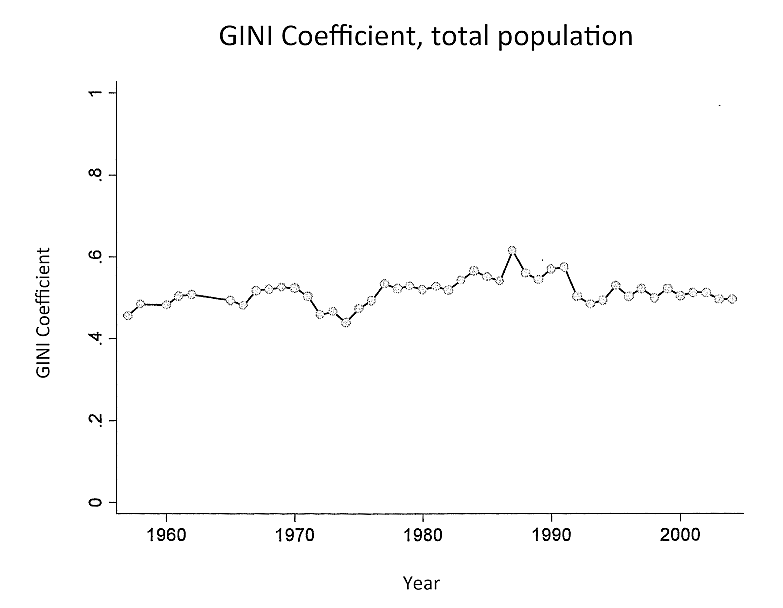
First, high levels of inequality existed in Chile prior to the implementation of the free market reforms that began in 1975. A recent book by economist Claudio Sapelli of the Catholic University shows that Chile’s Gini index coefficient* was higher in 1970 than what it is today (see graph below). Inequality dropped significantly between 1970 and 1975 as everyone became poorer (the average annual inflation rate in that period was 124.2% and by 1975 over 50% of Chileans lived below the poverty line). Inequality rose again in the second half of the 1970s as the economy recovered and people’s incomes began growing at different paces. As Luis Larraín of Chile’s Libertad y Desarrollo institute points out in a recent book, “It is a well‐​known fact that fast‐​paced processes of growth, in the early stages of development, create a worse distribution of income, as the example of China shows today”.
Media Name: sapelli1.png

Source: Claudio Sapelli, Chile: ¿Más Equitativo?, Ediciones Universidad Católica de Chile, 2011.

Second, inequality is decreasing in the Andean nation. Income disparity reached a zenith in the late 1980s and has decreased since then. Data from the UN Commission for Latin American and the Caribbean (ECLAC) shows that in 1990 Chile had a Gini index coefficient of 0.55 while in 2011 (latest year available) it was 0.51. In the last two decades of the free‐​market system, inequality has actually come down somewhat. Interestingly, Chile has less inequality than Brazil, but not many people blame the latter’s income disparities on its bloated big government development model.


Third, inequality in Chile will continue to go down since income distribution significantly improves among the young. Sapelli shows that Chile’s Gini index coefficient goes down with age (see graph below) as more Chileans, especially younger generations, have access to health care and education (which, as Miroff notes, are highly privatized). For example, the percentage of people aged 25–64 who have received high school education in Chile is 68%, lower than the OECD average of 71%. But when he looks at the generation aged 25–34, he notes that the rate goes up to 85%, not only higher than the OECD average of 80%, but also superior to the rates of the Netherlands, Norway and Australia. Today, 1.1 million students are enrolled in higher education (45% coverage) compared to just 200,000 in 1990. Over 70% of these students are the first generation in their families to receive higher education.

Media Name: sapelli2.png

Source: Sapelli, 2011.

Fourth, some of the policies announced by the newly inaugurated president Michelle Bachelet, supposedly aimed at rescuing Chilean capitalism “from its excesses” (as Miroff puts it), would actually benefit the richest segments of society. A study by the Libertad y Desarrollo institute found that if higher education were “free” in Chile (and by “free” read “paid by taxpayers”), 41% of the resources would go to finance the education of the richest 20%, and only 9% would go to the poorest 20%. As Miami Herald columnist Andrés Oppenheimer has repeatedly documented, “free” higher education in Latin America disproportionately benefits the well‐​off (and adversely affects the quality of the education).


The reasons behind Chile’s left‐​turn have been explained elsewhere. But for the sake of Latin America’s most prominent success story, and the example it provides to the rest of the region, it’s important to tackle the myth propagated by the left that Chile’s free‐​market system is something that needs a radical fix through higher taxes and government intervention.


*In the Gini Index, zero implies perfect equality, while one represents perfect inequality.
Related Tags
International Economics, Development & Immigration

Stay Connected to Cato

Sign up for the newsletter to receive periodic updates on Cato research, events, and publications.

View All Newsletters

1000 Massachusetts Ave, NW,
Washington, DC 20001-5403
(202) 842-0200
Contact Us
Privacy

Footer 1

  • About
    • Annual Reports
    • Leadership
    • Jobs
    • Student Programs
    • Media Information
    • Store
    • Contact

Footer 2

  • Experts
    • Policy Scholars
    • Adjunct Scholars
    • Fellows
  • Events
    • Upcoming
    • Past
    • Event FAQs
    • Sphere Summit

Footer 3

  • Publications
    • Books
    • Cato Journal
    • Regulation
    • Cato Policy Report
    • Cato Supreme Court Review
    • Cato’s Letter
    • Human Freedom Index
    • Economic Freedom of the World
    • Cato Handbook for Policymakers

Footer 4

  • Blog
  • Donate
    • Sponsorship Benefits
    • Ways to Give
    • Planned Giving
Also from Cato Institute:
Libertarianism.org
|
Humanprogress.org
|
Downsizinggovernment.org