After the Supreme Court struck down his first order restricting birthright citizenship in Trump v. Barbara, President Trump signed a new order on August 6. At first blush, the new order seems like only a blatant attempt to ignore the Supreme Court. That might be true, but there’s an alternative reading that is more bizarre and potentially frightening: The president might believe he can unilaterally decide whether US law applies to any particular person or groups of people.
The entire order rests on the assertion that presidents can decide who is subject to the jurisdiction of the United States and, therefore, US law. In a way, this is a far more dangerous claim. For instance, diplomats receive immunity not only from federal but also from state and local prosecution. If the president can suspend the laws—not just the enforcement of them but the laws themselves—the order would not only strip citizenship from many Americans, it would also create a massive new power for presidents to abuse.
The strange new order is already being challenged in court, but we still don’t know how the government will defend it.
Comparing the Two Orders
Here is a quick rundown of the order:
- Narrower: The order removes the children of illegal immigrants and temporary residents as explicit targets, and instead produces a new list of narrower parental categories (terrorists, foreign government employees, visa fraudsters, anyone traveling to the US for birth, and a few people in territories).
- Vaguer: The new list is less clearly defined, so there is greater uncertainty about some groups subject to it.
- Not exhaustive: The old order applied to two specific categories. The new order explicitly states that its list is representative, not “exhaustive.”
- Retroactive: The old order applied only to future births. This order has no such limit, potentially opening up the citizenship claims of current US citizens.
- Loss of citizenship: Strangely, the order requires denying any applicant for a citizenship document whose parent currently falls into an excluded category, regardless of their parent’s situation at birth (e.g., “parent is…a foreign government employee”). This is also unconstitutional.
- Applies to legal permanent residents: It denies citizenship for children of legal permanent residents if their parent fits into one of the categories.
- Applies to either parent: It covers children if either parent falls into the covered category, not just one, unless a parent is a citizen.
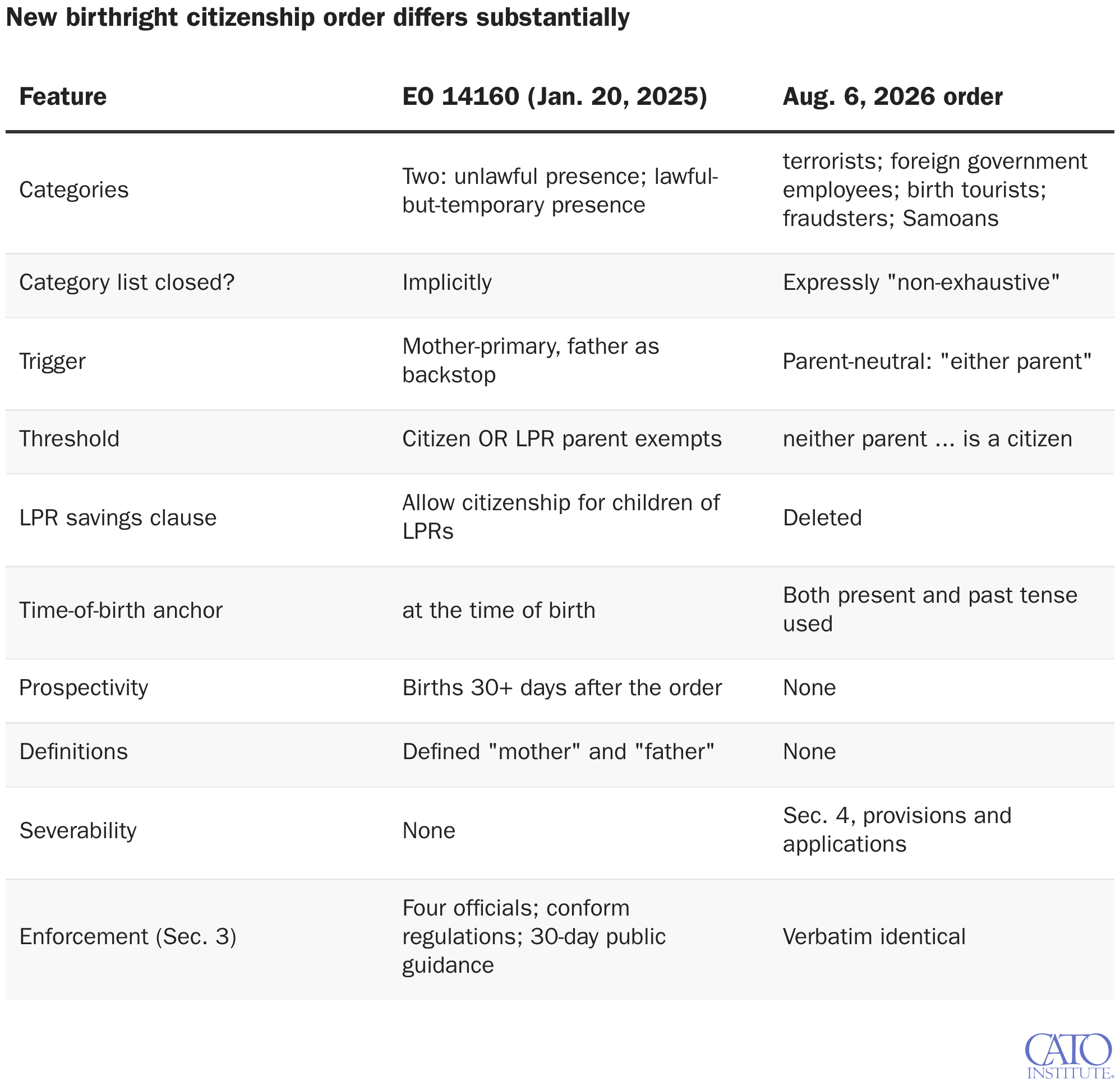
The New Legal Justification
The Fourteenth Amendment states that anyone born in the United States “and subject to the jurisdiction thereof” is a US citizen. The president’s first order asserted—without any supporting legal analysis—that immigrants without permanent lawful status in the United States were not subject to the jurisdiction of the United States. The Justice Department’s legal defense was that “jurisdiction” meant only political jurisdiction, meaning primary or sole “allegiance,” and allegiance was required only of citizens or individuals legally and permanently domiciled in the United States.
The Supreme Court rejected this interpretation. As Ilya Somin notes, the Court found that jurisdiction just refers to “the ‘[p]ower of governing or legislating.’” Under this rubric, the two groups today that could be exempt from US governance are foreign invaders that actually controlled territory, like “a castle or fort,” and “ambassadors (and their families), who were considered—by a fiction of extraterritoriality—to remain on foreign soil.” These groups are either not subject to US laws or outside of US control.
Given this determination, President Trump’s new order abandons its prior justification and explicitly ties its power to limit birthright citizenship to this latter phrase:
the Citizenship Clause of the Fourteenth Amendment to the United States Constitution extends the privilege of citizenship to children born to parents in the United States “for whom no extraterritorial fiction applie[s].” This order identifies, non-exhaustively, and prescribes action concerning certain categories of children of aliens who do not fall within the rule of birthright citizenship …
The extraterritorial fiction exists for diplomats because they and their children are not fully subject to US law—that is, they have immunity. The only way to extend the “extraterritorial fiction” that the administration now embraces would be to extend immunity—crucially, not just to the parents but also the children. As the Court stated:
Those children [in the certified class]…satisfy both elements of the Citizenship Clause: they are “born in the United States” and “subject to the jurisdiction thereof.”
The Fourteenth Amendment’s jurisdictional requirement applies to children, not the parents. A parent can be subject to US jurisdiction but not the child (a noncitizen non-ambassador who has a child with an ambassador outside of their household), and a child can be subject to US jurisdiction but not the parent (an ambassador who has a child with a US citizen). Even in the case of an invading army, a foreign invading soldier could be not subject to US jurisdiction, but his child could be, depending on the circumstances at birth (e.g., if the other parent was a US citizen or in territory controlled by the United States). The Trump administration’s defense will have to wade through these issues.
The New Order’s New Targets
Trump’s second order purports to adopt the Barbara majority’s justification, but as Steve Vladeck notes, its “non-exhaustive” list of parents whose children will be deemed not subject to US jurisdiction doesn’t appear to align with its legal justification:
- “is a foreign government employee”;
- is “employed by an international organization that possesses international-organization immunity”;
- “is…a member of a designated Foreign Terrorist Organization”;
- “engaged in a commercial transaction to purchase or access birthright citizenship for the person”;
- “engage in a commercial transaction to ensure that the person’s mother is present in the United States”;
- “engaged in fraudulent activity to obtain citizenship”;
- “engage in a commercial transaction with a surrogate present in the United States”;
- “is born in a territory or territorial waters of the United States where citizenship is not conferred by Federal statute.”
Ambassadors already fall outside the Citizenship Clause, and embassy and consular staff from the handful of countries with bilateral enhancement agreements hold the same diplomatic agent-level immunity. Beyond that narrow set, none of these groups is exempt from US criminal or civil jurisdiction.
The first of these would seem to be the easiest case, as it seems most similar to an ambassador. The problem is that foreign government employees—excluding those related to an embassy or consulate—do not currently receive any diplomatic immunity. The US government would have to show a court that it has taken steps to grant them any immunity. So far, it has not, though the order gives the relevant agencies 30 days to “ensure their regulations and policies are consistent with this order” (section 3(a)).
Alongside the executive order, the administration did make some changes to its page for ambassadors. Though it so far maintains the same narrow list of immunized positions, the government’s changes ended reference to the “blue list” for accredited diplomats, so now, with no official list, only the State Department knows who is immunized. The regulation still defines a diplomatic officer as a person on the Blue List, so the situation is confusing.
Immunity in Current Law
Does the president have the unilateral power to expand the list of individuals with immunity? Diplomatic immunity is governed primarily by the Vienna Convention on Diplomatic Relations (VCDR) of 1961, the Diplomatic Relations Act (DRA) of 1978, and the International Organizations Immunities Act (IOIA) of 1945. These statutes limit immunities and the president’s power. The DRA repealed broader “flat immunity” from a 1790 act and replaced it with narrower, graduated immunity tiers in the VCDR. Following Article 37 of the VCDR, the statute (22 U.S. Code § 254b) grants immunity to non-signatories’ “mission, the members of the mission, their families, and diplomatic couriers.”
Both VCDR and the DRA grant some level of immunity only to: members of a foreign mission—the head of mission and diplomatic staff, administrative and technical staff, and service staff—and, for the first two tiers only, to the members of their households who are not nationals (or, below the diplomatic-agent tier, not nationals or permanent residents) of the United States. Families of service staff receive no immunity at all. That means that their children get citizenship even if their parents are not fully subject to US jurisdiction in every respect. Administrative and technical staff and their families receive full diplomatic immunity for crimes (VCDR Art. 37), but under the 2024 regulation, their immunity is still deemed a lesser immunity unless there is a bilateral enhancement agreement that enhances their immunity. This means that their children receive citizenship.
Under the DRA, the president could grant immunity to the families of service staff of a mission or embassy, but only “on the basis of reciprocity.” Bilateral treaties have already raised all embassy staff and some consular staff to full diplomatic immunity for some countries in the case of criminal prosecutions. After consultation with Congress, the Secretary of State in concert with the Attorney General may similarly grant immunities for a consular post and their families—again, based only on reciprocity with the United States; that is, the other country would have to treat US consular officers in its territory the same way.
Foreign government employees who are not members of a diplomatic mission, consular post, or national mission to an international organization have no path to immunity, and neither do their families. As for international organizations, the president may only grant immunity to those employees notified to and accepted by the Secretary of State, and the immunity is only for official acts; the IOIA specifically states that this immunity does not constitute diplomatic immunity.
Inherent Presidential Authority?
President Trump might say that the president’s power under Article II of the Constitution to receive ambassadors implies the power to recognize immunities even absent a statute, and that who constitutes representatives of a foreign government is up to his discretion. The State Department’s regulation states that “the question of whether any particular person enjoys diplomatic agent-level immunity and is therefore not subject to the jurisdiction of the United States…is determined by the State Department.”
The preamble to the State Department’s 2024 regulation specifying who receives immunity states that immunity decisions are, in fact, based at least partly on “the President’s Article II authority to speak as the sole organ of the government with respect to agreements regarding diplomatic relations,” citing United States v. Belmont, 301 U.S. 324, 330 (1937).
In Belmont, President Roosevelt’s administration helped collect assets of a corporation that the Soviet Union had nationalized, despite no treaty and preempting a state law, and the Supreme Court permitted the collection, because the president has authority to make enforceable international agreements and no congressional statute blocked it. In Zivotofsky v. Kerry (2015), the Supreme Court “decline[d] to acknowledge” the “sole organ” view of Belmont as it was “unnecessary to the resolution of this case,” but nonetheless held that “the President alone determines what nations to formally recognize as legitimate” in part to identify “whether their officials will be immune.”
In Schooner Exchange v. McFaddon (1812), Chief Justice John Marshall seems to endorse the idea that immunities exist based on the law of nations, not any statute, writing:
It is true that in some countries, and in this among others, a special law is enacted for the case. But the law obviously proceeds on the idea of prescribing the punishment of an act previously unlawful, not of granting to a foreign minister a privilege which he would not otherwise possess.
The Ninth Circuit in Moncada v. Rubio (2025) stated: “The Constitution confers on the President alone the legal duty to receive diplomats and thereby immunize those diplomats from the jurisdiction of the United States.” However, it also asserted authority to establish if immunity was, in fact, granted. The DC Circuit in Carrera v. Carrera (1949) found that “judicial inquiry into the propriety of [the administration’s] listing [as a diplomat] was not appropriate.”
The argument that the president has authority to decide who may receive immunity absent a statute may be wrong—Congress clearly thought it could constrain the president—but given the Court’s concessions, it may not be frivolous. The question may be partly how committed the Trump administration is to denying birthright citizenship to, well, someone. Is it willing to unilaterally expand immunity just to salvage some kind of win here? Are courts willing to permit President Trump to call someone a “diplomat” who clearly is not? I doubt it.
Lesser and Revoked Immunity?
Here’s another question possibly left open by Barbara: How much immunity is necessary to trigger a loss of “jurisdiction”? Even “full diplomatic immunity” has limits, including civil actions related to professional or commercial activity outside of official functions. Some immunized representatives of foreign governments receive immunity only for official acts taken on behalf of the foreign government. By regulation, officials with lesser immunity are currently deemed to be subject to the jurisdiction of the United States for purposes of birthright citizenship. Native American tribes—who received citizenship via statute—were not fully exempt from US jurisdiction either.
Clearly, the analogue for excluding the children of foreign government employees is the ambassador exception, so it is very difficult to understand how the Trump administration could defend this expansion in court without referencing immunity. Could the Trump administration assert the authority to grant some lesser forms of immunity to avoid owning the full consequences of its attempt to undermine birthright citizenship? That would allow the president to have his cake and eat it too. In Moncada, the Ninth Circuit stated: “immunity only for official acts mean[s] that [the consul] and his family were subject to the jurisdiction of the United States.” But that was based on the practice and laws in effect at the time, so it’s unclear if it’s saying that it must be this way or just that it was this way.
Another issue arises when the parent and children enter and exit these new categories. Ambassadors and their families receive Office of Foreign Mission–issued accreditation ID cards as evidence of their status (though only certification verified by the State Department officially matters). Their immunity ends when the ambassador leaves or after being given a reasonable period to depart voluntarily after ceasing to be an ambassador. The children lose immunity when they leave the household, get married, or turn 21 (23 if attending university full-time, or indefinitely if disabled).
These rules could, I suppose, be applied to foreign government employees, but the executive order is not limited to children of “accredited” employees. In any case, what about the other categories? When does “membership in a foreign terrorist organization” begin and end for this purpose? When do a mother and her child lose their extraterritorial status after having committed fraud to obtain citizenship?
It is important to note that ambassadors’ immunity does not protect them for crimes committed while an ambassador unless they were official acts on behalf of the foreign state. Could President Trump simply assert that birth tourist mothers and their children had immunity when they gave birth but lost it when they left the United States or were later identified? Another have-his-cake-and-eat-it-too gimmick. It will be interesting to see if a defendant—a terrorist—uses this executive order in court as an assertion of immunity against prosecution, which could be one quick route to ending this debate.
The President Shouldn’t Succeed
The only alternative strategy to granting some kind of immunity—asserting the president can label someone metaphorically outside the United States with no real-world effect—is just a rerun of Barbara. The majority opinion foreclosed a purely metaphorical “outside of US jurisdiction,” based on vague ideas like “allegiance” or “domicile.” There must be a real-world way in which the child would be outside the jurisdiction of US law. Immunity metaphorical enough to allow someone to still be arrested or deported as a terrorist or visa fraudster certainly means that the person is subject to US jurisdiction, and gimmicks shouldn’t get the president around the implications of his actions.
The new executive order’s carve-outs targeting people traveling to give birth, surrogates, visa fraudsters, and foreign terrorist organization members are likely more important in scope. Nonetheless, it is worth pursuing the possibility and difficulties of redesignating foreign government employees because it is the category most likely to survive legal challenge and change current practice. Given the difficulties here, the other categories have almost no chance at all. Defending this order will require a high level of creativity, to say the least, and it seems unlikely to survive.
The Supreme Court in Barbara also acknowledged the exception for ambassadors, not solely because of the grant of immunity. Rather, the grant of immunity flowed from who they actually are. Ambassadors are—and Native Americans historically were—meaningfully under the jurisdiction of their home nation (“the United States had voluntarily ‘cede[d]…a part of its territorial jurisdiction’ to another sovereign (or quasi-sovereign)”). Unless the foreign country agreed to fully govern its employees or other nationals in the United States, the parallel breaks down. Indeed, in the key passage articulating its principle, the Court stated that “intersovereign concerns” drove the need for the immunity and exception to jurisdiction for ambassadors and (historically) Native Americans.
Moreover, diplomats under the Vienna Convention—and the Diplomatic Relations Act—must be “appointed” by the foreign state, which triggers the immunity. It is an inherently bilateral action. How many foreign governments will agree to immunize all US government employees in their countries and deal with the bilateral problems associated with immunizing all their employees in the United States? Not many, I suppose.
The Court also quoted Chief Justice John Marshall in Schooner Exchange v. McFaddon (1812), saying it would be “dangerous to society” if large numbers of “private individuals” were not “amenable to the jurisdiction of the country.” The exemption Marshall articulated in that case—for a military vessel at a US port—was based on “common usage and common opinion,” the law of nations, and dignity owed to other nations. There is no possible argument along these lines for the types of exceptions contemplated by the executive order.
This order would be an unprecedented departure from common practice in world history. Of course, ambassadors aren’t the only analogy available. The administration may attempt to liken foreign terrorist organization members to invaders, even though they do not control territory like a castle or fort and would be fully subject to arrest; by definition, terrorists are non-state actors, so there are no “intersovereign concerns.” The analogy for birth tourists isn’t clear to me, but the upshot is that unless Trump grants them immunity, whatever analogy he uses wouldn’t work.
The president’s effort to evade the Supreme Court’s order will likely not change the rules around birthright citizenship. The added danger of handing the president the authority to arbitrarily exempt certain groups from US laws makes this limited order as dangerous. In the best outcome for the president, this case could potentially tweak the rationale of the Supreme Court in such a way as to give Congress an opening to effect the birthright citizenship rule. Most likely, however, it will just generate new controversy around what should be a settled issue.
