There’s a big problem with Social Security.
Most people misunderstand its trust fund, believing it holds real financial assets that ensure future benefits—the equivalent of a piggy bank stuffed with dollar bills.
There’s a big problem with Social Security.
Most people misunderstand its trust fund, believing it holds real financial assets that ensure future benefits—the equivalent of a piggy bank stuffed with dollar bills.

To understand the real story behind the Social Security trust fund, let’s simplify the program’s income and expenses.
Social Security is simple: Payroll taxes from current workers go directly to current retirees and their dependents.
This is what’s known as a pay-as-you-go system.
It’s like a family that lives paycheck to paycheck—there’s no magic pot of gold, only a cycle of money coming in and going out.
The so-called trust fund? It’s essentially an IOU, or a promise to pay.
When Social Security collected more than it paid in benefits (pre-2010), the government spent the surplus in other areas instead of saving it. In exchange, the Department of the Treasury was writing IOUs to the Social Security Administration.
Imagine a child who earns money from mowing the neighbors’ lawns and puts it into a piggy bank to save up for a new bike.
However, his parents take it out to pay for household expenses and leave an IOU note behind.
When the time comes to buy the bike, the child opens the piggy bank only to find it full of IOU notes from his parents.
Social Security is already running deficits. Here’s the breakdown of money going in as of 2023:
Payroll taxes:
$1.054 trillion
covers 85 percent of costs
Taxation of benefits:
$49.8 billion
covers 4 percent of costs
The remaining 11 percent shortfall is covered by the program cashing in IOUs from its trust fund, which the Treasury finances by borrowing from the public. Since 2010, over $1 trillion of IOUs have been redeemed, adding to the federal debt.


Social Security’s funding challenge comes down to
So which solutions hold promise, and which fall short?
What about private accounts?
While diverting a portion of payroll taxes to private accounts was a viable option during surplus years, transitioning now faces a major hurdle.
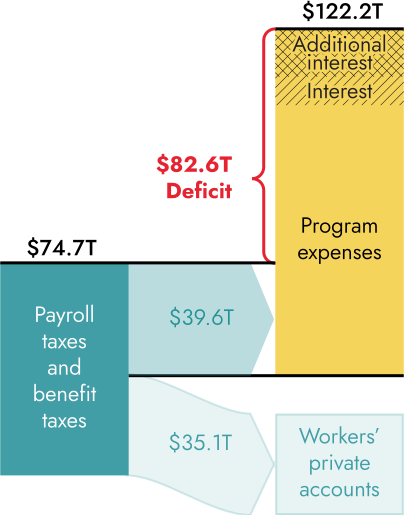
Diverting half of payroll taxes into personal accounts would increase the 30-year shortfall by $50 trillion, from $30.6 trillion to $82.6 trillion.
This creates a “double payment” problem: One generation would need to pay for current retirees’ benefits and save for their own retirement.
The result: Transitioning now would accelerate a debt crisis—not avert it.
What about “making the rich pay their fair share?”
Proponents of higher taxes suggest lifting or eliminating the cap on earnings subject to Social Security payroll taxes ($176,000 in 2025).
But here’s the thing: The current cap exists because Social Security was designed as an earnings-related benefit, not a welfare program.
Lifting the payroll tax cap would either sever this link and turn Social Security into a welfare program or would require massive payouts for the highest-income earners. Even worse, this option would mean a huge tax increase that would reduce incentives to work and invest among higher-earning Americans, including millions of small business owners.
Moreover, this creates only about five years’ worth of surpluses before returning to deficits by 2029—surpluses that would most likely be spent on other government programs anyway.
Legislators and the public need to confront the fiscal realities of Social Security:
The longer legislators wait, the more painful the eventual reforms will be. And by acting now and making gradual changes, workers get the time they need to plan.
The goal should be to realign Social Security with its original mission—preventing senior poverty—without overburdening current and future taxpayers. We can do this in the long run by slowing the growth of benefits and avoiding harmful tax increases on workers.
By facing reality today,
we can preserve Social Security for those who truly need it
while creating a system that works for future generations.


More on Social Security