Falsely declaring TARP a success emboldens current and future administrations to cite past intervention as precedent for similar government investment programs. That is the wrong lesson: From start to finish the 2008–2009 crisis responses from the Treasury, Federal Reserve, OCC, and FDIC were not a success. The government’s method for addressing the instability of a modest-sized bank through an exit strategy has been successful, as it is primarily a market-driven FDIC process reliant upon open market bidding for failing institutions. The process also has some good transparency aspects, as a short time after a bank is shuttered, the terms of the transaction and a matrix with details of all the bids for the bank are released.
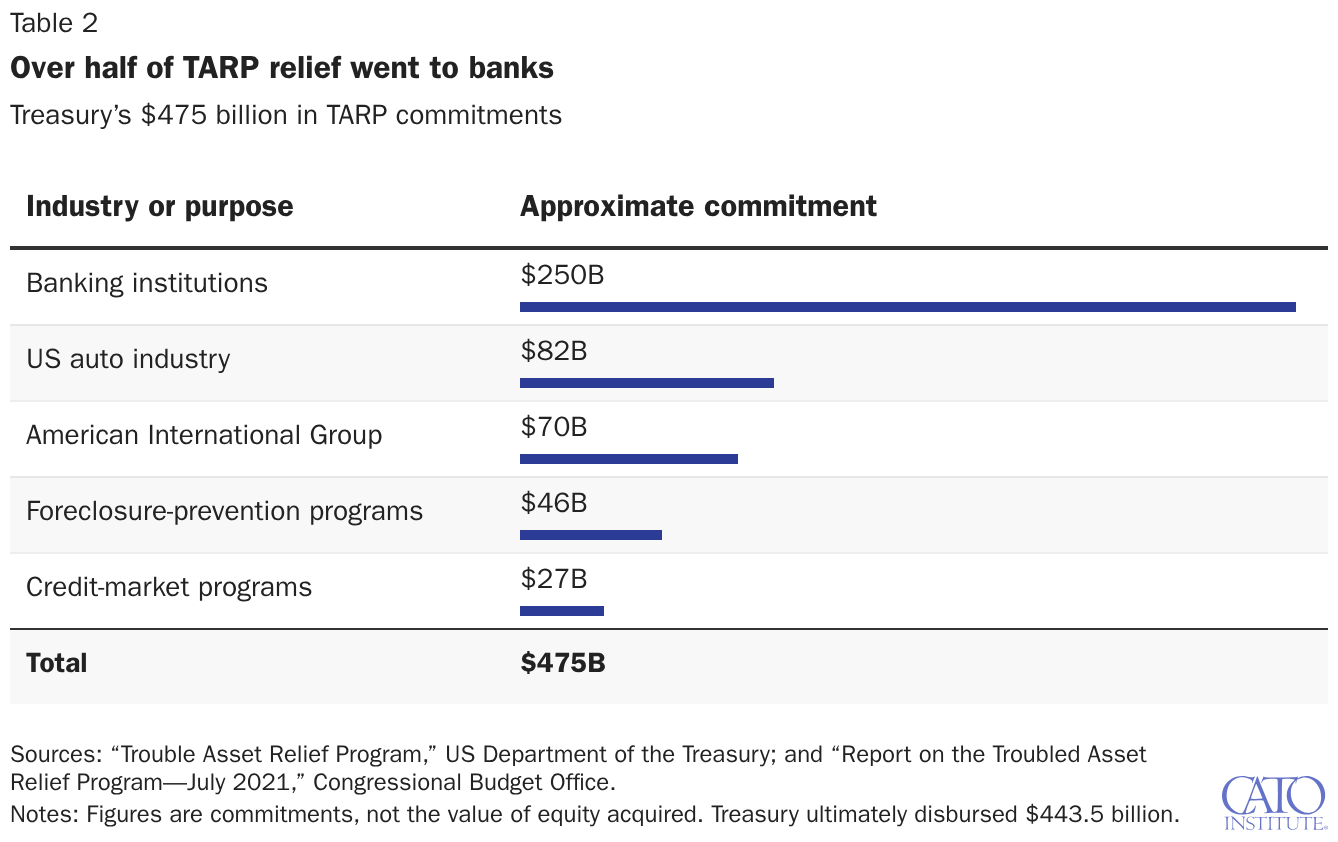
Alternatively, when a large bank is involved in an ad hoc merger or a TARP bailout (about two-thirds of TARP funds to banks went to the large banks), any investment decisions for the government pass into the political realm. Market-based methodologies are jettisoned, and the decisions are made by politicians or their appointees with the details kept secret for many years. Political decisions about the amount of funds provided and recipients of investments cannot be trusted because they do not have to pass a market test. Nor did TARP repayment eliminate the deeper problems of discretion, favoritism, opacity, and conflicts of interest. Similarly, today’s government stakes in companies are being assembled ad hoc, one company and sector at a time, through a patchwork of questionable statutory authorities by political appointees.
Treasury Secretary Scott Bessent has helped advance the idea of a US sovereign wealth fund. Such funds have often played a role globally in direct state intervention by making investments on behalf of governments. The Kuwait Investment Authority, for example, took a 16 percent stake in Gulf Bank in 2009 after the bank struggled when a foreign-exchange bet went bad.
President Trump, like Paulson and Geithner before him, has great confidence in his deal-making skills. After his administration orchestrated a government stake in Intel, Trump boasted that he would make “deals like that for our Country all day long.” And the administration has kept going, having now announced stakes in over 30 companies. Banks may well become targets, which is precisely why the TARP precedent should be treated with skepticism rather than celebrated.
The last thing the United States needs is a sovereign wealth fund (formal or informal) or any other standing method for implementing direct state intervention, ready to inject capital into poorly managed firms the next time a crisis arrives. Emergency programs have a way of becoming precedents; precedents have a way of becoming expectations; and expectations of rescue make the next intervention easier to justify before anyone has to prove that it worked.