• Fannie Mae and Freddie Mac, two giant government-sponsored enterprises (GSEs) that purchase home mortgages, were at the center of the 2008 financial crisis. After decades of government support, the GSEs failed in 2008.

  • Despite hundreds of billions in direct government support after the GSEs failed, they remain in federal conservatorship today. They currently dominate America’s mortgage market and are now even bigger than they were prior to the financial crisis, with combined assets of roughly $7.7 trillion.

  • The GSEs have never been fully private, and no private company would have been allowed to operate as they have after such spectacular financial failures.

  • The US homeownership rate has changed little since the 1960s, but volatility of home prices and home construction have been among the highest in the industrialized world.

  • The GSEs have promoted mortgage ownership, not homeownership, and Americans typically pay mortgage rates that are some of the highest in the developed world.

  • America does not need GSEs, especially in the housing market. It is long past due for Congress to take a different approach to housing policy by paring back and eventually ending federal involvement in home financing altogether.

Fannie Mae and Freddie Mac were at the center of the 2008 financial crisis. Since failing in 2008, both companies have been in government conservatorship, effectively under federal control. Long before 2008, however, these two government-sponsored enterprises (GSEs) were at the center of the US mortgage market. As the term suggests, Fannie and Freddie were not fully private firms prior to their conservatorship, despite many claims to the contrary.

The GSEs were, in fact, created by the federal government and granted special privileges that private companies do not have. For many decades, they benefited from the market’s belief that the federal government would financially support them, a belief that proved correct on more than one occasion. Largely due to government support, the GSEs currently dominate America’s mortgage market. Historically, they have artificially boosted both debt and home prices, and they have cost taxpayers billions in bailouts. Congress should get rid of the GSEs.1

Fannie and Freddie provide a poor precedent for the Trump administration’s efforts to take stakes in private companies. Congress rechartered Fannie and created Freddie through specific laws, while the administration’s recent deals are ad hoc executive arrangements with ordinary commercial firms that Congress neither created as public-purpose entities nor assigned statutory social missions comparable to the GSEs’ housing goals.

Where Did Fannie and Freddie Come From?

Freddie Mac was not created until 1970, but Fannie Mae’s roots date back to the passage of the National Housing Act of 1934. The act authorized the creation of “national mortgage associations,” envisioned as private companies that would purchase government-insured home mortgages to boost construction jobs. By 1938, no associations had yet been formed, so the Reconstruction Finance Corporation (RFC) chartered the National Mortgage Association of Washington. The RFC, a government-owned corporation established in 1932 during the Hoover administration, then promptly changed the association’s name to the Federal National Mortgage Association, giving birth to Fannie Mae (using the letters FNMA).

In 1954, the Eisenhower administration tried to privatize Fannie Mae but instead rechartered the company as a government corporation with “mixed” (public and private) ownership. The Treasury Department initially held all of Fannie’s preferred stock, while mortgage lenders gradually acquired privately held, nonvoting common stock. (Lenders that sold mortgages to Fannie were required to purchase the stock.) The federal government remained the majority owner until the 1968 reorganization. President Eisenhower’s advisers felt that the government was too deeply involved in housing policy to privatize Fannie immediately, so they instead tried to set it on a course toward privatization.

In 1968, the Johnson administration was desperate to remove debt from the federal budget. So, the Housing and Urban Development Act moved Fannie’s debt off the federal books and split Fannie into a federally chartered “private” company, Fannie Mae, and Ginnie Mae, a fully government-owned entity. Ginnie Mae was given Fannie’s former purpose of purchasing only government-insured mortgages, while Fannie was authorized to purchase mortgages not insured by federal agencies.

The act cemented the GSE model. It gave the newly reorganized Fannie Mae a $2.25 billion line of credit with the US Treasury, an exemption from state and local income taxes, and an exemption from registering with the Securities and Exchange Commission.

In 1970, President Nixon signed the Emergency Home Finance Act of 1970, a law that, among other measures, created the Federal Home Loan Mortgage Corporation, commonly referred to as Freddie Mac. Freddie was an entirely new GSE, designed specifically to purchase mortgages for the Federal Home Loan Banks (also a GSE), but its federal charter was almost identical to Fannie Mae’s and conferred the same special government privileges.2

How Did the GSEs Become So Large?

Both companies’ main purpose was to purchase mortgages, package them into mortgage-backed securities (MBS), and sell those securities to the public. The idea was to use this process (called “securitization”) to more easily—and safely, by diversifying geographic-specific risks—fund home mortgages, thus enabling people to obtain home mortgages more easily.

Throughout the 1980s, Freddie Mac focused on issuing MBS from the loans it purchased, while Fannie Mae decided to issue MBS and build its own portfolio of MBS and mortgages. This difference allowed Freddie to pass much of its financial risk to outside investors. Fannie remained directly exposed to a large amount of interest rate risk (i.e., the risk that interest rates would rise and damage the value of the company’s investments). Fannie’s choice to hold mortgages proved to be a mistake—when interest rates rose dramatically throughout the late 1970s and early 1980s, Fannie became insolvent.

The US General Accounting Office reported that Fannie suffered “cumulative net losses of over $350 million in 1981, 1982, 1984, and 1985.” Although insolvent, Fannie was saved through “regulator forbearance” (i.e., the federal government ignored the problem) and a special tax provision that allowed it to forgo paying federal income taxes for up to 10 years. Freddie Mac avoided financial trouble during this time mainly because it decided against expanding its own mortgage loan portfolio, a decision that was appropriate given the GSEs’ intended purpose. Regardless, this regulatory forbearance cemented the idea that the federal government would, as everyone had suspected, step in to prevent the GSEs from financial failure, making them “too big to fail” in the eyes of market participants.

At the end of 1981, Fannie held just under $60 billion in its mortgage portfolio and Freddie just over $5 billion. By the end of 1990, Fannie held a portfolio of nearly $114 billion, and Freddie’s was just over $21 billion. To fuel growth, the GSEs used their special government-sponsored status to borrow money at below-market interest rates, thus increasing their profitability at taxpayers’ expense.3 

But the GSEs were just getting started. In 1992, ostensibly to protect taxpayers, Congress passed the Federal Housing Enterprises Financial Safety and Soundness Act (the 1992 GSE Act). The act placed formal capital requirements on the GSEs and created the Office of Federal Housing Enterprise Oversight within the Department of Housing and Urban Development (HUD) as an independent regulator for the GSEs. The 1992 GSE Act also directed HUD to require that the GSEs meet certain affordable housing goals.

Specifically, the 1992 GSE Act called for the HUD secretary to establish three formal affordable housing goals: (1) a low-income and moderate-income goal; (2) a geographically targeted goal for housing located in underserved areas; and (3) a targeted income-based goal for “special” affordable housing. The new requirements went into effect in 1995, and the figures are regularly updated by the GSEs’ regulator, now a federal agency called the Federal Housing Finance Agency.

In 1994, Fannie announced its “Trillion-Dollar Commitment,” a program that earmarked $1 trillion for affordable housing between 1994 and 2000. Gretchen Morgenson and Joshua Rosner write that former colleagues described Fannie CEO Jim Johnson as “the original, if anonymous, architect of what became the disastrous homeownership strategy promulgated by William Jefferson Clinton in 1994.” Clinton’s National Partners in Homeownership, a private-public cooperative, set a goal of raising the US homeownership rate from 64 percent to 70 percent by 2000.

With this onslaught of political cooperation, taxpayer subsidies, and grant money, the US homeownership rate increased from 64 percent in 1994 to 69 percent in 2004. Yet, during the financial crisis of 2008, between six and eight million households lost their homes. The rate has now fallen back to 65 percent, just 1 percentage point higher than it was in 1968 after reaching as low as 63 percent in 2016.

From 1990 to 2003, Fannie and Freddie went from holding 5 percent of the nation’s mortgages ($136 billion) to more than 20 percent ($1.6 trillion). From 1997 to 2007, the GSEs even purchased $700 billion in privately issued subprime MBS to help meet their affordable housing goals, representing an approximately 30 percent share of the total issued (Figure 1). In 2008, the companies were deemed insolvent and put into government conservatorship. By 2012, their combined losses exceeded $250 billion.
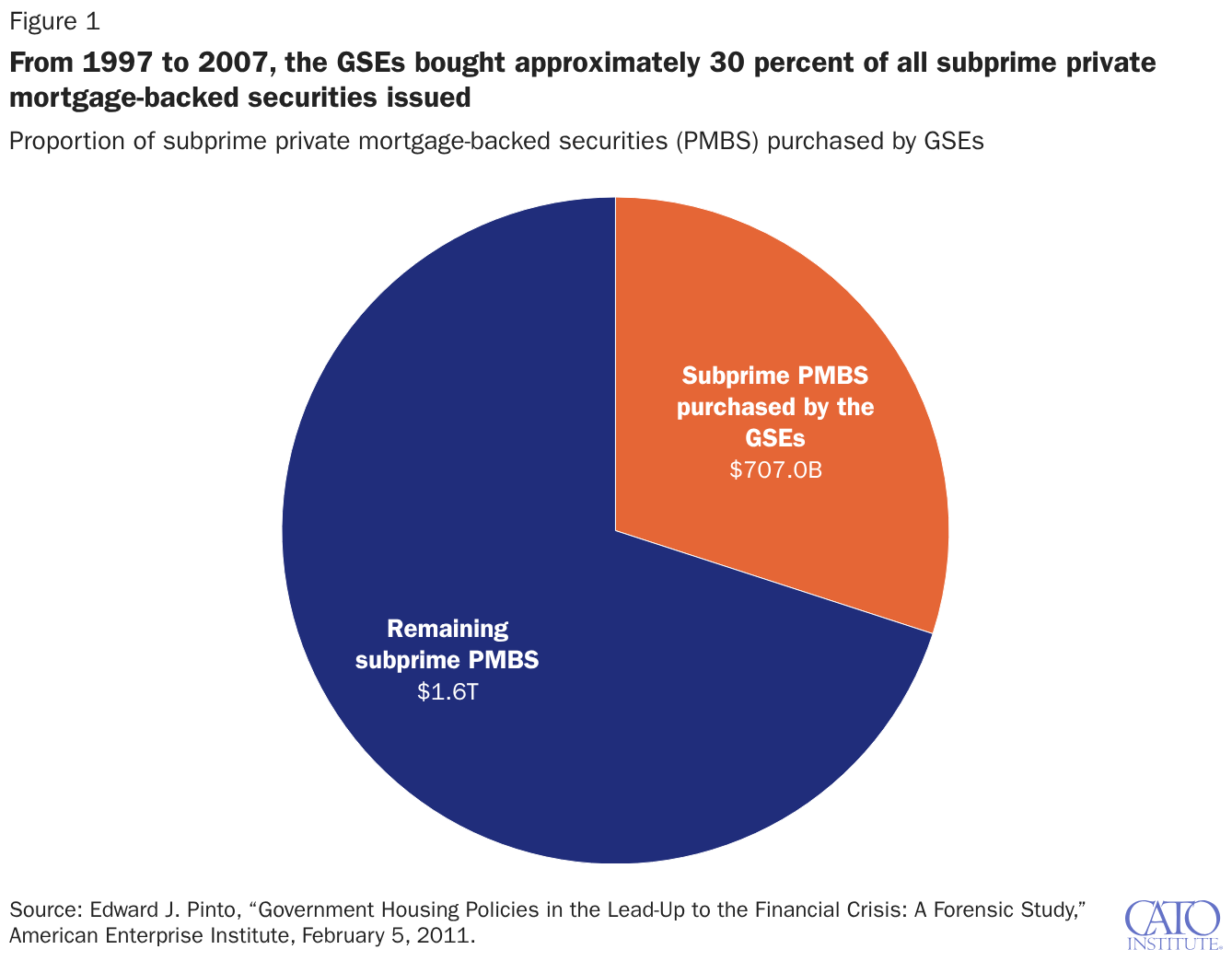
From 1997 to 2007, the GSEs bought approximately 30 percent of all subprime private mortgage-backed securities issued

Between 2001 and 2003, just before the housing market turmoil that precipitated the 2008 financial crisis, the GSEs’ affordable housing goals were as follows:

  • Low-income and moderate-income goal. At least 50 percent of the dwelling units financed by each GSE’s mortgage purchases should be for families with incomes no greater than the area median income (AMI), defined as median income for the metropolitan area or nonmetropolitan county.
  • Underserved areas goal. At least 31 percent of the dwelling units financed by each GSE’s mortgage purchases should be for units located in underserved areas, typically low-income and high-minority census tracts with high mortgage denial rates and low mortgage origination rates.
  • Special affordable goal. At least 20 percent of the dwelling units financed by each GSE’s mortgage purchases should be for very low–income families, those with incomes no greater than 60 percent of AMI, or for low-income families (with incomes up to 80 percent of AMI) in low-income areas.

Between 2026 and 2028, for single family homes, the low-income home purchase goal is 21 percent; the very low–income home purchase goal is 3.5 percent; the low-income refinance goal is 21 percent; and the low-income areas home purchase subgoal is 16 percent. For multifamily housing (properties with five or more units), the percentages and categories are: low-income goal, 61 percent; very low–income goal, 14 percent; and small multifamily low-income subgoal, 2 percent.

What Did Increased Federal Support Accomplish?

Throughout their 18-year conservatorship, many people have proposed plans to “reprivatize” Freddie Mac and Fannie Mae. Yet, the GSEs were never private companies in the first place, and virtually none of the proposals offered would make them truly private. Any change to the GSEs’ federal support while in conservatorship requires amending the government’s Preferred Stock Purchase Agreements (PSPAs). The federal government has amended the PSPAs several times since 2008, each time providing the GSEs with more financial support.

In addition to these direct bailouts, the Treasury and the Federal Reserve purchased more than $3 trillion in MBS and GSE bonds, staving off further losses. From September 2008 through December 2009, the Treasury purchased more than $220 billion of GSE MBS; from December 2008 through March 2010, the Fed purchased $134.5 billion of GSE bonds and more than $1.1 trillion of GSE MBS; and from October 2011 through June 2019, it purchased an additional $2.2 trillion in MBS.

Thanks to all this federal support, the companies are now even bigger than they were before the financial crisis. Fannie Mae’s mortgage loans (net of allowances) increased from $2.9 trillion in 2012 to $4.1 trillion in 2025, and Freddie Mac’s net mortgage loans increased from $1.7 trillion in 2012 to $3.3 trillion in 2025. Despite this growth, both GSEs still have negative capital balances and remain in federal conservatorship.

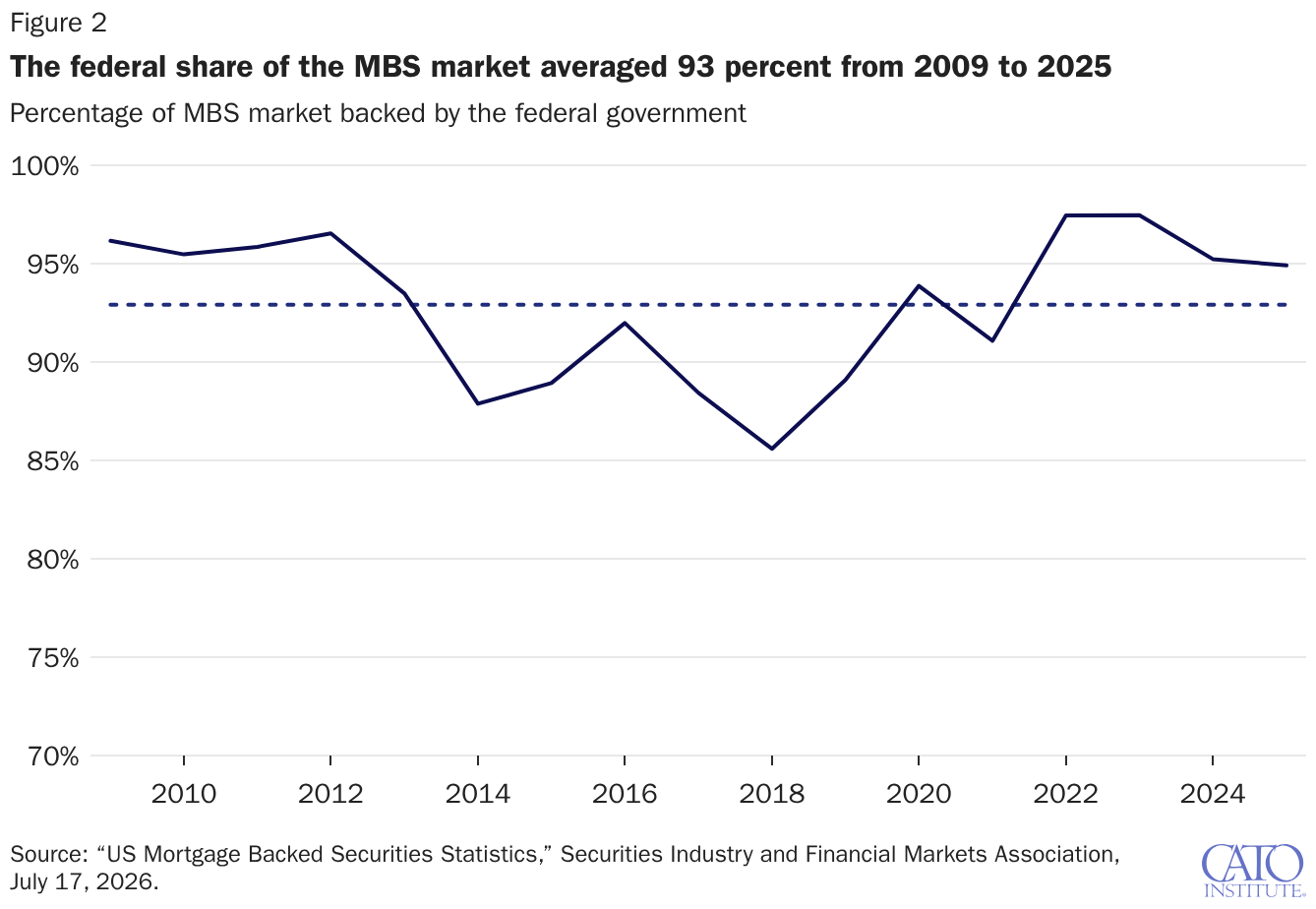
Before the 2008 financial crisis, the federal government controlled a dominant share of the US housing finance system, and that share has actually expanded. As of 2025, Fannie and Freddie (combined) guaranteed $7.8 trillion in mortgages, approximately 47 percent of the nation’s outstanding mortgage debt. From 2009 to 2025, Fannie and Freddie’s annual share of the total MBS issued averaged 70 percent. Including Ginnie Mae securities (those federally backed by Federal Housing Administration mortgages), the federal share of the MBS market averaged 93 percent per year (Figure 2). Moreover, from 2008 to mid-2026, the Federal Reserve went from holding zero MBS to nearly $2 trillion (combined Fannie, Freddie, and Ginnie MBS).

The federal share of the MBS market averaged 93 percent from 2009 to 2025

Although the US homeownership rate has changed little since the 1960s, volatility of home prices and home construction in the United States were among the highest in the industrialized world from 1998 to 2009. Overall, the evidence suggests that the extensive federal role has expanded Americans’ mortgage ownership but has done little to expand homeownership. (And American borrowers typically pay higher interest rates than borrowers in many developed countries.) At the very least, federal housing finance policies have magnified economic instability and pushed home prices higher. In the wake of the 2008 financial crisis, as the GSEs’ market share grew and the Fed purchased trillions of dollars of their MBS, home prices rose to 43 percent more than where they peaked before their crash.

What’s Next?

In the 1950s, the Eisenhower administration felt that the government was too deeply involved in housing policy to privatize Fannie immediately. President Eisenhower and his advisers would probably be dismayed to see how much more the government is involved now, especially after the 2008 crisis, and how much larger and more powerful the constituencies against privatization have become. Compared to the 1950s, it will now be much harder to get the federal government out of housing finance.

Advocacy groups ranging from the National Association of Home Builders to the National Association of Realtors now support a GSE-type system as a baseline, with explicit federal backing in mortgage markets. As with all investors, these groups want perfectly safe assets. So, it is understandable that a common political theme during the GSEs’ conservatorship has been that the US housing system cannot function without the GSEs and requires some kind of federal backing.

Members of Congress should not fall for these ideas. There is no such thing as a perfectly safe asset, even when it is backed by the federal government. More importantly, the expansion of the federally backed GSEs was at the heart of the 2008 financial crisis and the resulting recession. Separately, the GSEs are not necessary for the housing system to function because private markets work. In financial markets, thousands upon thousands of financial instruments, including both mortgage insurance and mortgage securities, are created without government directions and exist without any federal guarantee at all.

Countless businesses function well without any sort of government sponsorship. In most cases, competing with the federal government makes it more difficult for private companies to satisfy their customers. The mortgage market is no exception. GSEs and federal backing would only be necessary in the mortgage market if some kind of market failure occurred, and the housing market doesn’t pass that test. If anything, federal involvement has made the market function more poorly than it otherwise would have. Federal involvement throughout the housing finance system has crowded out private businesses, including those that would otherwise securitize and/​or insure mortgages, because it is so difficult to compete with the federal government.

Aside from these kinds of effects, the explicit shift to higher GSE use in the mid-1990s, with the goal of raising the homeownership rate to 70 percent, failed spectacularly. Since the GSEs imploded in 2008 and were placed in government conservatorship, taxpayers have been forced to provide hundreds of billions of dollars to prop up the GSEs—even with the Fed purchasing more than $3 trillion of the companies’ MBS, with current holdings of roughly $2 trillion—while homeownership lingers at roughly 65 percent.

Factoring in the economic losses associated with the 2008 recession, it’s much easier to argue that the GSEs should no longer be a part of the US housing finance system. Regardless, the burden of proof should fall on those who believe GSEs and federal backing are necessary. Without a market failure, meeting that burden is exceedingly difficult, if not impossible.

Conclusion

America does not need government-sponsored corporations, especially not in the housing market. This system privatizes profits while socializing losses, and it cannot be justified on economic grounds. Unfortunately, this kind of system is extremely difficult to undo because it creates concentrated benefits for powerful constituencies and disperses costs across millions of Americans.

Nor does America need the federal government to provide mortgage insurance or guarantee mortgage securities. This kind of federal involvement, especially through GSEs, has led to multiple taxpayer-funded bailouts and has artificially boosted Americans’ debt and home prices. If the federal government remains so embedded in the housing finance system, Americans will have plenty to remain unhappy about. It is time for Congress to take a different approach that pares back federal involvement until it has been removed altogether.

The GSEs are a poor precedent for the Trump administration taking stakes in over 20 private companies. While they should be eliminated, Congress rechartered Fannie and created Freddie through specific laws. Those laws gave them defined housing finance missions and imposed public goals such as expanding mortgage credit to targeted groups. Before conservatorship, the companies financed their operations mainly in private capital markets by issuing debt and guaranteeing mortgage-backed securities, though the expectation of federal backing lowered their borrowing costs and ultimately left taxpayers exposed.

The administration’s recent deals are ad hoc executive arrangements with ordinary commercial firms that Congress has not sanctioned through the proper channels. These deals have been made by repurposing congressionally appropriated funds and relying on questionable interpretations of statutes that do not expressly authorize federal equity acquisitions. This company-by-company ownership portfolio, assembled by the executive branch outside a genuine emergency, is a radical and unprecedented expansion of federal power.

The GSE experience shows where this path can lead. When the government ties its finances and policy objectives to a favored company, political goals distort business decisions, special privileges crowd out competitors, and accountability blurs. The arrangement invites favoritism and corruption, weakens market discipline, and makes officials reluctant to let the company fail. Mismanagement, bloat, zombification, and another powerful “too big to fail” constituency can follow, leaving taxpayers to absorb the losses.