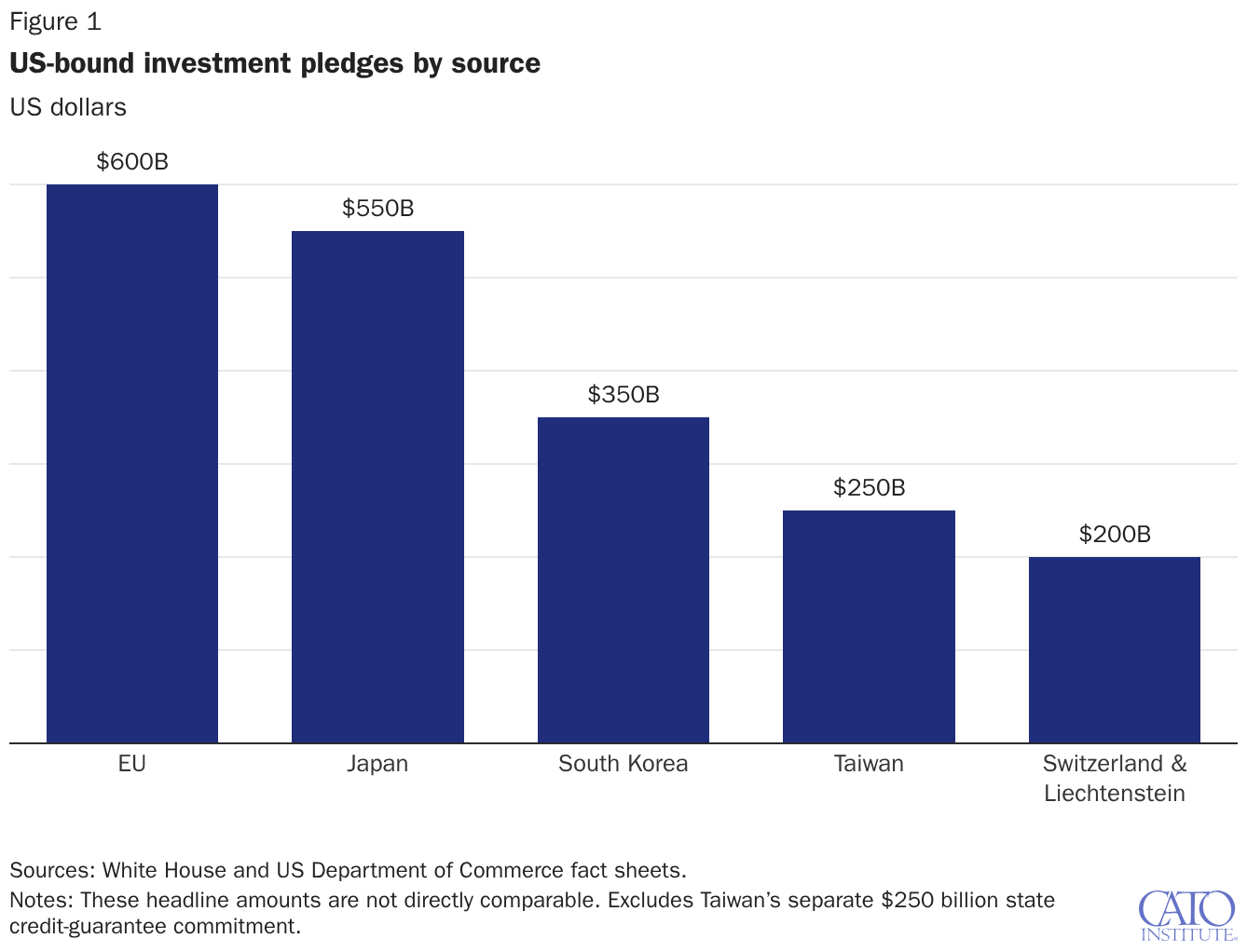
The Trump administration’s friendfunding approach is a new variation on an old policy with a long history. Traditional concerns about industrial policy still apply, and this structure creates additional ones.
Along with the traditional concerns of industrial policy comes a set of related issues concerning industry influence and transparency. For instance, where government-provided benefits exist, companies will seek to take advantage of them. Specific sectors will push to have their industry deemed crucial for economic or security reasons, and that definition can be stretched quite broadly. Are shoes crucial to the military, and thus must shoe production be done domestically? If shoes qualify, it becomes difficult to identify any industry unrelated to security.
Within a sector, companies will maneuver to maximize their benefits at the expense of competitors. Rather than focusing on production efficiency, companies will hire more lobbyists to take advantage of government benefits more effectively. This jockeying for government largesse inherently leads to problems with both transparency and corruption. Lobbying done behind the scenes renders the decisionmaking process opaque. Decisions begin to favor those with connections rather than those who are most qualified. Will those with connections to key administration players reach out to shape or join investment deals? If the investors have close ties to top political officials, does that make bailouts more likely should the investments turn sour?
Problems in choosing projects can lead to issues in how they are carried out. Without market discipline, unprofitable projects might be selected. Projects could go bankrupt or require perpetual subsidies to stay afloat. It is worth considering why market actors did not pursue a supposedly valuable project and government help is required.
Another problem with US industrial policy is its “seesaw” quality. Favored sectors change from administration to administration. The shift from pro–electric vehicle and pro-wind policies under Biden to anti–electric vehicle and anti-wind policies under Trump is a recent example. Little progress can be made in any direction when successive administrations reverse one another. Former Biden administration official Peter Harrell has written positively about the Japanese and South Korean arrangements, suggesting that their funds could serve as “patient capital” for “lower-return but strategically important projects.” A future Democratic administration, however, may decide to stop allocating money to a crude oil export terminal in favor of a more “environmentally friendly” project.
Turning to the specific circumstances of the Trump administration’s friendfunding, the announced framework lacks an oversight mechanism prescribed by Congress. The Commerce Department’s Investment Accelerator manages the transactions, but Congress did not create the program or set rules for project selection, valuation, conflicts of interest, government ownership, losses, disposition, or reporting. Nor has Congress designated an independent body to review these decisions. Harrell himself argues that Congress should establish oversight mechanisms while acknowledging that this would require more legislative initiative than Congress has shown. Without such guardrails, the usual problems of industrial policy, including opacity and industry capture, are likely to be worse.
Concerns abound about what impact this will have on US alliances. Japanese and South Korean officials have publicly expressed support for these investment plans. But it is unclear how they and other trading partners truly feel about being pressured in this way. If the projects underperform, or if people in those countries come to feel they were bullied, the resulting resentment could exact a cost that no trade deal can easily repair.
Part of the unease stems from the allocation of control and risk. The United States selects and oversees the projects, while Japan and South Korea supply much of the financing and bear the corresponding exposure. They have consultation rights and can decline a proposal, but their control is limited relative to their financial stake. If a Washington-selected investment goes sour, that imbalance can breed grievances, even among willing allies.
Signs of strain are already visible. Funding for the Japan-backed $40 billion nuclear project in Tennessee and Alabama has hit a roadblock because Japanese lenders want binding assurances that they will not be held liable in the event of a nuclear accident. The greatest risk may be political. For longstanding allies, including South Korea, a free-trade agreement partner for more than a decade, the deals reinforce the sense that established commitments have given way to transactional bargaining.
That concern is particularly visible in Alaska. President Trump’s announcement of South Korean investment in the Alaska LNG project—which Seoul later said it had not committed to—was made at the White House alongside Republican Sen. Dan Sullivan (R‑AK), who is facing a competitive reelection race in November. It created the impression that billions of dollars in South Korean taxpayer money could become intertwined with the administration’s domestic political priorities.
The arrangements may also raise legal concerns. Can the executive branch direct foreign money into government-controlled vehicles, claim their proceeds, and spend or dispose of them without congressional authorization? As the Trump administration learned from the IEEPA tariffs, courts may intervene when the executive branch pushes statutory boundaries too far. Legal experts have raised concerns under the Constitution’s appropriations clause and the statutes that enforce it, including the Miscellaneous Receipts Act, the Anti-Deficiency Act, and the Government Corporation Control Act. As they note: “Directing and spending money are among Congress’s most fundamental checks, not exceptions to them.”
Finally, President Trump and Commerce Secretary Howard Lutnick’s personal direction of investments creates another problem. This “personalist” approach frequently brings the risk of corruption and continues to substitute political officials’ judgment for the knowledge of market participants. It also makes for a messy transfer to a future administration with different priorities.