
The growth of educational freedom in America has been dramatic, with more than 70 programs now operating in over 30 states. While this is welcome news for many families in need of school choice, the rapid expansion has also revealed weaknesses with program design, particularly in funding stability, administrative structure, expenditure approval processes, and family access.
This paper identifies essential components for successful educational freedom programs, each of which will be explained in more detail:
- Universal eligibility. Any student can apply.
- Universal funding. Funding sufficient to cover all students who apply.
- Rollover. Unspent funds can be used for eligible expenses in future years.
- Competitive administration. Allow for multiple program managers rather than a monopoly.
- Streamlined expenditure approval. Offer multiple ways to pay and utilize risk-based auditing instead of prepurchase approval for most purchases.
The paper also traces how we arrived at today’s choice landscape and highlights lessons for policymakers seeking to maximize opportunity while avoiding new monopolies.
To sustain momentum, states must move beyond piecemeal design toward comprehensive frameworks. Only then can educational freedom deliver on its promises.
Introduction
Starting in the mid-19th century, the states began essentially monopolizing education by mandating funding of and attendance at government-run public schools. As the Cato Institute’s School Choice Timeline shows, many scholars, religious leaders, parents, and government leaders advocated for taxpayer funding of diverse educational options long before public schools were created.1
In his 1955 essay “The Role of Government in Education,” Nobel Prize–winning economist Milton Friedman, often considered the father of the modern school choice movement, accepted that governments could justify education mandates and funding.2 But he saw no reason for governments to run schools. His solution was taxpayer-funded vouchers that could be spent on approved educational services.
In 1990, the first modern school voucher program was launched in Milwaukee, enabling low-income families to use state tax dollars to pay private school tuition. In 1997, Arizona created the first tax-credit scholarship program, which included income restrictions. Rather than being directly funded with taxes, the program provides state tax credits to individuals or businesses who contribute to organizations that offer scholarships for private school tuition. These programs were dubbed “school choice” because they enabled parents to choose a school other than their child’s assigned public institution.
Arizona’s introduction of education savings accounts (ESAs) in 2011 brought about true education choice. ESAs allow parents to use state tax dollars to pay for a variety of educational expenses beyond private school tuition. Here, Friedman was again ahead of his time. In a 2002 interview, when asked about his vision of schooling, he responded:
Why is it sensible for a child to get all his or her schooling in one brick building? Why not add partial vouchers? Why not let them spend part of a voucher for math in one place and English or science somewhere else? Why should schooling have to be in one building? Why can’t a student take some lessons at home, especially now, with the availability of the internet?3
Although most states have enacted some degree of educational freedom, there is plenty of room to grow. Most programs remain limited to private school expenses and still restrict eligibility to specific segments of the population, such as children with special needs or low-income families.
As state leaders look to expand their programs, they need to comprehensively evaluate program design elements that will maximize educational freedom. This paper examines those key components before exploring various program structures and the historical context that have brought us to this moment.
Key Components of Educational Freedom
Successful educational freedom programs share essential components that determine whether they truly empower families or create new barriers (Box 1). These components emerged from observing implementation across more than 70 programs nationwide. States that neglect these components risk creating programs that look transformative on paper but frustrate families in practice.
The following sections examine each component in detail, providing concrete examples of what works and what to avoid.
Universal Eligibility
True educational freedom requires universal eligibility—no income limits, no special-needs requirements, and no restrictions based on prior school attendance. Early school choice programs were aimed at specific populations, typically students from low-income families or who had special needs. However, advocates had long pushed for broader access to education funding.4
Universal access promotes competition by incentivizing entrepreneurs to create new educational options as more students have access to funding. It is also fairer, because otherwise families who do not qualify but choose another option are forced to pay twice for education—once in taxes and again in tuition.
In 2021, West Virginia became the first state to incorporate universal eligibility when it enacted the Hope Scholarship ESA, a remarkable move given that the state previously had no private school choice program. The following year, Arizona expanded its ESA to universal eligibility. As of April 2026, 18 private school choice programs incorporated universal eligibility or were phasing it in over a few years.5 However, most of these are not truly universal; while any student can apply, not all will be accepted due to funding constraints.
Moving to Universal Eligibility in Stages
When political circumstances or implementation challenges make immediate universal eligibility difficult, a phased-in approach can be used. This could be income-based, in which a program initially targets lower-income families and then phases in higher-income families over a few years. Another option is to start with a program that targets specific populations, such as students assigned to low-performing schools or who have special needs, and then expands eligibility. The key is embedding the expansion into the law itself rather than hoping for the best in future political battles.
Universal Funding
Enacting an educational freedom program is only the first step. Without sufficient, stable funding, universal eligibility becomes hollow—families glimpse a new future only to have it snatched away by annual appropriations battles. When more students apply than funding can accommodate, children are left in limbo on wait lists, possibly stuck in a school that is failing them. Even worse, families could lose access to funding after they have made educational decisions based on scholarship availability. Having to switch schools whenever the state legislature changes the program would be challenging for both kids and parents.
The Problem of Insufficient Funding
The Louisiana Giving All True Opportunity to Rise, or LA GATOR, ESA was enacted with universal eligibility in 2024 and launched in 2025. But funding was left up in the air; the state legislature was tasked with appropriating an unspecified amount each year. For the program’s inaugural year, the legislature approved less than half of the funding requested by the governor, covering only around 6,000 scholarships despite nearly 40,000 students applying.6
Louisiana is not alone. Many state programs, especially new or newly expanded ones, are underfunded relative to the number of families who want to participate. The Utah Fits All ESA program was capped at $82.5 million in its first year (2024–2025), which was enough for around 10,000 scholarships. But so many families applied that the program administrator had to use a lottery system, and around 17,000 students were wait-listed.7 South Carolina’s Education Scholarship Trust Fund hit its legal enrollment cap for 2025–2026, and the state now directs additional applicants to a wait list.8
In Oklahoma, the refundable Parental Choice Tax Credit reached its annual cap in 2024, its inaugural year. The cap left thousands of families who applied unable to receive the credit, which ranges from $5,000 to $7,500 for private school expenses, with lower-income families eligible for a higher credit.9 Changes were made to the program, including an increase in the cap and a shift from calendar year to fiscal year to align with the school year. The credit for homeschoolers has a maximum value of $1,000 and an overall cap of $5 million. As of April 1, 2026, tax-credit awards for private school expenses were just below the new $250 million cap, and the homeschool cap had not been reached.10
North Carolina’s Opportunity Scholarship opened in 2014 and was limited to students with special needs. In 2023, the state legislature expanded the program to universal eligibility, effective for the 2024–2025 school year, which led to a surge in applications. Around 54,000 students were wait-listed.11 The legislature voted to increase funding enough to clear the wait list and overrode the governor’s veto of the increase.
A similar problem nearly occurred when Alabama rolled out its new Creating Hope and Opportunity for Our Students’ Education Act ESA for the 2025–2026 school year. More than 36,000 students applied, which the initial $100 million appropriation would not have covered. In response, lawmakers increased funding to $180 million.12
Ways to Ensure Adequate, Reliable Funding
As these examples illustrate, new and expanded educational freedom programs have given families hope, but those hopes can be dashed when interest exceeds funding. As lawmakers continue to expand choice, it is crucial that they include reliable funding streams that grow automatically with demand. Since each state funds education differently, there are multiple ways to accomplish the goal of sufficient choice funding. The key is to build programs that grow as needed to help reduce the uncertainty of annual appropriations battles, prevent wait lists, and ensure that families who want new options are not left out.
Formula Funding
For directly funded programs such as vouchers and ESAs, the most effective way to ensure that all eligible students can receive scholarships is to include the program in the state’s school funding formula rather than have a separate appropriation each year. This approach creates more reliable funding streams and makes it difficult to shrink programs, as reducing funding for public schools is politically unpopular.
Discussing public policy, the economist Thomas Sowell famously pointed out, “There are no solutions, only trade-offs.”13 This is applicable when considering how to fund educational freedom programs. Today, most states utilize a student-based funding model that starts with a base per-student rate and includes multipliers derived from considerations such as special needs and poverty.14 To make programs more accessible and impactful, similar multipliers should be included in scholarship amounts.
Including multipliers will also add complexity to the programs, which brings us back to Sowell’s trade-offs. While adding complexity, additional funding based on the higher cost of educating certain children will provide a more level playing field for private providers. This will encourage the creation and expansion of options that can serve students with diverse needs. And, because most states already have multipliers spelled out for their public schools, it should not be too difficult to transfer that system to choice programs.
While linking both the scholarship amount and total program funding to the state funding formula is ideal, that approach may not work in all states due to constitutional or political constraints. Some state constitutions are very specific about how public schools are funded, and the language may preclude funding choice programs in the same funding stream.
For example, in 2015, Nevada created a nearly universal ESA, which was by far the most expansive program at the time. But as often happens, opponents of parental choice filed a lawsuit to stop the program. In 2016, the Nevada Supreme Court ruled that the program was constitutional but the funding mechanism was not.15 The Nevada constitution has a unique provision requiring the state to appropriate public school funding ahead of any other part of the state budget. Since the ESA program was to be funded by subtracting money from participating students’ local school districts and there was no separate appropriation for the program, the court ruled that this violated the requirement to fund public schools first.
Given the likelihood that choice opponents will file lawsuits to stop school choice programs, policymakers should consider any constitutional restrictions as they craft new or expanded programs. Weighing what will work best for students against what is most likely to survive a court challenge is a crucial part of program design. But they should also realize that opponents may sue—and win—no matter how carefully a program is worded, as Kentucky lawmakers learned in 2022.
In 2021, the Kentucky legislature created an ESA-style program called Education Opportunity Accounts, which were to be funded by private donations with donors eligible to receive state income tax credits. The state legislators used tax credits instead of direct funding because the Kentucky constitution stipulates that “no sum shall be raised or collected for education other than in common schools.” School districts and other opponents of parental choice sued, and the state supreme court ruled that private donations that receive a tax credit are essentially the same as direct funding and therefore violate the state constitution.16
The experiences in Nevada and Kentucky illustrate how difficult it can be to fund school choice programs in a manner that will survive constitutional challenges, even when they are specifically designed with that goal. Using the state student funding formula to determine the scholarship amount and then having a separate appropriation line item is an approach that avoids direct entanglement with public school funding but enables the scholarship amount to adjust automatically over time. However, it runs the risk of political fights each appropriation season.
At least 10 states—Arizona, Arkansas, Florida, Georgia, Indiana, New Hampshire, Ohio, Oklahoma, Tennessee, and Wisconsin—utilize formula funding to some extent. But many of these programs have limited eligibility or other restrictions. Arizona and Florida have long-running programs that have been modified over the years and are currently universal and funded through the state funding formulas.
Arizona
Under Arizona’s Empowerment Scholarship Account law, the Arizona Department of Education takes state funds that would otherwise be allocated to a participating child’s school district and transfers them to the student’s ESA.17 While the legislature appropriates education funding each year, the statute provides that every eligible student who wishes to participate will receive funding based on the formula.
Florida
Florida’s Family Empowerment Scholarship for Educational Options is funded through the Florida Education Finance Program, which also funds public schools.18 All students who wish to participate receive funding based on state per-pupil amounts, which vary by grade level, county, and whether the student has a disability.
Automatic Escalators
When funding or enrollment caps are politically necessary, automatic escalators prevent permanent limitations. Rather than requiring annual legislative action, an automatic escalator provision increases capacity automatically based on predetermined triggers, as explained in the following state examples.
Arizona’s Corporate Tax-Credit Scholarship
In 2006, Arizona enacted its corporate income tax-credit scholarship program, which allows businesses to receive tax credits in exchange for donations to organizations that provide tuition scholarships to students from low-income families. The program was capped at $10 million in credits the first year, but the cap automatically increased 20 percent each year until growth was scaled back starting in 2020.19 Due to the automatic escalator and smaller statutory increases, the program grew from $10 million in 2006 to $158 million in 2024 before being capped at $135 million starting in 2025.
Florida’s Tax-Credit Scholarship
Florida took a similar approach with its tax-credit scholarship program, which was enacted in 2001. Beginning in 2011, the tax-credit cap automatically increased by 25 percent whenever 90 percent of credits were claimed the previous year. As a result, the program grew from $140 million in 2010 to $1.1 billion in 2022.20
New Hampshire’s Education Freedom Accounts
New Hampshire used a combined approach when expanding eligibility for its Education Freedom Accounts in 2025 to include every student in the state. Program funding is built into the law—the state department of education must transfer the per-pupil adequate education grant amount, plus any differentiated aid that would have been provided to a public school for that eligible student, to the scholarship organization. This means every student approved for an account will be funded.
However, the expansion included a cap of 10,000 students, which the program hit by the beginning of the 2025–2026 school year, putting several hundred students on the wait list. Fortunately, the program also included an escalator provision that automatically raises the enrollment cap by 25 percent for the following year when at least 90 percent of the maximum is reached.21 Because of the escalator, 12,500 accounts will be available in 2026, and the program will continue to grow with demand.
Rollover Provisions
Allowing families to roll over unused funds from year to year is essential for ESAs. Rollover provisions encourage families to spend wisely rather than rush to exhaust the balance before the end of the school year. Without them, parents face a “use it or lose it” scenario that incentivizes purchases they do not need or buying more expensive versions of necessary items. Allowing balances to accumulate rewards careful budgeting, keeps families cost-conscious, and helps guard against artificial tuition inflation because schools know parents are paying attention to price.
Rollover also gives families financial flexibility to plan for future needs. Education expenses often rise as children get older, whether for more advanced coursework, specialized services, or preparation for postsecondary education. By saving unused funds, families can smooth those costs over time and avoid being caught short in later years. Ideally, rollover funds can be used beyond high school rather than forfeited upon graduation. This would allow students to pay for college tuition, apprenticeships, or career training, further incentivizing the thoughtful use of funds.
Competitive Program Administration
Generally, when states create school choice programs, a state agency (often a treasury or education department) or a nonprofit organization is tapped as the program administrator. For example, in Arizona, the state department of education is responsible for most ESA-related tasks, such as determining student and provider eligibility, calculating scholarship amounts, approving expenses, and taking action if funds are misused. The state treasurer is responsible for financial oversight, including disbursing ESA funds to students’ accounts, and may contract with private firms to manage the accounts. In West Virginia, the legislature created an independent Hope Scholarship Board to administer the Hope Scholarship ESA. The administrator then typically contracts with a vendor to run the day-to-day aspects of the program.22
While some states allow multiple vendors to be hired, that is not happening in practice. “We have compromised away the idea that parents know best and have allowed a one-size-fits-all approach to creep in. We’re empowering monopolies instead of families,” points out education policy expert Katherine Bathgate.23
Bathgate’s 2024 report, “Breaking the Monopoly of ESA Implementation,” highlights the widespread reliance on single-vendor systems, in which states contract with a single platform or financial service provider to manage ESA funds. These vendors typically handle account setup, payment processing, transaction monitoring, compliance verification, and reimbursements. While these administrative functions are necessary, concentrating them in a single provider creates de facto monopolies. Box 2 shows potential problems that can occur when states monopolize these functions.
Policy Options for Promoting Competition
Bathgate notes that when there is only one vendor, the state is essentially the customer, as contracts are negotiated between the state and the vendor.24 This can push students’ and parents’ concerns lower on the priority list. By introducing competition among ESA vendors, states can correct the current incentive structure. The report offers three policy solutions that states could adopt to promote competition:
- Option 1—Open market. Allow anyone who meets specific standards to become a vendor, fostering maximum competition and innovation.
- Option 2—Mandate multiple vendors. Require the state agency responsible for the program to work with a minimum number of vendors (e.g., at least three).
- Option 3—Permission for multiple vendors. Allow the state agency in charge of the program to work with multiple vendors, encouraging but not mandating competition.
Importantly, vendor competition makes families—not the state—the customers. Families can change vendors when one is not working well. This competitive environment would encourage better technology, lower fees, more responsive operations, and vendors that specialize in meeting particular needs.
Streamlined Expenditure Approval
How families access and spend their education funds dramatically affects whether programs truly empower parents or simply create new bureaucratic hurdles. When the approval process is unwieldy or uncertain, parents may hesitate to spend their funds for fear they will not be reimbursed. Similarly, providers may not want to participate if they are unlikely to be paid in a timely manner.
Automatic Approval with Risk-Based Auditing
Rather than require preapproval for every expense, programs should automatically approve qualifying purchases and use risk-based auditing to ensure compliance with rules about eligible expenses. Other government programs use a similar method, including the Internal Revenue Service for income tax returns and health savings account (HSA) purchases and the Federal Emergency Management Agency for disaster relief. This approach
- eliminates delays that prevent families from taking advantage of time-sensitive opportunities,
- reduces administrative burdens on both families and program staff,
- focuses compliance efforts on higher-risk transactions rather than routine expenses,
- trusts parents as the primary decisionmakers for their children’s education, and
- maintains accountability through systematic review of spending patterns.
Programs should clearly define eligible expense categories (tuition, tutoring, curriculum, educational therapies, technology, testing, etc.) and allow automatic approval for purchases within those categories. Auditing can then focus on outliers and potential fraud rather than creating bottlenecks for every transaction.
Debit Cards for Immediate Access
Issuing debit cards, similar to HSA cards, enables families to make immediate purchases without reimbursement delays. Arizona’s ESA is the only program actively using debit cards, but they are available only to students with disabilities. Most other states require parents to make purchases through a dedicated online store or pay up front and request reimbursement. As noted in a 2024 survey of Arizona’s ESA participants, parents sometimes complain that prices in the online marketplace can be higher than what is available elsewhere.25 Having debit cards available allows parents to shop outside these marketplaces without having to pay out of pocket and then submit receipts for reimbursement.
Debit cards increase freedom and flexibility by
- allowing families to shop for the best prices and make purchases when opportunities arise,
- eliminating the financial burden of fronting money and waiting for reimbursement,
- working seamlessly with vendor systems for automatic categorization,
- providing real-time balance information to help families budget, and
- creating automatic transaction records for compliance purposes.
This payment method is particularly important for lower-income families who would benefit most from saving on purchases and may not have the cash flow to buy items up front while awaiting reimbursement.
Admittedly, debit cards carry a higher risk of fraud or misuse because they can be used outside a dedicated online marketplace, and it can be hard to recover funds that have already been wrongly spent. These challenges are not unique to ESAs; other government funding programs, such as the Supplemental Nutrition Assistance Program’s Electronic Benefits Transfer (EBT, formerly “food stamps”) and Medicaid, are similarly at risk. Despite the risks of improper usage, no one is suggesting that EBT or Medicaid recipients be limited to an online marketplace or be forced to pay up front and submit for reimbursement.
One thing to consider when evaluating the risk of misuse is that, unlike with EBT or Medicaid, parents have to give up a different government benefit that is typically worth more—free public schooling—to use an ESA. Parents have a strong incentive to stick to the ESA rules so they do not have to return to their former public schools.
States must carefully draft their programs to minimize fraud and misuse. Education expenses should be broadly defined to give parents the most flexibility in crafting a learning path for their children. But statutes should also hold parents responsible for improper spending. Penalties for unintentional misuse could include repayment, fines, or removal from the program. Intentional fraud might include similar penalties but could also trigger criminal prosecution depending on the situation.
It is worth noting that the previously discussed rollover provision could help minimize misspending, as unspent funds would be available for future expenses rather than being forfeited back to the state.
Closed Universe Online Marketplaces
Creating online marketplaces of preapproved educational vendors and products provides families with a curated shopping experience. While there can be problems with a dedicated online marketplace, as discussed, they can also offer some advantages for families. These “closed universe” platforms
- simplify compliance by ensuring that all vendors meet program standards,
- reduce friction in the purchasing process,
- help families discover new educational resources they might not otherwise find,
- enable comparison shopping within a trusted ecosystem, and
- streamline reporting and recordkeeping.
Importantly, these marketplaces should be optional conveniences, not mandatory restrictions. Families should retain the ability to purchase from non-marketplace vendors when those better meet their needs.
Reimbursement Options for Added Flexibility
While debit cards and online marketplaces provide convenience, reimbursement options remain essential. Reimbursement allows families to
- purchase used materials at significant savings,
- take advantage of sales and discounts,
- work with specialized providers who don’t participate in marketplace systems,
- buy from individual sellers (e.g., used curriculum, instruments, and equipment), and
- customize their education in ways that don’t fit preapproved vendor lists.
A well-designed reimbursement system processes claims quickly, requires minimal documentation for routine expenses, and provides clear guidance on what qualifies.
The Balanced Approach
The best programs offer families multiple options: debit cards for immediate purchases, online marketplaces for convenience, and reimbursement for maximum flexibility. This multipronged approach ensures that programs serve families rather than constrain them.
Program Design
While the core components discussed here apply to all educational freedom programs, states can structure their programs in various ways. Each design has advantages and disadvantages, and the best approach depends on state-specific factors such as tax structure, political environment, and existing education funding mechanisms.
Notably, states need not limit themselves to just one program type. More than 70 programs currently operate across 34 states, the District of Columbia, and Puerto Rico, indicating a willingness to enact multiple options.
Education Savings Accounts
As mentioned, ESAs were the first programs that funded educational options beyond private school tuition. With an ESA, a portion of state per-pupil funding is placed in an account that parents can use for a variety of approved education expenses. Arizona’s Empowerment Scholarship Accounts program, the first ESA in the United States, was launched in 2011 and initially limited to children with special needs.26 Over time, eligibility expanded, and in 2022, Arizona became the first state to offer universal eligibility for any school choice program.27
With 21 programs in 18 states, ESAs are the most widespread educational freedom option. Funding is typically based on state per-pupil funding at public schools, and students with special needs sometimes receive additional funding depending on their diagnosis.
Tax-Credit ESAs
Tax-credit ESAs like the ones in Florida and Missouri blend tax-credit scholarships with ESA flexibility. Similar to tax-credit scholarships, they are funded through donations for which donors receive credits against their state taxes. As with ESAs, they can be used for a variety of educational purchases, not just private school tuition.
Refundable Tax Credits
Refundable tax credits provide parents with a credit against their income taxes for education expenses they incur. The “refundable” aspect means families receive the full credit even if it exceeds their state tax liability. Minnesota has a limited, means-tested refundable tax credit that was created in 1997; participating families received an average credit of $379 in 2024.28 Oklahoma took a giant leap by passing a universal refundable tax credit in 2023.29 Idaho followed in 2025.30
In Oklahoma, the credit for students in private schools ranges from $5,000 to $7,500 per child, with lower-income families receiving the higher amount. Homeschooling families are eligible for a $1,000 credit per child for eligible expenses.31
Universal Tuition Tax Credit
“One size does not fit all” is a common slogan among supporters of educational freedom. This truth applies not just to student-learning options but to program design itself. When breaking free of the public school quasi-monopoly, we must avoid creating new monopolies.
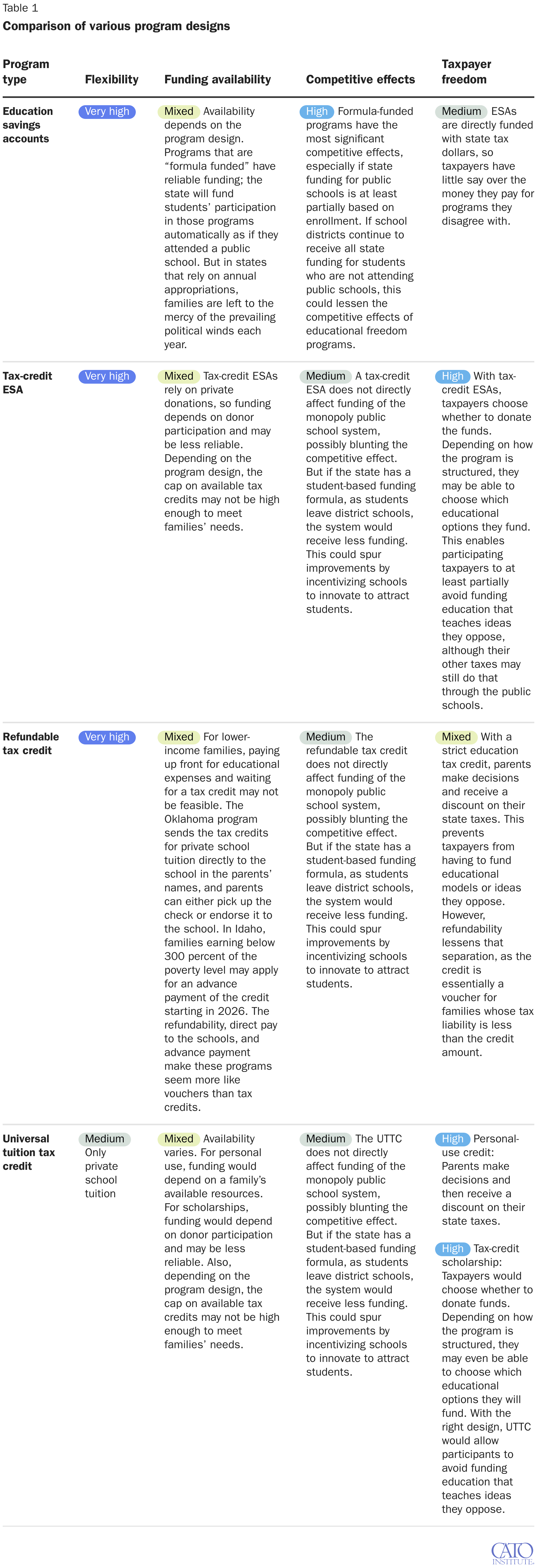
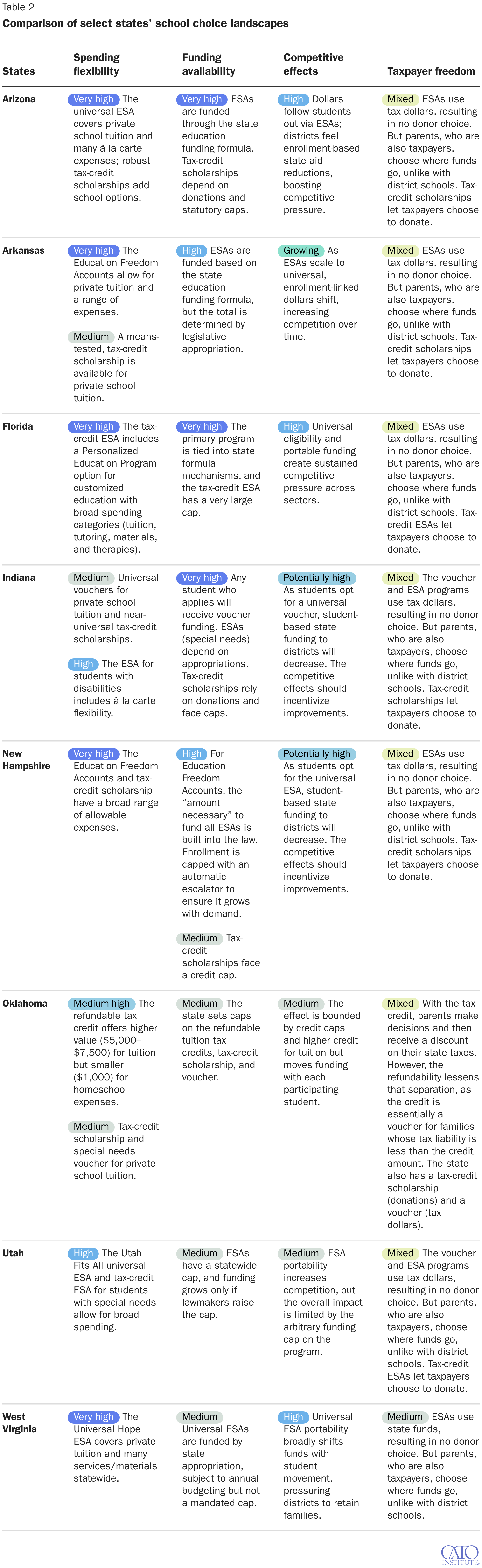
Matt Ladner, education expert and longtime education choice advocate, has called for a “combined-arms approach” to education that would provide multiple choice mechanisms in a state.32 He points to a Mackinac Center proposal for a universal tuition tax credit (UTTC), which would allow individuals and businesses to receive a state tax credit for tuition payments to public or private schools.33 The credit could be claimed for tuition paid for one’s own children or for other children’s scholarships. The beauty of this design is that it alleviates the double-payment penalty parents face when they pay tuition on top of education taxes while providing a scholarship funding pool for families who cannot afford tuition. Table A1 compares some features of these program designs, while Table A2 looks at these features in select state programs.
Recommendation: Combined Approach
In today’s landscape, ESAs are the gold standard for educational freedom. They provide the most stable funding, can be most successfully tied to the school-funding formula and made universal, and offer tremendous flexibility for families. Policymakers looking to create a new choice program in their state would do well to start by considering ESAs. However, as is often the case with innovation, this is an area that is always evolving.
Nearly a dozen states offer education tax credits that allow parents to receive tax breaks for their own education expenses. Around 20 states offer tax credits for donations to scholarships or ESAs. But the Mackinac UTTC proposal, which would combine personal-use education credits with credits for paying someone else’s education, remains innovative and untried. By combining aspects of the UTTC with ESAs, states can craft programs that provide the utmost flexibility while meeting students’ diverse financial and academic needs.
Policymakers should consider enacting programs that include:
- Individual education tax credits. Enable parents to receive tax credits for their own children’s education expenses, including a broad array of expenditures beyond tuition.
- Scholarship tax credits. Incentivize donations to scholarship-granting organizations that fund ESAs, which parents can use for tuition or other educational expenses.
Pairing both tax credits and including a wide range of expenses would benefit students across the income spectrum, regardless of what type of education they pursue.
Florida’s School Choice Program: Freedom, Flexibility, and Choice
Florida demonstrates the power of a combined-arms approach, offering multiple educational freedom programs that work together to maximize choice. In 2023, the state consolidated several programs while adopting universal eligibility. Sunshine State families now have access to a universal ESA for full-time private school students, a tax-credit ESA that includes a Personalized Education Program (PEP) option for families who want more flexibility, and an ESA for students with special needs.
The financial flexibility these programs offer has opened doors for families who previously felt locked into their assigned district school. ESAs can be used at participating private schools or for other educational expenses, including tutoring, curricula, and industry certifications. The average account value is $8,100, which is based on state per-pupil funding and is around 72 percent of average per-pupil spending in Florida public schools.34 Students with special needs may be eligible for higher amounts depending on their diagnoses, and they can use their accounts for home education expenses without enrolling in a PEP.
The ESA has no set cap for students in private schools as it is funded through the public school funding formula. Under the tax-credit ESA, PEP accounts are capped at 100,000 students for 2025–2026, which is up from 20,000 when the program was created in 2023. The cap will increase by 40,000 for the next school year and will be eliminated July 1, 2027. The special needs ESA has an enrollment cap that can increase annually.
Universal educational freedom that includes spending flexibility is transforming Florida. Education entrepreneurship is booming as parents and teachers create microschools, hybrid schools, homeschool co-ops, and à la carte learning options, which are explained in Box 3.35
Private schools, including religious ones, are flourishing as they face a more even playing field after decades of having to compete with “free” public schools.36
Florida has also embraced choice in the public school sector, including charter schools, specialized magnet schools, and open-enrollment policies that allow students to attend district schools other than the one they are assigned to. Clearly parents are embracing these new options—the 2023–2024 school year marked the first time that more than half of Florida students attended a school of choice.37 By offering multiple pathways to educational freedom, Florida ensures that families can find the option that best meets their needs while creating a robust, sustainable choice ecosystem.
Arizona Is Embracing Educational Freedom
As in Florida, Arizona shows how transformative a multifaceted approach to educational freedom can be. In recent years, the state expanded its Empowerment Scholarship Account to include universal eligibility and funding.38 Families can use these funds for full-time private schooling or a wide array of approved expenses—tutoring, curricula, therapies, online courses, industry certifications, and more. Students with disabilities can qualify for higher awards.
Arizona also has four tax-credit scholarship programs that provide individuals or businesses with tax credits when they donate to organizations that provide tuition scholarships to private schools.39 The tax-credit scholarships are stackable, which means a student can receive more than one scholarship—although a student cannot receive both an Empowerment Scholarship Account and a tax-credit scholarship. By stacking, a student can receive a larger scholarship than the value of the Empowerment Scholarship, which can be particularly helpful for lower-income families.
On the public school front, Arizona boasts one of the nation’s most robust choice ecosystems: a large and diverse charter school sector, specialized magnet programs, and statewide open enrollment so that students can attend district schools beyond their assigned school.40
The result is broad spending flexibility plus multiple pathways—ESAs, scholarships, charters, magnets, and open enrollment—that fuel education entrepreneurship and allow families to assemble the learning environment that fits them best. This is creating a durable, parent-driven choice landscape across the state that includes microschools, hybrid schools, and homeschool co-ops.
Conclusion
Educational freedom is rapidly becoming a mainstream expectation. But enacting a choice program is only the first step. Without the proper components in place, families face wait lists, red tape, and lost opportunities.
The key components for successful educational freedom programs are clear:
- universal eligibility that removes arbitrary restrictions
- universal funding that ensures every eligible family can actually participate
- rollover provisions to discourage wasteful spending
- competitive program administration that empowers families rather than monopolistic vendors
- streamlined expenditure approval through automatic authorization, debit cards, online marketplaces, and reimbursement options
States that adopt these best practices will create lasting, resilient programs that put families in charge. Programs can take various structural forms—ESAs, tax-credit ESAs, refundable tax credits, UTTCs, or a combination—but all should incorporate these essential components.
Ultimately, the test of educational freedom is whether parents can rely on it year after year, not just when appropriators allow. A well-designed system ensures that funding follows the student, options grow with demand, and families—not bureaucrats or monopolies—decide what education looks like.
By implementing thoughtful reforms that incorporate the features outlined in this paper, states can ensure that today’s surge in educational freedom becomes a permanent part of America’s education landscape. The opportunity is here. The question is whether policymakers will seize it by building programs designed for lasting success rather than political expediency.
Appendix
Citation
Hroncich, Colleen. “Let 1,000 Flowers Bloom: Best Practices for Advancing Educational Freedom,” Policy Analysis no. 1017, Cato Institute, Washington, DC, May 11, 2026.

About the Author


This work is licensed under a Creative Commons Attribution-NonCommercial-ShareAlike 4.0 International License.