
Trump Accounts are new early-life investment accounts that include a $1,000 government-funded seed investment for Americans born between 2025 and 2028. The accounts also allow additional contributions from families, employers, and charitable organizations. Trump Accounts are the latest addition to a tax code that already includes more than a dozen similar qualified investment accounts, each with its own eligibility rules, contribution limits, and withdrawal restrictions.
This policy analysis finds that Trump Accounts function primarily as a government welfare program rather than a tax-neutral investment vehicle. For most families, Trump Accounts are less tax-advantaged than existing alternatives and add considerable complexity to an already fragmented system, limiting participation. The analysis concludes by proposing reforms that build on the best features of Trump Accounts by adopting a Universal Savings Account structure and consolidating the remaining system into simpler, more flexible options that expand access and reduce complexity.
Introduction
The tax code offers more than a dozen qualified savings accounts, each with its own eligibility rules, contribution limits, and withdrawal restrictions. The result is a complex system that disproportionately benefits households with the financial sophistication and stability to navigate it. Newly created Trump Accounts, which include a $1,000 government-funded seed investment for Americans born between 2025 and 2028, are the latest addition to this maze. They introduce a novel structure that allows early-life saving through additional contributions from families, employers, and charities. However, in many circumstances, Trump Accounts are less tax-advantaged than existing alternatives.
This policy analysis evaluates Trump Accounts within the broader system of qualified savings vehicles. It finds that Trump Accounts’ value for most Americans is as a welfare program, not a tax-advantaged investment account. This is in contrast to other qualified accounts that primarily improve the tax treatment of personal savings. Trump Accounts add another layer of complexity to an already fragmented system, which will limit participation. The accounts’ more ambitious policy goals—reducing reliance on Social Security or fostering a new generation of capitalists—are not well supported by available evidence.
The analysis concludes by outlining a reform agenda that eliminates direct subsidies and consolidates the current patchwork of accounts into a smaller number of investment vehicles, including a more neutral and flexible Universal Savings Account that builds on the best features of Trump Accounts. By focusing on simplicity and liquidity, these reforms would expand savings opportunities for more Americans and forestall lawmakers’ political incentives to expand the currently limited subsidies.
Overview of Trump Accounts
Trump Accounts are custodial investment accounts established for children at birth or in early childhood and transferred to the beneficiary at adulthood. They combine features of tax-preferred savings vehicles and government welfare transfer programs. The accounts are designed to promote early-life saving, but do so through a structure that conditions tax benefits and access on complex rules. The accounts permit contributions from family members, employers, charities, and governments, and convert to a traditional Individual Retirement Account (IRA) on January 1 of the year the beneficiary turns 18. Trump Accounts will begin accepting contributions on July 4, 2026.1
Key features include:
- Government contribution: A one-time $1,000 deposit for children born in the United States between January 1, 2025, and December 31, 2028, regardless of parental immigration status. A parent or guardian must elect to open a Trump Account on the child’s behalf.2
- Family contributions: Parents, relatives, and friends may contribute up to $5,000 per year in after-tax (nondeductible) funds until January 1 of the year the beneficiary turns 18.
- Employer contributions: Employers may contribute up to $2,500 annually per employee to dependents’ accounts.3 These contributions are deductible to the employer and excluded from the employee’s taxable income. Employers may also facilitate employees’ own pre-tax contributions to a dependent’s account through a Section 125 Cafeteria Plan.4 Properly structured employer and employee contributions may be exempt from income and payroll tax, pending additional guidance from the Treasury Department.5 Employer and employee contributions count toward the overall $5,000 annual limit.
- Nonprofit and government contributions: Contributions from charitable organizations and government entities, which could include state governments, do not count toward the $5,000 annual cap.
- Investment restrictions: Funds must be invested in diversified, low-cost index funds composed primarily of US equities.
- Restricted access: Funds cannot be accessed before age 18. On January 1 of the year the beneficiary turns 18, the account converts to a traditional IRA, and those rules then apply.
- Early-withdrawal penalties: Withdrawals between ages 18 and 59½ incur an additional 10 percent penalty unless they satisfy an existing IRA exemption, such as paying for higher education tuition and related expenses or up to $10,000 for a first-time home purchase.6
- Tax treatment on withdrawal: Distributions are generally taxed at ordinary income rates (not the lower capital gains rate), but treatment differs by contribution type. Employer, government, and charitable contributions are fully taxable upon withdrawal. For after-tax contributions from parents, relatives, or friends, the original contribution (basis) can be withdrawn tax-free, while any investment earnings are taxed as ordinary income.7
Overview of Other Qualified Accounts
Traditional income tax systems encourage consumption over saving by assessing multiple layers of tax on interest and investment returns. Qualified investment accounts remove these layers of tax to varying degrees.
Wages are first taxed by income and payroll taxes. Individuals then choose to spend or save their after-tax income. Saved income is simply delayed consumption, set aside to be spent in the future. A saver’s earned interest income or investment returns are what the market pays to incentivize people to delay consumption. Under the income tax system, the increased value of investments is taxed again as interest, realized capital gains, dividends, and transfers at death.
The corporate income tax adds another layer of tax on income earned from corporate equity investments. Taxing investment returns reduces the after-tax return to saving, reducing the market incentive to delay consumption.8 Compared to wage tax rates, lower corporate, capital gains, and dividend tax rates, along with a large estate tax exemption, are policy features designed to reduce some of this bias against saving.
Another way the tax code reduces the income tax system’s built-in bias against saving is through qualified savings accounts, such as employer-administered 401(k) retirement accounts, IRAs, and 529 plan education savings accounts. These qualified investment accounts exempt capital gains, dividends, and interest from tax. The corporate income tax still reduces investment returns. In the accounts, savers can purchase a wide range of stocks, bonds, mutual funds, and exchange-traded funds, although rules vary.
By shielding investment returns from multiple layers of taxation, qualified accounts move the tax system closer to neutral treatment of consumption and saving. Research consistently finds that tax-advantaged accounts increase private savings.9 And over time, even small increases in private savings contribute to a larger capital stock, additional labor supply, and a bigger economy.
Qualified accounts allow taxpayers to contribute either tax-deferred income (traditional accounts) or after-tax income (Roth accounts). Contributions to traditional savings accounts are deducted from taxable income, so income taxes are not due when the contribution is made. The funds then grow tax-free and face ordinary income tax rates at withdrawal. Roth accounts receive after-tax contributions, grow tax-free, and no tax is due at withdrawal. If the contribution and withdrawal are made while the taxpayer is in the same tax bracket, the effective tax rate on an investment in a Roth or traditional savings account is identical.10 Other qualified accounts extend these same basic principles to specific types of future spending. Table 1 summarizes the most important features of the major qualified savings accounts.11
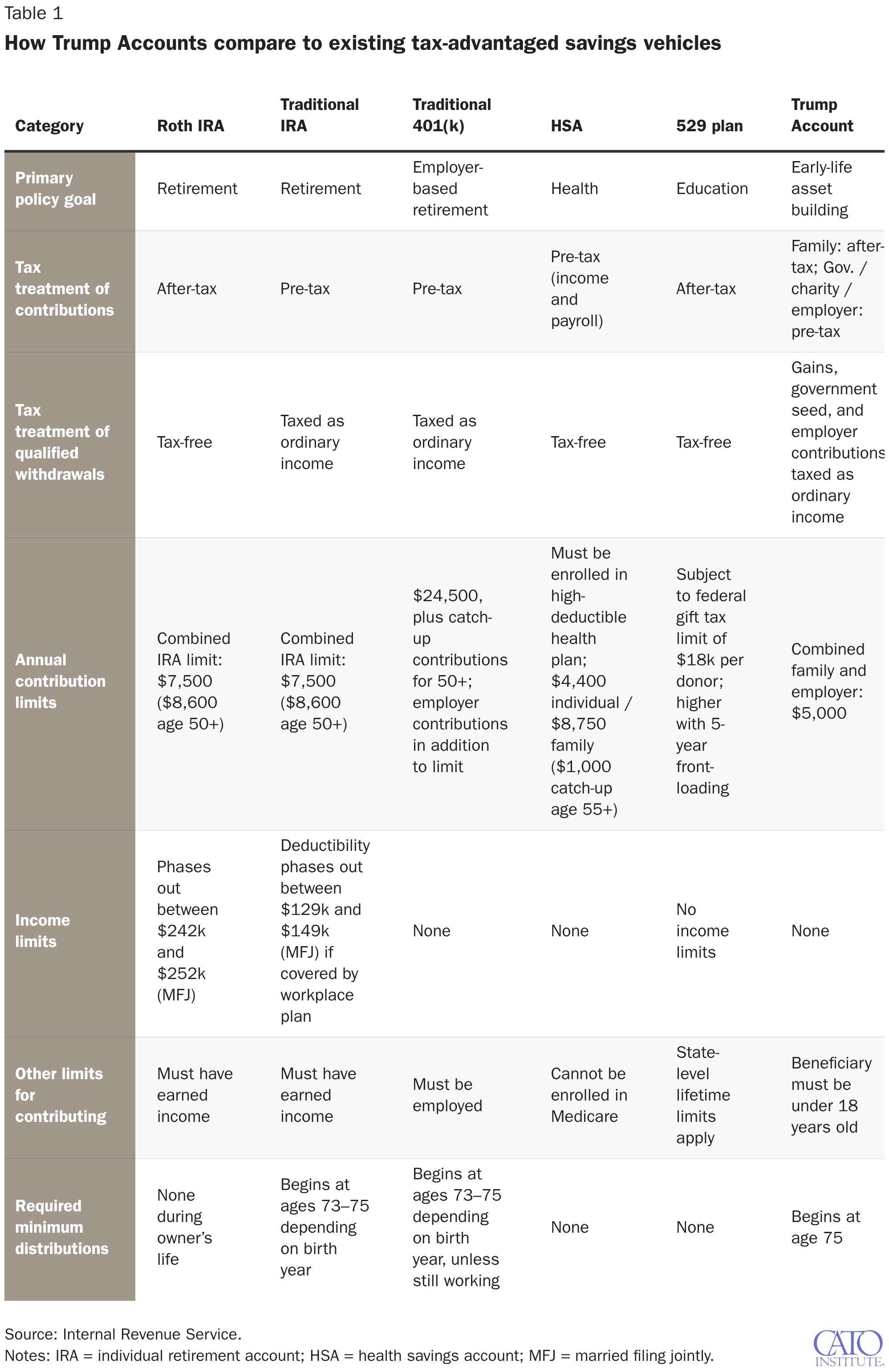
Section 529 plan education savings accounts allow after-tax contributions to grow tax-free, with withdrawals exempt from tax when used for qualified education expenses.12 Many other types of specialized accounts operate on similar principles, including Coverdell education accounts, ABLE disability savings accounts, and specialized small-business, self-employed, and employee-ownership accounts.
Health Savings Accounts (HSAs) provide additional tax benefits that overcorrect the income tax’s bias against saving, creating an implicit tax subsidy for qualifying health savings.13 In an HSA, contributions are deductible from both income and payroll taxes, and qualified withdrawals are tax-free. HSAs eliminate all taxes on qualified health savings, unlike qualified investment accounts, which eliminate taxes only on capital gains, dividends, and interest.
Comparative Tax Treatment of Saving
Table 2 provides a stylized comparison of how different account structures affect the after-tax value of personal savings. The illustration holds constant the amount of pre-tax income available to save, annual returns, and the investment term; it varies only the tax treatment of contributions. The example assumes a single $5,000 pre-tax contribution, a constant 7 percent annual real return, and a 30-year investment term. The stylized example applies a 24 percent income tax rate to ordinary income withdrawals and a 15 percent capital gains tax. The results isolate the mechanical effect of each tax structure on the return to saving.
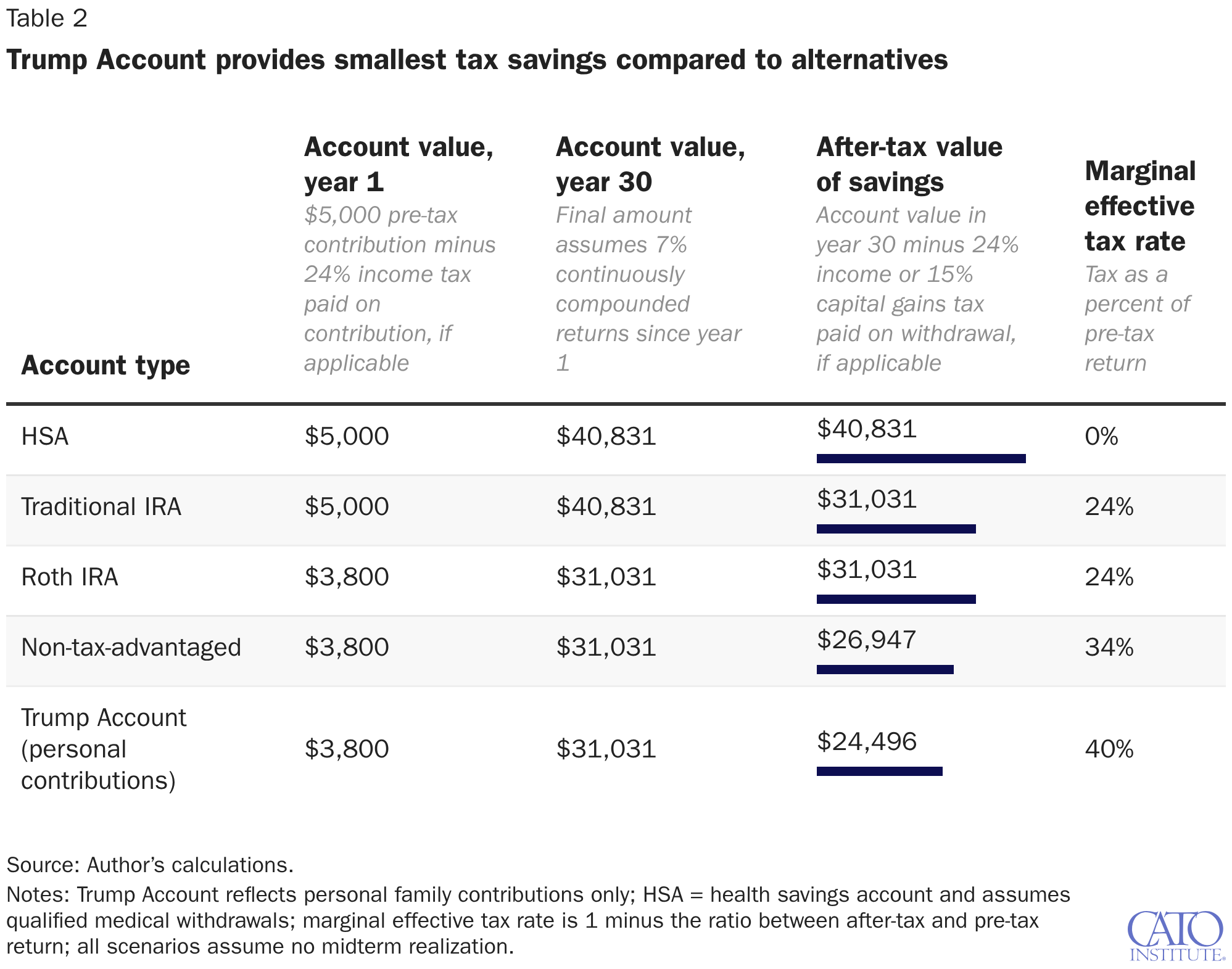
The taxable account serves as a benchmark for comparison. Contributions are made with after-tax income, and investment returns are taxed again upon realization.
Under these assumptions, traditional and Roth accounts produce identical after-tax outcomes. The traditional account allows the full $5,000 to be invested in year one and applies ordinary income tax rates on the full withdrawal. The Roth contribution is reduced by the income tax, but the after-tax principal grows tax-free. The tax paid up front is money that never enters the investment account; if it had been invested, it would have grown at the same rate as the rest, which is why taxing the money before or after compounding leads to the same result.
HSAs remove all taxes on qualified health care spending. Contributions are tax-deductible, and qualified withdrawals are tax-exempt. HSA contributions are also exempt from payroll taxes, which are not shown in Table 2.
The treatment of personal contributions to Trump Accounts differs from both neutral savings vehicles and the standard taxable benchmark. Contributions from family and friends are made from after-tax income, as in a taxable brokerage account, but investment gains are taxed as ordinary income upon withdrawal rather than at the lower capital gains rate. The result is that Trump Accounts produce the worst after-tax outcome of any option shown in Table 2. A family that saves $5,000 in a Trump Account instead of a regular taxable brokerage account would have $2,451 less after 30 years, solely because of the less favorable tax treatment on withdrawal.
The most attractive feature of a Trump Account is not its treatment of personal contributions but the ability to receive transfers from governments, employers, and nonprofit organizations. These contributions represent direct government subsidies or tax-free contributions from employers or nonprofit organizations. In that context, the accounts function less as a neutrality-enhancing investment vehicle and more as a welfare program.14 Any financial advantage of the accounts therefore derives primarily from the presence of these external contributions rather than from improved tax treatment of the contributions made by the beneficiary’s family or friends.
The stylized example in Table 2 abstracts away from important portfolio choices, such as interest-bearing investments (which are subject to ordinary income tax rates in normal taxable accounts) and annual dividend payments or midterm realized gains. Trump Accounts can offer specific tax advantages for certain investment strategies, including deferring midterm taxes due on interest income and on dividends and other realized gains, as well as more complex Roth conversion techniques (discussed in more detail below). But for the typical family making straightforward contributions, the basic tax math works against them.
One of the more sophisticated uses of Trump Accounts underscores how complexity shapes who benefits most. After the account converts to a traditional IRA at age 18, it becomes eligible for conversion into a Roth IRA. This strategy allows families to pay withdrawal tax when the beneficiary’s income and tax rate are low, so the funds can subsequently grow tax-free and avoid paying higher ordinary income taxes later in life. In effect, Roth conversion arbitrages differences in marginal tax rates across a person’s life cycle.
Executing this approach requires navigating multiple layers of tax law. The primary obstacle is the “kiddie tax,” which taxes a child’s unearned income above $2,700 (in 2026) at the parents’ marginal tax rate.15 Because a Roth conversion generates unearned income, it can trigger the kiddie tax and be taxed at the parents’ higher rate, defeating the purpose of converting while the child’s income is low. Families must also manage the tax liability triggered by the conversion, which can require access to additional funds from outside the account to avoid reducing the invested balance and paying penalties. Optimizing the strategy may also require spreading conversions across multiple low-income years and coordinating with other sources of income.16
While such planning can yield long-term benefits, it is costly, time-consuming, and for most people requires sustained access to specialized tax advice. It also carries the risk that the beneficiary withdraws funds at 18 for nonqualified purposes and pays the 10 percent penalty, undermining the advantages of the complex planning. For most households, complexity and up-front costs make these strategies impractical, and the existing 529 plan (with IRA rollovers) and taxable custodial brokerage accounts are still the best child investment options.
Complexity Makes Qualified Accounts Less Useful
The complexity of eligibility criteria, contribution limits, income phaseouts, and withdrawal rules across more than a dozen accounts discourages participation, particularly among households with limited time, low financial literacy, or insufficient outside savings for emergencies. The result is a system used primarily by those best equipped to navigate it.
For young households and those with lower or more volatile incomes, unrestricted access to savings is often most important. Qualified accounts condition favorable tax treatment on leaving funds untouched for long periods or restricting their use to government-approved purposes. Violating the rules triggers tax penalties. Individuals who do not want to commit to long-term lockups rationally choose not to use the accounts and forgo the tax benefits.
Lower-income households are significantly more likely to make early withdrawals in response to income shocks, job loss, or unexpected expenses. A report from the Government Accountability Office finds that the lowest-income households have the highest rates of early withdrawals and associated penalties. For example, 12 percent of households with incomes below $25,000 faced the 10 percent early-withdrawal penalty.17
Penalties on early or nonqualified withdrawals are intended to preserve targeted savings goals. In practice, they can leave households worse off than if they had avoided the accounts entirely. IRS data for tax years 2017–2019 show that for taxpayers with adjusted gross income (AGI) below $5,000, 43 percent of all taxes paid went to penalties from accessing their own savings. For those with AGI below $25,000, about 19 percent of income taxes paid went to penalties.18
Saving is often episodic and interrupted by life events. Conditioning tax benefits on rigid use requirements effectively taxes households for responding to their own financial needs, especially in emergencies.
At the other end of the income distribution, households with stable finances and access to professional advice can structure their affairs to maximize benefits in ways unavailable to others. Higher-income savers are more likely to maintain separate liquid savings, allowing them to avoid penalties altogether. They also routinely use strategies such as Roth conversions (as described above in the context of Trump Accounts) to shift assets from traditional accounts during low-income years to secure tax-free growth when income will be higher.19 Small business owners and the self-employed have even more planning opportunities through additional specialized accounts. The result is a system in which those with the greatest financial resources are best positioned to capture the largest benefits, while those facing liquidity constraints are least able to participate.
Simpler, Universal Accounts: International Evidence
International experience shows that simpler, more flexible investment accounts are a widely used and popular alternative to the current US system of special-purpose accounts. Canada and the United Kingdom have adopted universal savings account–type systems that allow after-tax contributions, tax-free investment growth, and unrestricted withdrawals.20 The result is a savings and investment vehicle that households can use for any purpose without having to navigate a complex set of rules.
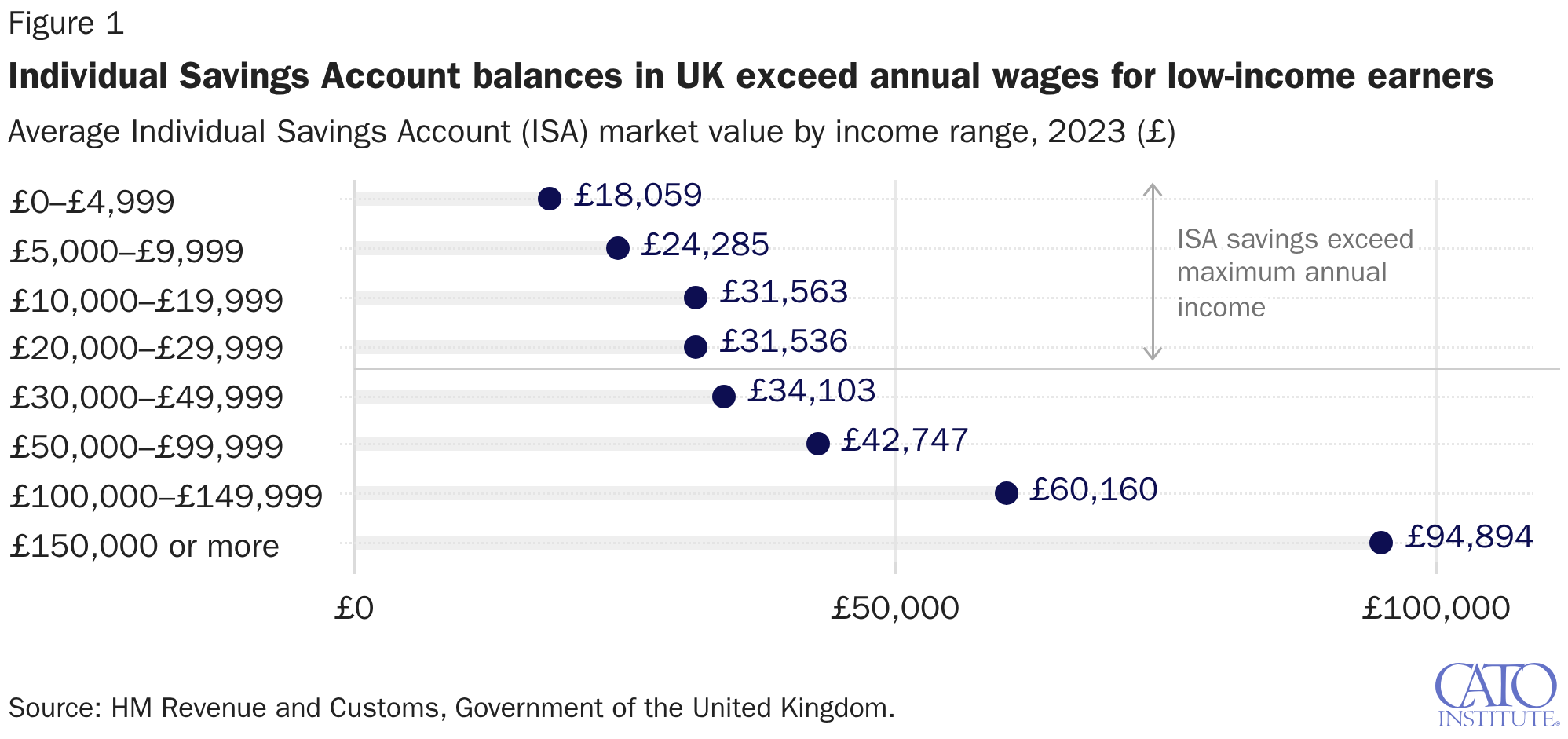
The United Kingdom’s Individual Savings Accounts (ISAs) illustrate the appeal of this approach. ISAs allow annual contributions of up to £20,000 (about USD 27,000) with no income limits, and funds can be withdrawn at any time, for any reason, without penalty. The accounts are widely used. Roughly 40 percent of eligible British adults hold an ISA, and contribution rates are higher than for Roth IRAs in the US.21 More than 60 percent of ISA holders earn less than £30,000 annually (about USD 40,500), and, as Figure 1 shows, lower-income households tend to hold more in ISAs relative to their income than higher earners.22 Average ISA market value exceeds annual income for the first four income groups. These patterns suggest that simple accounts that allow easy access can attract broad participation without the need for targeted subsidies or restrictions.
Canada’s Tax-Free Savings Accounts (TFSAs) provide similarly strong evidence. Introduced in 2009, TFSAs allow after-tax contributions, tax-free growth, and unrestricted withdrawals. Canadians can make annual contributions of up to CAD 7,000 (around USD 5,100) in 2026. Beginning at age 18, yearly contribution limits can be rolled over to future years, so an eligible person who was at least 18 in 2009 and opens an account in 2026 for the first time could contribute up to CAD 109,000 (around USD 80,000) in the year he opens the account.23
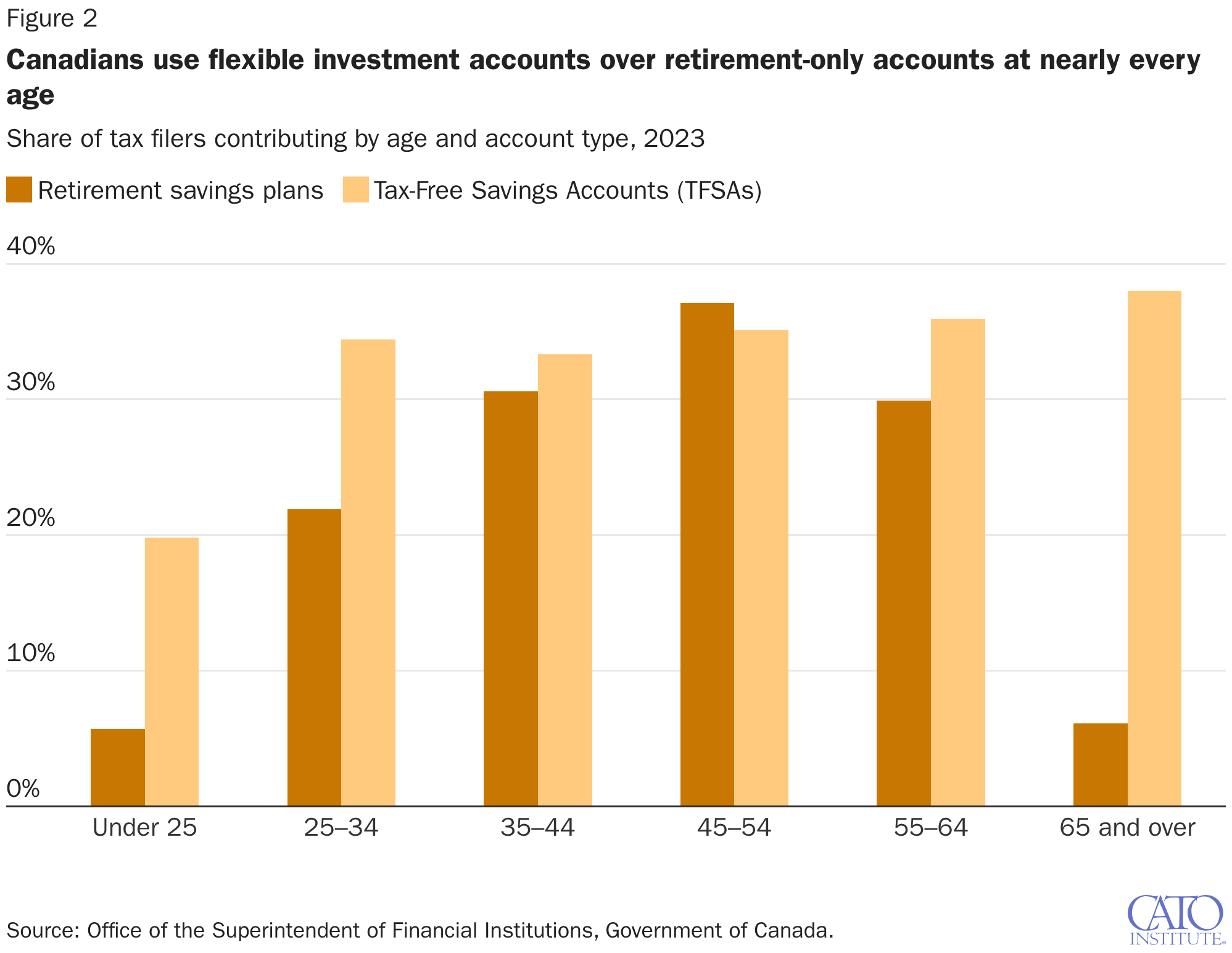
Thanks in part to strong private financial institution support and marketing, participation has grown rapidly, with 62 percent of Canadian tax filers holding an account in 2023, up from 42 percent in 2013.24 TFSAs are especially popular among younger and lower-income savers, who value the ability to access funds for unforeseen events that may strain their other available resources. Figure 2 shows this clearly: For nearly every age bracket, TFSA contribution rates exceed dedicated retirement savings rates. The gap is largest for the youngest savers, and shrinks until retirement age. Strikingly, annual TFSA contribution rates are fairly consistent across taxpayers aged 25 and older.25
The TFSA data also show that even very low-income households maintain meaningful balances, often exceeding their annual income.26 The accounts function as both long-term savings vehicles and short-term financial buffers, improving financial resilience for Canadians at every income level.
Should the Government Subsidize Savings?
Qualified savings accounts remove an existing tax penalty on saving. Trump Accounts go further through direct government subsidies of $1,000 per child. Proponents often justify this subsidy with a simple argument: If equities earn a 9 percent nominal return on average and the government can borrow at 4 percent, then the government can effectively arbitrage the difference by financing long-term investment through household accounts.
This argument misunderstands the nature of financial returns and the constraints of public finance.
First, higher returns come with higher risk. Higher stock returns compensate investors for uncertainty, whereas government borrowing must be repaid regardless of the outcome. Financing a $1,000 transfer with debt shifts that risk; households benefit from the upside when returns are high, but taxpayers remain responsible for servicing the debt regardless of investment performance. The policy does not so much create new wealth as redistribute risk across time and among taxpayers, with no guarantee that returns will exceed borrowing costs.
Second, market returns and borrowing costs are not fixed. If the government borrows to fund private investment accounts, it can push up interest rates and reduce private investment, shrinking any supposed advantage.27
The argument also runs counter to the government’s intertemporal budget constraint, which dictates that the government must repay what it borrows by raising future taxes or cutting spending elsewhere. These costs are immediate and certain, while any investment gains are uncertain and deferred, reducing the real benefit of the subsidy. This fiscal exposure is not limited to the initial $1,000 contribution (which the Joint Committee on Taxation estimates will be about $3.5 billion a year).28 Once established, such programs create a clear political incentive to expand the subsidies over time.
A related issue is that the policy effectively substitutes public saving for private saving. If households treat the $1,000 contribution as part of their lifetime wealth, they may reduce other forms of saving or adjust consumption accordingly. In this case, the program does not increase aggregate capital formation but instead reshuffles the composition of saving, especially among lower-income households, with the government borrowing to fund assets that would have been accumulated anyway. Unlike tax-preferred savings incentives, a lump-sum transfer does not affect the relative price of current versus future consumption and therefore does not directly change an individual’s marginal incentive to save.
Policies that explicitly encourage or subsidize new savings can leave many households worse off. The Trump Account structure could lend itself to future expansions that add explicit saving subsidies, similar to the existing Saver’s Credit.29 Existing proposals, such as the 401Kids Savings Account Act, would add a government savings match for some low-income taxpayers.30 As retirement scholar Andrew Biggs has extensively documented, low-income workers who are automatically enrolled in retirement plans may offset new contributions by increasing borrowing or reducing other forms of saving. The result is that gross retirement balances rise, but net household wealth can decrease. Meanwhile, households may face greater risk in case of emergencies, due to reduced access to liquid assets.31 Even policies that encourage saving among young workers with future high earning potential induce suboptimal life-cycle consumption patterns.32 When the government subsidizes saving, it makes people poorer.
Will Trump Accounts Replace Social Security or Create an Ownership Economy?
One of the more ambitious defenses of Trump Accounts refers to political culture rather than direct fiscal policy. Treasury Secretary Scott Bessent called Trump Accounts “a backdoor for privatizing social security.”33 Economist Alex Tabarrok echoed this view, suggesting that “the accounts could reduce reliance on Social Security” and offset some of the fiscal cost of the new program.34 The implication is that private wealth accumulation could gradually displace the need for public retirement benefits, thereby enabling reform.
That argument overstates what these accounts can plausibly do. Trump Accounts are legally and financially disconnected from Social Security. They do not alter Social Security’s benefit formula, payroll taxes, or retirement age. They simply create a new savings vehicle alongside the existing pay-as-you-go system. Bessent himself later clarified that the accounts would “supplement” rather than replace Social Security.35
The political case is weaker still. The US already has a large and long-standing system of private retirement savings. In 2024, 70 percent of near-retirement households had a private retirement account, and the growth of 401(k)s and IRAs over several decades has not produced meaningful momentum for scaling back Social Security.36 Older Americans are the most financially secure age cohort, with the most lifetime market exposure, yet as beneficiaries of the current system they also remain among the most vocal opponents of Social Security reform.37 Given that track record, there’s little reason to believe a new federal transfer program will reduce existing popular transfer spending without a specific policy trigger.
A more general argument is that Trump Accounts will “mint a new generation of capitalists” and create “an ownership economy.”38 While stock market participation and wealth building are worthy goals, there is little evidence, domestically or internationally, that publicly or privately funded investment accounts have a meaningful positive effect on people’s views of the market or the capitalist system. For example, adoption of 401(k) plans has increased significantly over the past several decades, while Americans’ positive views of capitalism have declined.39 The country of Chile tells a similar story. After more than four decades of mandatory private investment accounts, Chileans did not become enthusiastic capitalists. In 2021, they elected a socialist who promised to “bury neoliberalism.”40 The private pension system itself was the top grievance in the 2019 mass protests, and in 2025, Chile’s Congress overhauled it to increase the state’s role.41 Australia’s compulsory superannuation system offers a similar lesson, with almost two-thirds of Australians reporting a moderate or high sense of grievance that the economic system is rigged to benefit the wealthy.42
Reforms
Trump Accounts point in two directions: one toward a simpler, more flexible savings system that can set more Americans up for financial success, the other toward expanded welfare and additional complexity. Reform should follow the first path.
The core innovation of the Trump Account is not its tax treatment but its structure. It allows childhood investment accounts that can receive contributions from multiple sources. Those features are worth expanding upon. The government subsidy is not. Direct government contributions do not reliably increase aggregate saving, require restrictive rules to prevent misuse, and pose unnecessary fiscal risks, especially if subsidies expand over time. Eliminating the subsidy would allow the accounts to be simplified and repurposed as flexible savings vehicles rather than conditional transfer programs.
A reformed system should retain the early-life account structure while removing the features that generate complexity and distortions. Families, employers, and charitable organizations should be allowed to contribute to accounts established at birth. All contributions could be made on a pre-tax basis, deducted by the contributor, with funds accumulating tax-deferred and taxed at ordinary income tax rates upon withdrawal. Because all funds are ultimately taxed, this structure simply defers taxation and allows resources to be more flexibly shared across generations.
The key design choice concerns access. The simplest and most economically neutral approach is to allow full flexibility, permitting families and beneficiaries to determine how and when funds should be used. Removing age and use restrictions would eliminate the need for penalties, reduce administrative burdens, and ensure that savings can respond to changing household needs. However, to encourage contributions from employers and third parties, a limited lockup period—such as restricting access until age 18 per current Trump Accounts—may be a reasonable compromise. After that point, funds should be fully liquid, with no penalties or restrictions on their use.
Upon the beneficiaries reaching adulthood, the accounts could transition into a Universal Savings Account that allows continued tax-deductible contributions from any source and unrestricted withdrawals. Investment options should be unrestricted after the transition to the Universal Savings Account. This would preserve the original goal of encouraging early saving while aligning the account with a neutral, simplified framework in adulthood. The accounts could also be designed like the Universal Savings Account proposed by Sen. Ted Cruz (R‑TX) and Rep. Diana Harshbarger (R‑TN) to allow after-tax contributions and tax-free withdrawals (Roth treatment).43 However, the traditional (tax-deferred) structure would maintain consistency with the existing Trump Account rules to the greatest extent possible.
Congress has taken modest steps toward flexible emergency savings within the employer-sponsored retirement system. The SECURE 2.0 Act of 2022 created pension-linked emergency savings accounts (PLESAs), which allow lower-income employees to make after-tax contributions of up to $2,500 to a sidecar account linked to their employer’s retirement plan, with penalty-free withdrawals permitted at any time.44 This new tool reflects bipartisan recognition that rigid withdrawal rules reduce participation and leave households worse off during financial shocks. However, the sidecar is narrow in scope, limited to the employer-sponsored context, and leaves untouched the broader architecture of penalties and use restrictions that discourage saving among households without access to workplace plans. If anything, it simply adds more complexity to the system. PLESAs are a useful proof of concept for a more meaningful, flexible savings plan such as Universal Savings Accounts.
A broader reform could extend the logic of Universal Savings Accounts to all qualified accounts. The current system of more than a dozen special-purpose accounts should be consolidated into a small number of neutral, general-purpose investment vehicles. A streamlined system could include a Traditional Retirement Account and a Roth Retirement Account with a combined annual contribution limit (e.g., $40,000 per individual, plus employer contributions), alongside a Universal Savings Account with a modest annual cap of $10,000. These accounts should be individually owned, portable across jobs, and free of the overlapping restrictions and nondiscrimination rules that overly complicate current law.45 Existing accounts could be grandfathered, with new contributions directed into the simplified system and optional rollovers allowed over time.
This approach builds on a proposal in former President George W. Bush’s fiscal year 2005 budget to consolidate existing accounts into a simplified system of Retirement Savings Accounts for long-term saving, Lifetime Savings Accounts for unrestricted use, and Employer Retirement Savings Accounts for workplace plans.46 By maintaining an employer-sponsored retirement plan, the proposal recognized that the existing 401(k) system is intertwined with complex labor and tax laws, including nondiscrimination testing, coverage rules, and fiduciary requirements under the Employee Retirement Income Security Act of 1974 (ERISA).47 These rules are intended to shape employer behavior, but in practice they add significant complexity, limit flexibility, reduce access, and make it difficult to integrate employer-sponsored plans into a fully individual, portable system. Although true simplification requires separating the savings account system from government rules designed to shape individual or business behavior, the 2005 proposal would nonetheless represent a significant step toward that end.
The organizing principle of these reforms is neutrality and simplicity. Rather than layering new subsidies and restrictions onto an already complex system, the tax code should allow individuals to save for their own priorities with minimal economic distortion. By eliminating government-funded contributions and replacing special-purpose accounts with flexible alternatives, policymakers can expand access to savings while reducing complexity and improving economic efficiency.
Citation
Michel, Adam N. “Improving Trump Savings Accounts,” Policy Analysis no. 1019, Cato Institute, Washington, DC, June 9, 2026.

About the Author


This work is licensed under a Creative Commons Attribution-NonCommercial-ShareAlike 4.0 International License.