It certainly seemed like a great story.
Jordan Fischer, an investigative journalist at WUSA9, probably thought he’d struck gold. President Trump had federalized the DC police force and sent the National Guard into the capital. And there it was: hard data that appeared to show this was having a devastating impact on the DC restaurant industry.
OpenTable tracks seated restaurant reservations across its platform in top global cities—creating what they call a daily “state of the industry” measure. Analysts tracked it closely during the pandemic. And its contemporary numbers looked stark. From August 11th, the date the President announced his takeover, DC reservations had plunged against the same calendar date a year ago. In fact, across the first week of DC’s policing militarization, restaurant attendance was down a huge 24 percent compared to the equivalent week in August 2024, bottoming out at a massive 31 percent below last year’s reservation levels on August 13th.
For those opposed to the President taking control of DC’s police, it was apparently easy to imagine that a quarter to a third of DC’s highly political, 90+ percent Democratic population of diners would be scared witless of seeing Humvees and khaki patrols on their streets. And what about tourists? Narratives soon developed that they’d be terrified of checkpoints, counter-protests, and the sight of boys in uniform too.
Some restaurateurs, no doubt sincerely upset at the policy, were more than happy to confirm the tale: Trump’s takeover, they said, was causing diners to cower at home and cancel their reservations and trips. In short order, the talking point about a devastating impact on restaurants was semi-viral on X. Anecdotal reporting of struggling restaurants and bars (in August) buttressed the coverage. Meanwhile, the country’s most prestigious newspapers had put their own reporters on the case to produce different versions of the same story, all based on the hook of the OpenTable data.
There was just one problem: the figures were highly misleading, comparing apples to oranges. In fact, they told us nothing about whether Trump’s policy was having an impact on restaurant reservations. Yet rather than dig deep to examine whether the claims were valid or just in-line with the journalists’ biases, many scribblers were only too willing to amplify the idea that Trump had caused a restaurant meltdown, even when it became obvious this wasn’t the case.
Living and working in the district, I was highly skeptical of these reports of a sharp downturn in restaurant attendance, on aggregate. Nobody I know has expressed fear of going out for dinner. In fact, I know a few whose families from outside DC said they want to visit because of the police presence. And restaurants near me didn’t look so much emptier. So, I pondered whether something kooky had affected last year’s baseline, making the subsequent decline during the takeover week look more dramatic than the underlying effect of the President’s decision. My first thought was a major conference or tourist event in 2024 inflating restaurant numbers—this is DC after all.
It didn’t take much digging to discover that, from August 12th to August 18th, 2024, over 350 eateries in the DC metro area had taken part in the twice-annual “Restaurant Week.” The promotional event, run during the quieter periods of winter and summer, has restaurants offering multi-course meals at fixed prices. The whole point is to boost restaurant attendance.
Crucially, this year’s Summer Restaurant Week came a week later than 2024’s. So when reporting the restaurant reservations drop for the first week of Trump’s takeover, journalists had used data comparing a non-Restaurant Week in 2025 to a Restaurant Week in 2024. That made the assumed “Trump effect” on reservations a statistical illusion.
OpenTable themselves seemed aware of this confounding variable. Responding to journalists, they’d also provided week-to-week data showing only a 7 percent decline in the first week of Trump’s takeover against the week before. That’s already much smaller than the year-on-year figure, but the possible “Trump effect” shrinks even further knowing that restaurants always tend to be quieter later in August given returns to school. And since the week in question was immediately before Restaurant Week, we might expect some people to forgo eating out to save for the coming promotional discounts too.
Sure enough, when Restaurant Week 2025 kicked off on Monday August 18th, DC attendance was up 29 percent from the same date last year—the final day of last year’s Restaurant Week. Throughout the rest of Restaurant Week 2025, in fact, attendance was up year-on-year between 11 and 31 percent, depending on the date. At the very least, this showed that Restaurant Week is good at drumming up business, so damning the tale of a large decline because of Trump’s police takeover.
Fischer, to his credit, had the integrity to amend his original story on August 21st, as the Restaurant Week effect became clear. But his initial instinct was to report the Monday 18th figure uplift as if it were a response—a “show of support” for the restaurant industry struggling under DC’s military takeover—rather than an effect of the promotion that happens every year and which distorted his original narrative. Perhaps unsurprisingly, given local opposition to Trump’s policy, news that the President probably hadn’t savaged restaurant attendance in the city didn’t get the same fanfare online, and the old factoid continued to be shared.
Major newspapers even continued pumping out their own versions of the original story, still using the cause-and-effect narrative blaming Trump’s DC takeover. The Washington Post noted the Restaurant Week timing issue in its story on the subject but nevertheless attributed the decline to Trump’s policies like it was an assumed conclusion. (I responded with a letter to them.)
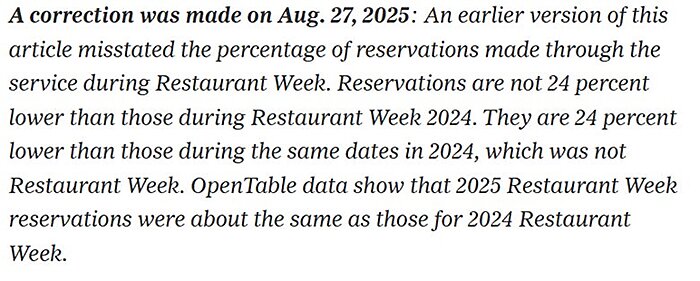
The New York Times was worse still, incorrectly declaring that reservations this year were “24 percent lower than those during Restaurant Week 2024, held the same time last year.” After several tweets and notifications from me about this inaccuracy, they issued a correction online—now citing just the 7 percent week-on-week figure alone in the article. [At the time of writing, the correction continues to bungle the details of when Restaurant Week 2024 took place (see below)].
The story, though, has stuck, in part because of its propagation from people with big followings.
Peter Baker, the NYT’s White House correspondent, tweeted the original Fischer piece on August 19th, earning 1.4 million views. After many, including me and—more prominently—the White House, pointed out the issue with the data, he failed to clarify, amend or delete the tweet.
Eventually, he did a follow-up saying that Fischer had updated his piece as restaurant numbers “rose again” as 2025 Restaurant Week began. But, again, this implied the figures were driven by customer responses to struggling restaurants, rather than Restaurant Week timing.
Remarkably, now fully aware of the issue, Baker then just repeated the original claim of a 24 percent decline again in sharing the NYT’s version of the story on August 26th. A raft of other outlets, including the Bulwark, repeated it, invoking the NYT’s authority. Baker’s new tweet alone has almost 200k views again.
And so, this yarn spread uncritically, bar some tweets from me, until the White House railed against the “fake news narrative.” But even now that the main evidence used for these conclusion has been disproven, newspapers have largely kept their original stories and headlines about Trump’s takeover causing a downturn, based on nothing more than a handful of anecdotes from DC restaurant managers and owners.
At one level, I get it: we’ve all been guilty of motivated reasoning. There are a host of strong policing and civil liberties arguments against Trump’s militarization, but it’s oh so tantalizing to presume that all bad things must go together.
As Nate Silver has implied, it’s not crazy to assume, either, given the DC population’s ideological priors, that there could be a negative effect on restaurant attendance from the National Guard being here.
A quarter to a third of diners, though? C’mon! That doesn’t pass the smell test. And an effect that large simply wasn’t ever supported by any analysis of the data that considered the timing. Precisely because DC is an ideologically homogenous echo chamber, journalists should have been especially cautious of the figures.
Faced with conflicting evidence, humans are prone to grasp at straws for a reason to ignore it (hence the ‘rallying to support the restaurant industry’ theory when the strong August 18th data came out). It’s a depressing example of how false narratives can stick whatever the evidence shows. My own inbox is full of people angry at me for “defending Trump” for pointing this out, rather than seeking truth on this issue.
For what it’s worth, it’s still plausible to me that there might be smaller depressive effect on restaurants of Trump’s policy! Reservation numbers for the three days after the first Restaurant Week 2025 were still up 13 percent, 1 percent, and 10 percent year-on-year. That alone shows no devastating hit so far. But, perhaps because of these premature stories, 230 of the 380 restaurants participating in Restaurant Week extended the promotion a second week, which is likely to lift reservations somewhat, albeit with less success than the first week. Because of the extension, we’ll only get non-restaurant week to non-restaurant week comparisons starting September 1st.
What we can say with confidence, however, is that so far, there’s no hard evidence that Trump’s crackdown is systematically hurting DC restaurants, and especially not on the scale originally reported. Buttress this with other data that implies DC diners were already spending less out this year, hotel occupancy rates are only being modestly down from last year (and still in line with national trends), and Destination DC saying no major events and conventions have been cancelled, and the doomsday narrative just doesn’t hold.
None of this, sadly, has slowed the misleading statistic’s spread, which continues apace. In fact, this whole sorry episode is a good case study in how fake—or at least very misleading—news spreads and sticks when politics brain is involved. The original claims chimed with what many people believed, and when shown to be misleading, well, it was only too easy to use anecdotes or whataboutery.
About the Author
