While war with Iran continues fitfully in the Middle East, archaeologists have recently discovered a new reason for focusing on that ancient country. In the hills of western Iran at a site known as Tapeh Tyalineh, archaeological digs have uncovered a treasure trove of thousands of artifacts that reveal much about the long-distance trade of 5,000 years ago.1 These artifacts, including 7,000 seal impressions related to “exchange, accounting, administration, and storage,” tell us a great deal about how trade was administered in the early Bronze Age and about the lengths to which our species has long been willing to go to organize and engage in trade. Archaeologists have concluded that the human settlement at Tapeh Tyalineh was engaged in trade with more than 150 merchants throughout Western Asia.2
The extent to which these ancient Iranians went to facilitate trade far and wide is worth recalling now, as the disruptions to trade and the other spiraling repercussions for the global economy caused by the American and Israeli war against Iran—including the largest oil shock in history—are distorting and undermining commerce everywhere.3 Added to this is the arbitrary avalanche of tariffs and other trade barriers that have been imposed by the US since Donald Trump’s return to the White House. On April 2, 2025, not long after beginning his second term, President Trump, in violation of international trade law and US treaty commitments as a member of the World Trade Organization (WTO), announced steep and sweeping global tariffs on imported products from nearly all countries.4 He called them his “Liberation Day” tariffs, and they were only the beginning. More and more tariffs have since been applied by the US, both globally and on individual countries and their products, even as some of Trump’s supposedly “reciprocal” tariffs have been overruled by the Supreme Court.5
Such recollection is helpful because some of the US’s once-leading trading partners are now, like the ancient Iranians of Tapeh Tyalineh, going to great lengths to tilt their trade policies toward more trade with the rest of the world. Apart from Canada and China, few US trading partners retaliated with tariffs of their own. Quite the contrary: Where the United States has embraced trade coercion, many of its trading partners have heightened their trade cooperation, leading to further economic integration that excludes the US.6 Where the US no longer even tries to hide its protectionism, many US trading partners are mostly maintaining their commitments to further trade liberalization and concluding new trade agreements to achieve it—agreements that exclude the United States (Figure 1).7
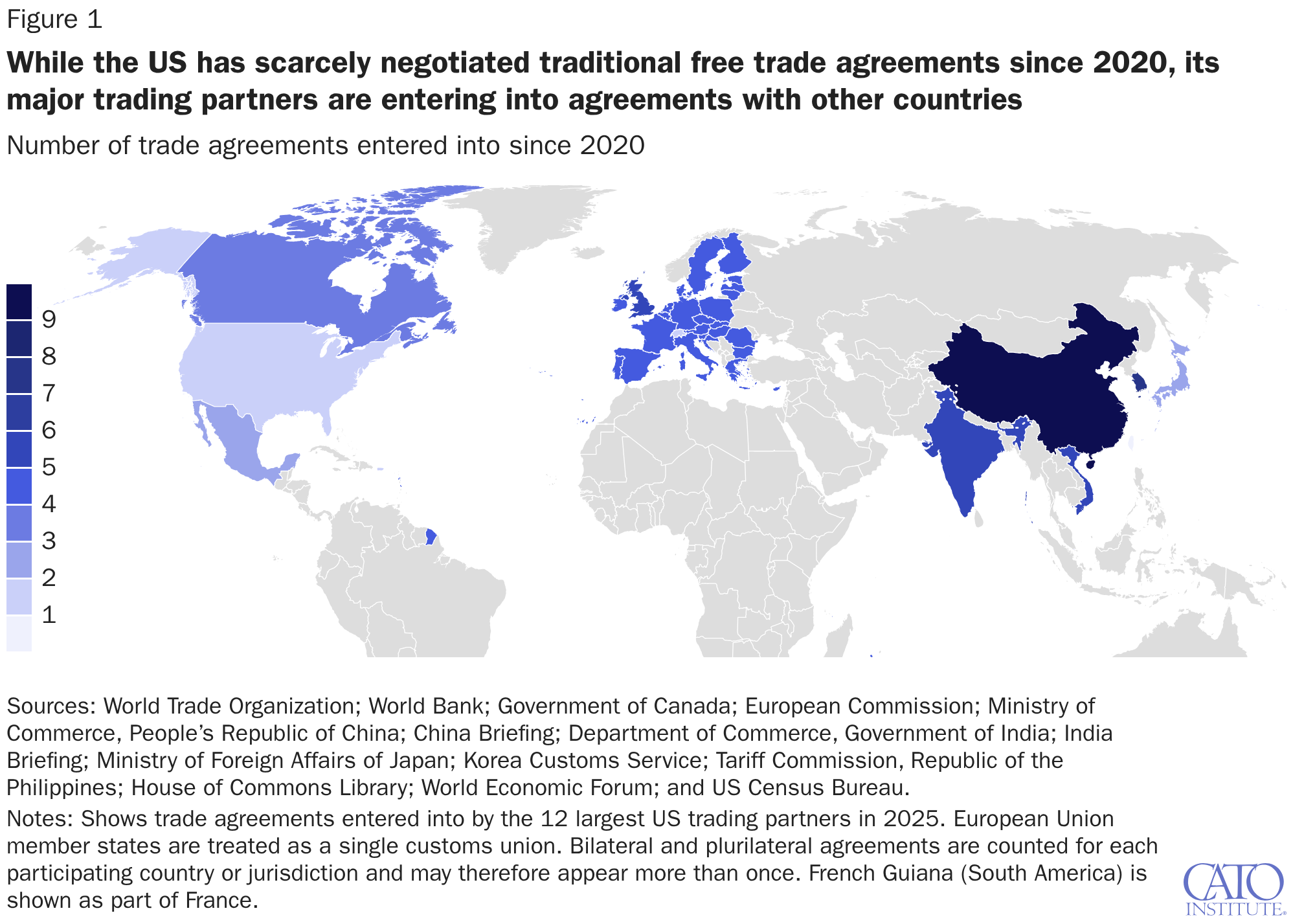
Intense American media and political focus on President Trump’s unpredictable trade maneuvers has largely obscured “a broader trend of increased global integration outside the US.”8 In regional trade agreements involving the European Union (EU), India, Latin America, Africa, and the trans-Pacific, to name only a notable few, there is abundant evidence of attractive markets outside the US, and countries that could be trading more with the US are looking elsewhere for opportunities to advance their economies through increased international exchange of goods and services. Rather than showing the rest of the world the indispensability of access to the American marketplace, the Trump tariffs, together with the general uncertainty created by his constant chaotic changes to them, are encouraging other countries to reduce their trade with the US and find desirable markets elsewhere. As a result, the long-standing centrality of the American economy to the global economy—taken for granted by many Americans—seems to be diminishing by the day.
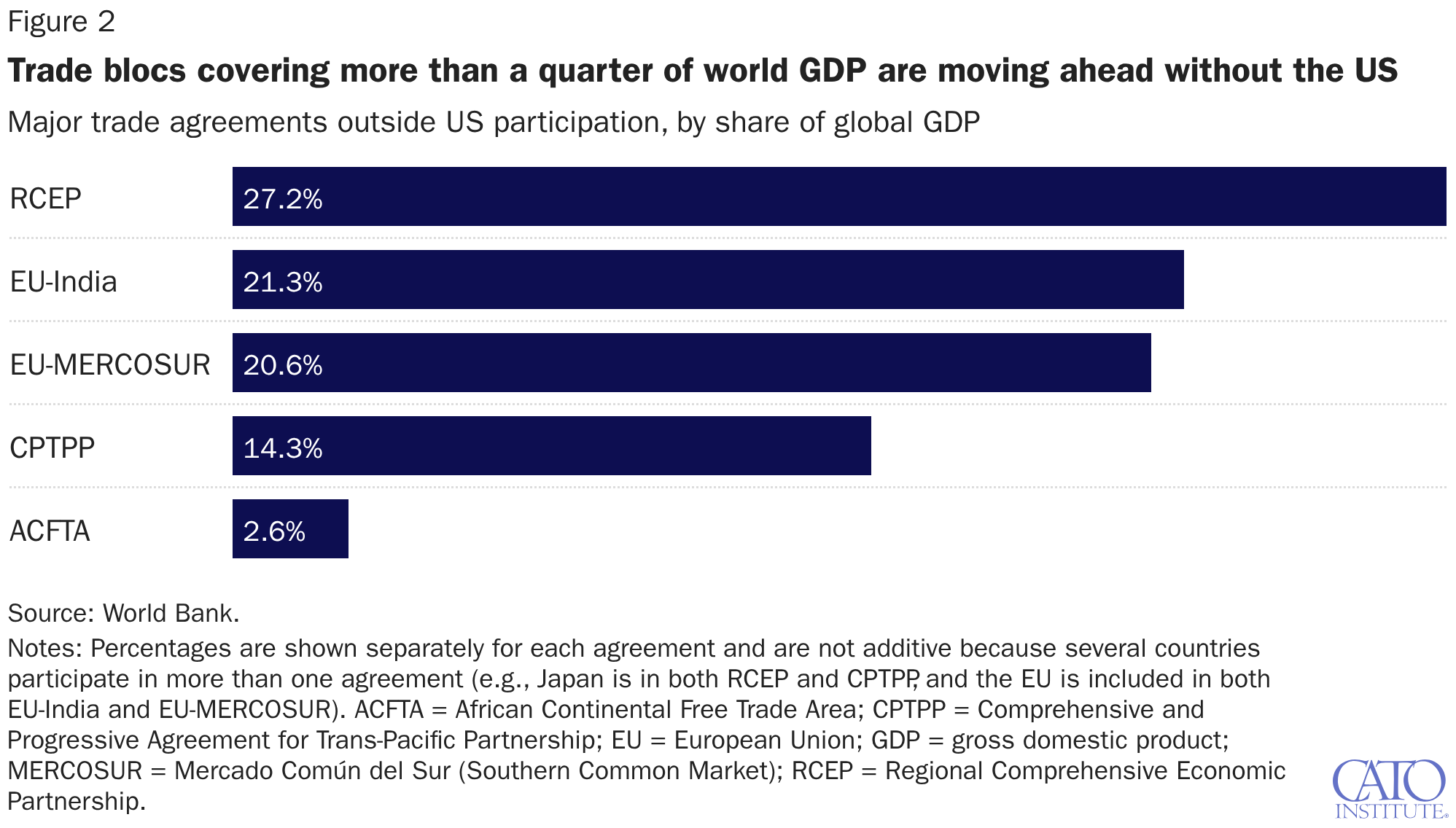
Several examples of new and evolving trade arrangements between other groups of countries that do not involve the US are evidence of this new Trump-caused trend in world trade. It’s a trend that seems bound to gain momentum in the absence of any sign the US intends to return to its historical bipartisan policy of lowering tariffs and other barriers to trade and upholding the international rules of trade that find their most important expression in the rule-based multilateral trading system of the WTO. Although numerous examples could be cited, this trend is amply evidenced in the new trade agreement between the EU and India, the new trade agreement between the EU and the MERCOSUR (Mercado Común del Sur, or Southern Common Market) countries of South America, new trade agreements involving MERCOSUR and other Latin American countries, the implementation of the African Continental Free Trade Area (ACFTA), and the ongoing evolution of the Comprehensive and Progressive Agreement for Trans-Pacific Partnership (CPTPP) (Figure 2).9
Like those of Tapeh Tyalineh, the seals of these deals extend far and wide and, unless there is a significant change soon in US trade policy, could herald a new and less American shape for the world economy. We might come to think of it as the other Liberation Day—the liberation of the rest of the world from much of their historic trade with the United States.
The India–European Union Free Trade Agreement
India has recently surpassed China as the world’s most populous country. There are nearly 1.5 billion Indians, all of them potential customers for American goods and services. The Trump administration has not ignored the potential of the Indian market, which is the fourth largest in the world. With Trumpian fanfare, the conclusion of negotiations on a bilateral trade deal between the two countries was announced in January 2026. But there is much less to this US-India deal than it may seem. It could vanish at the social media whim of America’s mercurial president, and India has been delaying its implementation due to yet another new threat of punitive US trade restrictions on Indian imports. The deal also pales in comparison commercially to a much more ambitious and comprehensive bilateral trade agreement concluded recently by India with the EU.
The US has trumpeted that its deal will lower tariffs on imports of Indian products to 18 percent, a significant reduction from the astronomical 50 percent tariffs imposed on those imports on Liberation Day. But this would still be about six times higher than US tariffs on Indian imports in 2024, the year before President Trump’s return to the White House—not that much of a deal for India.10 And what’s in it for the US? India says it will eliminate or reduce tariffs on imports of a wide range of US products. However, there is no published agreement, so it is unclear how extensive these tariff cuts would truly be.
Importantly, mutual frustration with US trade bullying has inspired India and the 27-member EU to go around Washington and, after 20 years of trying, conclude their own deal. It creates the world’s largest free trade zone, encompassing two billion people and almost 25 percent of global gross domestic product (GDP).11 Expected to take effect later this year, the EU-India free trade agreement (FTA) has much more clarity, depth, and certainty of effect than the pending deal between the US and India. The total trade coverage of the EU-India FTA is 96.6 percent for India and 99.3 percent for the EU. And, unlike the US deal, the EU deal is rooted in law as a binding international treaty, not written in what could be disappearing ink.
My Cato colleague Colin Grabow has looked closely at both deals and has concluded correctly:
The available details strongly suggest that the EU emerged with a more liberalizing, durable, and economically sound agreement. By contrast, the US-India arrangement appears narrower in scope, less certain in effect, and more deeply rooted in a mercantilist mindset that treats imports as a problem rather than a benefit.… European negotiators obtained extensive market-opening commitments from India while also liberalizing access to Indian goods. The agreement is broad in scope, legally binding, and built around the premise that trade creates value on both sides of the border. The United States, by contrast, appears to have accepted a less durable arrangement that prioritizes export gains—many of them uncertain—while maintaining significant barriers against Indian imports. There is little the American side seems to have obtained in terms of durable market access that Europe did not, and a great deal that Europe will enjoy that Americans will not.12
Amid the continuing capriciousness of the Trump trade policy, and despite the often coercive economic pressures being applied by the US on its trading partners, countries that still wish to enhance their prosperity by deepening and broadening trade ties beyond their own borders are increasingly ignoring US intimidation. To be sure, multilateralism in trade is on the defensive, and the future of the multilateral, rule-based world trading system under the auspices of the WTO is in question. Yet this does not mean all other countries have abandoned the multilateral goal of freeing trade.
Instead, at least for now, other countries are pursuing the goal of further trade liberalization piecemeal and cumulatively through an ever-increasing array of new bilateral and plurilateral trade arrangements. The EU-India deal, for one, “demonstrates how countries are adapting to new global realities to liberalise trade.… Instead of steering away from free trade, countries are becoming selective and seeking bilateral arrangements with strategic partners.”13 In addition to the traditional goal of reaping the economic gains from freer trade, countries are also motivated to conclude these new agreements to safeguard supply chains and maintain economic security in a world economy decidedly less predictable than it was before Donald Trump’s ascendancy.
The European Union and Latin America: The MERCOSUR Partnership Agreement and More
The EU is looking not only to India to diversify its trade and enhance its trade opportunities. As the US becomes a less reliable trading partner, and as European markets are inundated with a flood of Chinese products diverted there because of the ongoing US-China trade conflict, the EU is also looking, among other places, to South America for more and better markets. In January 2026, following a quarter of a century of on-and-off negotiations, the EU and four of the countries in the South American trade bloc known as MERCOSUR—Brazil, Argentina, Uruguay, and Paraguay—concluded a new trade agreement that will “create one of the largest free-trade zones in the world, connecting markets with more than 700 million people.”14
By the terms of this agreement, MERCOSUR will end tariffs on 91 percent of EU exports, and the EU, in turn, will eliminate tariffs on 92 percent of MERCOSUR exports.15 In particular, the EU is expected to ship significantly more automobiles, machinery, and pharmaceuticals to the MERCOSUR countries, while they are expected to ship more agricultural products and raw materials to Europe. Two-way trade in services is likewise expected to increase. In announcing the agreement’s conclusion, Ursula von der Leyen, president of the European Commission, gave voice to a view that remains widespread and is the very opposite of Trumpian mercantilism: “Our message to the world is this: Partnership creates prosperity, and openness drives progress.”16
Some groups within the EU have long been wary of additional economic integration with South America, and in a close vote, the European Parliament referred the deal to the European Court of Justice for review, which could have delayed its implementation for two years.17 The European Commission has nevertheless provisionally applied the agreement as of May 1, 2026, creating a trading bloc of more than 770 million consumers.18 Meanwhile, within MERCOSUR, Argentina, Brazil, Uruguay, and Paraguay have all ratified the deal.19 Bolivia, which did not participate in the negotiations, may be able to join later.20 After 25 years, it looks as though those who have long sought this deal on both sides of the Atlantic Ocean have succeeded at last, with the imminent prospect of important economic gains for all the countries involved.
This is not the only new trade agreement involving countries in Latin America—but not the US—that has been concluded or is in the making. Last year, MERCOSUR concluded a new trade agreement with the European Free Trade Association, which comprises the non-EU states of Iceland, Liechtenstein, Norway, and Switzerland.21 MERCOSUR has officially launched negotiations with Japan on a new economic partnership and is discussing a free trade agreement with Canada.22 In 2025, Chile and the EU concluded a new trade agreement.23 The EU and Mexico have modernized their long-standing trade agreement to eliminate tariffs on nearly all food exports and further expand their economic ties.24
While the new trade deal between the EU and MERCOSUR has finally been falling into place, and with other negotiations and deals on Latin American trade not involving the United States proceeding, what has the Trump administration been doing to increase trade with its neighbors in the Western Hemisphere? Not much. Indeed, it is doing more to decrease that trade than increase it. Most shocking is the president’s treatment of the US’s two leading trading partners, Canada and Mexico. The US has chosen not to renew the United States-Mexico-Canada Agreement for another 16 years, which triggers instead an annual review process that will continue to 2036.25 Long and labored negotiations await, and there is now a pervasive uncertainty that will constrain mutual trade and investment in North America. According to Trump, “We don’t need anything that Canada has; we don’t need anything that Mexico has.”26 The illusion of the possibility of autarky deludes the White House.
Farther south in the hemisphere, the policy of the Trump administration has been characterized less by commercial engagement than by bellicosity, including a return to the gunboat diplomacy of a century ago with military intervention in Venezuela and military actions in the Caribbean. Trump has expressed special animosity toward the government of Brazil for its prosecution of his authoritarian friend, former Brazilian President Jair Bolsonaro, manifested in the levy of 50 percent tariffs on Brazilian imports—not quite the same as the European approach. The US has signed a new trade deal with Argentina that trims a lot of tariffs, but, as Grabow has pointed out, the deal “amounts to a narrow framework rather than a full-fledged free trade pact. Many Argentine exports remain subject to Trump’s misnamed ‘reciprocal’ tariffs, and Argentina’s commitments fall well short of the access the EU has secured.”27 Beyond this, the Trump administration has not shown much interest in South American trade. Meanwhile, South America’s largest trading partner, even with the expected new access for the EU, remains China.28
Africa and the African Continental Free Trade Area
The recent US approach to trade relations with Africa has been equally inadequate, especially when compared to the actions of other countries trying to prosper from commercial engagement with that continent. Belatedly, the US Congress enacted, and President Trump signed into law in February 2026, an extension of the African Growth and Opportunity Act (AGOA), which provides duty-free access for African products to the US market.29 But the extension was for only until the end of 2026, perpetuating uncertainty and diminishing the US’s reputation as a reliable trading partner. Further diminishing the importance of the AGOA extension is that these African countries remain subject to the 10 percent global tariff the president imposed following the Supreme Court’s decision overruling his earlier round of “reciprocal” tariffs.30 While this second round of global tariffs expired on July 24, 2026, three AGOA beneficiaries—Angola, Nigeria, and South Africa—are now subject to 12.5 percent tariffs for their alleged failure to prohibit imports of goods made with forced labor.31
American trade skeptics might ask: Why does this matter? Most African countries are impoverished, aren’t they? Twelve of the 20 countries with the world’s fastest growth rates are in Africa.32 Africa is projected to become the second-fastest-growing part of the world after Asia. But while Asia’s population is predicted to soon begin declining, Africa’s is expected to continue increasing, reaching 2.5 billion by 2050. Total business and consumer spending in Africa will be $6.7 trillion by 2030. Africa’s role as a source of production and consumption, not to mention energy and many critical minerals, is bound to continue expanding. Countries in other parts of the world, including the United States, cannot afford to be sidelined from Africa in the global search for trade, investment, and numerous other commercial opportunities.
Adding significantly to the African market’s appeal are efforts by 54 member countries of the African Union to implement their agreement on an African Continental Free Trade Area (ACFTA). The ACFTA’s overall goal is to establish a single market that will be the world’s largest free trade area in terms of the number of countries it comprises. With an internal market of 1.4 billion people and a combined GDP of $3.4 trillion, the ACFTA seeks to boost the current paucity of intra-African trade by eliminating trade barriers, particularly for value-added goods. The ACFTA’s plan includes formalizing and harmonizing customs and customs procedures, eliminating the inefficiencies of red tape, improving supply chains and making them more sustainable, and establishing common external tariffs to create a more predictable business environment that will encourage more trade and investment. This agreement has the potential to become a catalyst for Africa-wide change that will create more and better jobs, establish regional value chains, attract foreign direct investment, and stimulate economic development.
As noted in the United Nations Economic Commission’s Economic Report on Africa 2025, there is abundant empirical evidence of the ACFTA’s capacity to drive Africa’s trade-led integration.33 The report highlights critical enablers of progress such as investment in infrastructure, digitalization, climate resilience, elimination of energy gaps, reduction of food insecurity, and governance reforms crucial for realizing the agreement’s full benefits. The ACFTA is projected to increase intra-African trade by up to 45 percent in 2045—with notable gains in manufacturing, agro-processing, and services—and raise Africa’s GDP by 1.2 percent.
As with Latin America, other countries—unlike the United States—are not equivocating about pursuing the multitude of potential commercial opportunities on offer in Africa. Foremost among them is China, which is now by far Africa’s leading trading partner. In 2025, Chinese exports to the continent soared by nearly 26 percent to $225 billion, driven by African demand for such manufactured goods as machinery, electronics, and automobiles and other vehicles.34 In turn, Africa primarily exports raw materials such as crude oil, minerals, and agricultural products to China.
Therein lies the opportunity for America to gain a larger share of the market in Africa by providing the Africans what the Chinese are not: an increase in value-added trade in exchange for the raw materials needed by the US. Yet this opportunity is being missed while the Chinese further solidify their leading role in African trade. Just days after the US extended the AGOA for one year, China announced that it would expand its own duty-free treatment to imports from 53 African countries without any time restriction.35 The value to China of its trade relations with Africa will be magnified as the ACFTA is fully transformed from an agreement into a competitive commercial reality that will add to the African market’s global appeal.
East Asia, Southeast Asia, and the Pacific Basin
The fastest-growing part of the world is Asia. Even more than Africa, the United States must be actively and successfully engaged in trade with Asia if it is to continue prospering. In the mercantilist mindset that now prevails, US exports to Asia are desirable but US imports are not, unless they are of critical minerals or most other raw materials that are necessary to the production of American industry. But why would Asian countries want to absorb US exports if they cannot in turn have more access to the US market?
The center of the burgeoning Asian trade boom is, of course, China. As Trump’s misguided “trade war” with China moves toward a second decade, the US is not the only country engaged in Asian trade that sees China as the focus of its trade relations in the region. So, too, do the Asian countries that surround China to the east, south, and southeast. All else being equal, many of these countries, facing the looming leviathan of Chinese economic might and suasion, would prefer to focus on trading with the US. The trade policies of the Trump administration, however, make this difficult, replete as they are with the various forms of scofflaw unilateral trade actions and take-it-or-leave-it intimidation. These Asian countries are thus left with little choice but to play both sides in the US-China trade confrontation.
Asia exemplifies the Trump administration’s overall approach to concluding bilateral trade deals following the Liberation Day “reciprocal” tariffs. As Inu Manak of the Council on Foreign Relations has explained, these are not traditional trade agreements. Rather,
Most are so-called framework agreements that outline areas for future negotiation, while implementing a temporary tariff truce. Those agreements are eventually expected to become finalized reciprocal trade deals, which more closely resemble traditional U.S. trade agreements. Unlike those traditional agreements, Trump’s reciprocal trade deals exclude any role for Congress. Furthermore, all agreements include language that suggests room for constant modification and quick termination. The message is clear: a trade agreement no longer guarantees predictability in trade relations with the United States.36
Bilateral “frameworks” concluded by the US with Japan, South Korea, Vietnam, Indonesia, and Malaysia all fit this description. Several of them promise considerable mutual economic benefits, especially through foreign direct investment in US industry. Others, such as the deal with Indonesia, mostly provide benefits to the US only. Despite how they have been presented, these supposed agreements are coercive in character. Their legal status is dubious, and implementation depends entirely on presidential whim: What Donald Trump has given he can just as easily take away. There is no congressional or other domestic or international accountability whatsoever for a US failure to comply with these deals.37
In stark contrast, the centerpiece of the considerable American interest in maximizing US trade as part of a “pivot” to Asia was supposed to be the Trans-Pacific Partnership, a trade agreement the US negotiated with Pacific Rim countries but then abandoned upon Donald Trump’s arrival to the White House in 2017. This self-defeating decision by the US, however, did not mark the end of the Trans-Pacific Partnership. Instead, the agreement’s other members proceeded with minor changes—and without the United States—to reframe the regional agreement as the Comprehensive and Progressive Agreement for Trans-Pacific Partnership (CPTPP). Unlike Trump’s recent bilateral Asian deals, the CPTPP is a real and substantial trade agreement.
Today, the CPTPP includes Australia, Canada, the United Kingdom, Brunei, Chile, Japan, Malaysia, Mexico, New Zealand, Peru, Singapore, and Vietnam, which together represent about 7 percent of the global population and 14 percent of global GDP.38 These numbers are increasing. Most of the CPTPP members on the eastern side of the Pacific Rim are Latin American countries, and their number keeps growing.39 Costa Rica concluded accession negotiations in May 2026, Ecuador has applied for membership, and Uruguay has expressed its intent to do the same. In addition, China, Taiwan, Ukraine, Indonesia, the Philippines, and the United Arab Emirates have applied to join the CPTPP.
Thus, the US remains on the sidelines of a regional trade arrangement whose high standards and aggressive trade liberalization have made it the gold standard for free trade agreements.40 And the CPTPP does much more than lower tariffs among its members. Innovations in the CPTPP include binding digital trade rules, streamlined rules of origin, enforceable labor and environmental standards, and facilitation of global supply chains. Of particular note is a groundbreaking chapter on state-owned enterprises (SOEs) and designated monopolies, intended to ensure fair competition between government-backed entities and private companies and already employed as a model in some other free trade agreements.41 By remaining outside the CPTPP, the US is missing out on many of the economic benefits that are being enjoyed by member countries.
Meanwhile, China has not remained on the sidelines in establishing enhanced trade frameworks for Asia. In addition to applying for CPTPP membership, China has been advancing aggressively on other regional fronts.42 One is the Regional Comprehensive Economic Partnership (RCEP), which is not as comprehensive in raising standards or liberalizing trade as the CPTPP but is larger in scope and coverage. Signed in November 2020, the RCEP includes 15 countries, many of them also in the CPTPP, that account for about 30 percent of the global population and 30 percent of global GDP. This makes it the largest trading bloc in history, an arrangement that is expected to eliminate about 90 percent of the import tariffs among participants over 20 years.43 As with the CPTPP, a growing number of countries have applied for membership. The RCEP is not as ambitious as the CPTPP on issues such as labor, the environment, and trade in services, but its schedules of tariff reductions are thousands of pages long.44
China is also working diligently to strengthen its economic and other ties with the 11 countries that comprise the Association of Southeast Asian Nations (ASEAN), with which it already has a long-standing free trade agreement.45 China is endeavoring to build on this relationship in ways that would enhance its economic sway while assuring the ASEAN countries that it does not seek regional domination.46 These countries are profiting from their trade with China, but they remain wary of China’s reassurances and look longingly to the US to provide a counterbalance. Yet the US is mostly watching from afar.
Conclusion
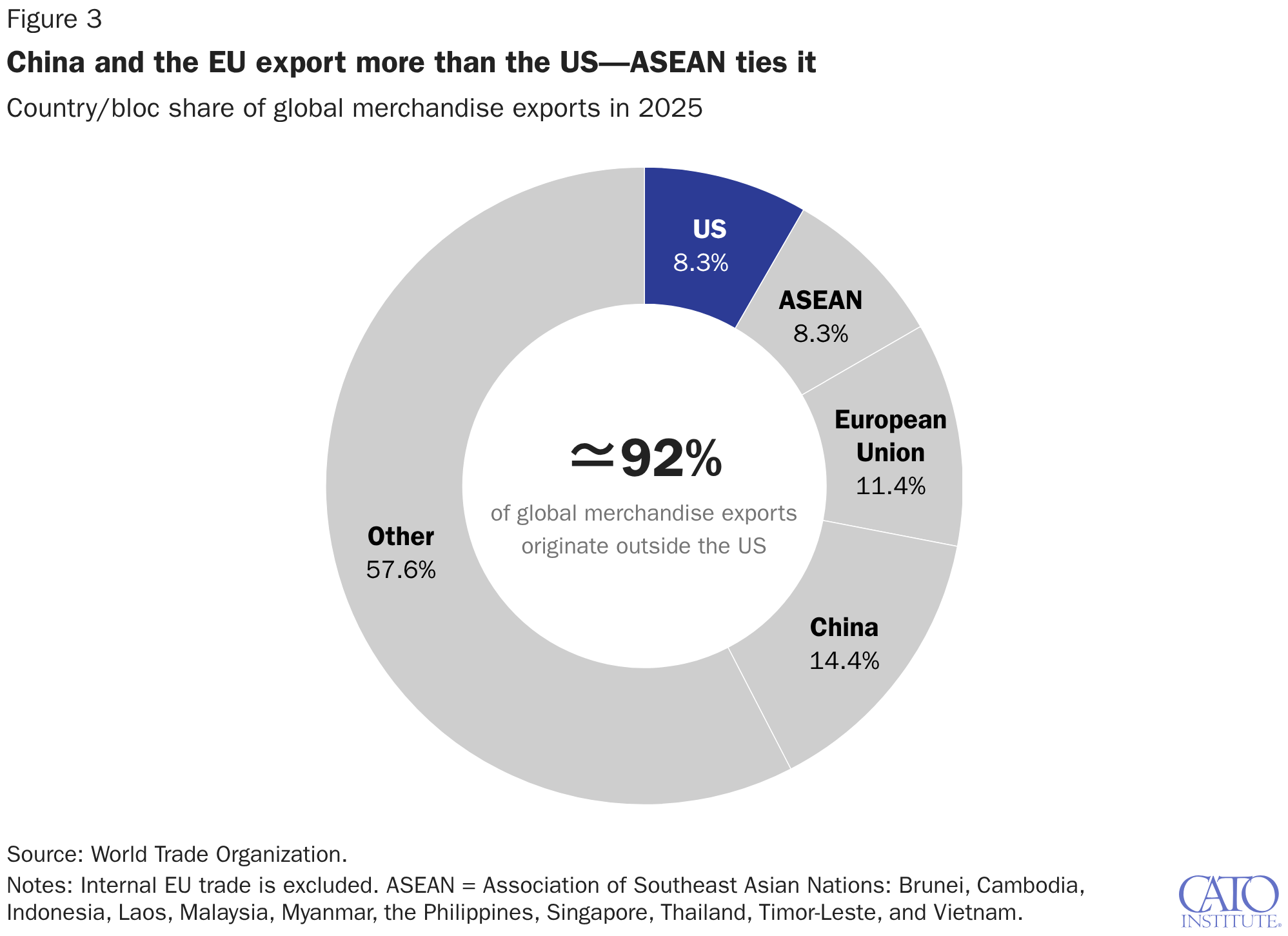
In all this, and much more, the current transformation of international trade positions the United States on the outside looking in—and likely to watch its already-middling share of global exports (Figure 347) shrink even more in the years ahead. US trade policy has increasingly turned the country from a paragon of international trade into a pariah and a market to be avoided, if at all possible. The distinguished international trade economist Robert Lawrence has asserted that President Trump’s trade policies are helping “create a world without America.”48 This stark assertion may edge a bit toward exaggeration, though less and less so as time passes. What can be stated with increasing certainty is that the protectionist trade policies of Donald Trump, ever in flux, are making it less likely that archaeologists 5,000 years from now will identify the geographical center of 21st-century world trade as being in the United States. To avoid this fate, the US must return to its long-standing policy of freeing trade and establishing and upholding the international rule of law in trade. This should be done through regional agreements, if need be, but preferably within the multilateral legal structure of the World Trade Organization, a vital international institution for which President Trump has so far expressed only contempt.

About the Author


This work is licensed under a Creative Commons Attribution-NonCommercial-ShareAlike 4.0 International License.