The federal minimum wage has lost over 27 percent of its purchasing power since it was last raised.… That is unacceptable. Millions of Americans cannot be allowed to fall further and further behind economically.
Sen. Bernie Sanders (I‑VT), April 17, 20231
For decades, working Americans have seen their wages flatline. One major culprit of this is the failure of the federal minimum wage to keep up with the economic reality facing hardworking Americans every day.
Sen. Josh Hawley (R‑MO), June 10, 20252
The average worker is producing two and a half times more value than they were producing in 1968, yet they’re being paid half as much.
Rep. Ro Khanna (D‑CA), April 28, 20263
Introduction
What is the minimum wage in America? Some libertarians might say “$0”—the wage obtained when unemployed. But the most common answer is $7.25 per hour, the federal wage floor set by the Fair Labor Standards Act and unchanged since July 2009.4 Advocates for a higher federal floor have long pointed to that figure as evidence of governmental neglect of low-wage workers in a world of rising prices. That has motivated several pushes to raise the federal minimum wage to $15, $17, or even $25 per hour.5
That line misses that minimum wages in the US are not set solely, or even primarily, at the federal level. States can set wage floors above, but not below, the federal minimum. Many states permit counties and cities to do the same. The result is that the minimum wage a worker faces may be set by their city, county, state, or federal government—whichever’s floor is highest.
Understanding the evolution of the minimum wage that workers live under requires tracking changes across all these jurisdictions. This briefing paper attempts to do just that. It calculates the working-age, population-weighted effective minimum wage (EMW) and reports it as a national average EMW on January 1 and July 1 of each year since 2000, accounting for laws in the 30 states that have set the wage floor above $7.25 and the 74 substate localities that had higher local ordinances still. We also calculate metropolitan statistical area (MSA) EMWs from 2010 to 2025 and report MSA minimum wage bites (i.e., the minimum wage as a proportion of the median hourly wage) over time.
The key finding is that the working-age, population-weighted minimum wage has increased from $7.45 in 2010 to $12.13 today. Far from losing 33 percent of its real value since 2010—as an updated version of Senator Sanders’ quotation would assume—the effective minimum wage workers face has increased by 8 percent in inflation-adjusted terms. That is strikingly different from the “frozen at $7.25” story.
Why This Matters for Federal Policy
Calls for a much higher federal minimum wage rest heavily on the claim that America’s wage floor has been frozen at $7.25 since 2009. That is true of federal law but not of the minimum wage many workers live under. We show that most workers already live under a higher state or local wage floor. A federal jump to $15, $17, or $25 would therefore not “catch up” one neglected national labor market to protect real wages but override a patchwork of local choices and bind most forcefully where lawmakers have not already chosen high wage floors. These are places where local industries or productivity levels may provide good reason to believe a higher minimum wage would be harmful.
The scale of the economic effects of a minimum wage depends on its bite rather than its absolute level. A $17 wage floor in San Jose is not the same as a $17 floor in rural Mississippi. Within a locality, minimum wage floors can bite harder still in individual sectors, jobs, or subregions. Economists typically proxy for bite by how high a wage floor sits relative to median hourly wages.
High minimum wages in areas with already high median pay may create harmful adjustments for businesses without causing large aggregate job losses; the same minimum wage in lower-paying areas could price many inexperienced, young, or less-skilled workers out of jobs, hours, or entry-level opportunities entirely.
Despite many commentators claiming otherwise, the bulk of the minimum wage literature finds that raising the wage floor leads to “disemployment” effects—job and hour cuts—particularly for young and unskilled workers.6 The Congressional Budget Office’s report on the Raise the Wage Act recognizes this trade-off.7 Higher federal minimum wages raise pay for some low-wage workers but cause others to lose hours, fringe benefits, or employment.
Economists continue to think that those disemployment effects are greatest at larger bites. A recent poll from the Employment Policies Institute found that nearly three-quarters of economists oppose a $15 federal minimum wage, 90 percent oppose a minimum wage up to $20 per hour, and 96 percent oppose more than $20 per hour.8 This aligns with other older survey results.9
Some studies in recent decades have found smaller or muted disemployment effects from certain modest minimum wage increases during times of economic growth. But there are methodological critiques of these minority of papers, and even when headline employment losses look small, there is no free lunch.10 Firms may adjust through other margins: fewer hours, less predictable schedules, reduced benefit eligibility, higher prices, automation, or a shift toward more experienced workers. Evidence from Seattle, for example, found that moving the minimum wage to $13 reduced hours in low-wage jobs.11
A large, one-size-fits-all federal wage floor is therefore a particularly blunt and risky policy. Although we’d prefer no minimum wage whatsoever, state and local variation allows wage floors to better reflect local productivity, prices, and labor market conditions. A dramatic federal increase would instead nationalize an aggressive policy choice and impose it where the bite is highest and local policymakers have already rejected it. For low-wage regions and vulnerable workers, that risks turning an anti-poverty promise into a ban on jobs whose productivity cannot support Washington’s preferred wage.12
Methodology
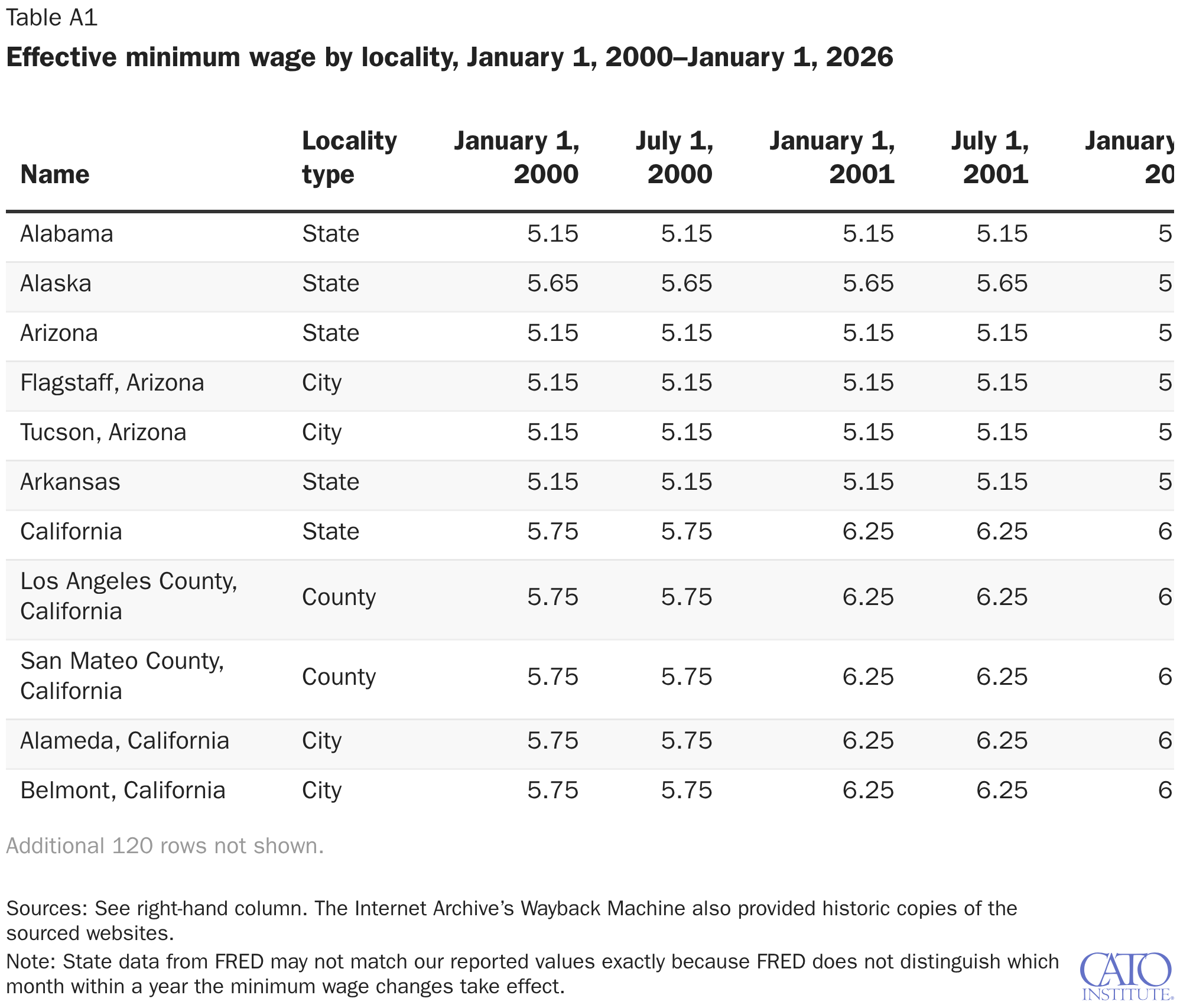
This analysis tracks federal, state, and local changes to minimum wage ordinances (MWOs) in 131 relevant geographies over the 26-year period from January 1, 2000, to January 1, 2026 (Table A1, Appendix).13 Geographies include:
- 48 states with standard minimum wage laws;
- 3 geographies under Oregon’s tiered minimum wage law;
- 5 geographies under New York’s tiered minimum wage law;
- Washington, DC;
- 61 cities with MWOs; and
- 13 counties with MWOs.
We report each geography’s mandated minimum—the greatest of any relevant city, county, state, or federal wage floor—as snapshots from January 1 and July 1 of each year, as these dates are when most MWO changes take effect. All inflation adjustments peg dollars to their January 2026 purchasing power using the Consumer Price Index (CPI).14
We construct the same geographies’ populations using incorporated and census-designated places from the 2000 census and five-year estimates from the American Community Survey (ACS) for 2010–2024.15 Then, we weight each MWO by the working-age (16–64 years old) population living under it to calculate national and MSA-level averages of minimum wage levels.16
Our analysis focuses on the typical minimum wage potential workers and employers can expect in each geography. To that end, we exclude from the analysis sector-specific minimum wages,17 those that apply only to city or state government employees, provisions offering longer phase-ins or exemptions for small businesses/youth employees or those requiring higher wages from “macro” employers,18 and carve-outs for tipped workers.
Findings
On January 1, 2010, the point when our data reflect the last federal minimum wage increase, 36 states adhered to the federal minimum wage of $7.25. Washington state had the highest state minimum wage at $8.55 and Santa Fe, New Mexico, had the highest wage floor anywhere in the country at $9.85.
Only 20 states still experience the federal wage floor in 2026. Washington state’s minimum wage is $17.13 today, and the District of Columbia’s floor is even higher at $17.95. Tukwila, Washington, has the highest wage floor anywhere in the country at $21.65 per hour.
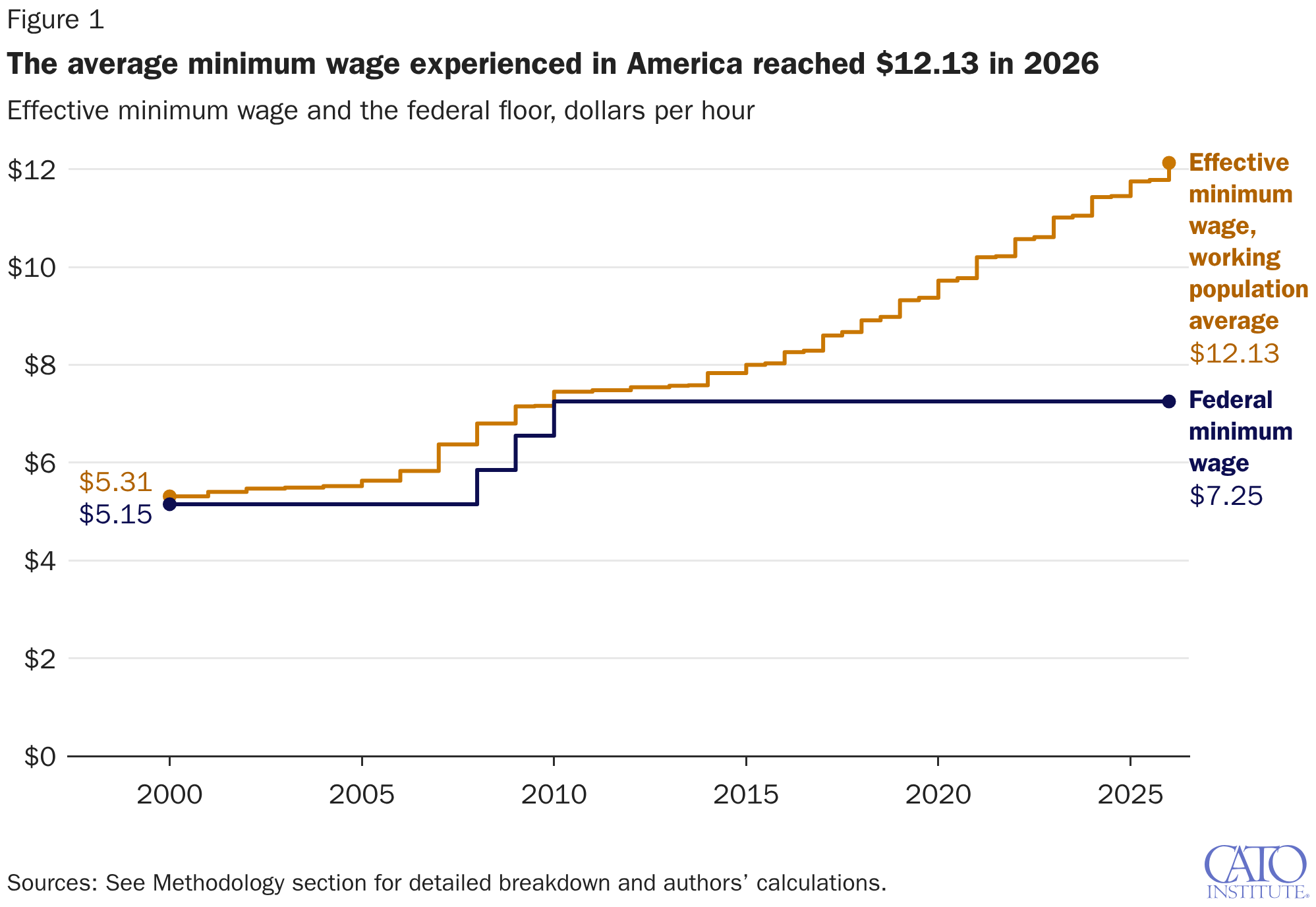
The average effective minimum wage more accurately reflects how the minimum wages that bind Americans have changed over the past 16 years. In January 2010, the working-age, population-weighted EMW was $7.45. This reflected that for workers in most places, the $7.25 federal floor was the highest minimum wage. By January 2026, the EMW had reached $12.13. Far from stagnant since 2009, the average nominal EMW has never been higher. It’s grown 62.8 percent in nominal terms since January 2010 (Figure 1).19
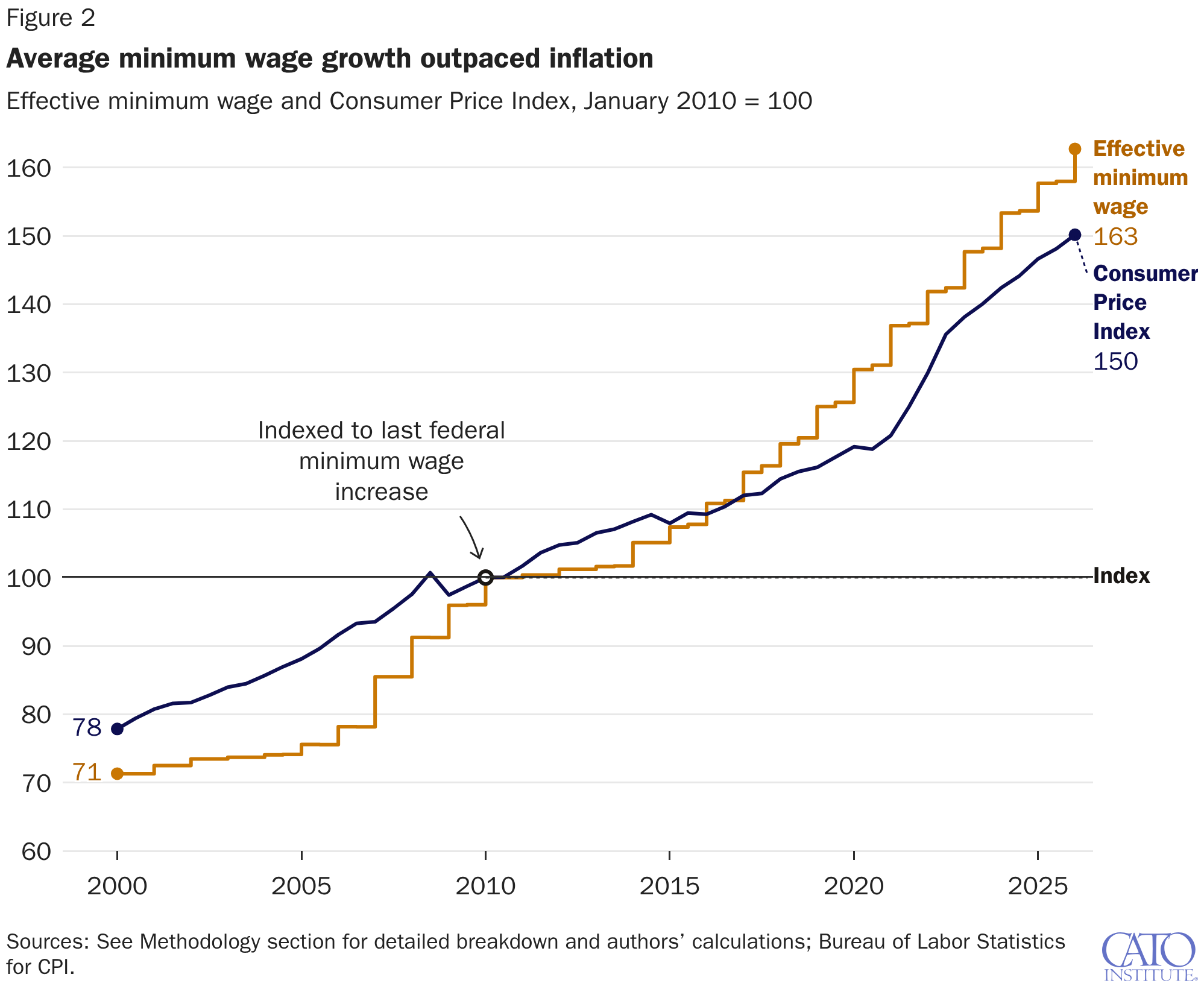
The EMW also grew faster than inflation, meaning that it grew in real terms over this period. Figure 2 indexes the EMW and CPI to January 2010 and traces their divergence over time.20 By January 2026, the nominal EMW was up 62.8 percent compared to 50.2 percent growth in the CPI, reflecting real growth of 8.4 percent. The same has been true since 2000. Over the past 26 years, the EMW grew 128.2 percent compared to 92.9 percent growth in the CPI, an increase in purchasing power of 18.3 percent.
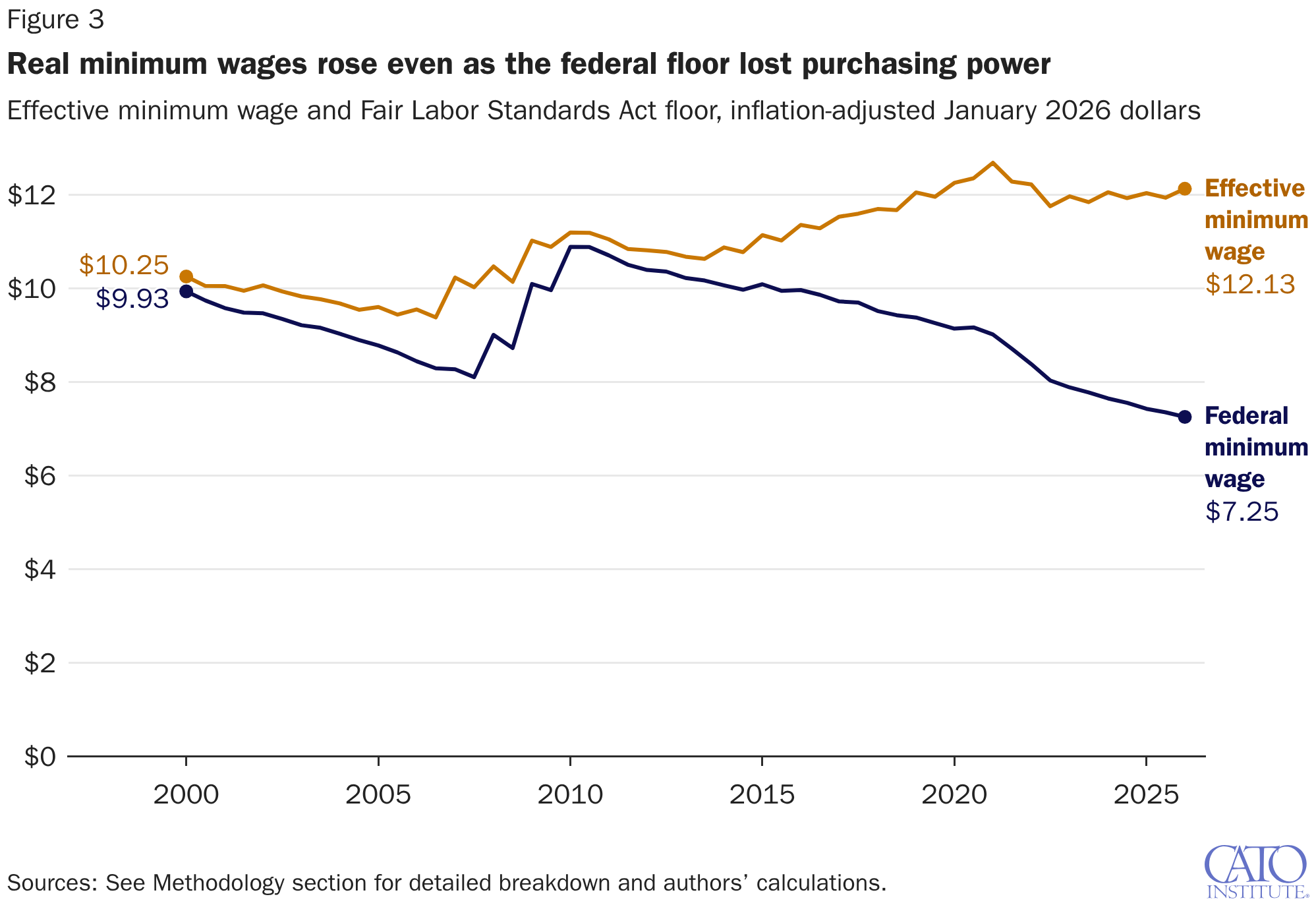
Calculating the real EMW (Figure 3) shows only three periods of purchasing power loss since 2000.21 It trended downward through 2006 but jumped in January 2007 as many states began enforcing their own higher minimum wages. By January 2007, before any changes to the federal floor, the real EMW was already higher than the real federal floor was in 2000.
The real EMW continued to outpace inflation until 2010, largely because of increases to the federal minimum wage enacted in 2007.22 After the federal minimum wage reached $7.25 by 2010, the EMW’s purchasing power fell until 2014 but not below its 2007 level. It rose aggressively to a January 2021 peak, driven by state and local minimum wage increases, before losing 7 percent of its purchasing power by July 2022 due to post-COVID-19 inflation.
That reversal was temporary. By January 2026, the real EMW had recovered to $12.13, only $0.54 below its peak. That is still above virtually any pre-2020 value.
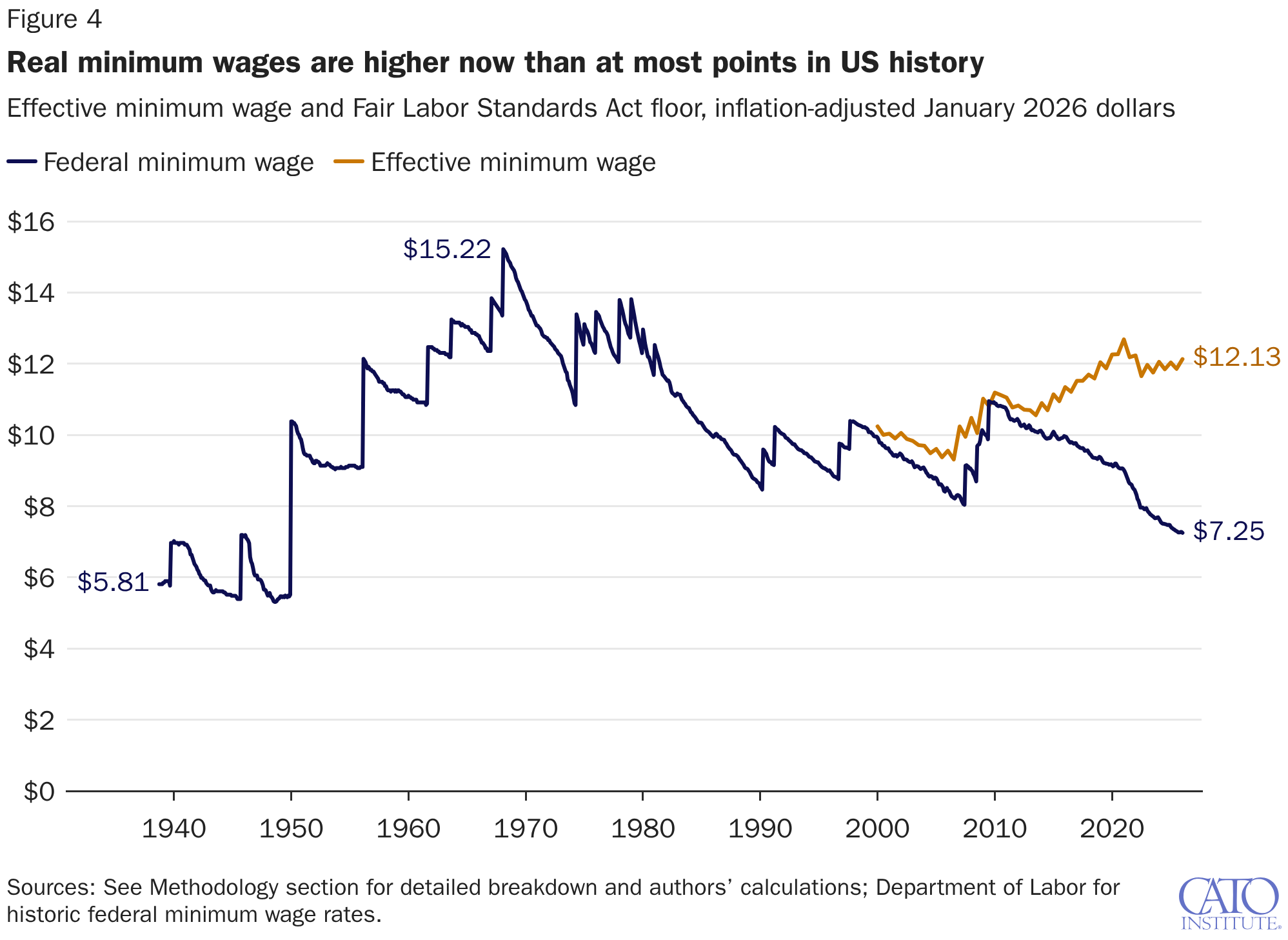
As a result, the EMW is higher now than the real federal floor was at most points through its history in the US (Figure 4).23 If we average out the full 90-year history of federal minimum wages in the US, then the historic federal floor is $9.92 in January 2026 dollars.
It’s true that local variation in prices and wages means no single national calculation like this will capture all workers’ experiences. But by the same logic, differential price changes across states and localities provide an argument against a one-size-fits-all, binding federal minimum wage. The EMW is a descriptive statistic that averages across local variation, while a higher federal wage floor would override any local variation. If cost-of-living differences across regions mean a single national EMW is misleading, that is an argument for local minimum wage policies being preferable.
EMW Gains Are a National Trend, Not Purely Coastal
In January 2000, the population-weighted EMW was $5.31, only $0.16 above the federal floor of $5.15. The current EMW of $12.13 is $4.88 above the $7.25 federal floor. While 20 states still adhere to the federal floor, 24 states have passed state-level wage floors of $12 or higher, and 16 have reached $15 or higher.
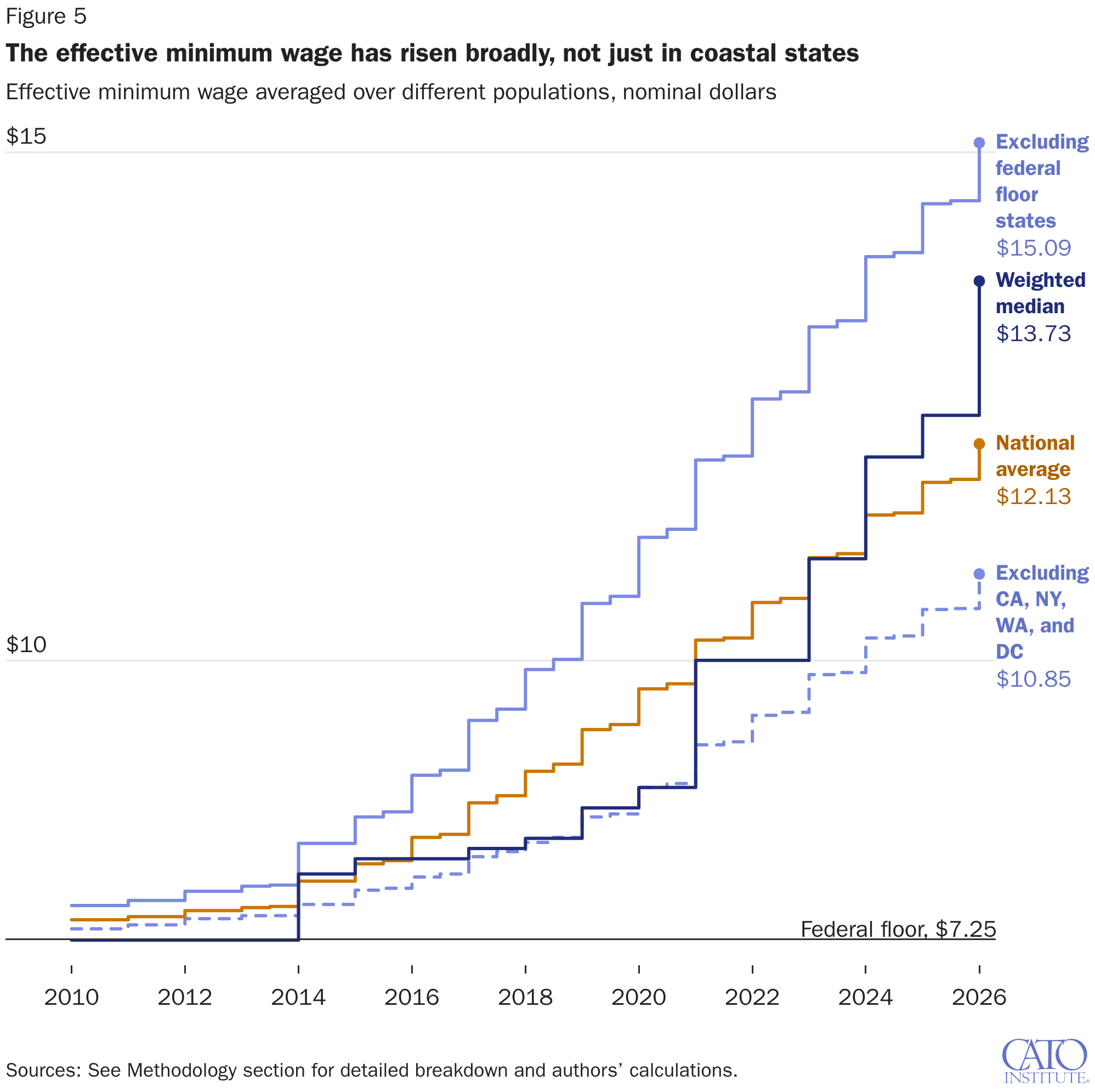
Skeptics may argue that the apparent gains are driven primarily by select states such as California, a state of nearly 20 million working-age people. Yet even when excluding California, New York, Washington state, and DC—the areas most associated with aggressive minimum wage increases—the national EMW average was still $10.85 in January 2026. That tracks the purchasing power of $7.25 in January 2010 and is higher than the purchasing power of $5.15 in January 2000. Real minimum wages are still up even when excluding the highest MWO areas.
Line up every working-age American in order of the minimum wage where they live, and the person in the exact middle in January 2026 lives in Michigan, which is subject by law to a $13.73 wage floor. That is the population-weighted median; half of Americans live somewhere that mandates a higher wage, and half live somewhere with a lower rate.
In 2024, the median wage floor surpassed the average, meaning that the $7.25 federal minimum has become the outlier, not the norm (Figure 5).24 More Americans now live above the average floor than below it, reflecting a left-skewed distribution in which the holdout federal floor states pull the average down from what most workers experience. For instance, as of January 2026, more working-age Americans live under a $15 or higher floor (41.1 percent) than under the $7.25 federal minimum (37.5 percent).
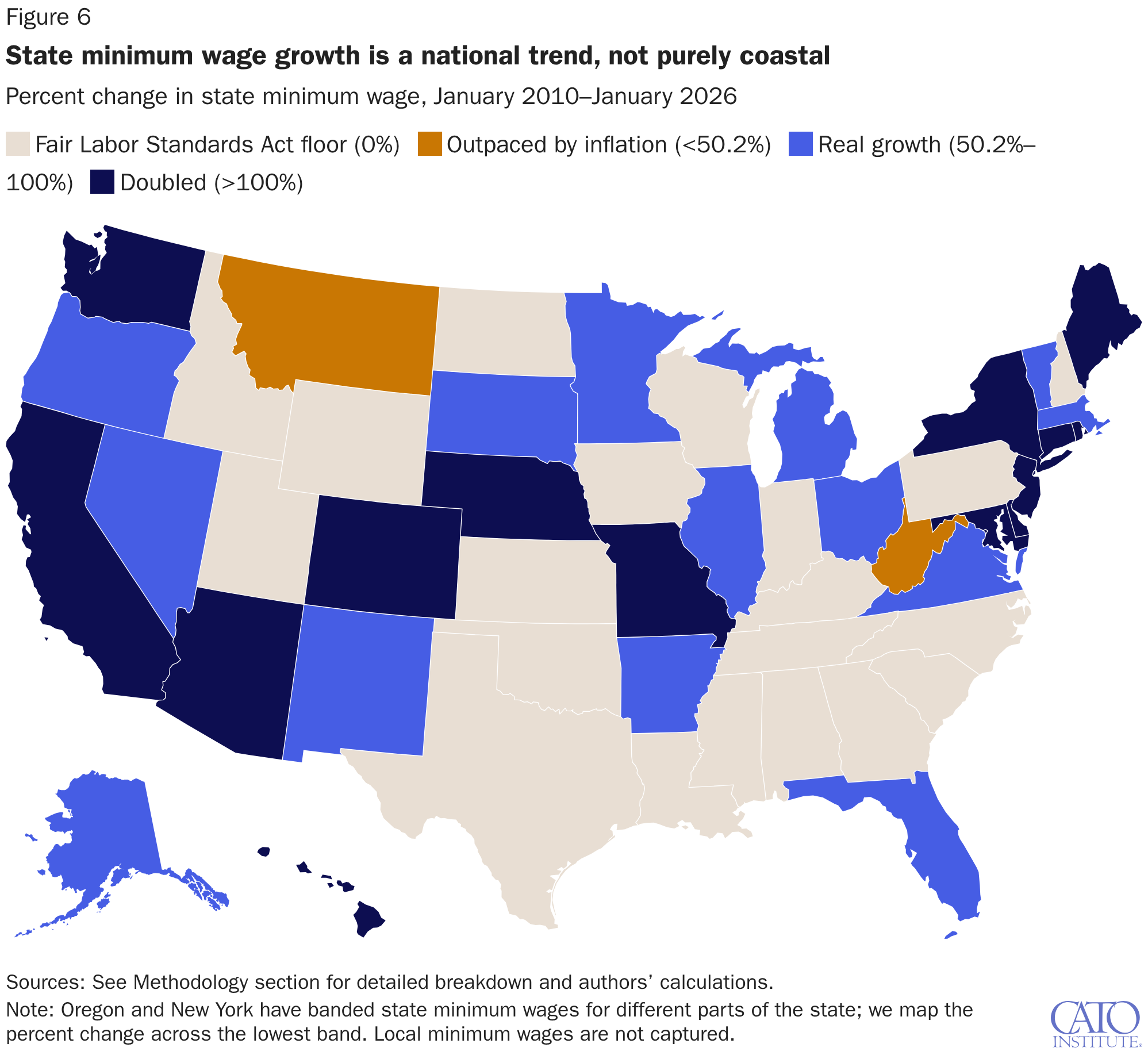
The geographic breadth of minimum wage activity is visible in the state-level data too. Between January 2010 and January 2026, 16 states that had previously relied on the federal floor enacted increases, including South Dakota (now at $11.85), Florida ($14.00), Missouri ($15.00), Nebraska ($15.00), and Arizona ($15.15). That list includes states in the Midwest and US South with Republican control of governorships and state legislatures, not just the coastal Democratic areas typically associated with active minimum wage policy.
As shown in Figure 6, 28 states, plus DC, outpaced inflation with their minimum wage increases since 2010.25 Of those, 15 more than doubled their minimum wage. That’s even before considering substate minimum wages, which buoy the EMW experienced by many state residents further, especially in states such as California, Illinois, Maryland, Minnesota, and New Mexico.
High MWOs Bring Large Minimum Wage Bites
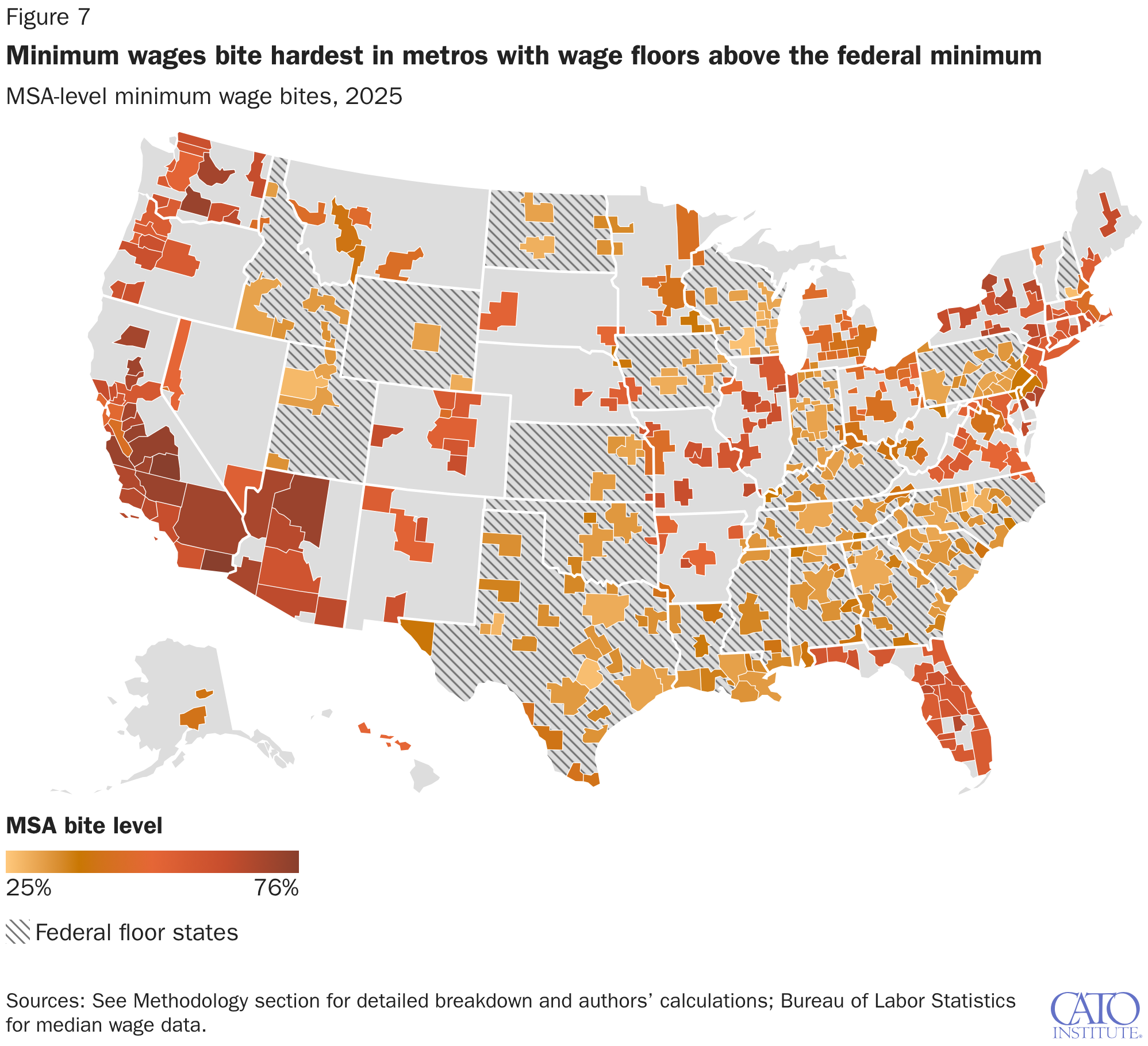
Our state and local minimum wage dataset also allows us to calculate working population-weighted EMWs by metropolitan statistical area. Combined with the Bureau of Labor Statistics’ median hourly wage data, this yields each MSA’s minimum wage bite—the effective minimum wage as a percentage of local median hourly wages.26
Figure 7 maps the bite across metropolitan areas in 2025.27 The darkest sections, California, Florida, and the Northeast Corridor, are areas where aggressive state and local floors have pushed the wage floor to between 60 and 75 percent of local medians. That’s an extremely high bite.
Interior metros generally sit lower because market wages have continued rising on their own, leaving legislated wage floors well below what employers already pay.
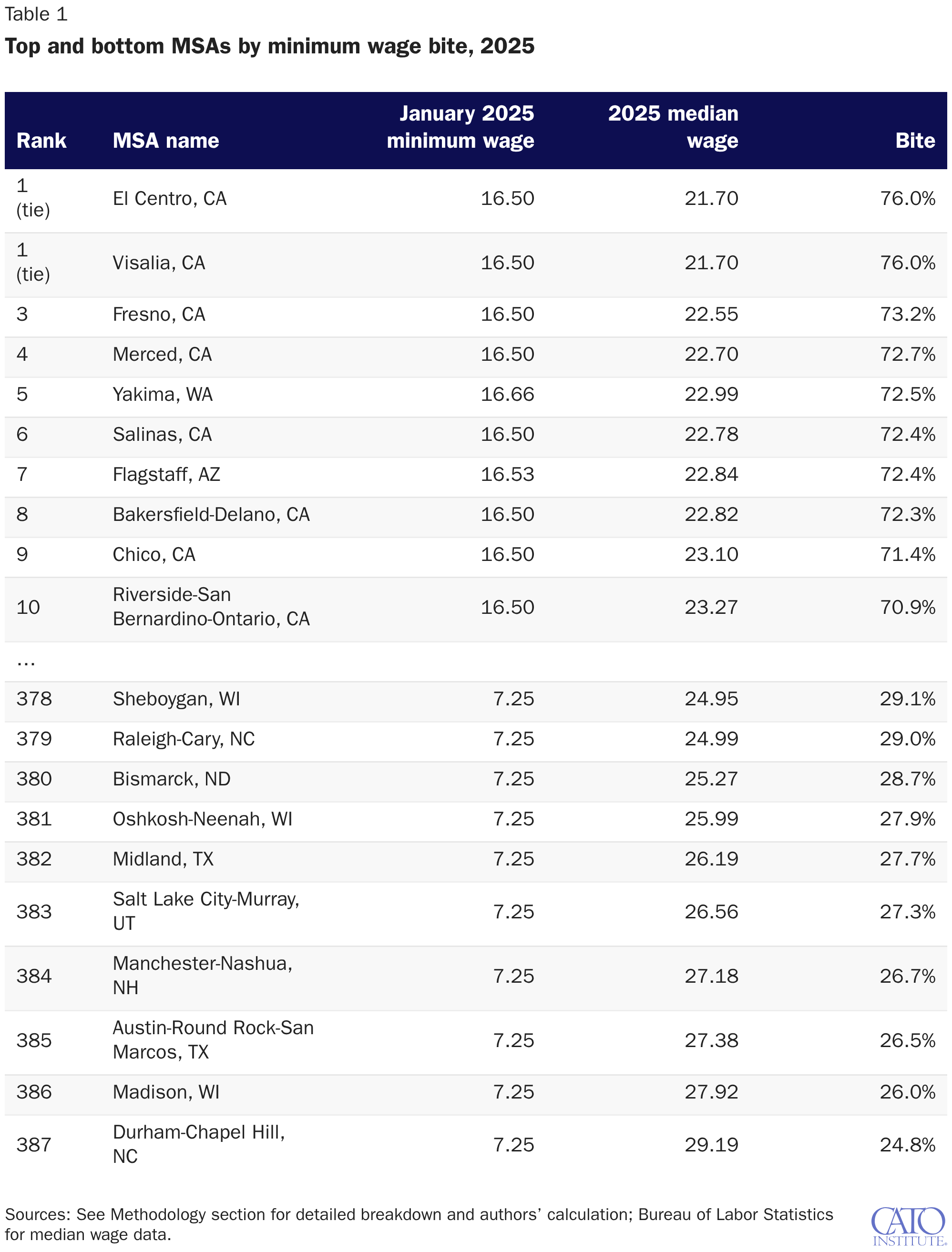
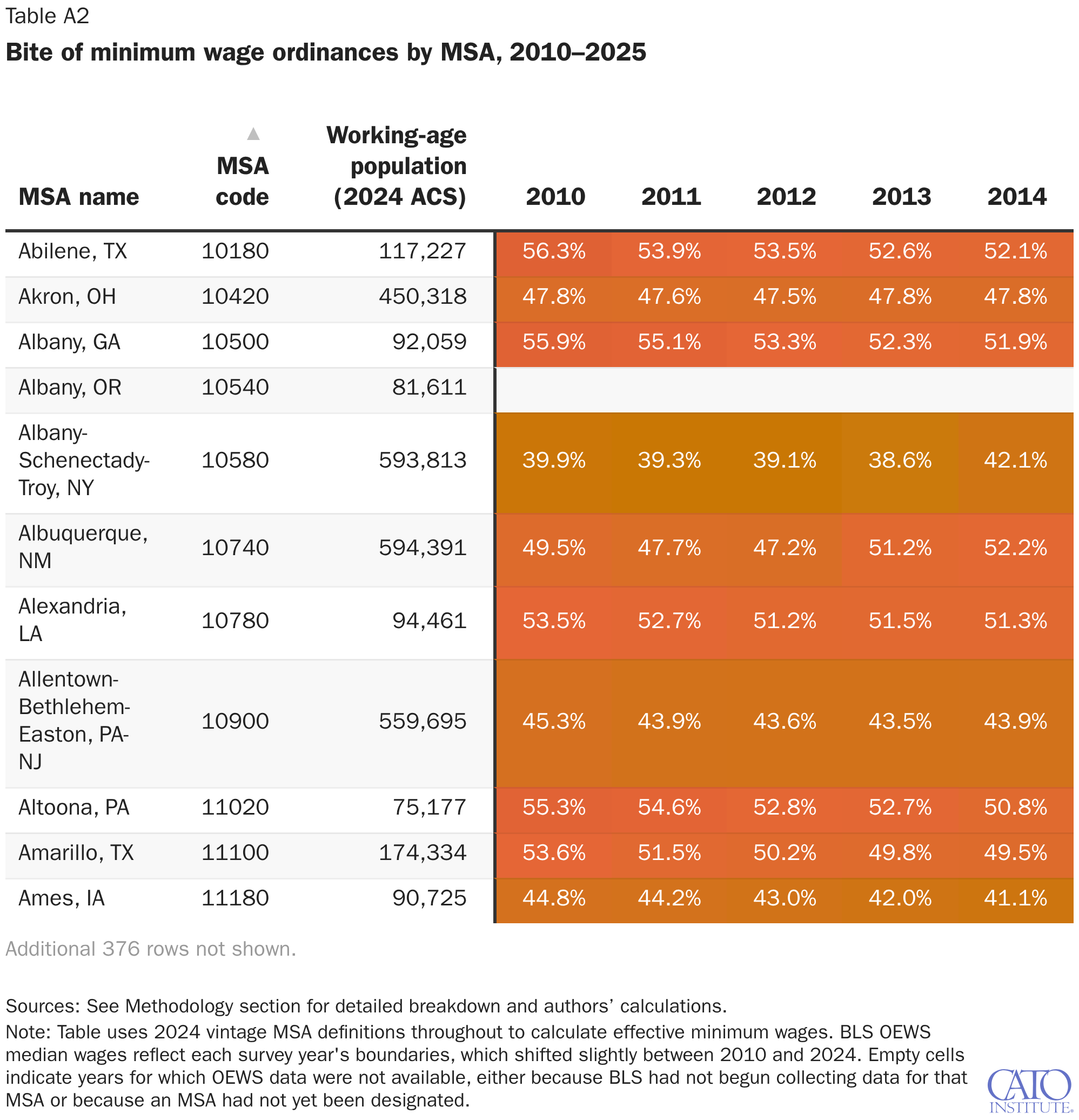
Consistently, the largest minimum wage bites occur in smaller metropolitan areas of states with aggressive state and local MWOs (Table 1).28 That should inspire caution among advocates for blanket wage floors covering diverse areas. (We provide bite estimates for all MSAs from 2010 to 2025 in Table A2 of the Appendix.)
The Bite of a Higher Federal Minimum Wage
The Raise the Wage Act (RTWA) has periodically been reintroduced in Congress with broad support from Democratic lawmakers. Its latest version, introduced in 2025 by Senator Sanders with 32 cosponsors, would raise the federal minimum wage to $17 per hour over five years.29 If enacted today, the federal minimum wage would reach $17 in 2031.
We project 2031 median hourly wages by inflating 2025 data by the Congressional Budget Office’s implied projected average wage growth.30 Because mean wages grow faster than medians, this will overstate future medians and make our bite estimates conservative lower bounds.31 Even so, the proposed minimum wage relative to local median hourly wages would reach 75 to 80 percent in the hardest-hit MSAs, overwhelmingly in rural areas (Table 2).32
The more recent Living Wage for All Act (LWAA) would peg the federal minimum wage to two-thirds of the national median every year.33 That would push bites even higher (Table 2).
Other areas face smaller bites because their economies are more concentrated in higher-productivity sectors. Some are unaffected because local minimum wages already exceed $17. As with aggressive state minimum wages, a federal floor inevitably bites hardest in rural states and MSAs.
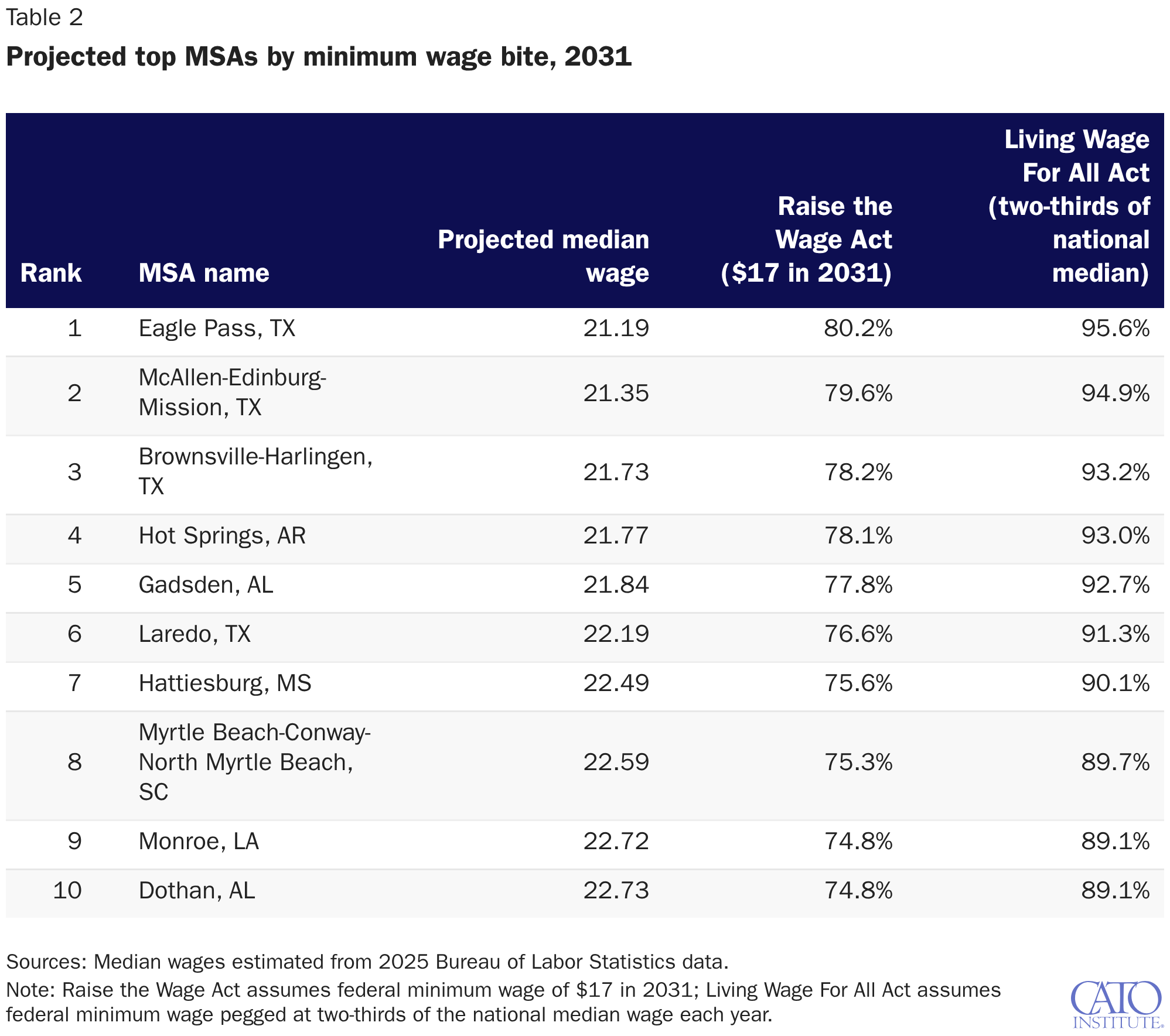
These estimates are conservative for a second reason: 8 of the 10 most-affected MSAs lagged national wage growth over the past 15 years.34 If they continue their historic trends rather than track national growth going forward, bites of a $17 federal minimum could reach 85 to 90 percent of local median hourly earnings. LWAA bites could exceed 100 percent. That would require significant labor market reorganization; over half of all local workers would be directly affected.
The national median hourly wage was $24.51 in 2025; the same inflator projects it to reach as high as $30.37 in 2031, implying a national lower-bound RTWA bite of 56 percent, or 67 percent under the LWAA. That would significantly expand the United States’ 2025 federal bite of 30 percent or a bite of 48 percent for that year’s EMW calculation.35
For context, the average Organisation for Economic Co-operation and Development minimum wage bite excluding the US was 43 percent in 2000 and 57 percent in 2024.36 The United States’ highest-bite MSAs already sit much higher, and bills proposed in Congress would push the national bite significantly above 50 percent while driving bites to extreme levels in rural MSAs.
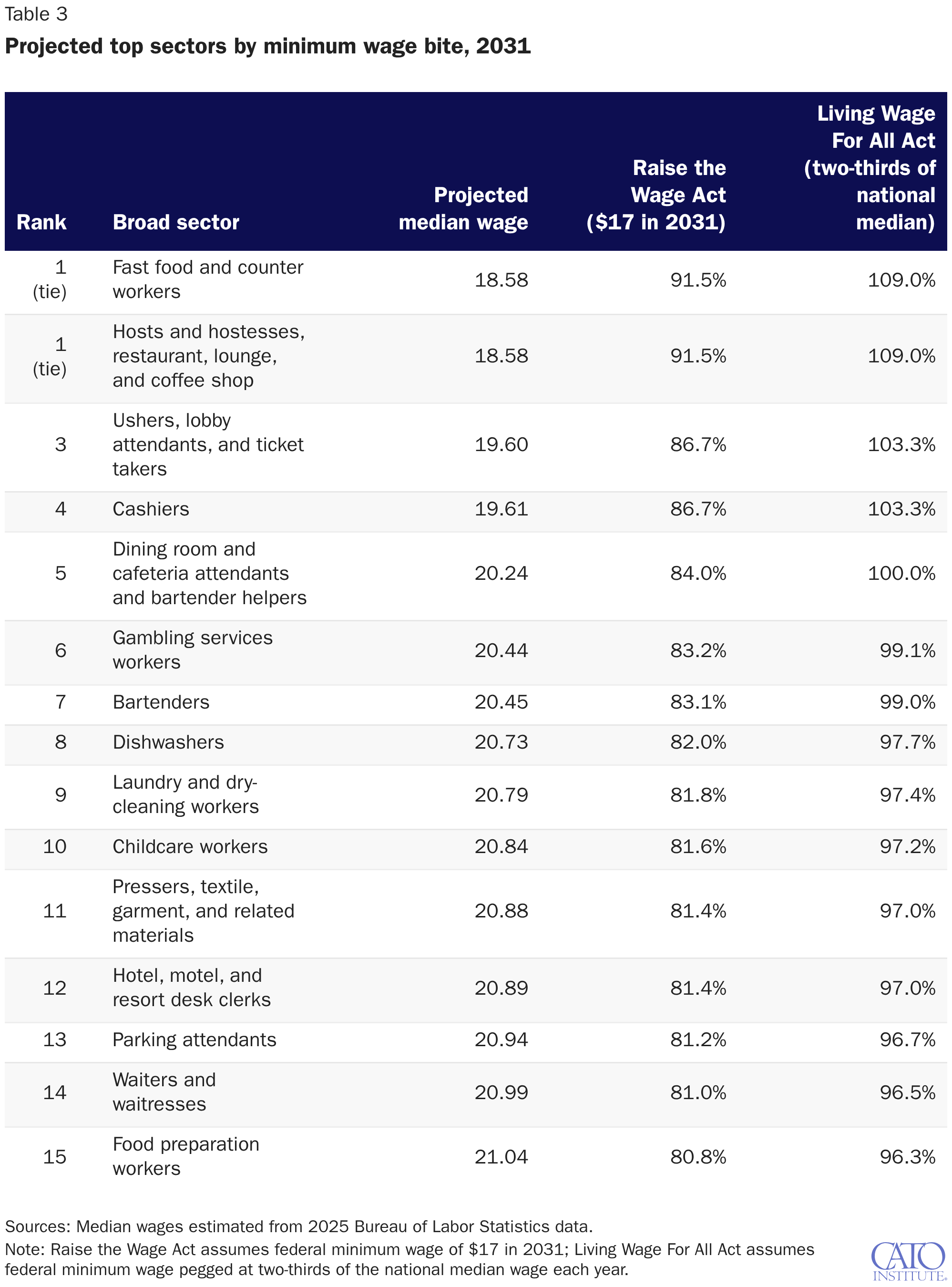
Table 3 extends the analysis to show which broad occupational groups would see the largest bites using the same wage growth calculation.37 In the categories with the lowest median hourly wages, bites reach 80 to 90 percent under the RTWA and exceed 100 percent under the LWAA.38
Conclusion
The narrative that minimum wages have been frozen at $7.25 for 17 years captures a fact about federal law but not a meaningful economic reality. In 2024, only 1 percent of workers’ wages were at or below that federal minimum, reflecting market wage growth and state and local wage regulation.39
By January 2026, the working-age, population-weighted effective minimum wage stood at $12.13; the weighted median was $13.73. In real terms, the EMW is at one of its highest levels in our dataset’s 26-year history, despite a temporary inflation-driven dip after 2021. Our data also show how smaller MSAs in states with the highest minimum wages predictably have the highest minimum wage bites.
The myth that workers throughout the country have seen an eroding minimum wage drives calls for a $17 or even $25 per hour federal floor. Not only has the EMW faced by workers increased in inflation-adjusted value given state and local policy, but imposing a high federal rate would risk jobs and opportunities through dramatic increases in localities where local policymakers’ decisions imply that they consider it to be damaging.
Appendix
Reconciling with a Past Estimate
The economist Ernie Tedeschi previously calculated a nationwide effective minimum wage higher than ours.40 The difference is Tedeschi weights by the hours worked by minimum wage workers exclusively, while we weight by working-age population.
It’s easier to be classified as a minimum wage worker when minimum wages are higher, so Tedeschi’s method weights the areas with more restrictive MWOs higher than ours. Localities with higher minimum wages will tend to have more minimum wage workers. That weighting is correct to answer Tedeschi’s question: “What is the average wage earned by those defined as minimum wage workers?” But we answer a different question: “What is the average minimum wage that Americans are governed by?”
About the Authors


This work is licensed under a Creative Commons Attribution-NonCommercial-ShareAlike 4.0 International License.