Menu

Main navigation

  • About
    • Annual Reports
    • Leadership
    • Jobs
    • Student Programs
    • Media Information
    • Government & External Affairs
    • Store
    • Contact
    LOADING...
  • Experts
    • Policy Scholars
    • Adjunct Scholars
    • Fellows
  • Events
    • Upcoming
    • Past
    • Event FAQs
    • Sphere Summit
    LOADING...
  • Publications
    • Studies
    • Commentary
    • Survey Reports and Polling
    • Books
    • Reviews and Journals
    • Public Filings
    LOADING...
  • Blog
  • Donate
    • Sponsorship Benefits
    • Ways to Give
    • Planned Giving
    • Meet the Development Team

Issues

  • Constitution and Law
    • Constitutional Law
    • Criminal Justice
    • Free Speech and Civil Liberties
  • Economics
    • Banking and Finance
    • Monetary Policy
    • Regulation
    • Tax and Budget Policy
  • Politics and Society
    • Education
    • Government and Politics
    • Health Care
    • Poverty and Social Welfare
    • Public Opinion
    • Technology and Privacy
  • International
    • Defense and Foreign Policy
    • Global Freedom
    • Immigration
    • Trade Policy
Live Now

Cato at Liberty


  • Blog Home
  • RSS

Email Signup

Sign up to have blog posts delivered straight to your inbox!

Topics
  • Banking and Finance
  • Constitutional Law
  • Criminal Justice
  • Defense and Foreign Policy
  • Education
  • Free Speech and Civil Liberties
  • Global Freedom
  • Government and Politics
  • Health Care
  • Immigration
  • Monetary Policy
  • Poverty and Social Welfare
  • Public Opinion
  • Regulation
  • Tax and Budget Policy
  • Technology and Privacy
  • Trade Policy
Archives
  • September 2021
  • August 2021
  • July 2021
  • June 2021
  • May 2021
  • April 2021
  • March 2021
  • February 2021
  • January 2021
  • December 2020
  • November 2020
  • October 2020
  • September 2020
  • August 2020
  • July 2020
  • June 2020
  • May 2020
  • April 2020
  • March 2020
  • February 2020
  • January 2020
  • December 2019
  • November 2019
  • October 2019
  • September 2019
  • August 2019
  • July 2019
  • June 2019
  • May 2019
  • April 2019
  • March 2019
  • February 2019
  • January 2019
  • December 2018
  • November 2018
  • October 2018
  • September 2018
  • August 2018
  • July 2018
  • June 2018
  • May 2018
  • April 2018
  • March 2018
  • February 2018
  • January 2018
  • December 2017
  • November 2017
  • October 2017
  • September 2017
  • August 2017
  • July 2017
  • June 2017
  • May 2017
  • April 2017
  • March 2017
  • February 2017
  • January 2017
  • December 2016
  • November 2016
  • October 2016
  • September 2016
  • August 2016
  • July 2016
  • June 2016
  • May 2016
  • April 2016
  • March 2016
  • February 2016
  • January 2016
  • December 2015
  • November 2015
  • October 2015
  • September 2015
  • August 2015
  • July 2015
  • June 2015
  • May 2015
  • April 2015
  • March 2015
  • February 2015
  • January 2015
  • December 2014
  • November 2014
  • October 2014
  • September 2014
  • August 2014
  • July 2014
  • June 2014
  • May 2014
  • April 2014
  • March 2014
  • February 2014
  • January 2014
  • December 2013
  • November 2013
  • October 2013
  • September 2013
  • August 2013
  • July 2013
  • June 2013
  • May 2013
  • April 2013
  • March 2013
  • February 2013
  • January 2013
  • December 2012
  • November 2012
  • October 2012
  • September 2012
  • August 2012
  • July 2012
  • June 2012
  • May 2012
  • April 2012
  • March 2012
  • February 2012
  • January 2012
  • December 2011
  • November 2011
  • October 2011
  • September 2011
  • August 2011
  • July 2011
  • June 2011
  • May 2011
  • April 2011
  • March 2011
  • February 2011
  • January 2011
  • December 2010
  • November 2010
  • October 2010
  • September 2010
  • August 2010
  • July 2010
  • June 2010
  • May 2010
  • April 2010
  • March 2010
  • February 2010
  • January 2010
  • December 2009
  • November 2009
  • October 2009
  • September 2009
  • August 2009
  • July 2009
  • June 2009
  • May 2009
  • April 2009
  • March 2009
  • February 2009
  • January 2009
  • December 2008
  • November 2008
  • October 2008
  • September 2008
  • August 2008
  • July 2008
  • June 2008
  • May 2008
  • April 2008
  • March 2008
  • February 2008
  • January 2008
  • December 2007
  • November 2007
  • October 2007
  • September 2007
  • August 2007
  • July 2007
  • June 2007
  • May 2007
  • April 2007
  • March 2007
  • February 2007
  • January 2007
  • December 2006
  • November 2006
  • October 2006
  • September 2006
  • August 2006
  • July 2006
  • June 2006
  • May 2006
  • April 2006
  • Show More
October 17, 2018 10:44AM

Why Federal Debt Is Damaging

By Chris Edwards

SHARE

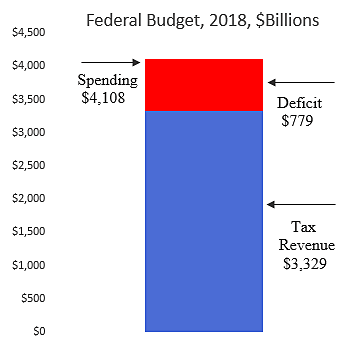
Media Name: budget_2018.png

The U.S. Treasury reports that the federal budget deficit was $779 billion in fiscal 2018. The deficit is caused by spending in excess of tax revenues and is financed by borrowing from foreign and domestic creditors.


Federal spending in 2018 was $4,108 billion and tax revenues were $3,329 billion, so Congress financed 19 percent of its spending with borrowing. Did taxpayers—who will ultimately bear the burden—really consent to that extra debt‐​financed spending? It is like Dad leaving the kids some cash to buy pizza, and then coming home to find that they also used his credit card to rack up charges on the Internet.


Unless the politicians grow up and start making reforms, the deficit will likely grow from $1 trillion in 2019 to more than $2 trillion a year a decade from now.


Annual deficits are piling onto accumulated federal debt held by the public of $16 trillion. That is $127,000 for every household in the nation. Compared to the size of the economy, today’s federal debt is, by far, the highest in our peacetime history.


Why is soaring government debt so worrying?

  1. Spending Induced. Most federal spending is for subsidy and benefit programs, not for activities that increase productivity. Subsidy and benefit programs distort the economy and generally reduce overall output and incomes. Those distortions occur whether spending is financed by debt or current taxes. But the availability of debt financing induces policymakers to increase overall spending, which at the margin goes toward lower‐​valued activities.
  2. Tax Damage Compounded. When taxes are extracted to pay for government spending, it induces people to change their working and investing activities, which distorts the economy and reduces growth. When spending is financed by borrowing, the tax damage is pushed to the future and compounded with interest costs.
  3. Investment Reduced. Government borrowing may “crowd out” private investment, and thus reduce future output and incomes. Economist James Buchanan said, “By financing current public outlay by debt, we are, in effect, chopping up the apple trees for firewood, thereby reducing the yield of the orchard forever.” The crowd out will be reduced if private saving rises to offset government deficits. But the CBO says, “the rise in private saving is generally a good deal smaller than the increase in federal borrowing.” Government debt may also deter investment through expectations—businesses will hesitate to invest if rising debt creates fears of tax increases down the road.
  4. Borrowing from Abroad. A decline in private investment due to government borrowing may be avoided if capital is attracted from abroad. Indeed, huge federal borrowing has been facilitated by global capital markets, and today more than 40 percent of federal debt is held by foreigners. Borrowing from abroad may prevent a fall in domestic investment but does not prevent the shifting of costs to future taxpayers. As government debt rises, more of our future earnings will be taxed to pay interest and principal on the government’s debt to foreigners.
  5. Macroeconomic Instability. CBO warns that a “large and continuously growing federal debt would … increase the likelihood of a fiscal crisis in the United States.” Experience shows that high levels of government debt tend to reduce growth and increase financial fragility. In their study of financial crises through history, Carmen Reinhart and Ken Rogoff concluded, “again and again, countries, banks, individuals, and firms take on excessive debt in good times without enough awareness of the risks that will follow when the inevitable recession hits.” Government debt, they found, “is certainly the most problematic, for it can accumulate massively and for long periods without being put in check by markets.”

Sadly, with regard to the federal budget, policymakers seem to be in la‐​la land, a “euphoric dreamlike mental state detached from the harsher realities of life.” They dream about spending on their favorite programs and act as if there won’t be harsh consequences to their profligacy. But there will be. Future living standards are being eroded as huge costs are being pushed forward, and the rising debt will eventually spark a damaging financial and economic crisis.

Related Tags
Tax and Budget Policy
Creative Commons License
This work is licensed under a Creative Commons Attribution-NonCommercial-ShareAlike 4.0 International License.

Stay Connected to Cato

Sign up for the newsletter to receive periodic updates on Cato research, events, and publications.

View All Newsletters

1000 Massachusetts Ave. NW
Washington, DC 20001-5403
202-842-0200
Contact Us
Privacy

Footer 1

  • About
    • Annual Reports
    • Leadership
    • Jobs
    • Student Programs
    • Media Information
    • Government & External Affairs
    • Store
    • Contact
  • Podcasts

Footer 2

  • Experts
    • Policy Scholars
    • Adjunct Scholars
    • Fellows
  • Events
    • Upcoming
    • Past
    • Event FAQs
    • Sphere Summit

Footer 3

  • Publications
    • Books
    • Cato Journal
    • Regulation
    • Cato Policy Report
    • Cato Supreme Court Review
    • Cato’s Letter
    • Human Freedom Index
    • Economic Freedom of the World
    • Cato Handbook for Policymakers

Footer 4

  • Blog
  • Donate
    • Sponsorship Benefits
    • Ways to Give
    • Planned Giving
    • Meet the Development Team
Also from Cato Institute:
Libertarianism.org
|
Humanprogress.org
|
Downsizinggovernment.org