Note: The payroll tax calculator was updated on October 1, 2026, to reflect the CBO’s 2026 Long-Term Projections for Social Security.
Republicans have resisted broad tax increases for decades. Social Security’s approaching insolvency may be testing that commitment.
The Washington Post recently reported that several prominent Republicans are becoming more receptive to raising taxes to avoid Social Security reform. While much of the current debate concerns raising or eliminating the limit on earnings subject to Social Security taxes, Rep. Tom Cole (R‑OK), chair of the House Appropriations Committee, said he is “willing to look at the [payroll] tax rate” and “willing to raise the amount of income through tax.”
Before lawmakers put such an increase on the table, workers deserve to know what it would cost them.The Wage Losses Behind a Payroll Tax Rate Increase
Cato’s new Social Security Payroll Tax Calculator allows workers to enter their annual earnings and see how different tax rates would affect them.
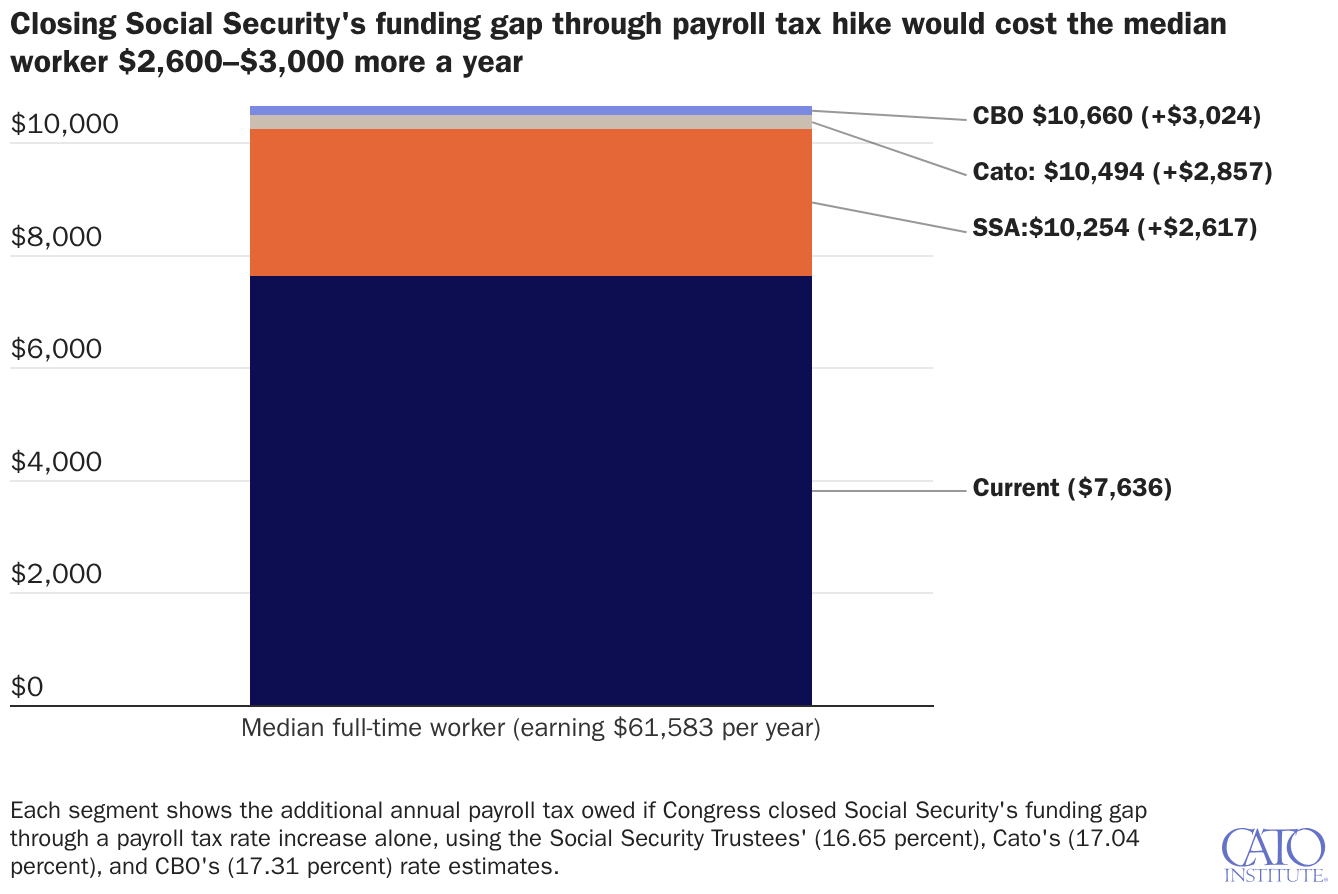
The combined Social Security payroll tax is currently 12.4 percent on earnings up to $184,500 (a level that grows each year with average wage gains). The calculator compares the current rate with three estimates of what payroll tax rate would be required to address Social Security’s 75-year financing shortfall through higher payroll taxes alone:
- 16.65 percent under the 2026 Social Security trustees’ assumptions;
- 17.04 percent under the Cato Social Security model; and
- 17.31 percent under the Congressional Budget Office’s assumptions.
Users can enter their annual salary and select any payroll tax rate between the current 12.4 percent and 17.31 percent to see the resulting tax burden and compare it with their current burden.
Projected rates differ because each model makes different assumptions about fertility. The Congressional Budget Office further assumes longer life expectancy, a smaller payroll tax base, and slower economic growth than the Trustees. But they all illustrate the same basic point: closing Social Security’s shortfall entirely through payroll taxes would require a substantial increase.
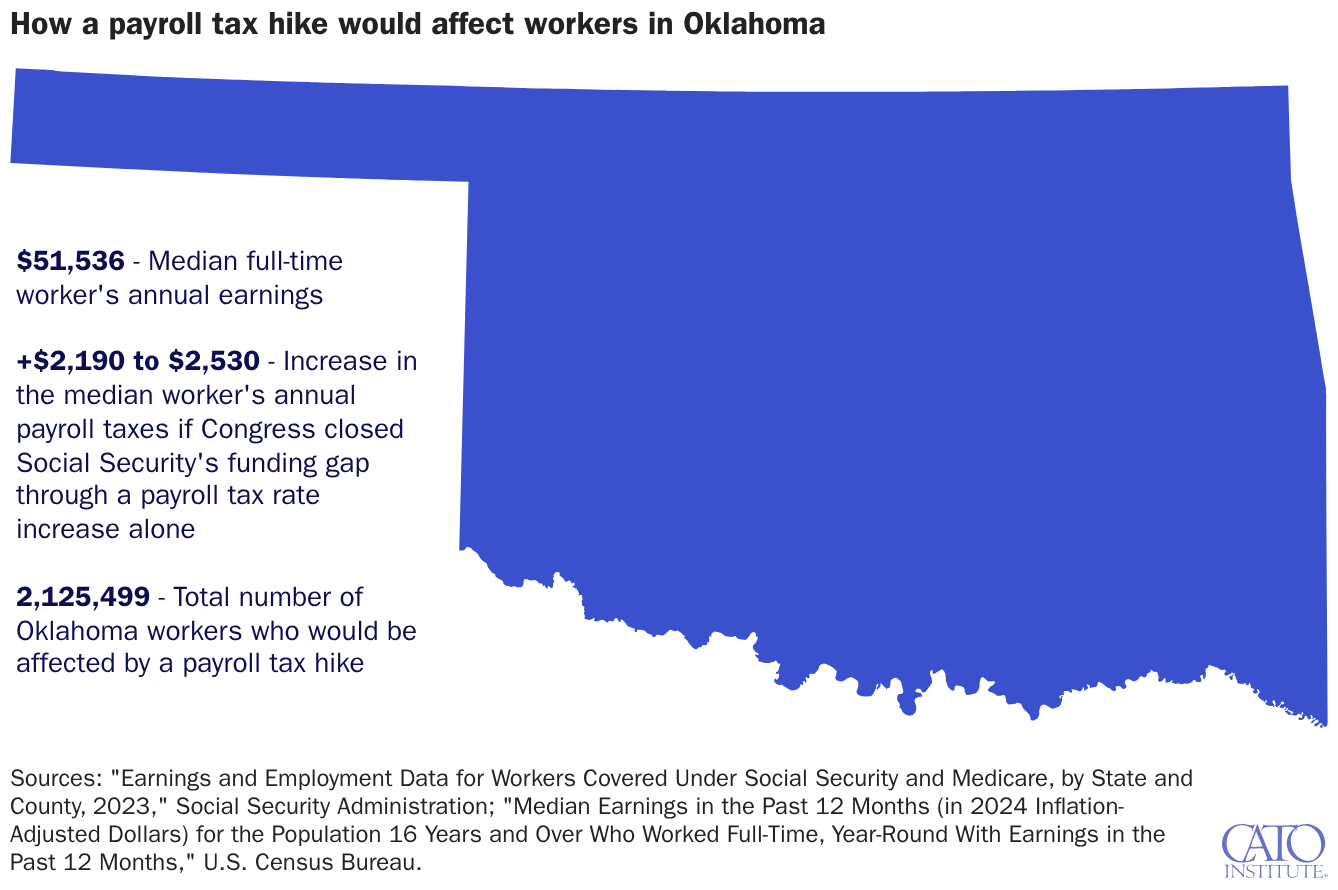
Consider Rep. Cole’s home state of Oklahoma. A median full-time, year-round worker earns approximately $51,536. Raising the combined payroll tax rate to the levels estimated by the three models would increase the tax associated with that worker’s earnings by between $2,190 and $2,530 annually (see figure below). That’s more than two months of median rent in Oklahoma.
The national figures are even larger. A median US full-time worker earning $61,583 a year would face an increase between $2,617 and $3,024 (see chart below).
These increases amount to roughly two months of the median rent countrywide.
Employees would not necessarily see that entire amount deducted from their paychecks. Workers and employers formally split the payroll tax, with each paying half. But the employer contribution is still a cost of employing the worker, and workers still bear much of that cost through lower wages and reductions in other compensation. Self-employed workers pay the entire combined rate directly.
The calculator shows how much more tax would be imposed on a worker’s earnings. It does not capture the broader economic consequences of raising the cost of work. Employers would likely respond through some combination of slower wage growth, reduced benefits, fewer hours, and less hiring. Workers would keep less of each additional dollar they earn, weakening incentives to work. The calculator does not capture the full economic cost of imposing a 34–40 percent increase in the Social Security payroll tax rate.
What Would Workers Be Paying For?
A tax increase of this magnitude would finance a benefit structure that automatically becomes more expensive over time and provides the biggest benefits to the highest-income earners, who are most capable of saving for more of their own retirement.
Social Security’s initial benefits are indexed to the growth of economy-wide wages, which generally rise faster than prices. This means that each successive generation is promised higher inflation-adjusted initial benefits than the generation before it. At the same time, Social Security’s retirement ages are not indexed to longevity. As Americans’ average lifespans continue to increase, lifetime benefit receipt goes up, even without additional years of earnings.
Together, these features cause lifetime benefits and program costs to grow. A tax-only solution would require younger workers to surrender an increasing share of their compensation to finance scheduled benefit growth, including benefits for retirees who are well-positioned to provide more for their own retirement.
Consider that the highest-earning retirees can receive annual benefits exceeding $60,000, with dual-earning, high-income couples able to claim twice that amount. The number of couples who can collect in excess of six figures from Social Security is rising as benefits grow even more generous over time.
Reduce, Do Not Fuel, the Growth in Social Security
Congress has better options.
Legislators could slow benefit growth for higher earners while protecting workers who depend most heavily on Social Security. They could gradually shift from wage indexing toward price indexing, preserving the purchasing power of initial benefits without providing ever-higher real benefits to each successive generation. They could also index retirement ages to longevity so that longer lives do not automatically translate into longer periods of unfunded retirements. We examine how other countries have pursued such reforms and the economic conditions and political processes that allowed difficult reforms to be enacted in our recent book, Reimagining Social Security: Global Lessons for Retirement Policy Changes.
Ultimately, Congress should consider transforming Social Security into a more focused retirement safety net that provides predictable protection against poverty in old age while leaving workers with more of their earnings to save and invest. The American retirement landscape has fundamentally changed since Social Security’s inception. Today, about 81 percent of full-time private-sector workers have access to employer-sponsored retirement plans, and other innovations such as target date retirement funds have facilitated unprecedented opportunities to build retirement wealth for typical working-class people.
Rather than requiring younger Americans to surrender more of their paychecks to finance growing payments to affluent retirees, Congress should refocus Social Security on protecting seniors from poverty. Gradually slowing benefit growth for higher-income retirees would preserve reliable support for vulnerable Americans while putting the program on a more sustainable fiscal path.
The longer Congress waits to address Social Security’s financing shortfall, the more difficult the necessary adjustments become. The Social Security trustees estimate that an immediate and permanent increase in the combined payroll tax rate from 12.4 percent to 16.65 percent would maintain projected solvency for 75 years. If Congress waits until 2034, the required rate would rise to 17.30 percent. Acting sooner would give Congress more options to phase in benefit changes gradually without imposing massive tax hikes on Americans.
