
The Trump administration is pressuring local governments to sign cooperation agreements with Immigration and Customs Enforcement (ICE) by threatening access to grants for ambulance services, police gear, and rape prosecutions. This escalation will lead to fresh rounds of litigation and policy uncertainty. If successful, it would establish a concerning precedent that would allow the executive branch to use the expansive volume of federal grants to coerce other levels of government into following a president’s policy agenda.
Turning Grants into a Power Grab
With many state and local governments refusing to use local resources to support deportation efforts, the Trump administration has used a variety of methods in seeking to eliminate sanctuary policies. This includes attempting to claw back previously disbursed Homeland Security funding and issuing agency-wide memos freezing certain grants based on immigration policy demands. Affected governments sued to retain access to the funds. Although some cases remain ongoing, other cases led to courts blocking the administration’s moves.
While there will certainly be litigation over the administration’s latest approach, jurisdictions such as Miami are choosing to cooperate rather than risk losing access to the grants for an unknown period.Since the latest move by the Trump administration has not yet been blocked, it is important to recognize that it represents an attempted power grab on two different fronts.
First, Congress never authorized linking these grants to cooperation with ICE, meaning that the executive branch is attempting to usurp the legislative branch’s authority. Second, the executive branch is attempting to control policy at the state and local levels. If courts do not rule against the administration, it would encourage similar tactics in the future, with potential ramifications across the spectrum of domestic policy areas.
Presidents of Both Parties Using Grant Coercion
This is not the first time that an administration has sought to use federal grants to dictate policy to state and local governments.
Starting in 2016, the Obama administration (followed by the first Trump administration) attempted to use Department of Justice grants to pressure cities into complying with immigration-related demands. This led to years of litigation, with most courts ultimately ruling against the federal government. Outside of the immigration space, the Obama and Biden administrations sought to use grants to dictate policies related to gender identity in schools, though both were eventually blocked in court.
The Trump administration’s attempt to use federal grants to obtain cooperation with ICE is also an example of the degradation of the separation of powers, as governing power is increasingly concentrated in the White House.
Growth of Federal Grants is the Root Cause
Crucially, the grants themselves are the root of the problem. State and local governments receive federal funding for a variety of functions that are not proper federal concerns. In the current fight, these include local law enforcement, social programs, and disaster response. While local governments have a responsibility to address problems such as violent crime, it does not follow that funding should be routed through Washington. Perversely, the importance of such activities makes the administration’s coercion more effective.
State and local governments have become increasingly dependent on more than $1 trillion per year in federal handouts for everything from police and first responders to education and health care, which gives Washington the ability to coerce state and local policies. Without this dependence, the Trump administration would lose its (legally arguable) leverage over cooperation with ICE.
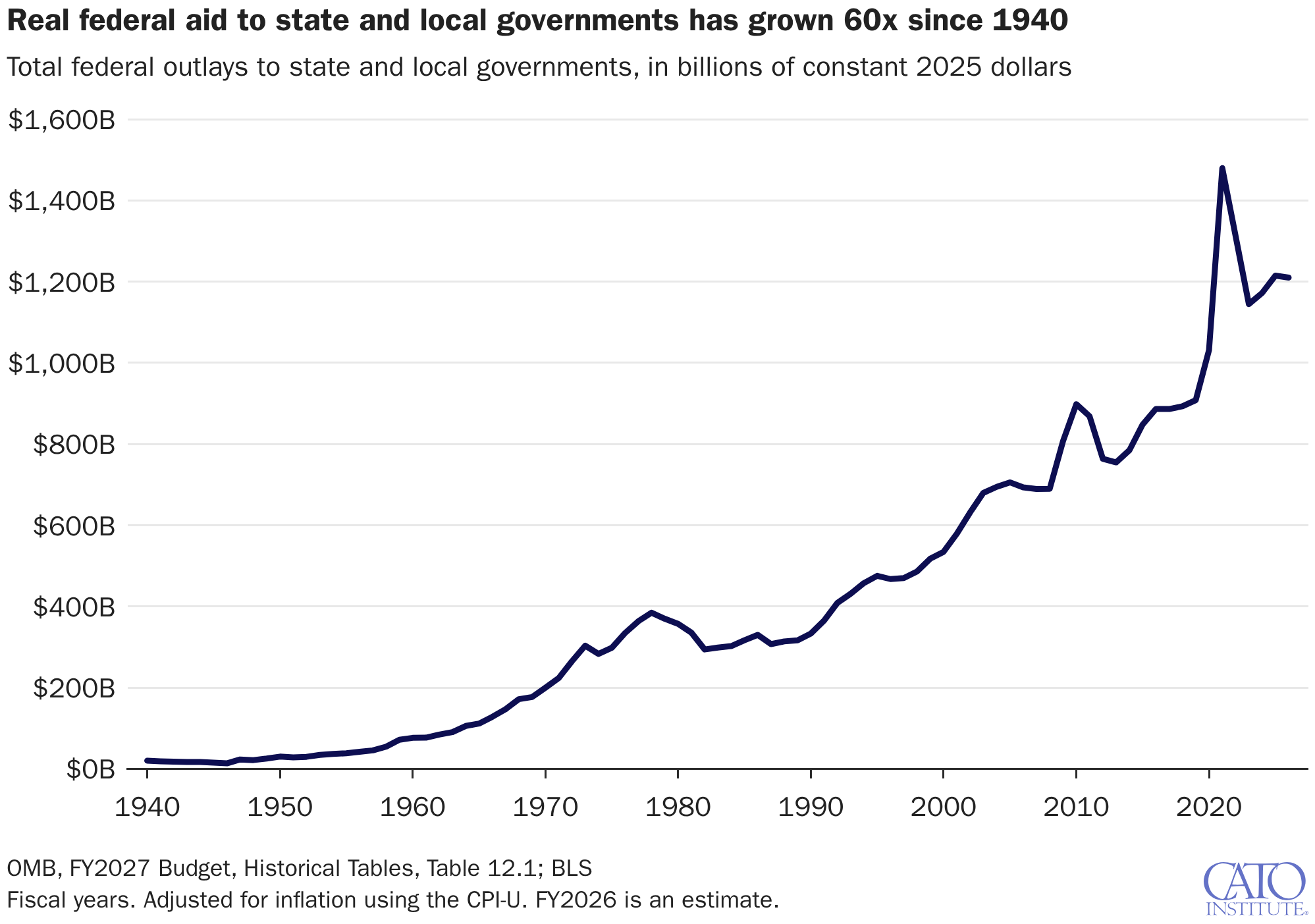
Further, state and local governance should not depend on an increasingly dysfunctional and heavily indebted federal government, and the staggering volume of grant programs means that Congress is unable to provide meaningful oversight of most of them.
Congress Can Stop Grant-Based Coercion
Congress should rein in the Trump administration’s overreach. For example, the Senate added language to a continuing resolution pushing back against the administration’s proposed rulemaking that would centralize grantmaking power with political appointees. While the administration’s separate immigration-related grant maneuver would be more complicated to stop, Congress should still intervene.
More fundamentally, Congress should simply reduce the number and funding level of federal grant programs, with the goal of eliminating them altogether. Drawing down federal aid to state and local governments would reduce the deficit while also rebalancing the distribution of power in a manner that is healthier for American democracy. Most of the programs in question are funded through the appropriations process. Changing course will require moving away from the habit of governing through various continuing resolutions and instead scrutinizing programs unrelated to proper federal responsibilities.
Congress should not only block the administration’s power grab but also reduce incentives for similar power grabs by limiting the amount of power that flows through federal grants.
