The American Legislative Exchange Council has just released its latest Report Card on American Education, and will be hosting an event to launch it in Washington, DC, tomorrow, at the Heritage Foundation. I haven’t had a chance to get very far into it yet, but it was established on Monday of this week that ALEC can predict the future, so it’s certainly worth a look.
Cato at Liberty
Cato at Liberty
Education

Today is the mid-point of National School Choice Week, and we’re once again rockin’ to the oldies of prognostication. This time we’re going all the way back to the Mann. That’s Horace Mann, the “Father of the Common School” himself.
It is Mann who, among many things, is probably most responsible for introducing one of the deepest underlying sentiments supporting government schooling: that public schools will unify us and give us peace. As he waxed eloquent in his first annual report as Secretary of the newly-constituted Massachusetts State Board of Education:
Amongst any people, sufficiently advanced in intelligence, to perceive, that hereditary opinions on religious subjects are not always coincident with truth, it cannot be overlooked, that the tendency of the private school system is to assimilate our modes of education to those of England, where churchmen and dissenters, —each sect according to its own creed,—maintain separate schools, in which children are taught, from their tenderest years to wield the sword of polemics with fatal dexterity; and where the gospel, instead of being a temple of peace, is converted into an armory of deadly weapons, for social, interminable warfare. Of such disastrous consequences, there is but one remedy and one preventive. It is the elevation of the common schools.
How wrong Mann was.
Keep in mind that as of 1837, the year Mann gave his first address, some pretty impressive unifying things had happened in America despite education being grounded in families, private schools, and yes, churches. We’d established unified colonies; penned and ratified a Declaration of Independence that enunciated foundational American values; fought and won a war against the greatest military power on Earth; established a new nation; and created a national government based on a Constitution that — though it’s legs are under constant assault — still stands.
But let’s get to Mann’s prediction: Did “elevation of the common schools” end “social, interminable warfare”?
Not on your life. Indeed, by attempting to force diverse people into a monolithic system of government schools, it most likely exacerbated social tensions and sparked otherwise avoidable wars. To name just a few school-stoked conflagrations (both real and rhetorical):
- The Philadelphia Bible Riots of 1844, sparked by a dispute over whose version of the Bible — Roman Catholic, Protestant, or neither — would be allowed in the public schools. By the conclusion of the rioting hundreds of people had been killed or injured and millions of dollars of property damage inflicted. Similar conflict — though not as physically destructive — occurred in many other American towns, with social strife largely only lessened when Catholics established their own school system.
- The Scopes “Monkey” Trial, a sensational case that grabbed the attention of the entire nation as a Tennessee court ruled whether or not it was acceptable to teach evolution in public schools. It is a topic that continues to rip communities apart today, and is so hot that, even where state standards mandate evolution be taught, most biology teachers avoid it. They simply don’t want to deal with the acrimony that would ensue.
- In 1974, Kanawha County, West Virginia, was plunged into a state of near-civil war over books selected by the county school district that many residents perceived to be anti-Christian and anti-American. Before the strife subsided commerce had ground to a halt, at least one person had been shot, and schools had been dynamited.
These are just some of the most well known or violent of the battles in the “interminable warfare” sparked not by private schooling, but the public schools Mann promised would bring peace if they became ascendant. Indeed, as I itemized in an analysis of just the 2005-06 school year, values-based skirmishes are fought all around us, all the time, whether over prayer in the schools, reading assignments, bullying and student speech, ethnic studies, and on and on. But that is exactly what we should expect when people of widely diverse religions, ethnicity, and philosophies are all required to support a single system of government schools. They won’t just give up the things that are often at the very heart of their lives — they will fight to have them taught.
Perhaps the biggest irony in all this is that students who attend private schools, even after adjusting for important non-school factors, are actually more knowledgeable about civics, active in their communities, and tolerant of others than are public school students. As University of Arkansas professor Patrick Wolf discovered in reviewing the empirical literature:
The statistical record suggests that private schooling and school choice often enhance the realization of the civic values that are central to a well-functioning democracy. This seems to be the case particularly among ethnic minorities (such as Latinos) in places with great ethnic diversity (such as New York City and Texas), and when Catholic schools are the schools of choice. Choice programs targeted to such constituencies seem to hold the greatest promise of enhancing the civic values of the next generation of American citizens.
How could this be? Because, in contrast to the assumption of Mann and others, most people don’t have to be forced to embrace tolerance and responsible freedom, they choose them. Public schooling, conversely, sends the message that government, not individuals freely working together, is responsible for whatever problems communities face. Even more importantly, by forcing diverse people together, government schools drop them into a zero-sum arena and render conflict all but inevitable.
Common schools haven’t brought us peace in our day. Indeed, quite the opposite.
Back in 1993, when Whitney Houston hit #1 with “I will always love you”, there was something that California-based state schooling advocates didn’t love at all: a school voucher ballot initiative. Much was written on the subject, and in 1994 a booklet was published summarizing the arguments for and against (Voices on Choice, K. L. Billingsley, ed.). In today’s School Choice Week installment, we’ll hear from those who were agin’ it.
Maxine Waters, United States Congress (D, Los Angeles):
“Contrary to claims, school choice will be devastating for urban, minority, and poor students who desperately need quality education.”
Delaine Eastin, California State Representative (D, Fremont):
“Having schools without [government] standards won’t improve learning.” Private school choice “won’t teach more kids how to read and write.”
Well, actually… U.S. private school choice programs usually do improve student achievement significantly in one or more subjects, and they have never been shown to have a negative impact on student achievement. The domestic scientific evidence to that effect was collected and summarized last March by Greg Forster, for the Foundation for Educational Choice. I do have one quibble with the report (it doesn’t count the insignificant findings in studies that have at least one significant finding, as is standard practice in literature reviews) but even after addressing it the aforementioned statements would still hold true.
Heck, even the few choice programs that don’t currently seem to be raising test scores are substantially raising students’ graduation rates–and doing it at substantially less cost to taxpayers than the state schools.
What’s more, when we cast a wider net and look at scientific studies comparing government and independent schools within countries all over the world, the results are even more dramatic. In fact, it is the least regulated, most market-like schools that most consistently outperform state-run monopoly school systems such was we have in the U.S.
Delaine Eastin:
“[T]his initiative allows schools to fail. But it does nothing to protect taxpayers when they do. When public school systems go belly up as a result of the voucher initiative, the courts are likely to rule that taxpayers will be stuck with the tab—and it won’t be cheap.”
Modern private school choice programs have been operating around the country for as long as twenty years, and I know of no case in which they have been found to increase the total burden on taxpayers. In fact, the only systematic studies of the issue find that these programs save taxpayers money—sometimes quite a bit of it. Florida’s legislature has studied the fiscal impact of that state’s k‑12 scholarship donation tax credit program, and found it to save $1.49 for every $1 it reduces revenues. That’s a nearly 50% return.
What’s more, the program has been found in two separate studies to both improve achievement of students who remain in public schools and to improve achievement of students who receive scholarships to attend private schools. It’s not hard to fathom why: on average, private schools spend thousands less per pupil than does the public school monopoly.
Warren Furutani, past president, Los Angeles City Board of Education:
“It is no coincidence that dollars are being pulled from our underfunded, overburdened school system at the same time our governor and the president of this nation are pushing vouchers and choice.”
Um… Yeah… About that claim that “dollars were being pulled” from “underfunded” public schools in California. I just happen to have the actual spending trend handy:
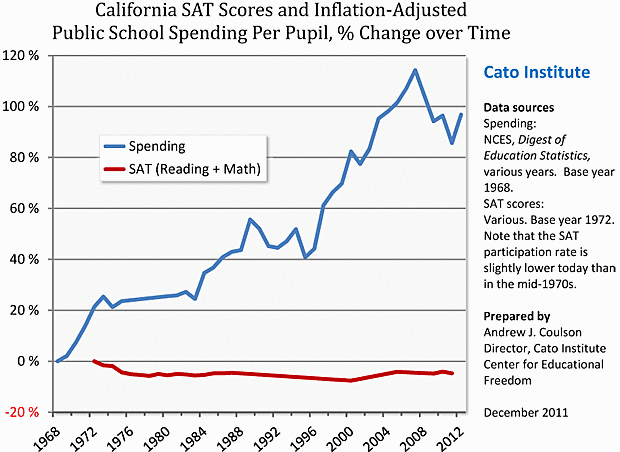
So, not only were these Status Quo Stalwarts unable to correctly predict the future, they had some difficulty accurately describing the present. Oh, and while thrifty school choice programs around the country have been improving student achievement and attainment, it’s hard to say the same for the California’s state education monopoly.
Related Tags
*by 2005…
Defenders of the educational status quo have long argued that we don’t need wholesale reform because our state-run school system can be fixed. If we simply raise spending, shrink classes, hire more teachers, or wait for the latest government mandate to work, they’ve promised, our problems will be solved. Reformers have predicted the opposite: that pouring more resources into the public school monopoly will only make it more expensive, not better, and so we need to inject real parental choice, get rid of the red tape that hobbles educators, and unleash market incentives. Who’s right?
My colleagues and I at Cato’s Center for Educational Freedom normally answer that question with empirical research, but in honor of School Choice Week
we’re taking a different tack. We’re letting the status quo defenders and reformers speak for themselves, by dredging up their predictions of decades past to see who was a Nostradamus and who a Nostradumb—. To kick off this week-long series, here’s our first blast from the educational past:
“School Spending Predicted to Climb 50% by 2005” [Education Week, Sept. 22nd, 1994]
A report published by the American Legislative Exchange Council predicted that public school spending would climb “from nearly $262 billion in 1994 to $386 billion by 2005.” ALEC also warned that the new spending would do little to help children learn, because public schooling is a government-run monopoly and monopolies are notoriously wasteful and inefficient.
Not everyone agreed. The Ed. Week story cautioned that ALEC’s “projections do not square with [substantially lower] federal estimates, and school finance experts have questioned their methodology.”
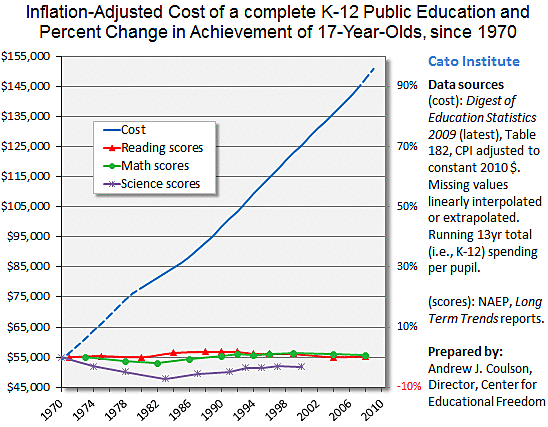
Who was right? To find out, we first have to adjust ALEC’s prediction to account for inflation (their estimate of what spending would be in the year 2005 was, of necessity, made in 1994 dollars, which were worth a lot more than dollars in 2005). Using the BLS inflation calculator, we find that ALEC’s prediction amounts to $509 billion in 2005 dollars. That turns out to have been… too low. Real U.S. public school spending in 2005 was $529 billion, according to the 2008 federal Digest of Education Statistics.
As for student achievement, ALEC was right about that, too. Tested near the end of their k‑12 schooling, students performed no better in 2005 than they did in 1994—or, for that matter, in 1970 (see chart below).
Related Tags
As I explain in an op-ed in today’s Orange County Register, that’s not a theoretical question. After adjusting for inflation and enrollment growth, CA spent $27 billion more on K‑12 public schooling in 2010 than it did when Jerry Brown was first elected governor back in 1974. SAT scores fell over that period (see chart below).
And if a $27 billion spending boost was associated with a decline in SAT scores, why would anyone expect Governor Brown’s proposal to raise another $7 billion in education taxes to do any good?
Note that the above version of the chart includes an extra two years of (estimated) spending data from the Brown administration’s current budget document, compared to the version than ran in the OCR. I’d left off those years because I didn’t want to include estimates, only concrete figures, but I’ve already been asked about them so I include them here. The picture’s the same either way.
Related Tags
On Sunday we marked the tenth birthday of the No Child Left Behind Act by reviewing its decade of futility and explaining why federal education adventuring is basically doomed to failure. (Enjoy some of our extensive coverage here, here, and here.) This week we got yet more evidence that federal policy is always big on promises, itty-bitty on results. According to the latest reports, most of the winners of President Obama’s $4.35-billion “Race to the Top” competition are well off pace to fulfill the promises they made to get the dough. Well off schedule, that is, except for adopting the laughably dubbed “state-led and voluntary” national curriculum standards that the federal Race to the Top essentially demanded they use.
It’s just as I warned back in 2009, when Race to the Top was all the transformative rage in both left and right edu-policy circles:
Have plans for reform? Sure. Break down a few barriers that could stand in the way of decent changes? That’s in there, too. But that’s about it. And the money is supposed to be a one-shot deal – once paper promises are accepted and the dough delivered, the race is supposed to be over.
In light of those things, how is this more appropriately labeled the Over the Top Fund than the Race to the Top Fund? Because while not requiring anything, it tries to push unprecedented centralization of education power. It calls for state data systems to track students from preschool to college graduation. It calls for states to sign onto “common” – meaning, ultimately, federal – standards. It tries to influence state budgeting.
To be fair, the feds could still hold states accountable and keep the RTTT dough if and when the states break their promises. But that would still be another failure, and all the money states and Washington will have spent on RTTT will have gone for naught. But, then, spending for naught is something we should be very much used to by now.
Ten years later, it’s clear that the No Child Left Behind law is a failure. Instead of driving better academic performance of K‑12 students, NCLB has cost many billions of dollars with no discernible positive impact on student achievement. Worse, the law has laid some of the groundwork necessary for the adoption of national standards, another step toward a fed-approved and standardized K‑12 curriculum, an outcome many of the law’s former proponents explicitly oppose.
Neal McCluskey argues in this new video that the only reasonable (and Constitutional) course for the feds now is to simply bow out of K‑12 education completely.