
I’ve crossed swords with Nobel Prize-winning economist Paul Krugman on health care. But in his latest Substack post, we are largely singing from the same sheet music (forgive the lengthy excerpts; I want to save all of this lest he delete it):
much of U.S. health care is already socialist. In fact, the government’s role is so large that U.S. health care is better described as partially privatized socialism than as anything resembling a free market…
government programs pay more total dollars for medical bills than the private insurers do…
by the raw numbers, then, U.S. health insurance looks as much public as private. But that understates the government’s role: Private health insurance in the U.S. is both highly regulated and heavily subsidized.This is obviously true for the insurance coverage purchased by tens of millions of Americans through the exchanges established by the Affordable Care Act. But employment-based health insurance, which covers 161 million Americans, is far more of a government creation than most people realize…
If your employer pays you $10,000, that’s taxable income. But if your employer pays $10,000 toward a company health insurance plan that meets certain criteria, it isn’t taxable. That’s a huge effective subsidy, running at more than $300 billion a year. Take that subsidy into account, along with the more than $100 billion per year spent subsidizing policies purchased under the ACA, as well as the outlays on Medicare and Medicaid, and net effect is that the government pays for more than two-thirds of Americans’ health insurance.
Granted, there are strings attached…
The fact is that virtually all of private healthcare insurance is already well under some form of government control through regulation and tax subsidies…
the way Medicare operates…could be summarized by the old Marxist slogan “From each according to his ability, to each according to his need.”…
if Medicare is socialism, then the whole U.S. health insurance system, with the government paying most of the bills and placing conditions on private insurers, is almost equally socialist. If you insist on calling any program the government pays for and regulates socialist, then U.S. healthcare would best be described as a partially privatized form of socialism.
I hit many of the same notes in National Affairs last year:
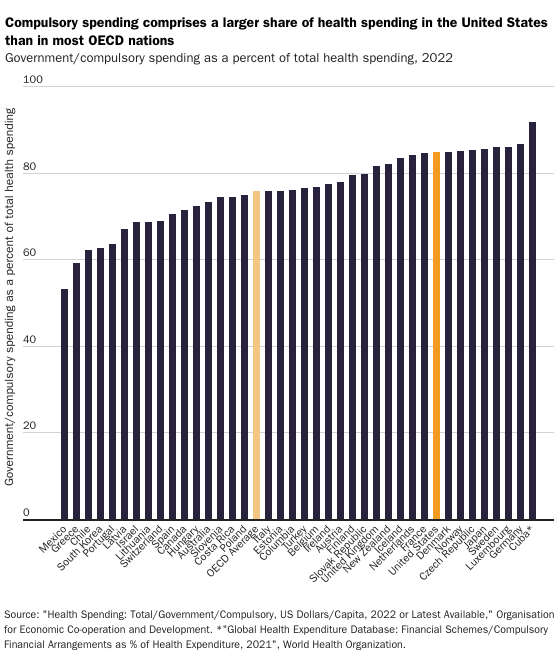
When it comes to government control of health spending, the United States is closer to communist Cuba (89%) than the average OECD nation (75%)
Of course, I disagree not only with Krugman’s conclusions (e.g., nearly everything supporters say about Medicare for All is incorrect) but also some of his premises.
Krugman has long held that pervasive market failure in health care necessitates government intervention. But a careful read shows that the sacred text on which he leans—fellow Nobel laureate Kenneth Arrow’s 1963 article “Uncertainty and the Welfare Economics of Medical Care”—does not necessarily support that conclusion.
Similarly, when Krugman says the government creates an implicit subsidy for employer-sponsored health insurance (ESI), he isn’t technically wrong. But he is making mistakes that muddle his analysis and his readers’ comprehension.
For example, Krugman misstates the size and the nature of the implicit subsidy for ESI. That subsidy equals the additional resources that people devote to ESI (i.e., the amount of additional ESI workers purchase) because the government threatens them with higher taxes if they don’t purchase ESI. The $300 billion figure Krugman cites, however, is an estimate of implicit penalties, not subsidies. It estimates the additional tax liabilities the government will impose on workers if they stop purchasing ESI.
In Krugman’s defense, nearly all economists follow this convention. But ubiquity does not absolve error. And it’s just…weird that economists have agreed to describe a tax penalty primarily in terms of an implicit subsidy it creates. I don’t recall any economists describing Obamacare’s individual mandate as an implicit subsidy for minimum essential coverage. So why do it here?
Krugman also laments that “last year Medicare Advantage plans were overpaid by $84 billion.” Converting that passive-voice construction to the active voice might help Krugman see that the organization that overpaid private insurers is the same one that he wants to control all health spending.
All that aside, Krugman’s post is a useful corrective to claims that the US health sector’s excessive prices and spending, low-quality care, and access gaps are due to free markets.
