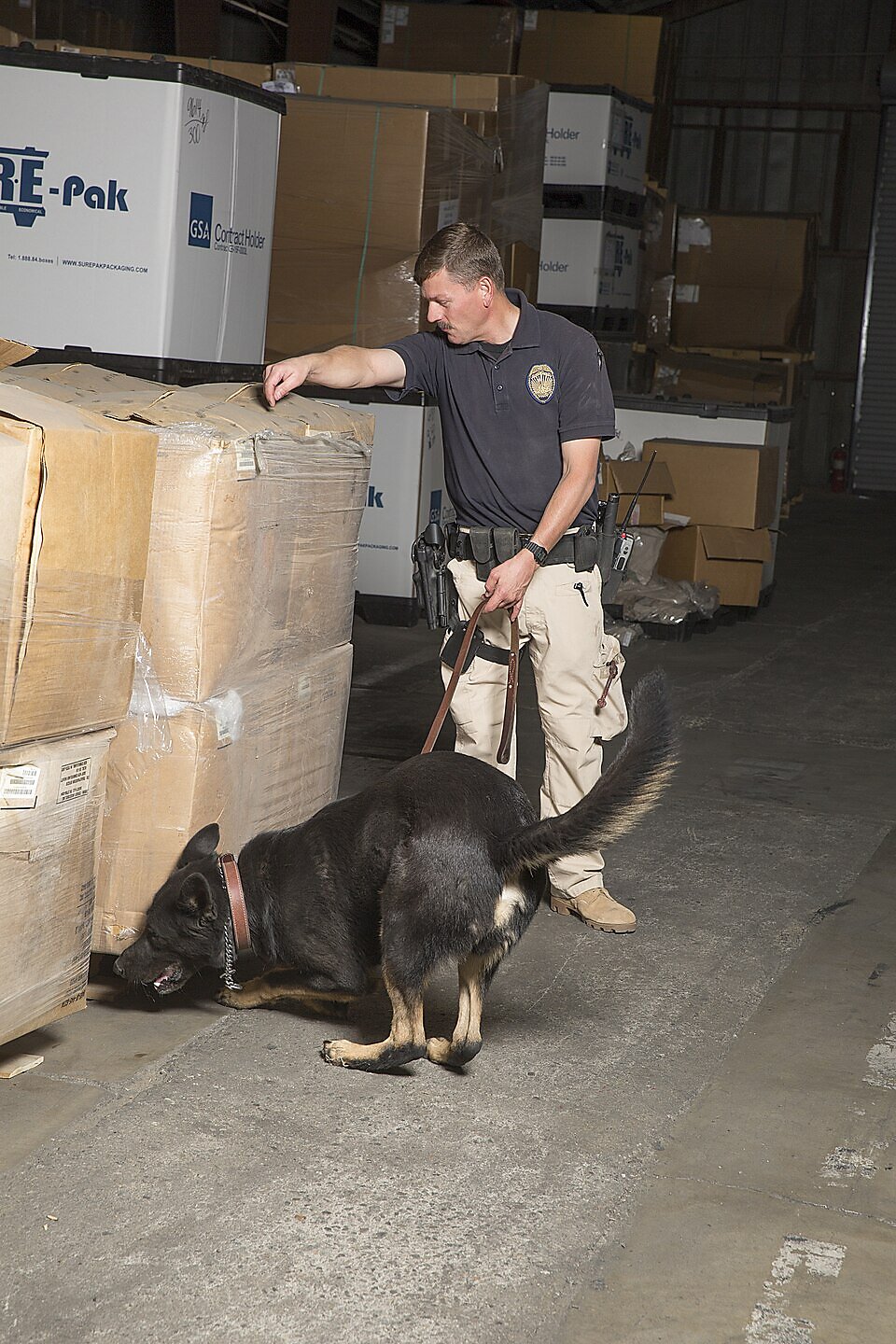
In March 2019, law enforcement officers, accompanied by a drug-detection dog, entered the locked hallway of a multi-unit apartment building. Petitioner Erik Johnson was one of the building’s tenants. Without Johnson’s knowledge and without a warrant, the dog sniffed the lower seam of Johnson’s front door and then gave an alert signaling the presence of narcotics.
The dog’s alert supported probable cause for officers to obtain a warrant and conduct a comprehensive search of Johnson’s home, which led to his being charged with drug and firearm offenses. Johnson moved to suppress the evidence. The district court denied the motion, and Johnson was convicted following a jury trial. On appeal, he argued that the sniff of his front door constituted an impermissible, warrantless search. The Fourth Circuit disagreed for two reasons.
First, it held that drug-detection dogs are unique in that they can only detect contraband, and because there is no reasonable expectation of privacy in contraband, their discovery cannot violate the Fourth Amendment. Second, it distinguished the area surrounding the front door of an apartment from the front porch of a single-family home, holding that the curtilage doctrine (which protects the area immediately surrounding the home) does not afford Fourth Amendment protections to an alcove outside the door to an individual apartment located in a multi-unit building.
Johnson now seeks Supreme Court review, and Cato filed a brief supporting his petition. The decision below erred in both of its holdings. Although the Supreme Court has held that drug-dog sniffs are sui generis, it has never gone so far as to apply this reasoning to excuse warrantless searches of the curtilage. Moreover, any previously plausible justification for doing so has become untenable. In the years since this Court declared drug-dog sniffs unique, evidence has shown that the infallible drug dog is a thing of myth. Dog sniffs should be treated like other Fourth Amendment intrusions—especially in the area immediately surrounding the home.
Further, the decision below impermissibly curtailed constitutional protections in the domestic setting where they matter most. The fact that other tenants have access to a common hallway—one steadfastly locked against outsiders who might seek to enter—does not remove the privacy afforded to the curtilage. Apartment-building hallways, like homes, are not open to the public. And though tenants do not have an absolute right of exclusion over the hallways around their apartments, the same is true for homeowners.
One may conceivably hold a social license to dawdle indefinitely on a public sidewalk, but there is emphatically no right to linger uninvited beside a stranger’s front door—its adjacency to the world beyond notwithstanding. That holds true whether that person dwells in a freestanding house or is one of the millions of Americans who live in multi-unit apartment buildings.
The Fourth Circuit’s opinion would deny curtilage protections to anyone whose home happens to share halls and walls with others. But homes under a common roof should enjoy the same Fourth Amendment protections as those beneath their own eaves. And the people who live within apartment homes, whether due to the accidents of life or the realities of need, are no less entitled to constitutional privacy than are householders. The Supreme Court should grant review and reverse.
