The Census Bureau released the poverty report for 2025 yesterday, the first to cover a full year of the second Trump administration. According to the Official Poverty Measure (OPM), 10.2 percent, or 34.5 million Americans, live below the federal poverty level, a drop from 10.6 percent in 2024. The Bureau’s other yardstick, the Supplemental Poverty Measure (SPM), put the 2025 rate at 13.1 percent.
But both measures are deeply flawed. The OPM overstates poverty by not counting most welfare benefits, such as noncash assistance and refundable tax credits, as income. The SPM counts more of that spending but sets a poverty threshold that rises in real terms nearly every year, making it increasingly difficult to say whether the poor are better or worse off from one year to the next.
As a result, neither of the Census Bureau’s measures gives an accurate picture of poverty in America.
The OPM’s Trillion-Dollar Blind Spot
The OPM has been the federal government’s primary poverty measure since 1969, comparing a household’s pretax cash income to a fixed threshold that varies by family size.
The OPM counts “money income” such as pretax wages, Social Security benefits, and cash welfare from programs like Supplemental Security Income (SSI) and Temporary Assistance for Needy Families (TANF). Eligibility standards (and, by extension, spending) for many federal welfare programs, namely the Supplemental Nutrition Assistance Program (SNAP), school meals, Head Start, the Obamacare subsidies, and parts of Medicaid, use poverty guidelines derived from the OPM. But none of these programs’ benefits to recipients count as income when the OPM measures poverty. Housing subsidies and refundable tax credits from programs like the Earned Income Tax Credit (EITC) and Child Tax Credit (CTC) aren’t counted, either.
The result: a poverty measure that paints an inaccurate picture of the state of low-income households. For example, as Cato scholar John Early and former Senator Phil Gramm wrote in the Wall Street Journal last year, a single parent of two earning $11,000 a year qualifies for more than $53,000 in refundable tax credits and in-kind benefits, raising the family’s income to $64,000, but the federal government still counts that parent as “poor.”
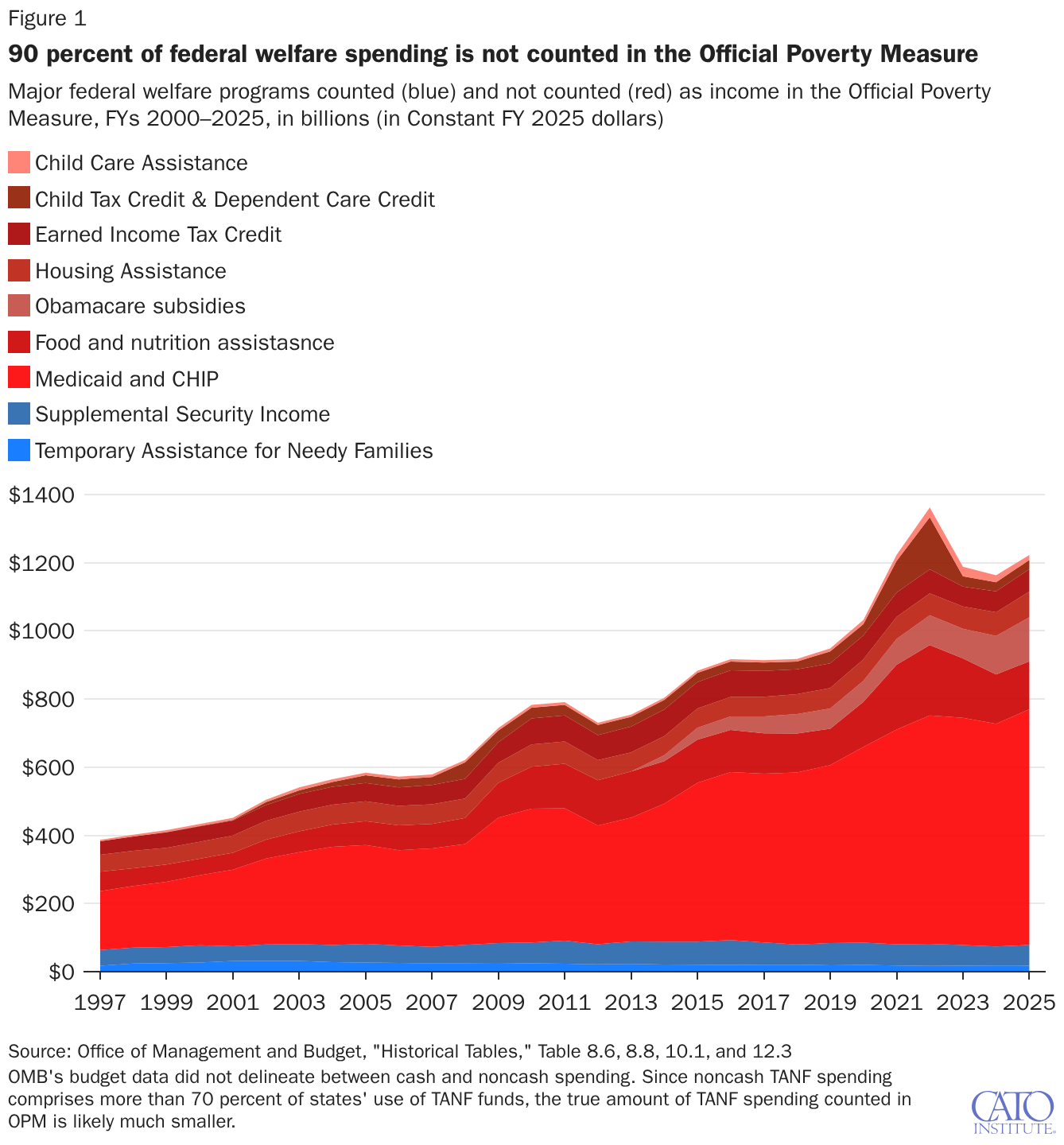
This accounting gap has only grown over time. Roughly 90 percent of the $1.2 trillion the federal government spent on major welfare programs in fiscal year 2025 fell entirely outside what the OPM counts as income (Figure 1).
The SPM Fixes One Problem and Creates Another
The Census Bureau’s SPM, introduced in 2011, addresses some of the OPM’s largest shortcomings. Notably, the SPM’s income measure includes refundable tax credits, food stamps, school meals, and other in-kind benefits that the OPM ignores. However, the SPM leaves out Medicaid, the largest category of welfare spending, and assigns no direct value to employer-sponsored health insurance.
The SPM’s other major problem is how the poverty threshold is set. Rather than using a single fixed threshold adjusted for inflation, as the OPM does, the SPM recalculates the threshold every year based on what a broad cross-section of American households, poor and non-poor alike, spent on food, clothing, shelter, and utilities over the preceding five years. When Americans in general spend more on those goods, the SPM’s poverty threshold rises to match, regardless of whether poor households actually have more resources to live on.
That design creates two distinct problems: First, the SPM ends up functioning more as an inequality metric than a poverty metric. The Council of Economic Advisers admitted as much in 2014, noting that “eliminating poverty defined with a relative measure may be nearly impossible, as the threshold rises apace with incomes.” The SPM’s poverty rate can drop even when the poor lose resources, so long as others lose more. Second, because SPM thresholds move with past spending patterns, SPM trends become increasingly difficult to interpret over time. These flaws undermine the SPM’s reliability in answering even the basic question of whether the poor have moved up the income ladder over the past decade.
A 2023 National Academies report recommended elevating the SPM to replace the OPM as the federal government’s primary poverty statistic, including for determining welfare program eligibility. AEI scholar Kevin Corinth estimated that this change would have raised the poverty guideline for a family of four by 34 percent (or $13,150) by 2033, thereby increasing federal spending on Medicaid and SNAP by at least $124 billion between 2024 and 2033 due to expanded eligibility.
What Fuller Measures Reveal About Poverty in America
Many economists have developed newer poverty measures that better account for poor households’ income from government benefits. Last year, the Congressional Budget Office (CBO) published a report with a new poverty measure that corrected many of the methodological flaws of the OPM and SPM. Notably, CBO’s measure included in-kind transfers, tax credits, and employer-sponsored health insurance. The measure also adopted the OPM’s fixed thresholds rather than adopting the SPM’s shifting standards.
CBO found that just 0.5 percent of Americans had income below the poverty threshold in 2021. Part of this was due to pandemic-era transfers, including multiple stimulus checks and the temporarily expanded Child Tax Credit. But even when averaged across the full 1979–2021 period, CBO’s measure put poverty at 3.5 percent, compared with 13.3 percent according to the OPM (Figure 2).

This more comprehensive measure also revealed a trend that neither the OPM nor the SPM fully captures: growing government transfers, not rising earnings, drove most of the decline in poverty since 1979. This suggests that America’s poor are increasingly reliant on government assistance, rather than earnings from gainful employment, to stay above the poverty line.
Getting the Numbers Right
Congress should require the Census Bureau to publish a poverty measure that accurately reflects the benefits low-income households receive. Senator Kennedy’s (R‑LA) Poverty Statistics Enhancement Act (S. 3756) would be a step in the right direction, requiring the Census Bureau to publish a new poverty measure using CBO’s methodology, alongside the OPM and SPM, in the agency’s annual poverty report.
A more comprehensive poverty measure that breaks down the components of poor households’ income, including an accurate account for welfare benefits, would give federal taxpayers a clearer picture of the effects of welfare spending. Policymakers could also better evaluate whether government transfers are helping people move up the income ladder and become self-sufficient, rather than simply substituting for work, or whether local communities and civil society are better positioned to address the individualized needs of those still entrenched in poverty.
