Chairman Hageman, Ranking Member Fernandez, and distinguished members of the subcommittee:
Thank you for the opportunity to testify on the reliability and affordability of America’s electrical grid. The Cato Institute is a nonpartisan public policy research organization dedicated to the principles of individual liberty, limited government, free markets, and peace. I am the Director of Energy and Environmental Policy Studies at Cato, and my research focuses on the economics and reliability of electricity, the role of free markets in improving the availability and affordability of energy and natural resources, and environmental regulations that impact the energy sector.
I commend you for examining the impacts of public policy on the reliability and affordability of America’s power grids, especially in the U.S. Insular Areas.
Executive Summary
Americans depend on a strong energy infrastructure for our health and well-being, and the electrical grid is the most important—and fragile—piece of energy infrastructure we have. Unfortunately, power grids across the country are damaged by public policies at nearly every level of government.
The stakes for policymakers are high, and the impacts of flawed energy policies are coming into starker focus every day. For example, Hawaii’s forced energy transition began to show signs of strain in January of this year, when the local utility was unable to meet demand for several hours during a rainstorm.
During extreme weather, Americans need reliable electricity to survive. Day to day, we need reliable and affordable electricity to thrive and grow.
The power grid should be an asset to American prosperity, but policymakers—through a multitude of subsidies, regulations, and mandates—have wounded it to the point that it is now becoming a dangerous liability.
I. Reliable and Low-Cost Electricity is Essential
At the turn of the millennium, the National Academies of Engineering ranked the electric grid the greatest engineering achievement of the twentieth century.1 The main criterion for selection was how much an achievement improved people’s quality of life. Access to reliable electricity improves the quality of life of every American.
There is a clear nexus between the affordability of electricity and energy security at the household level. A recent Congressional Research Service (CRS) report on electric utility disconnections highlighted the hardships and threats to energy security faced by many American families:
“Researchers estimate that approximately 1% of households are disconnected each year. Broader measures of energy insecurity (e.g., foregoing other necessary expenses like food or medicine) are higher, with approximately 30% of American households experiencing some form of energy insecurity. Black and Hispanic households appear more likely to be disconnected than non-Hispanic White households. For many American families, electric utility disconnections are the most significant threat to energy security.”2
Data compiled by CRS highlight the affordability challenge: “The share of Black households experiencing energy insecurity is about twice as high as that for White households (52% compared to 27% in 2020). Similarly, the share of Hispanic or Latino households experiencing energy insecurity is about twice as high as that for households that are not Hispanic or Latino (47% compared to 25% in 2020).”
In the U.S. Insular Areas—which have electricity rates3 and poverty levels4 that are well above the mainland U.S. average—access to affordable energy is an even greater challenge. Grants seeking to move Insular Areas away from fossil fuels will: 1) not meaningfully impact the global climate given their small greenhouse gas footprints and 2) exacerbate the energy insecurity of these areas by limiting their primary energy sources to intermittent, weather-based resources like solar and wind.
II. Energy Policies Are Undermining Reliability and Affordability
Under a reasonable set of regulations, electricity suppliers will rise to meet challenges and deliver low-cost, reliable electricity to consumers across the United States. However, energy and environmental policies are creating predictable problems with grid reliability and affordability.
Last year, for the first time ever, NERC identified energy policy as a leading risk factor for electric reliability.5 In NERC’s 2023 ERO Reliability Risk Priorities Report, the energy transition—specifically the changing resource mix—tops the risk rankings.
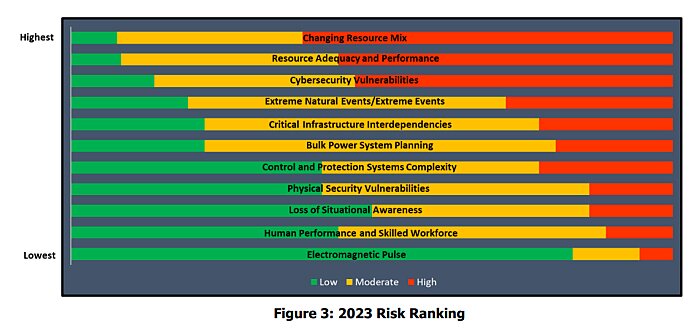
The reliability impacts on island systems could be more profound than the impacts on mainland systems. That is because smaller, islanded systems already face much lower levels of system inertia. In other words, energy policies that force the shutdown of high-inertia generators (such as large thermal plants fueled by hydrocarbons) place an outsized risk on island systems. Observers have been aware of the problems associated with inertia-less solar power for quite some time.
“Especially in island grids which already have a lower inertia than large interconnected systems, the frequency response will be highly deteriorated when conventional generation is replaced by solar or wind power.”6
In addition to minute-by-minute grid frequency challenges, forced retirements of thermal generation can also cause problems with aggregate electricity supply, commonly called resource adequacy. A lack of resilient supply caused more than 100,000 Hawaiians to lose electric service during a rainstorm in January of this year.7 Blackouts and cost increases should not be the norm in America, yet policymakers continue to set the stage for both.
Regarding cost increases, utility officials warned that the closure of Hawaii’s last coal-fired power plant would increase electricity rates because “oil-generated power costs as much as five times more than coal.”8 Oil-generated electricity may not always be so much more expensive than coal-generated electricity, but it is well known that oil markets are significantly more volatile than coal markets. Closing the door on coal and forcing island communities to get by on other resources clearly cuts against the goal of ensuring a reliable and affordable grid.
Below is a snapshot of three public policies that pose a significant risk to reliable, secure, and affordable electricity on the mainland and in the U.S. Insular Areas.
A. The Inflation Reduction Act Weakens the Grid with Subsidies
The Inflation Reduction Act (IRA) threatens to undermine the well-functioning of the power grid by flooding it with subsidized, intermittent energy. One inescapable fact of the electricity industry is that dispatchable resources are necessary to match supply with demand and keep the grid energized at all times.9 By providing unlimited amounts of subsidies to intermittent resources like wind and solar energy, the IRA erodes the economics of dispatchable resources.
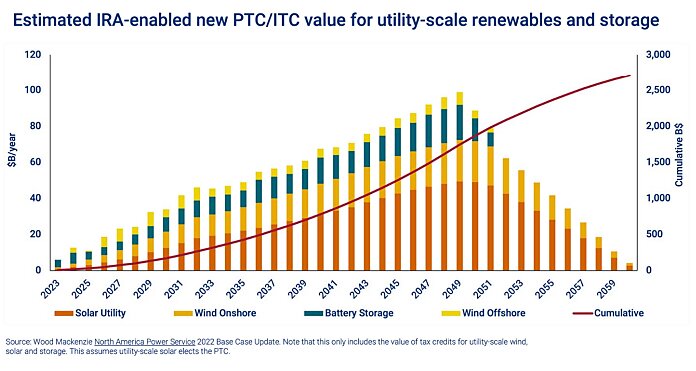
If we look beyond the 10‐year budget window, the cost of the IRA credits could increase and remain high for years, perhaps indefinitely. That is because the “applicable year” when the production tax credit (PTC) in the IRA is supposed to phase down is triggered by an impossible-to-meet greenhouse gas (GHG) reduction target. Specifically, GHG emissions in the electricity sector must fall to 25 percent of their 2022 level for the PTC to begin to phase down.
The total cost of energy credits in the IRA is an unstable number with no reasonable cap. Note that the target in the IRA is a GHG emissions level rather than a GHG intensity. The U.S. Energy Information Administration (EIA) analyzed electricity sector GHG emissions in the IRA reference case (and in the no‐IRA case) and found neither case to hit the “applicable year” target by 2050. Hence, the IRA subsidies are set to pile up for decades, potentially reaching $3 trillion in just the PTC alone.10
The distinction between a level-based and intensity-based target matters because electricity demand is growing, making the IRA targets even harder to hit. The chart below assumes GHG emissions targets will be hit around the year 2050.11 It is an illustrative example of how large the IRA subsidies could be. To be clear, I do not believe the GHG emissions targets in the IRA will be met by 2050.
As discussed below, the IRA also enables the Environmental Protection Agency (EPA) to claim certain unproven technologies are adequately demonstrated when, in fact, they are merely adequately subsidized. Thus, the IRA forms the basis of the EPA’s Best System of Emission Reduction (BSER). Basing permanent rulemakings on temporary budget reconciliation measures like the IRA is inappropriate.
B. EPA Regulations Hurt Reliability and Affordability
The EPA’s regulatory regime is laden with legal infirmities, conflicts of interest, and technical and economic problems. The proposed power plant GHG regulation—sometimes referred to as CPP 2.0 because it’s the second attempt at a Clean Power Plan—relies on technologies that have not been “adequately demonstrated” by any stretch of the meaning of that term.12 The proposal is so legally dubious that I am concerned the goal of the policy is to inject uncertainty in the planning and financing of hydrocarbon-based electricity generation rather than to enact a durable regulation.
As mentioned above, the energy subsidies in the IRA enable the EPA’s overreach because they allow the EPA to set standards based on hypothetical deployment of highly subsidized resources. In the CPP 2.0 proposal, EPA relied explicitly on the subsidies in the IRA to claim that the BSER technologies—carbon capture and storage (CCS) and low‐GHG hydrogen—are “adequately demonstrated.”13 A corollary of EPA’s reliance on IRA subsidies is that, when fiscal realities demand a claw-back of IRA subsidies, the CPP 2.0 will have to be clawed back as well.
Assuming CPP 2.0 does not receive an immediate stay from the courts, its practical impact will be to greatly reduce the supply of electricity. Given that CCS is not commercially available at any useful scale, the only compliance option for owners of coal-fired power plants is to shut down. The same goes for natural gas-fired generators—low‐GHG hydrogen is at best very expensive and at worst unavailable. The inevitable result of the rule is the shutdown of a significant amount of reliable generation.
The proposed tailpipe emissions standard, if found to be legal, will of course limit the choices Americans have in our vehicles, but it will also greatly increase the demand for electricity. That is because a significant amount of the energy needed for transportation will have to shift from being supplied by petroleum (gasoline and diesel) to being supplied by the power grid. In other words, the tailpipe rule will further increase demand growth, which is already accelerating.
The result of reduced supply and increased demand is straightforward to predict: increased prices and, unfortunately, energy shortfalls. What that means for a typical electricity consumer is a higher power bill and an increased risk of blackouts.14 According to NERC, we are already in an elevated risk scenario. Hence any EPA proposal to force an increase in demand or a decrease in supply—including the tailpipe rule and CPP 2.0—will further weaken an already fragile grid.
III. EPA’s Regulatory Impact Assessments Are Inadequate
In the case of both the tailpipe rule and CPP 2.0, the EPA used a proprietary model developed by an outside consulting firm to estimate the impacts of the rules on the retail price of electricity. Although the price estimates are something of a black box, there are indications that the process is deeply flawed.
The draft regulatory impact assessment for the tailpipe rule states that “[r]egional average retail electricity price differences showed small increases or decreases (less than approximately 1 to 2 percent),” meaning that EPA’s price model violates the law of supply. In no case should a rule that forces the rapid electrification of the transportation fleet—which represents a large increase in the demand for electricity—cause a reduction in prices.
Regarding the price impacts of CPP 2.0, EPA finds that vastly reducing the supply of electricity generation would only increase retail electricity prices by 0.2% in 2035 on average.15 This is an implausible estimate made possible by a proprietary model. Why would the EPA not rely on the Energy Information Administration, an independent wing of the U.S. Department of Energy? The EIA is more than capable of modeling the cost impacts of CPP 2.0, as it showed when it modeled the cost impacts of the original Clean Power Plan using the National Energy Modeling System.16
The EPA could also inflate the estimated benefits of its own regulations. In both the tailpipe rule and CPP 2.0, the EPA is poised to use a greatly increased estimate of the Social Cost of Carbon Dioxide (SC-CO2) to justify its proposals. One fundamental problem (among others) is that the EPA is moving ahead of the Interagency Working Group process to update the SC-CO2 and instead using its own estimate. In other words, the EPA can print its own regulatory currency—the SC-CO2—to be used in justifying its own rules under the required cost-benefit analyses.
As I wrote in formal comments to the EPA regarding CPP 2.0, the EPA should improve its rulemaking by offering an objective, unbiased assessment of the reliability and cost impacts.17 To that end, the EPA should issue a new supplemental notice seeking comment on the impact of the rule on the cost of electricity.
IV. A Reliable and Affordable Grid Requires Less Government Intervention
As I see it, there are two starkly different paths forward regarding electricity policy. The first, which I endorse, is to embrace American values and foster an electricity industry that is built on fierce competition to serve consumers. The second, which I fear is taking hold presently through the IRA and EPA rules discussed above, is to force an unwise transition to politically favored, intermittent resources.
Intermittent resources such as wind and solar energy should be allowed to take their rightful place in electricity systems. Congress should remove the IRA subsidies (along with all energy subsidies, including subsidies for hydrocarbons and nuclear energy) to encourage right-sized investments in energy resources that leave electricity customers and federal taxpayers better off. The IRA will force significant amounts of intermittent energy onto the grid—far more than would be consistent with the goal of ensuring a reliable grid at least cost to consumers and taxpayers. At the same time, the EPA is recklessly shutting down reliable generation.
Rather than allowing an energy crisis of their own making to unfold, policymakers should foster a reliable, low-cost grid that provides a solid foundation upon which to build a strong and growing American economy. The way to ensure a robust grid is simply to remove the harm inflicted by unwise energy policy.
Finally, I urge policymakers to show restraint and humility when interfering with the electric power sector. Policymakers have important decisions to make about America’s energy future, and it is vital that members of Congress and other policymakers first do no harm. As NERC has noted, “[e]ducation for policymakers and regulators to increase awareness of the reliability implications of policy decisions is a critical need.”18
Thank you for the opportunity to provide testimony on the critical issue of the reliability and affordability of America’s electric grids.

About the Author


This work is licensed under a Creative Commons Attribution-NonCommercial-ShareAlike 4.0 International License.