Within hours of the Supreme Court’s decision on February 20, 2026, to strike down President Donald Trump’s tariffs under the International Emergency Economic Powers Act (IEEPA), the administration pivoted to a different executive authority and implemented sweeping tariffs. Invoking Section 122 of the Trade Act of 1974, Trump imposed a new 10 percent global tariff with numerous exceptions, arguing that the United States faces “fundamental international payments problems” stemming from “large and serious” balance-of-payments (BoP) deficits.1
The administration’s proclamation marshaled a list of reasons for finding that such a BoP deficit exists: a $1.2 trillion goods trade deficit in 2024, a US balance on primary income that turned negative in 2024 after being in surplus for decades, deficits in voluntary transfers such as remittances, and a decline in the United States’ net international investment position.2 The administration claims that, altogether, these factors constitute the kind of international payments crisis that Section 122 was designed to address.
Notably, these justifications refer to subcomponents of the BoP that are either negative or trending downward. Yet the BoP is an accounting identity that summarizes America’s international transactions. A deficit in one of the three primary components of the BoP—the current account, the capital account, and the financial account—or any of their subcomponents (e.g., the trade deficit is the largest subcomponent of the current account) must be offset by surpluses across the other components or subcomponents. The BoP, thus, should be equal to zero by construction. When Sections 122 was legislated, a BoP “deficit” had a specific, technical definition relating to pressure (or potential pressure) on the value of the US dollar and US official reserves (i.e., gold).
Substantial debate—historical, economic, and legal—has centered on whether Section 122 fits the current moment.3 Experts point out that the global economy has changed significantly from the 1970s, when Section 122 was drafted, debated, and enacted, and that the factors that led to BoP crises under the former Bretton Woods monetary system no longer exist.4 Moreover, the current state of the US BoP does not suggest that the country faces “fundamental international payments problems,” a large trade deficit notwithstanding.
Two lawsuits, one by a coalition of 24 state attorneys general and another by a pair of small businesses, have been filed against the president’s Section 122 tariffs in the Court of International Trade (CIT).5 On May 7, 2026, a 2–1 decision from the CIT ruled the tariffs illegal. The court reasoned that the administration had relied on trade and current account deficits to proclaim the tariffs—not a BoP deficit under Section 122 as the term was understood at the time of the statute’s enactment. The court, however, declined to issue a universal injunction and instead granted relief to only the three plaintiffs that successfully established standing—the two private importers and the state of Washington.6 The government promptly appealed the CIT’s ruling to the US Court of Appeals for the Federal Circuit, which temporarily paused the injunction on May 12.7
As this is the first time that Section 122 has been invoked, the prospects for these lawsuits are unclear. A holistic analysis of the historical context in which Section 122 was enacted, the underlying economics of the BoP, and the statute’s text and legislative history nevertheless reveals that the administration’s invocation of Section 122 is fundamentally flawed.
The Global Economy Has Changed Significantly Since Section 122 Was Enacted
To understand why the Trump administration’s invocation of Section 122 is so legally strained, it is necessary to understand the monetary world that produced the statute—a world that ceased to exist more than 50 years ago.
Toward the end of World War II, with the Allied powers increasingly convinced of their eventual victory, delegates from more than 40 countries gathered in Bretton Woods, New Hampshire, to design a postwar monetary system.8 The system’s architects were trying to prevent a re-creation of economics during the interwar period, when competitive devaluations, capital controls, and economic nationalism crippled international trade and deepened the Great Depression. In the view of many American policymakers at the time, those realities contributed to the political and economic instability that made World War II possible.9
The architects at Bretton Woods created an international monetary system of fixed exchange rates, gold convertibility, and reserve exhaustion, which governed the global economy from 1944 until the system’s de facto breakdown between 1971 and 1973. Under Bretton Woods, the dollar was pegged to gold at $35 per ounce and other major currencies were pegged to the dollar. The United States bore the obligation of standing ready to convert dollars into gold on demand from foreign central banks. A “balance-of-payments deficit” had a precise—and alarming—meaning under the system: Foreign banks were accumulating more dollars than they wished to hold voluntarily and could demand gold in exchange, draining US reserves.10 By the late 1960s, foreign dollar holdings of nearly $50 billion far outstripped the US gold reserves of roughly $10 billion, making it mathematically impossible for the US to honor its convertibility obligation.11
On August 15, 1971, President Richard Nixon closed the gold window.12 A short-lived attempt to salvage the Bretton Woods system through the so-called Smithsonian Agreement collapsed by March–April 1973, when several of the world’s major currencies, including the US dollar, began to float freely.13 International efforts to reform the global monetary system concluded in 1976, after the Board of Governors of the International Monetary Fund (IMF) approved amendments to the fund’s Articles of Agreement that legalized floating exchange rates and abolished gold’s formal role in the system. These measures entered into force in 1978.14 This change effectively ratified what markets had forced into existence. And with that, the “classic” BoP deficit problem that Section 122 was designed to address ceased to exist.15
Section 122 and the Legal “Smoking Gun”
Section 122(a) mandates the president to temporarily restrict trade, including by imposing tariffs of up to 15 percent for a period of no more than 150 days (unless extended by an act of Congress):
Whenever fundamental international payments problems require special import measures to restrict imports—
(1) to deal with large and serious United States balance-of-payments deficits.
(2) to prevent an imminent and significant depreciation of the dollar in foreign exchange markets, or
(3) to cooperate with other countries in correcting an international balance-of-payments disequilibrium.16
President Trump relied on the first of these three prerequisites for action under the statute.
The language in a separate provision of Section 122 itself refutes the administration’s reading that a large trade deficit (and deficits in other subcomponents of the current account) constitute a BoP deficit. Remember, Section 122(a) mandates the president to temporarily restrict trade “whenever fundamental international payments problems require special import measures … to deal with large and serious United States balance-of-payments deficits.”17 On the flip side, Section 122(c) authorizes the president to temporarily liberalize trade, including reducing tariffs by up to 5 percent “whenever the President determines that fundamental international payments problems require special import measures … to deal with large and persistent United States balance-of-trade surpluses.”18
In other words, Congress used “balance of payments” in one subsection and “balance of trade” in another—in the same statute, in adjacent provisions, deliberately. It is inconceivable that Congress intended for these distinct concepts to be used interchangeably. The statutory architecture only makes sense if Congress viewed the two issues as requiring distinct responses. The CIT’s majority opinion took the same view, reasoning that this distinction—together with Section 122’s legislative history—confirms that “balance-of-payments deficits” is a “term of art” with a specific and objective meaning.19
The United States’ filing at the World Trade Organization (WTO) to notify and justify the current tariffs further clinches the argument. On March 20, 2026, the US notified the WTO’s Committee on Balance-of-Payments Restrictions that it was invoking Article XII of the General Agreement on Tariffs and Trade (GATT), the provision governing the use of import restrictions to address a depletion of official monetary reserves, as the international law basis for the Section 122 import restrictions.20
This is a significant concession. GATT Article XII has a precise and well-understood meaning: It permits import restrictions only to “forestall the imminent threat of, or to stop, a serious decline in [a contracting party’s] monetary reserves, or in the case of a contracting party with very low monetary reserves, to achieve a reasonable rate of increase in its reserves.”21 This is exactly the classic Bretton Woods understanding of what a “balance-of-payments” crisis means. The same understanding is reflected in what economic historian Phillip Magness identifies as the correct historical reading of Section 122 and in the House Ways and Means Committee report discussing the statute, which cited a “large decline in the US net international monetary reserve position” as the paradigm case for invoking Section 122.22
By filing under Article XII, the administration implicitly acknowledged that the operative international standard is reserve depletion, not a trade deficit. Yet the WTO filing contains no reserve data, no IMF assessment, and no attempt to show that US monetary reserves are threatened or declining. It simply restates the White House’s proclaimed conclusory finding. The Trump administration cannot credibly argue before US courts that a trade deficit constitutes a “large and serious balance-of-payments deficit” under Section 122 while simultaneously grounding its WTO notification in GATT Article XII—a provision whose logic rests entirely on reserve adequacy, not trade flows.
History Confirms Flaws in Trump Administration’s Use of Section 122
The Nixon administration developed the legal provisions that became Section 122 in March 1973, less than two years after the president’s decision in August 1971 to suspend the dollar’s convertibility to gold and impose a 10 percent supplemental tariff.23 As Magness notes, this decision came after the United States registered a record-high deficit in its official reserves—that is, a BoP deficit.24 Nixon reportedly used the duties as leverage for negotiations with industrialized countries in Europe and Asia (primarily, West Germany and Japan) aimed at devaluing their currencies in relation to the US dollar.25 By March 1973, the exchange rates agreed upon as part of the resulting Smithsonian Agreement were abandoned, effectively signaling the end of the Bretton Woods system.26 Meanwhile, Nixon’s emergency tariff was challenged in court.27
While the US dollar and other major currencies effectively floated at that point, the future of the international monetary system remained unclear. For one, floating exchange rates contravened the IMF’s Articles of Agreement. On the other hand, international discussions on monetary reform aimed for a system of “stable but adjustable par values with some provision for floating rates,” not wholesale floating.28 It would take until 1976 for monetary officials to agree on amendments to the IMF’s Articles of Agreement that legalized floating exchange rates through the Jamaica Accords.29 President Gerald Ford signed legislation authorizing US acceptance of the amendments in 1976, and the reformed articles entered into force in 1978.30
Against this backdrop and the Nixon administration’s goal that the Trade Reform Act of 1973 (original name) be part of a broader approach to reforming the global economic system and achieving equilibrium in international payments, the president requested specific authority to “help correct deficits or surpluses” in the US payments position.31
Legislating Section 122
The Nixon administration’s proposed bill makes clear that the BoP was understood as a holistic concept, not a synonym for the trade balance. The administration’s bill explicitly stated that a “serious” BoP deficit would be considered to exist whenever the president found that:
(A) the balance of payments (as measured either on the official reserve transactions basis or by the balance on current account and long-term capital) has been in substantial deficit over a period of four consecutive calendar quarters, or
(B) the United States has suffered a serious decline in its net international monetary reserve position, or
(C) there has been or threatens to be a significant alteration in the exchange value of the dollar in foreign exchange markets.32
In other words, the administration did not look at only one particular component or subcomponent of the balance of payments (e.g., the trade balance) to conclude that a serious BoP deficit justified additional tariffs.
The House did not vote on the Nixon administration’s bill and instead considered its own version of the Trade Reform Act (which was seemingly drafted in concert with the executive, as it sought a bill that would pass without detrimental amendments).33 The House bill kept the president’s authority to address BoP crises via trade measures (now codified as Section 122), albeit with a different statutory architecture and guardrails (i.e., a tariff ceiling of 15 percent and a time limit of 150 days).34 Notably, the House bill also omitted the criteria that the administration’s bill had outlined for finding that a “serious” BoP deficit existed, with the Ways and Means Committee reporting that “it is not possible to formulate a definition with mathematical exactness.”35 Nevertheless, the committee report on the bill strongly suggested that it also did not equate a BoP deficit with a deficit in one of its subcomponents:
For the purposes of [Section 122(a)], a “large and serious US balance-of-payments deficits” shall be considered to exist whenever the President determines that the balance-of-payments has been in substantial deficit over a period of time and that such deficit is likely to continue in the absence of corrective action. A large decline in the US net international monetary reserve position would be evidence of a serious balance-of-payments deficit.36
The committee report also cited the BoP position in August 1971 (i.e., the month Nixon imposed the 10 percent tariff) as an example of a “large and serious” BoP deficit. The committee pointed out that the deterioration of the US trade balance “together with enormous pressures of liquid capital movements resulted in an annual rate of deficit based on the official settlements basis of $23 billion during the first 6 months of 1971.”37 The CIT’s majority similarly interpreted the committee’s drafting choices—the deletion of the parenthetical definition in the administration’s bill and the omission of a specific measurement formula in lieu of a requirement that BoP deficits be “large an serious”—not as license for the president to select any subaccount he chooses but as a means to grant flexibility to the president while circumscribing his authority.38
After the bill passed the House, the Senate Finance Committee revisited Section 122 and amended the language in subsection (c) regarding presidential authority to liberalize trade to deal with a fundamental international payments problem. Whereas the House bill provided that the president could lower tariffs whenever “large and persistent balance-of-payments surpluses” were present, the committee amended this term to “balance-of-trade surpluses.” The committee’s report on the bill explicitly notes that this change was a deliberate legislative choice:
The Committee felt it important to alter the sections of the House bill which would have provided authority to reduce tariffs and/or suspend quotas whenever there was a finding of a persistent balance of payments surplus, because it is possible, indeed likely, that there will be a large influx of short term and long term funds from oil-producing countries which could create a large payments surplus while at the same time, the United States may be suffering a large trade deficit. In these circumstances, eliminating or reducing barriers to US imports would not be a proper remedy for a US balance of payments surplus induced by an inflow of “petrodollars.”39
In other words, the committee specifically contemplated a scenario in which the balance of payments and the balance of trade pointed in opposite directions—a payments surplus alongside a trade deficit—and concluded that they required different policy responses. That was the opposite of the administration’s position, which treated a trade deficit as though it automatically creates a BoP problem that justifies import restrictions.
The same Senate Finance Committee report also makes clear how narrowly Congress understood Section 122, noting that the BoP authority it was conferring “is not likely to be utilized.”40 Congress expected the provision would address rare monetary emergencies, not serve as a general-purpose tariff lever.
Section 122 Was Outdated from the Outset
The provisions that became Section 122 were scrutinized as the bill moved through Congress. Witnesses at hearings before the House Ways and Means and Senate Finance Committees questioned the effectiveness of using tariffs to address fundamental BoP problems in light of the US adopting a floating exchange rate.41 Rep. Henry Reuss (D‑WI), who would later chair the House Banking Committee, approved of the bill yet described Section 122 as “superfluous and unwise” given the dollar’s floating rate.42 House Ways and Means Committee Chair Wilbur Mills (D‑AR) and Nixon’s Treasury Secretary George Schultz agreed that exchange rate adjustments, rather than tariffs, would be a more effective solution for a longer-term BoP problem.43
The Trade Act of 1974 was enacted on January 3, 1975, meaning that Section 122 lay in disuse for more than 50 years until President Trump used it to impose the current 10 percent tariffs. In most of the intervening years, the US had run persistent trade deficits, yet presidents had not felt compelled to invoke Section 122. This issue came to a head in 1984, when the Senate Finance Committee asked the Reagan White House to determine the applicability of the statute for addressing the nation’s trade deficit. As Magness explains, Martin Feldstein, the chair of Reagan’s Council of Economic Advisers, rejected this contention, arguing that because net private investment offset the US current account deficit, the country did not need to draw down its official reserves and thus the US was not experiencing a BoP deficit.44
The long-run inaction under Section 122 is particularly telling because Section 122(a) requires the president to take action to deal with international payments problems caused by BoP deficits. The Senate explicitly changed the House version of Section 122(a) to make presidential action not a matter of discretion but a requisite. (Under the statute, if the president determines that taking action would be contrary to US national interests, he or she must consult with designated congressional advisers from the House Ways and Means and Senate Finance Committees.45) While the Senate report is silent on who ultimately determines the existence of a “fundamental international payments problem” (the House report suggests that it is the president), it is telling that there is no known instance of a president refusing to take action under Section 122 and informing Congress thereof.46
The Economics of the Balance of Payments Today
The US balance of payments is a summary of American international transactions involving goods, services, and investment. It has three subcomponents: the current account, the financial account, and the capital account.47 The trade balance, meanwhile, is one component (albeit the largest) of the US current account. As an accounting identity, the BoP should always equal zero—with deficits in one subcomponent being offset by surpluses in the others.48 The Peterson Institute’s Kimberly Clausing and Maurice Obstfeld have explained that a BoP deficit results from a country having insufficient private financial inflows to finance its current account deficit, forcing it to draw down reserves.49
That description bears no resemblance to the United States today. The dollar’s reserve currency status means foreign investors willingly hold dollar-denominated assets, providing financial inflows that offset the current account deficit. When investment inflows are included, the US registered a BoP surplus of approximately $96 billion in 2025 (Figure 1).50
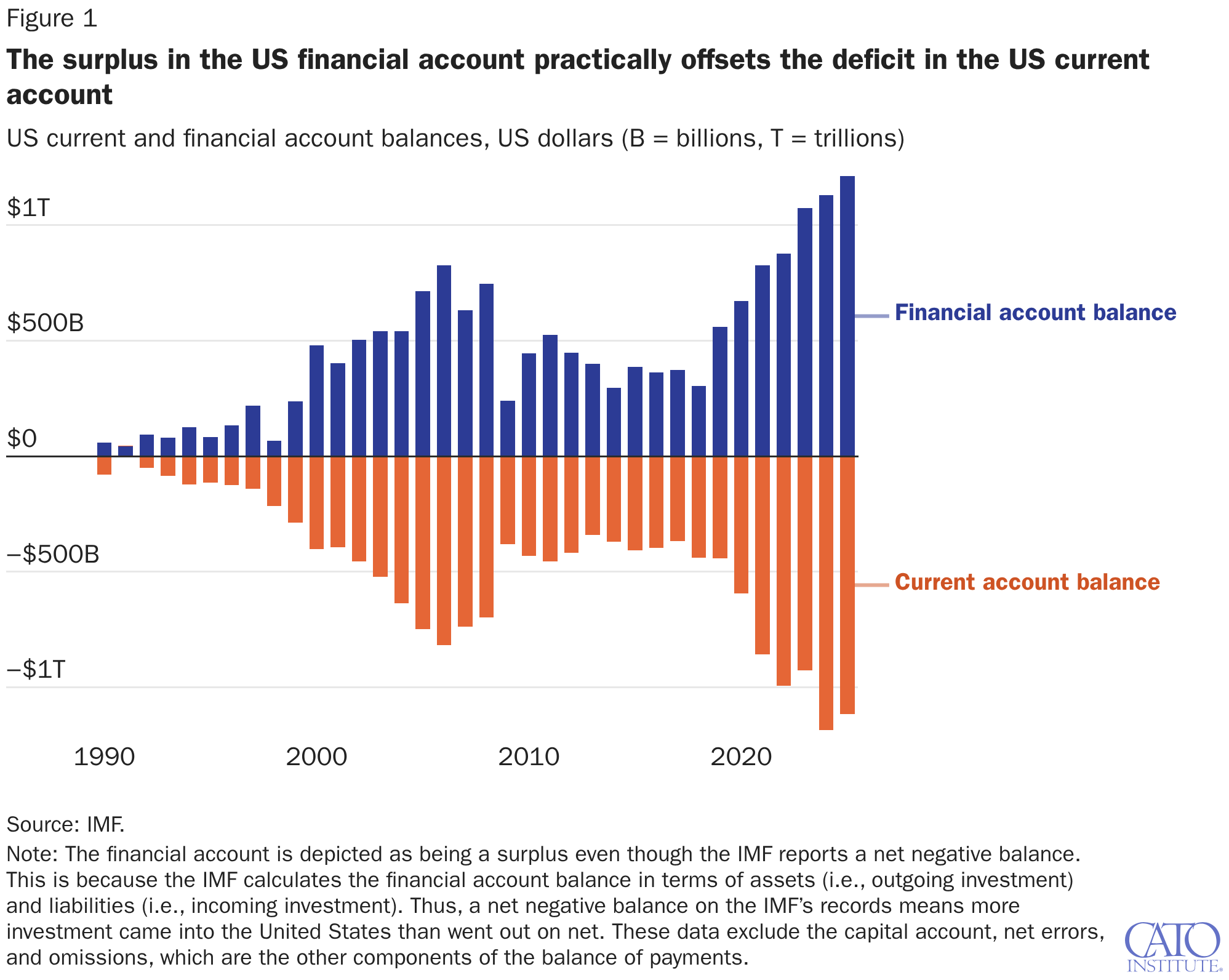
In its announcement claiming serious BoP deficits, the Trump administration also cited the deterioration of the United States’ net international investment position (NIIP) with liabilities exceeding assets by roughly $26 trillion, or 89 percent of GDP in 2024. This claim fares no better as evidence of a payments emergency. Former IMF second-in-command Gita Gopinath recently explained that the deterioration of the United States’ NIIP has little to do with persistent trade deficits. Instead, it largely reflects the dramatic outperformance of US equities relative to foreign equities over the past decade. Accounting for only current account flows, the NIIP would be around −50 percent of GDP, only marginally higher than in 2015.51
Nor does the administration’s implicit theory—those countries running large bilateral trade surpluses with the US are the ones accumulating American assets—withstand scrutiny. As Gopinath also noted, China has run the largest surpluses over the past 10 years yet has shifted some investment away from the US. Instead, it is smaller-surplus European countries and Japan that are acquiring US assets.52 In other words, the causal link the administration implies simply does not exist.
Even though President Trump has tried to justify the tariffs as necessary “to deal with large and persistent balance of payments deficits” pursuant to Section 122(a)(1), the economics of the BoP today explain why the alternative justifications under the statute also do not hold up. Section 122(a)(2) permits tariffs “to prevent an imminent and significant depreciation of the dollar.”53 Measured against a basket of currencies, the US dollar indeed depreciated by 8 percent between January 21, 2025, and February 19, 2026 (i.e., the day before the Supreme Court’s IEEPA ruling), but this rate of change is not uncommon over the course of a year in the floating-rate era.54 (And in fact, the dollar has slightly appreciated since the ruling.55)
More importantly, the depreciation since January 2025 is the result of other political and economic factors, not the US being unable to finance its current account deficit (which it does year after year through financial account surplus). Because these accounts practically offset each other, it is unnecessary to impose tariffs “to cooperate with other countries in correcting an international balance-of-payments disequilibrium” under Section 122(a)(3), notwithstanding concerns about excess surpluses and deficits across different countries’ current accounts.56
Conclusion: Implications for Courts and Congress
The Trump administration likely understands that this legal fight will almost certainly not be fully resolved before the 150-day clock for Section 122 expires on July 24—and that the tariffs are designed to serve as a bridge to longer-term authorities under Sections 301 and 232.57 But that litigation strategy doesn’t make the underlying legal theory sound, as confirmed by the CIT’s May 7 ruling. (It also does not insulate the administration from having to refund importers if courts ultimately find these tariffs to also be illegal.) A plain reading of Section 122’s text, confirmed by its legislative history and the administration’s own prior admissions, makes it clear that Congress did not authorize tariffs to address trade deficits. In fact, as an amicus brief filed by 48 economists before the CIT indicates, Trump’s reading of Section 122 would transform the statute from a tool to address a narrowly defined set of circumstances into one that can be arbitrarily invoked at any time, given that by definition, some components of the BoP will always be in deficit.58 If the president wants that extraordinary power, the proper course is to ask Congress for it.
The dissent in the CIT’s ruling previews an issue that could bear on appeal: Courts may determine that the administration is not limited to finding the existence of a BoP deficit on the basis of the measures used by the Bureau of Economic Analysis to compute the BoP at the time of Section 122’s enactment.59 As these measures are moreover no longer published, the courts could find that the administration has more flexibility in ascertaining the existence of a BoP deficit through alternate measures and that these factual findings—along with a determination that a “fundamental international payments problem” exists—are beyond the scope of judicial review.60 If so, the litigation may not succeed even if the overarching statutory argument that the trade or current account deficits do not amount to a BoP deficit are correct, giving Congress all the more reason to step in and reform the law.
Congress should first decide whether Section 122 is worth keeping, given how much the international economy has transformed since the statute’s enactment. If it decides in the affirmative, Congress should then aim to clarify the meaning of “large and serious balance-of-payments” deficits in a system of floating exchange rates, including specifying that a deficit in a component or subcomponent of the BoP alone does not amount to a crisis. Congress should also add more procedural guardrails to the granting of product exemptions—that is, requiring the administration to justify each exemption. If Section 122 is indeed meant to address systemic issues and be nondiscriminatory, it belies logic, and the purposes of the statute, that the president can grant nearly 80 pages of product exemptions by simply appealing to the “needs of the United States economy” or that identical products could be subject to differential treatment if one is imported under a certain trade agreement and the other is not.61
US trade policy in 2026 should not be dictated by statutes designed to address problems that arose under conditions from a bygone era, especially if those statutes only contain limited guardrails against executive branch abuse.
About the Authors


This work is licensed under a Creative Commons Attribution-NonCommercial-ShareAlike 4.0 International License.