In October 2025, the US Senate passed Sen. Tim Scott’s (R‑SC) Renewing Opportunity in the American Dream to Housing Act of 2025 (the ROAD to Housing Act) as an amendment to the National Defense Authorization Act (NDAA) for fiscal year 2026.1 The ROAD to Housing Act is mostly a continuation of the status quo in federal housing policy, but it would increase federal involvement in state and local zoning decisions, a significant negative change.
The larger problem is that the act is based on a misguided housing shortage narrative, much like the story that has driven federal housing policy for decades.2 Because it is based on this false premise, Americans are likely to incur negative unintended consequences from the act, including further distorted home prices and potential overbuilding. Overall, it is unlikely that the policies in the ROAD to Housing Act will satisfy many critics of federal housing policy over the past few decades.
This briefing paper explains how the housing shortage narrative is misguided and provides an overview of the ROAD to Housing Act. While it does not provide a comprehensive analysis of the act, it does provide several examples of how the act perpetuates the policy status quo and increases federal involvement in housing. As the House and Senate conference committee negotiates the final version of the NDAA, members should reject the policies in the ROAD to Housing Act.
The Housing Shortage Narrative Is Flawed
The narrative of the US housing “shortage” (or “crisis”) is a main justification for many of the policies in the ROAD to Housing Act. Section 5203 of the act claims that the United States “is facing a housing supply shortage” across the United States. This narrative is flawed in many ways.
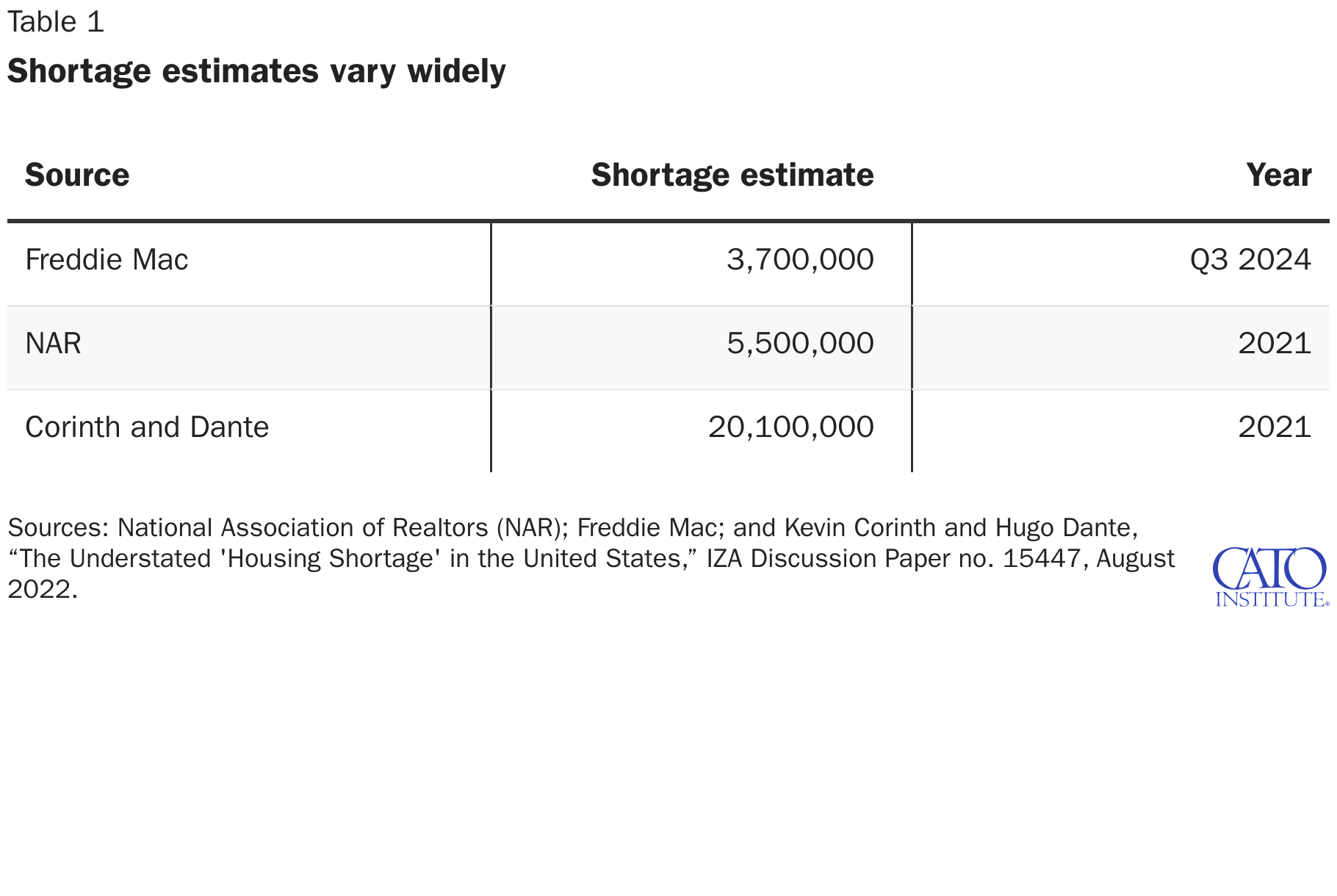
Proponents of this narrative typically cite a wide range of housing shortage estimates published by various groups, including the government-sponsored enterprise Freddie Mac and the National Association of Realtors (see Table 1).3 However, these estimates are typically produced by models that rely on subjectively determined variables, such as target vacancy and household formation rates. Moreover, output from these models is very sensitive to small changes in such variables, and reasonable alternative assumptions can easily convert estimated housing shortages into surpluses.
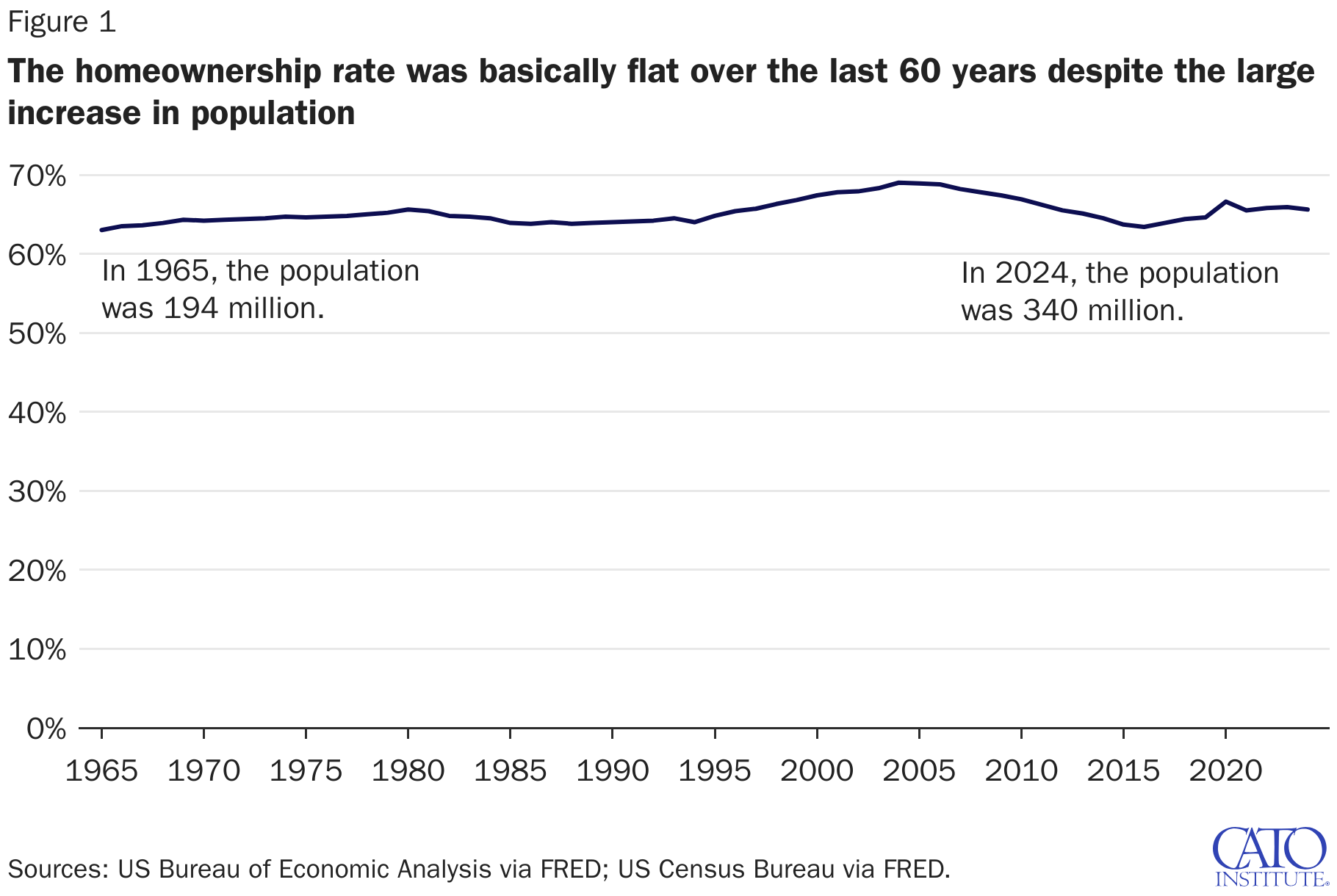
Aside from these models, a great deal of basic data undermines the crisis narrative. For instance, housing construction at the national level displayed an increasing trend between 2012 and 2024, declined in early 2020, and then quickly recovered.4 While the US homeownership rate rose slightly from approximately 63 percent to 65 percent between 1965 and 2024, the US population increased from 194 million in 1965 to 340 million by 2024, thus indicating a much larger number of people owning homes (see Figure 1).5 While the optimal number of homes could still be larger, especially with less regulation, it is difficult to characterize this kind of market as one in crisis.
Moreover, annual home price appreciation has slowed since the pandemic peak, largely due to (among other factors) higher interest rates and a relatively high inventory of homes for sale.6 While there was a spike in home prices during the pandemic, one that can be attributed to multiple unique factors, that period also coincides with record low interest rates and the Federal Reserve’s large-scale purchase of agency mortgage-backed securities, a program which the Fed ended in 2022.7
Median annual housing cost as a percentage of income has been relatively flat since 2001 and is down to 22.4 percent from its 2011 peak of 24.6 percent. This relationship holds for renters, first-time homebuyers, repeat homebuyers, and all households in general.8 In fact, in 2024, the median cost of a home sold was a smaller portion of median household income than any year between 2013 and 2018.9
While house prices as a percentage of income have increased over the long term, housing is a normal good, and Americans have experienced phenomenal real income growth during the past several decades. Of course, it is possible that prices for normal goods can also rise if supply is restricted, and there is little doubt that there are too many regulatory restrictions on supply. However, people have been able to spend a larger portion of their income on housing while still having a larger amount of income leftover, so it is not surprising that housing demand would have increased.10
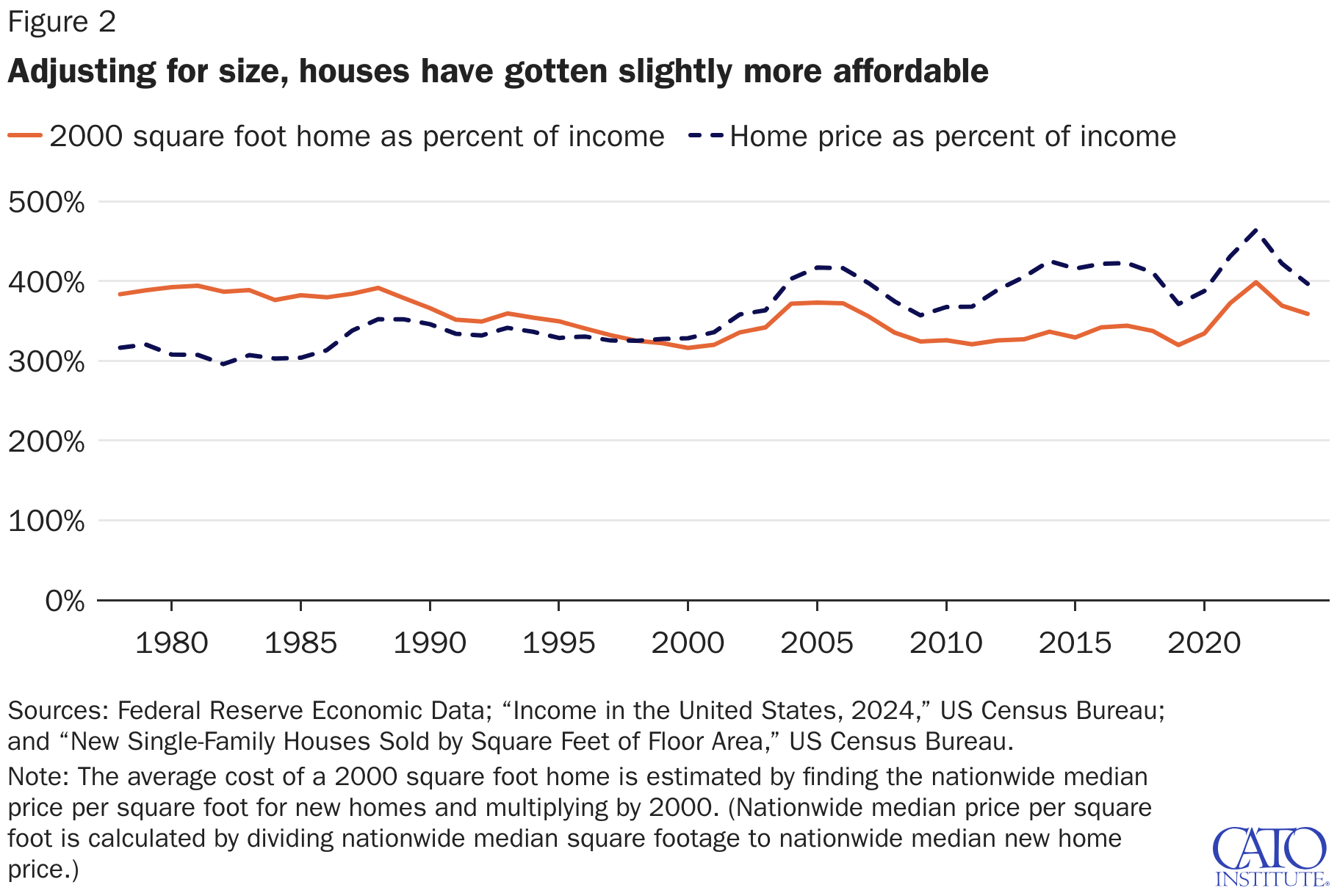
As a result, homes have gotten larger and are now standard with what would historically have been considered luxury features: items such as garages, air conditioning, and extra rooms.11 Per square foot, housing is basically as affordable now as it was 40 years ago, and these larger houses are being shared by fewer people as households have been getting smaller. For the median household, the amount of housing (measured by square footage) that can be bought with a year’s worth of income has been relatively flat since 1978 (see Figure 2.) Naturally, had there not been so many zoning and land-use restrictions across the nation, Americans would have likely been able to purchase even more housing.
A Note on Prices, Supply, and Zoning Regulations
Many have argued, as do proponents of the ROAD to Housing Act, that a low supply of housing was the main driver of high prices during the pandemic. As with the broader crisis story, there is good reason to question this argument.12
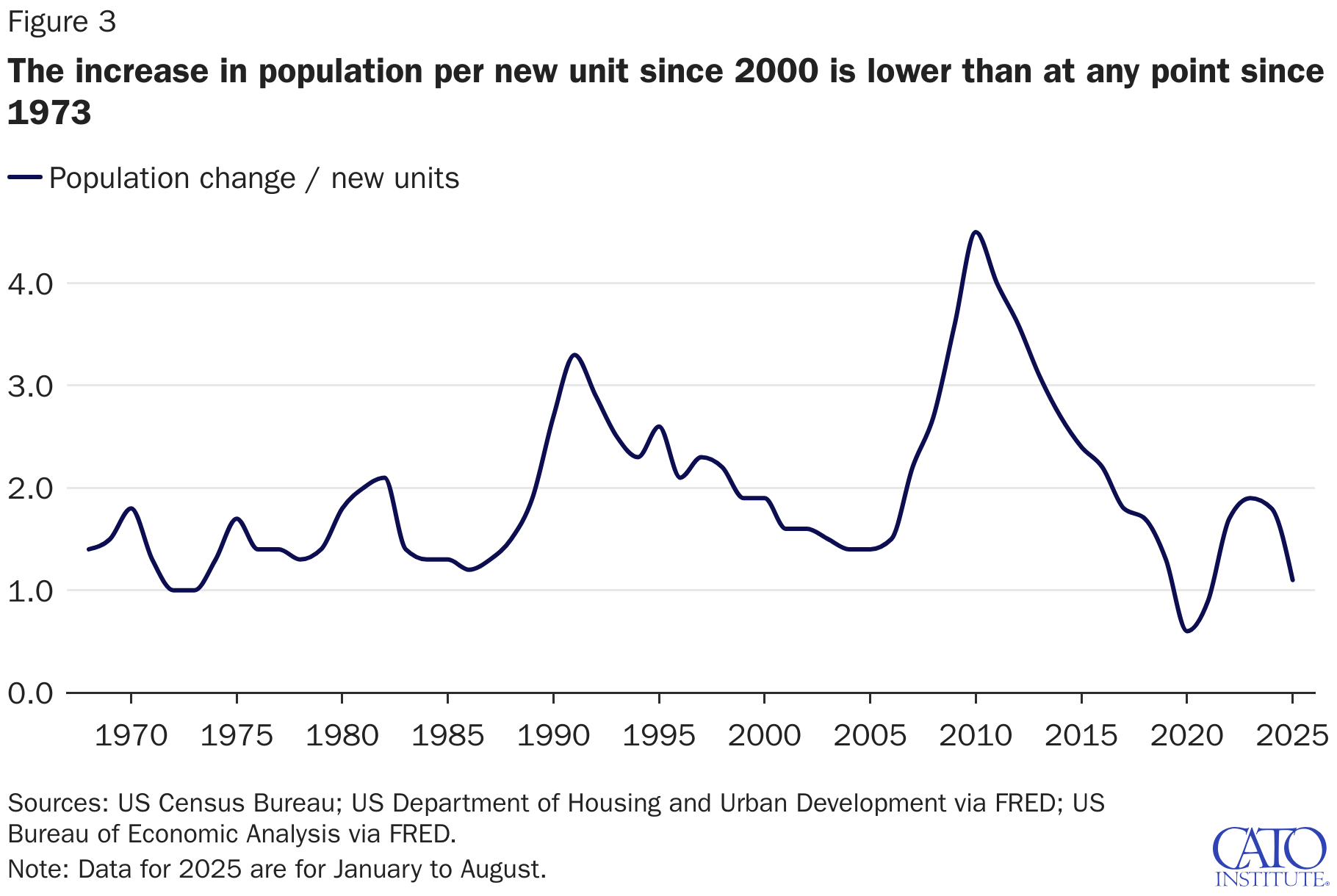
For starters, a relatively large amount of housing was built relative to the increase in population at that time. As Figure 3 shows, the increase in population per new unit constructed declined steadily between 2010 and 2020, and after 2020 it has been lower than at any point since 1973.13 This pattern implies that, at the very least, a relatively higher volume of housing has been built compared to population growth.14 Naturally, the optimal quantity of housing could be larger still, but it is difficult to characterize a housing market that tends to keep up with population growth as one in crisis.
Despite these trends, many housing advocates support efforts to relax zoning restrictions and other regulations that would make it easier and less costly to build new housing. We agree that local officials should undertake those efforts in their communities. Elected officials should be aware, though, that studies show no clear consensus on the effects of zoning deregulation on prices. In some cases, zoning changes are even associated with higher prices.15
To some degree, housing will always be supply-constrained, whether owing to construction time or the scarcity of available space to build in desirable areas, so local officials should always make the construction process as simple and straightforward as possible. However, it is important to note that there is demand for neighborhood-level restrictions, particularly by higher-income households. Absent land-use restrictions, private agreements by organizations such as homeowner associations could re-create or even increase local supply constraints, driving up prices on top of that from amenity effects.
Federal officials should not undertake efforts to drive home prices down nationally any more than they should undertake policies to drive up prices.16 To whatever extent a local housing market needs additional supply, driving prices down will be counterproductive because the more prices fall, all else remaining constant, the fewer houses builders will want to build. Perhaps more importantly, such a policy would have diverse effects on different groups of Americans, with existing homeowners most likely being made worse off. The overall welfare effects of such a policy are highly uncertain and potentially harmful. The federal government should do less to affect home prices, not more.
Regardless, these regulatory decisions, especially those concerning zoning and building codes, are best left to local officials who best know their constituents, rather than the federal government. Multiple provisions in the ROAD to Housing Act violate this principle.
The ROAD to Housing Act of 2025
The ROAD to Housing Act is a 316-page bill with eight separate titles. Among other items, the bill makes mild changes to several Veterans Affairs programs, requires additional oversight of multiple federal regulators, and requires multiple studies. It tries to address the alleged housing shortage by extending several old policies and implementing some new ones.
Expansions of Existing Programs in ROAD
Section 5101 of the act broadens the criteria under which the Department of Housing and Urban Development (HUD) can award grants to HUD-approved (public and private) organizations that provide homeownership and rental counseling. Since the Housing and Urban Development Act of 1968 was passed, HUD has been authorized to provide some types of assistance to these providers, and Section 1444 of the 2010 Dodd–Frank Act explicitly authorized HUD to award grants for counseling services.17 Section 5101 also authorizes HUD to review the performance of counseling agencies, and ultimately terminate assistance based on those reviews. Regardless of whether these changes improve accountability, it is difficult to see how they will materially affect the supply of housing.
Section 5205 of the act increases the maximum percentage that banks can invest in low- or moderate-income communities from 15 percent of their capital stock and 15 percent of their surplus to 20 percent (of each category). In 1992, the Depository Institutions Disaster Relief Act implemented this investment allowance with thresholds of 10 percent, and the Financial Services Regulatory Relief Act of 2006 increased the maximum percentages to 15 percent. It is very difficult to evaluate the marginal impact of any of these changes, especially given the myriad other policy incentives for banks to invest in low- and ‑moderate income communities.
Similarly, the act makes several other changes that seem unlikely to marginally increase housing supply. For instance, Section 5202 allows HUD to give additional weight to competitive grant applicants that are located in, or that primarily serve, a community designated as an Opportunity Zone, a designation that was created in 2017. Aside from whether the Opportunity Zone program is effective, HUD already awards grants for projects in Opportunity Zones. In fact, even developers who build apartment buildings are already eligible for Opportunity Zone credits.18
The ROAD to Housing Act also expands the Rental Assistance Demonstration (RAD) and Moving to Work (MTW) programs. The RAD program, created in 2012, was explicitly designed to help convert project-based public housing assistance into Section 8 rental assistance vouchers. On the surface, it is difficult to see how this expansion would increase the overall supply of housing, and at least one prominent group, the National Low Income Housing Coalition, opposes expanding RAD out of concern for “the enforcement of tenant protections” at RAD properties.19 Additionally, recent research on the RAD program suggests that areas with RAD redevelopment experienced “larger losses in very low-income residents compared to similar, untreated neighborhoods,” as well as “larger increases in rental housing costs.”20 Similarly, it is difficult to see how or why expanding the MTW program, created in 1996 to improve cost-effectiveness in public housing, would increase housing supply. Incidentally, the National Low Income Housing Coalition opposes the MTW and has long called for a full evaluation of the program.21
New Policies in ROAD
The act also includes several new policies with the explicit goal of increasing housing supply, but even some of these changes are truly just expansions of existing policies. For instance, Section 5206 authorizes HUD to adjust the amount received in Community Development Block Grants (CDBGs) based on improvements to housing growth in a metropolitan city or county.22 This provision allows HUD to use a formula that increases or decreases a locality’s CDBG based on whether its annual percentage increase in the number of housing units is above or below the median. While this formula will surely increase the amount of CDBG funds sent to various localities, it is not clear whether those funds will cause the supply of housing to be higher than it would be otherwise.
Section 5207 of the act amends the environmental review process to allow states, local governments, and Indian tribes to speed up authorization for housing developments. The act states that the HUD Secretary may “for purposes of environmental review, decision making, and action pursuant to the National Environmental Policy Act of 1969 … designate the treatment of assistance administered by the Secretary as funds for a special project for purposes of section 305(c) of the Multifamily Housing Property Disposition Reform Act of 1994.” Under current law, HUD is allowed to speed up funding for special projects provided that the “State or unit of general local government” agrees to assume all responsibility for environmental regulatory reviews. Section 5207 amends the law by adding the term “Indian Tribe” to “State or unit of general local government.”
Section 5208 of the act requires HUD to promulgate new regulations that exempt certain housing-related activities from federal environmental review regulations. The Senate Committee on Banking says that this section of the act right-sizes National Environmental Protection Act review for small and infill housing projects, but the details in the legislative language matter.23
First, the act gives this regulatory relief for “HUD Housing Related Activities,” meaning that anyone receiving assistance (of all kinds) from HUD while providing these activities will receive regulatory relief.24 In other words, only those receiving financial or other assistance from HUD will receive regulatory relief, not all private developers and citizens who are subject to the National Environmental Protection Act rules. Second, the act defines the set of activities so broadly that it pushes the boundary of the term “housing activities.” For example, Section 5208 defines housing-related activities to include, among many other items, things such as the rehabilitation of public facilities; the replacement of sewer lines; providing tenant-based rental assistance; providing heating, ventilation, and air-conditioning assistance for renters; providing day care and nutritional services; equipment purchases; various economic development activities (including inventory financing); and subsidies for home mortgage down payments and closing costs. Overall, it is very difficult to argue that these changes will add to the supply of housing, but they will clearly expand the payoff for entities that receive financial assistance from HUD.
Section 5209 of the act creates a new Innovation Fund to provide federal grants of between $250,000 and $10 million to communities that increase their housing supply. Although framed as benignly providing incentives to reform local zoning and land-use regulations, the language is very broad and likely to send additional federal funds to state and local governments for projects they’re already undertaking.
For instance, the act states that any eligible entity receiving these grants can use the funds to conduct any of the activities listed in section 105 of the Housing and Community Development Act of 1974.25 This list of activities eligible for federal assistance includes, among other things, the acquisition of property for the beautification of urban land or the conservation of open spaces; conducting code enforcement; the provisioning of public services (including child care, welfare, or recreation needs); and the “payment of reasonable administrative costs related to establishing and administering federally approved enterprise zones.” As with several other provisions in the bill, it seems the main goal of this Innovation Fund is to more widely distribute federal grants rather than to increase the supply of housing.
Some reform advocates would like to provide federal incentives for state and local governments to improve their zoning and land-use regulations. However, many state and local governments have already undertaken such efforts, and local officials surely have superior knowledge, compared to federal officials, regarding local housing issues.26 Moreover, attaching reforms to federal grants in this manner undermines federalism and risks further politicization of local zoning and land-use policies. There is a real danger that this kind of policy could ultimately allow federal officials to force specific zoning and land-use policies on state and local governments.
There are several other policies in the ROAD to Housing Act that run the same risk of undermining federalism over the long term while doing little to boost housing supply. Section 5210, for instance, establishes a HUD grant program for local communities to establish preapproved housing designs. Once established, this kind of policy could easily be used to force local officials to develop specific types of housing.
Homeownership Is a Misguided Goal
Aside from the ROAD to Housing Act, promoting homeownership is a commonly cited policy priority at the federal level. For decades, policymakers have promoted the idea of increasing homeownership, both broadly and among targeted groups, especially minority and low- and moderate-income households. Many justify these policies as a good way to increase Americans’ wealth in the long term, but the truth is that promoting homeownership in this manner is a poor policy choice.
Not only is it risky to saddle lower-income households with 30-year mortgages, but it is also not clear that buying a house is an objectively good investment. In fact, if a household rents and invests the money saved from not buying, the renting household’s net worth may end up higher than if the same household had bought a house. Whether renting or buying is a better decision for wealth accumulation depends on several factors, including current and future rent, home prices, borrowing rates, and market returns. Due to the many uncertainties in the future evolution of these metrics, as well as the added expenses that come with purchasing a home, it is wrong to make the blanket statement that buying a house is better than renting.27 Federal officials should refrain from stigmatizing renting, and they should eliminate policies that favor ownership over renting.
Conclusion
For decades, national policy has consistently distorted housing markets, and there is little reason to expect different outcomes now, especially with policies such as those in the ROAD to Housing Act. The federal government cannot solve these local issues, nor should it try.
Instead of spending more on housing grants and increasing federal involvement in local housing policy, the federal government should reverse course. It should also stop artificially increasing demand through monetary policy, eliminate federal control over the mortgage market, and do away with the many other implicit and explicit subsidies it currently undertakes. When Congress negotiates the final version of the NDAA, it should reject the ROAD to Housing Act’s misguided proposals.
The authors would like to thank Christian Kruse for his assistance on this project.

About the Authors


This work is licensed under a Creative Commons Attribution-NonCommercial-ShareAlike 4.0 International License.