Total government spending on the welfare state, including at the federal and state levels, amounted to about $3.4 trillion in 2023. That year, the federal government spent roughly $3.1 trillion on welfare and entitlement programs, an amount equal to approximately 50 percent of all federal outlays (an increase from approximately 45 percent in 2022). Nearly $2.3 trillion of federal expenditures went to Social Security and Medicare, and the other $823 billion funded means-tested welfare benefits. States spent an additional $301 billion on means-tested welfare programs.
All comparisons in this brief are calculated on a per capita basis rather than per household, which avoids attributing native-born welfare consumption to immigrants living in mixed-status households. Based on data from the Survey of Income and Program Participation (SIPP), we find that, on a per capita basis, immigrants consumed 24 percent less welfare and entitlement benefits than native-born Americans in 2023. Immigrants were 14.8 percent of the US population and consumed just 10.4 percent of all means-tested welfare and entitlement benefits in 2023. Noncitizen immigrants—including those lawfully present in the United States on various temporary visas, lawful permanent residents, and illegal immigrants—consumed 53 percent less welfare than native-born Americans. Noncitizens were 7.5 percent of the population and consumed just 3.2 percent of all welfare. However, naturalized immigrants consumed 20 percent more welfare than native-born Americans because they were an older population—they consumed 6.6 times more Social Security and 5.4 times more Medicare than noncitizens on a per capita basis. Naturalized immigrants were 7.2 percent of the population and consumed 8 percent of welfare benefits.
This study is a methodologically revised version of earlier Cato briefs on this topic, so the findings here are not directly comparable to earlier versions. Nevertheless, the overall finding that immigrants use less welfare than native-born Americans on a per capita basis is consistent among the briefs, even though there is substantial heterogeneity within the immigrant and native-born populations.
Background
Immigrant consumption of welfare benefits has been a contentious policy issue for decades. This brief is the latest in a series of Cato policy briefs on immigrant welfare consumption intended to supply more up-to-date information to policymakers and the public.1 We methodologically updated this brief in several ways to improve its accuracy, which means its findings are not directly comparable to earlier Cato briefs on this topic.
The federal government spent roughly $3.1 trillion on welfare and entitlement programs in 2023, an amount equal to approximately 50 percent of all federal outlays (an increase from 45 percent in 2022). In 2023, nearly $2.3 trillion went to Social Security and Medicare, whose intended beneficiaries are the elderly, while the other $823 billion went to means-tested welfare benefits, whose intended beneficiaries are people in poverty. States spent an additional $301 billion on means-tested welfare benefits.2
Means-tested welfare programs are intended to aid people in poverty of any age. Eligibility for those programs and the value of their benefits are based on various factors, including the recipient’s immigration status, income, and employment. For the purposes of this brief, means-tested programs include Medicaid; the Supplemental Nutrition Assistance Program (SNAP); Supplemental Security Income (SSI); Temporary Assistance for Needy Families (TANF); the Special Supplemental Nutrition Program for Women, Infants, and Children (WIC); and the earned-income tax credit (EITC). The EITC is relatively smaller than the means-tested welfare benefits distributed outside the tax code.
Entitlement programs are intended to aid the elderly, and age is the primary eligibility requirement for entitlements. The value of taxes paid into the program and the number of years worked by recipients also affects their eligibility and the value of their benefits, among other factors. For the purposes of this brief, Medicare and Social Security benefits are considered to be entitlement programs. Social Security benefits include self-benefits and benefits on behalf of children. The Census Bureau’s 2024 Survey of Income and Program Participation (SIPP), which examines the year 2023 and is the source of the data for this brief, doesn’t cover every welfare or entitlement program, but the programs it does cover are responsible for the vast majority of American welfare state spending.3
Methodology and Data Sources
The Survey of Income and Program Participation (SIPP) is a household-based survey constructed from a series of nationally representative panels that follow the same households over a multiyear period, providing detailed information on the relationship between income, employment, demographic characteristics, and participation in welfare programs. It is the Census Bureau’s main dataset for studying welfare use over time rather than at a single point, distinguishing it from cross-sectional surveys such as the Current Population Survey (CPS).
The SIPP’s monthly income and benefit questions allow for more accurate estimates of annual welfare consumption than surveys that measure only point-in-time participation. The survey collects monthly histories of earnings, jobs, household composition, and participation in the welfare programs mentioned below, and it supplements these core data with topical modules on assets, health, and family structure. With respondent consent, SIPP responses are also linked to administrative records, improving the measurement of income and program receipt.4 The SIPP is conducted in “waves,” meaning that the first series of responses from a given panel constitutes Wave 1 for that panel, the following year’s interviews of that same panel covering the next calendar year constitute Wave 2 of that panel, and so on. This brief uses Wave 1 and 2 microdata from SIPP. Waves 1 and 2 of the 2024 SIPP cover the usage rates and dollar values of means-tested welfare and entitlement programs from January to December 2023.
The SIPP measures reported receipt and use of benefits rather than legal eligibility or compliance, meaning that it captures the benefits consumed regardless of whether receipt of them fully complied with program rules. The survey is not designed to directly detect fraud, but its longitudinal structure makes some forms of misreporting easier to identify than in cross-sectional surveys such as the CPS by revealing implausible month-to-month changes and internal inconsistencies in income, employment, and program participation, as well as linkage to some administrative records. More fundamentally, SIPP measures reported receipt and use of benefits rather than legal eligibility or compliance because the questions ask whether respondents received a benefit in a given month, not whether they were legally eligible to receive it. As a result, SIPP captures benefits consumed regardless of whether the receipt of them was fully compliant with program rules, with the important limitation that fraud that was successfully concealed from survey responses will not appear in the data. The additional steps we take below to link benefits consumed to actual budgetary data on expenditures per program increase our confidence that fraudulently consumed welfare benefits are included in the SIPP data.
Several steps were necessary to calculate the value of per capita welfare consumption for immigrants and native-born Americans. The initial step involved using the appropriate survey questions in SIPP to calculate the dollar amount spent per capita on welfare used by immigrants and native-born Americans. Then we performed two adjustments to account for the systematic and heterogeneous underreported consumption of benefits in SIPP and other surveys of welfare consumption.5 These adjustments affect estimates of dollar amount spent per capita, not estimates of concurrent program use or duration of use.
Our first adjustment accounts for responses to SIPP that underreport benefit use. However, the amount of underreported benefit use differs across racial and ethnic groups, which adds an extra wrinkle. Unfortunately, the underreporting is not available by nativity, country of origin, citizenship status, or age, so we had to rely on race and ethnicity. We accounted for this by adjusting the value of benefits consumed upward for all groups, based on the ethnic and racial composition of individuals in the SIPP data, by using unemployment insurance undercount rates.6 The effect of this adjustment is increased benefit consumption across all groups to different extents. The undercount rate adjustment, controlled for race and ethnicity, is a methodological change from earlier Cato analyses of welfare consumption by nativity. Therefore, estimates in this analysis are not directly comparable to previous analyses. After the first adjustment, there is still a gap between the amount of welfare individuals report having consumed and the amount spent by the government. Our second adjustment thus uniformly increases benefit consumption across all groups by the difference between reported consumption and total government spending on these welfare programs. These adjustments bias estimates upward for all groups.
Additionally, several nuances in welfare program eligibility in the SIPP dataset must be understood to accurately interpret the results. Program eligibility and the value of benefits received are based on the unit of assistance, which is either the individual or the household. Individuals are the unit of assistance for Medicaid, SSI, Social Security benefits, and Medicare. The household is the unit of assistance for WIC, TANF, SNAP, and the EITC. The SIPP dataset does not allow us to divide the welfare benefits legally received by the members of a household for programs with a household unit of assistance. Therefore, we divided the benefits from WIC, TANF, and SNAP equally across all household members. Because SIPP does not record the dollar amount of Medicaid and Medicare benefits expended per user, we relied on the total expenditure numbers from the Centers for Medicare and Medicaid Services to calculate the per user expenditure rate. This method avoids attributing average program costs to enrollees who did not meaningfully consume services because per enrollee expenditures are assigned only to individuals reporting health care utilization associated with the majority of spending. We first identified individuals who reported Medicare and/or Medicaid coverage in 2023 in the SIPP data and then identified the individuals who reported consuming health care services that account for most health care expenditures: hospital stays, prescription medication use, and physician visits.7 We assigned these individuals the reported per enrollee expenditure amount for 2023. Likewise, SIPP does not provide the EITC dollar amounts, so we obtained undercount-adjusted usage rates by tax-filing household and multiplied these rates by the mean EITC amount obtained from the Joint Committee on Taxation.8
Other studies evaluating immigrant welfare participation and consumption use the household as the unit of analysis for all programs.9 However, we dispute this approach because many spouses and children of immigrants are native-born Americans. Counting native-born welfare consumption as immigrant consumption improperly inflates estimates of immigrant welfare use and deflates native-born consumption. Moreover, this approach reduces usage rates and benefit levels for means-tested welfare and entitlement programs with individuals as the unit of assistance. A rule by the Trump administration’s Department of Homeland Security implicitly sides with our preferred measure of using individuals as the unit of assistance rather than the flawed household approach when estimating the potential for current immigrants to consume welfare in the future.10 All estimates are subject to sampling error and survey measurement error. However, the differences reported here are large and consistent across welfare programs, age groups, immigration statuses, and racial and ethnic groups.
Results
Figure 1 shows the average per capita welfare costs by program for all native-born Americans and immigrants. All immigrants individually consumed an average of $8,234 in 2023, 24 percent less than native-born Americans, who consumed an average of $10,772. The average native-born American consumed more than the average immigrant for all welfare programs covered by SIPP, other than the EITC and WIC, of which immigrants consumed $150 and $3 more on average than natives, respectively. In all calculations, tables, and figures, TANF includes state maintenance of effort expenditures, which state governments are required to spend on benefits and services for needy families each year to qualify for federal TANF funding. The SSI expenditures also include federally administered state supplementation. Because the SIPP data do not distinguish between the use of federal and state funds, these inclusions produce more accurate estimates.
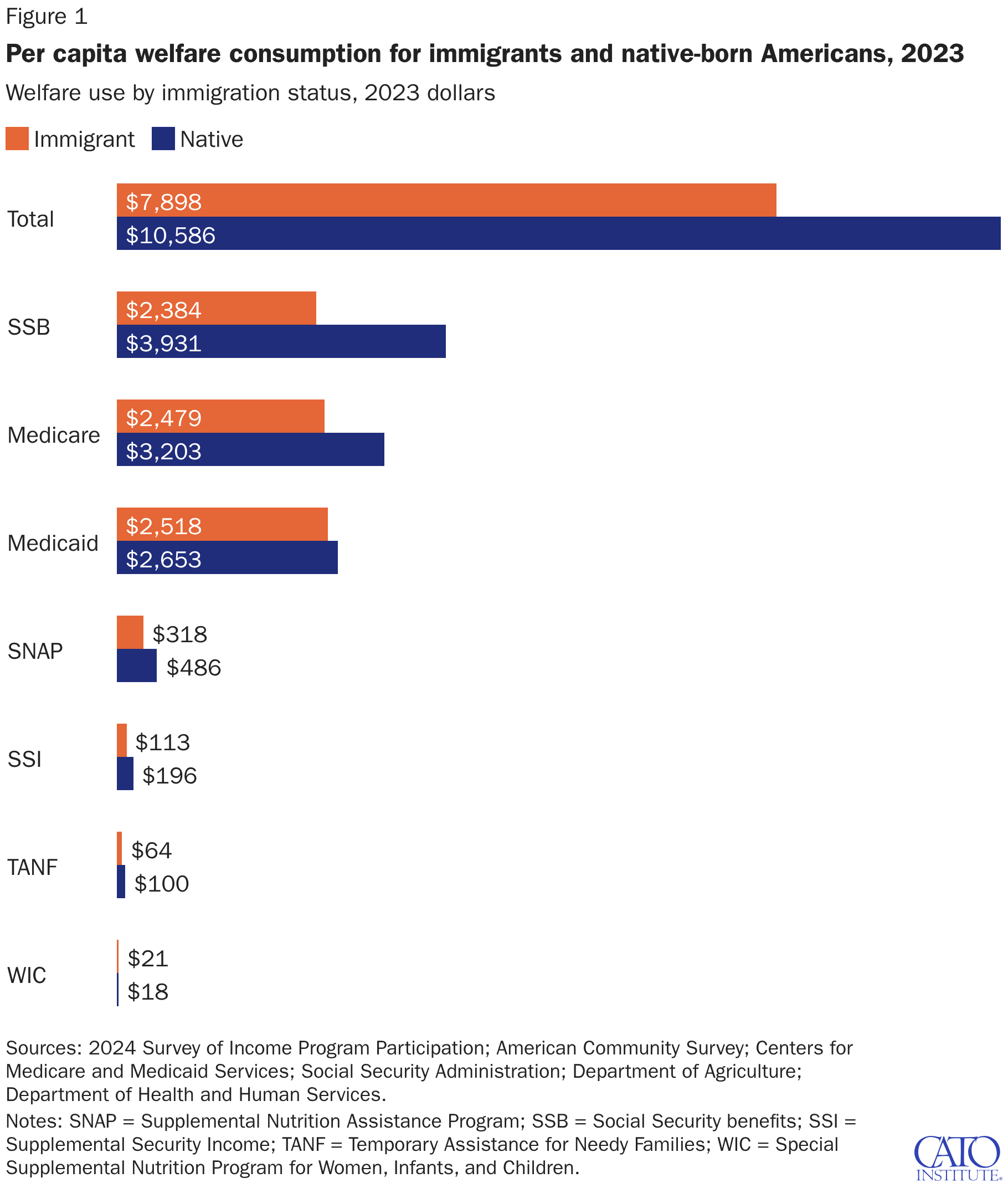
Among all immigrants, naturalized immigrants and noncitizens consumed vastly different amounts of welfare. Noncitizens, including those on various visas and those who are illegal immigrants, consumed $5,041 of welfare benefits on average, which is 53 percent less than native-born Americans. Noncitizens in every major age group we analyzed (0–17, 18–64, and 65 or older) used less welfare benefits on average than native-born Americans. Meanwhile, naturalized immigrants used $12,956 of welfare benefits on average—20 percent more than native-born Americans.
In 2023, all immigrants consumed 39.3 percent less Social Security, 22.6 percent less Medicare, 5.1 percent less Medicaid, 34.6 percent less SNAP, 42.2 percent less SSI, and 35.9 percent less TANF than native-born Americans on a per capita basis. Noncitizens used a relatively lower amount of welfare than immigrants in general and, by extension, native-born Americans. In particular, noncitizen consumption of Medicare and Social Security benefits was 72.2 percent and 81.3 percent, respectively, below that of native-born Americans. This is despite their median age being 39.8, which is higher than the median native-born age of 36.6 years.11 However, per capita consumption of Medicare and Social Security benefits by naturalized immigrants was 50.7 percent and 22.7 percent, respectively, higher than that of natives. This was driven by their higher median age of 52.9.12 Furthermore, all immigrants received fewer total benefits across all age groups (0–17, 18–64, and 65 or older).
Per capita, welfare costs varied by race and ethnicity within each group of native-born Americans and all immigrants (Figure 2). Black and Hispanic immigrants used less welfare than native-born Americans of the same race, but white and Asian immigrants used more welfare than their native-born Americans of the same race. Average per capita use was highest for black natives, followed by white immigrants. Among immigrants, on a per capita basis, white immigrants consumed the most welfare, Hispanic immigrants the second most, Asian immigrants the third most, and black immigrants the least. The differences in per capita welfare consumption by immigrants in different racial groups were driven by age, with individuals in older groups consuming more welfare on average.
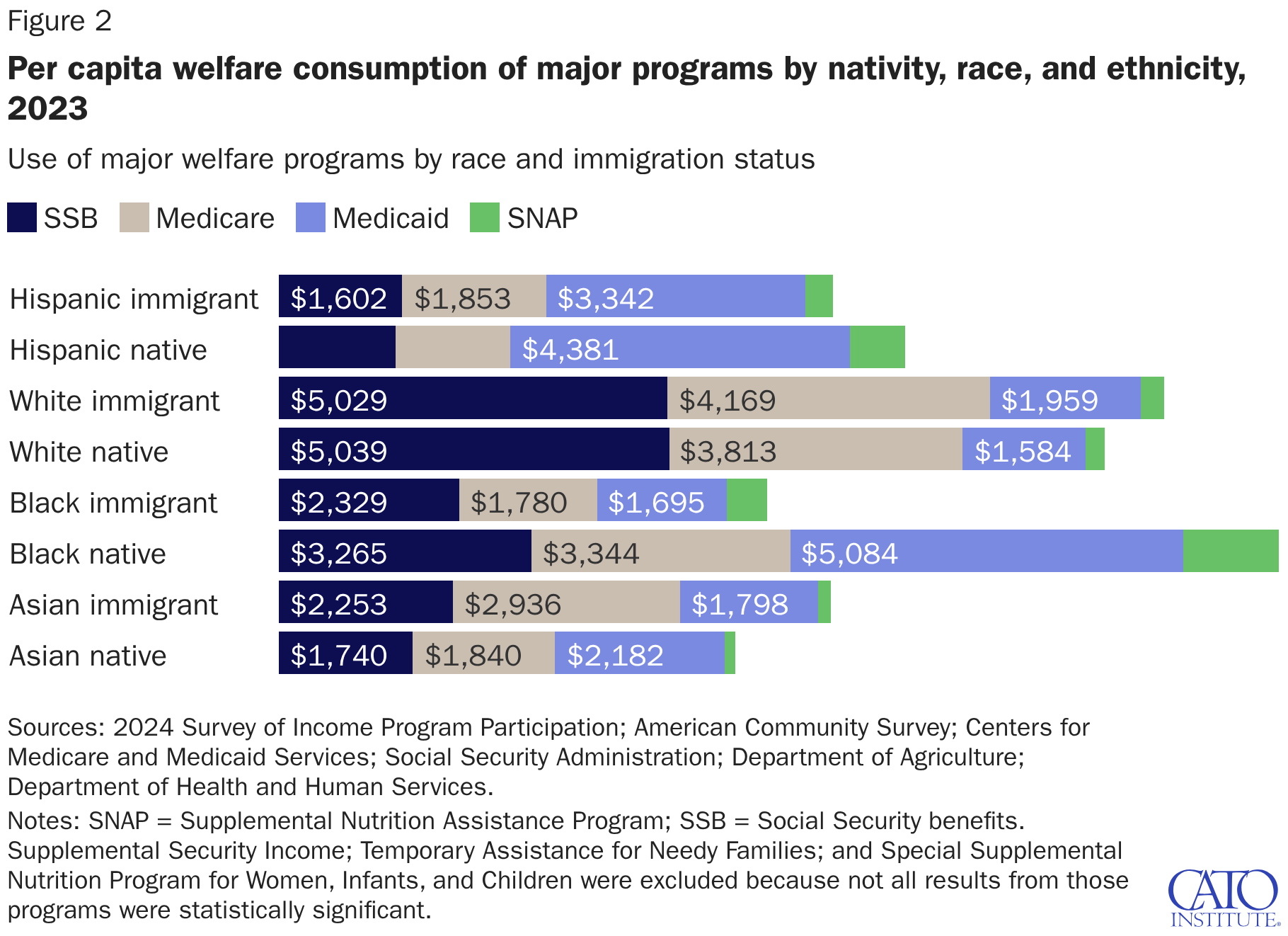
Figure 3 shows per capita receipt of the EITC by immigration status. Whether we consider all immigrants or only noncitizens and naturalized immigrants separately, these groups received more EITC on a per capita basis than native-born Americans. Furthermore, Figure 4 shows that Hispanic immigrants and black native-born Americans received the most EITC of all the groups, while white immigrants and Asian native-born Americans used the least.
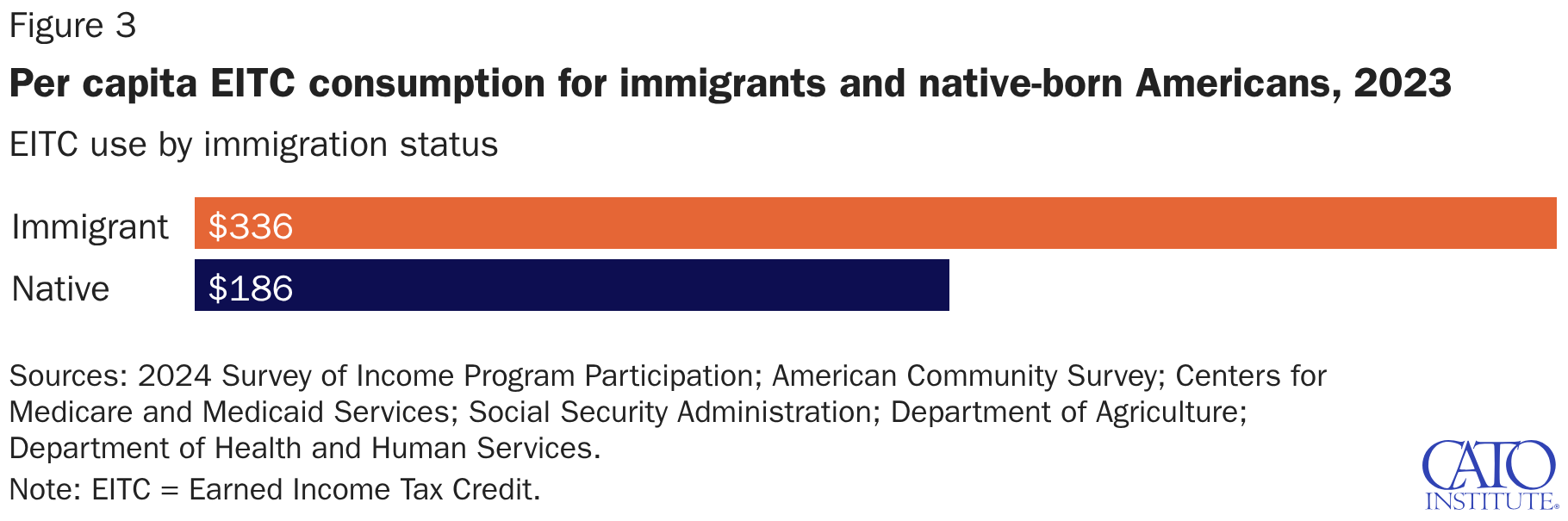
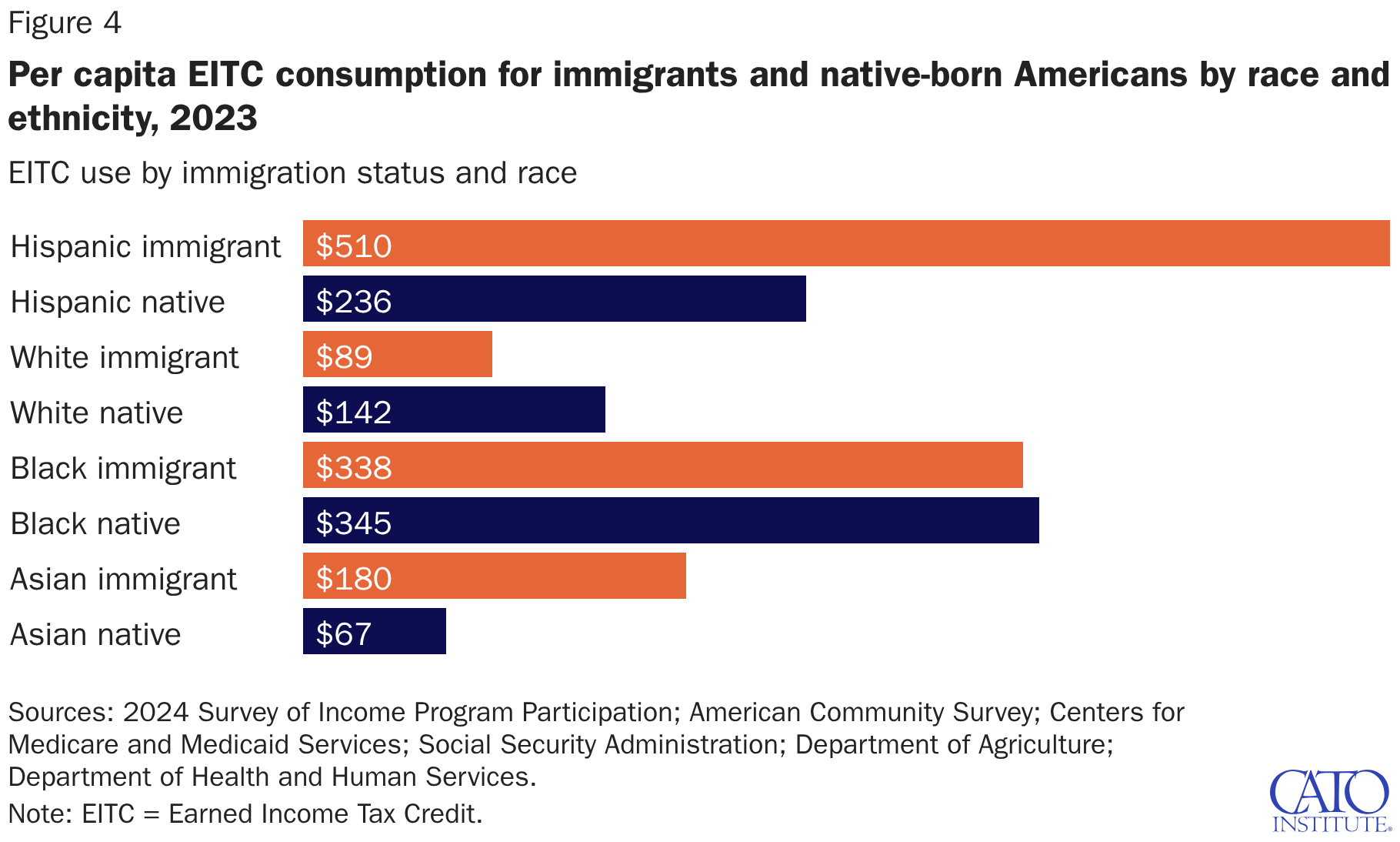
Figure 5 shows the share of immigrants and native-born Americans reporting use of welfare by the number of programs they used. In addition to lower per capita welfare use, immigrants were more likely report no welfare use. However, only slim majorities of both immigrants and of native-born Americans reported no welfare use in 2023. This indicates that large portions of both immigrants and native-born Americans are welfare recipients. Since these percentages cannot be undercount-adjusted similarly to how the dollar value of benefits can be, the real percentages of each group on welfare programs are almost certainly larger. Immigrants were more likely to use either only one program or four or more programs, while native-born Americans were more likely to use two or three programs compared to immigrants, but these differences were small.
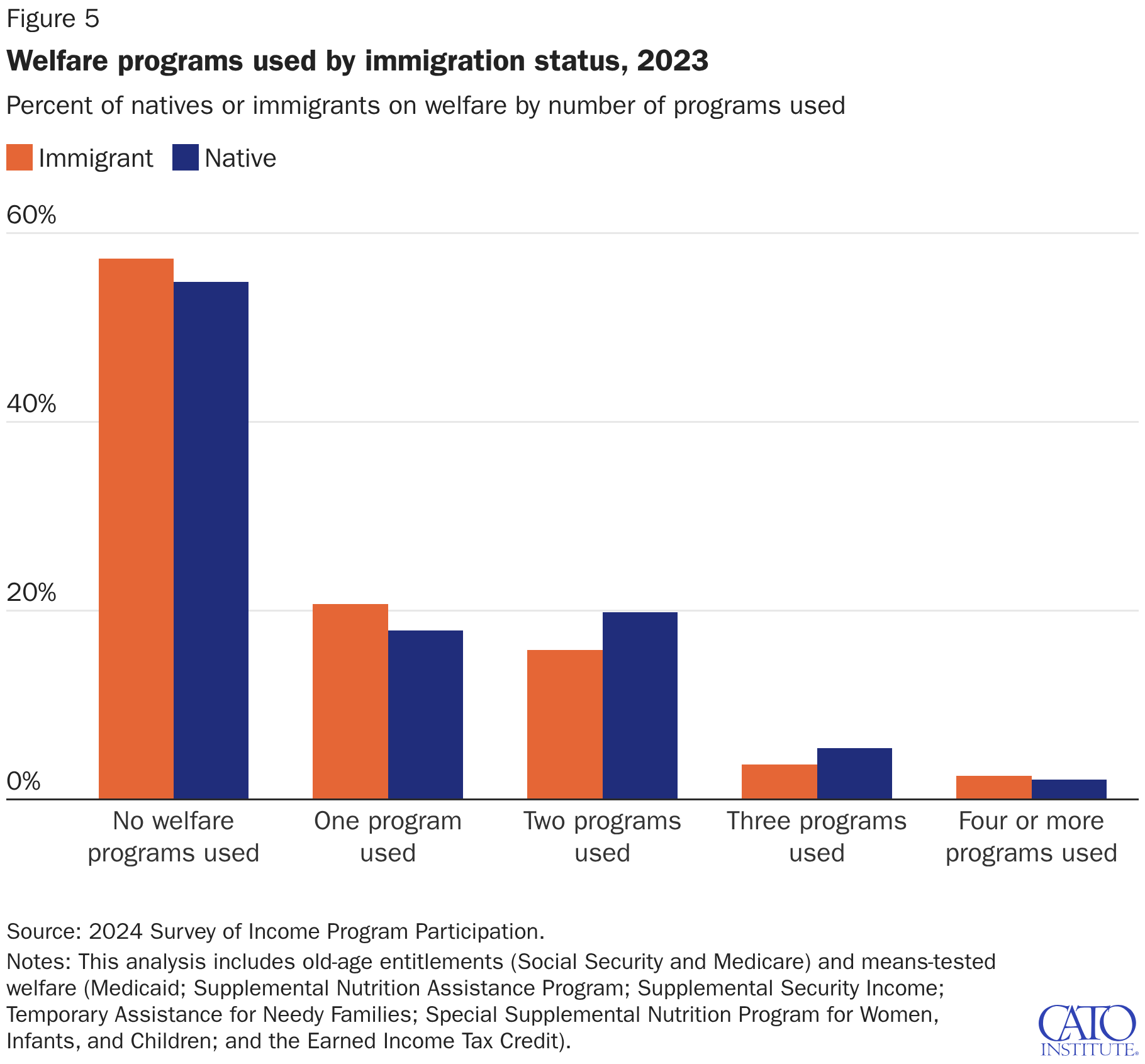
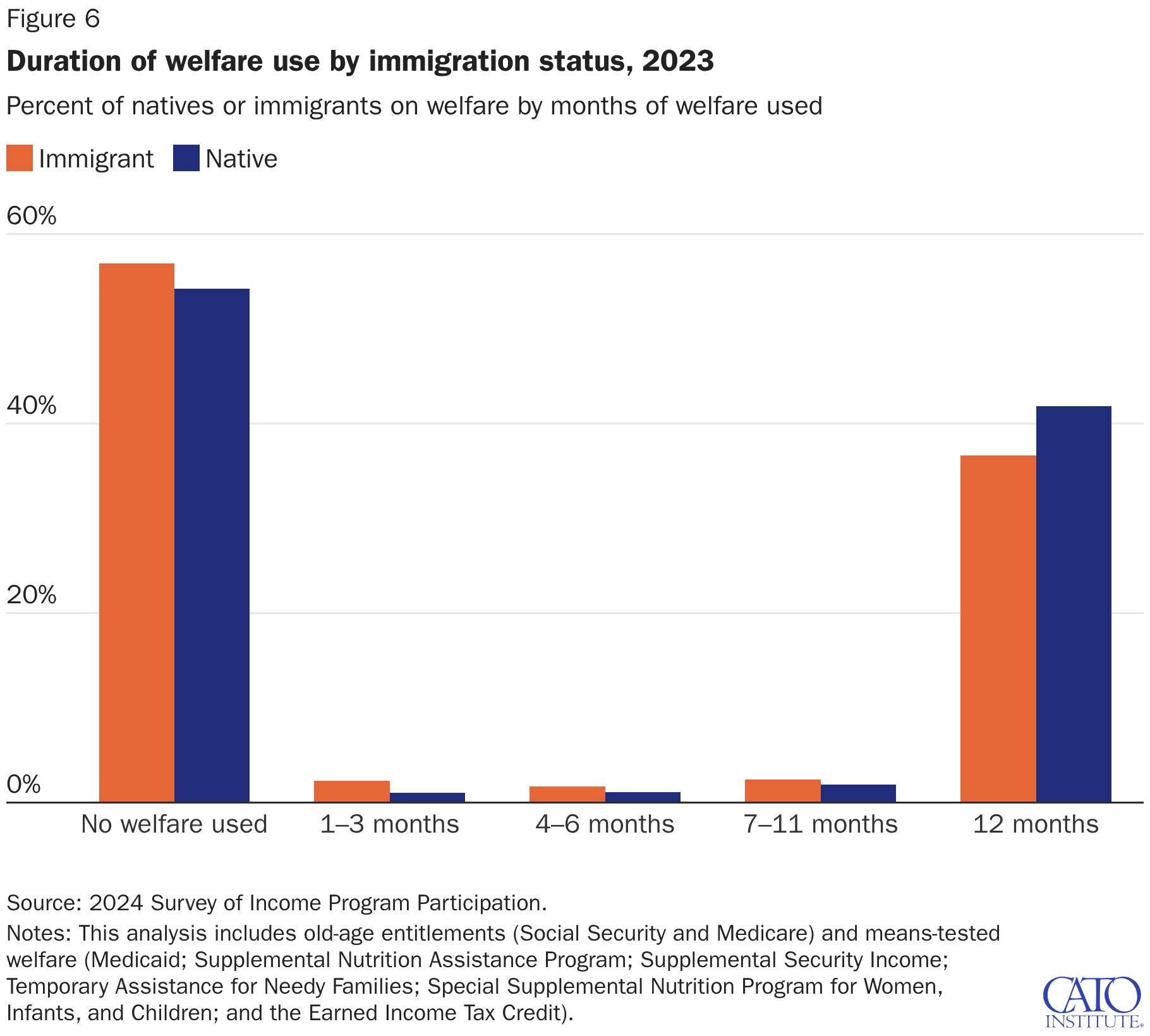
Figure 6 shows the percentage of immigrants and native-born Americans on welfare by reported duration of use. Again, immigrants are more likely to report having used no welfare. Furthermore, immigrants are less likely to use welfare for the entire year and are more likely to report only temporary use. Nearly 42 percent of native-born Americans report being year-round welfare recipients, compared to just under 37 percent of immigrants.
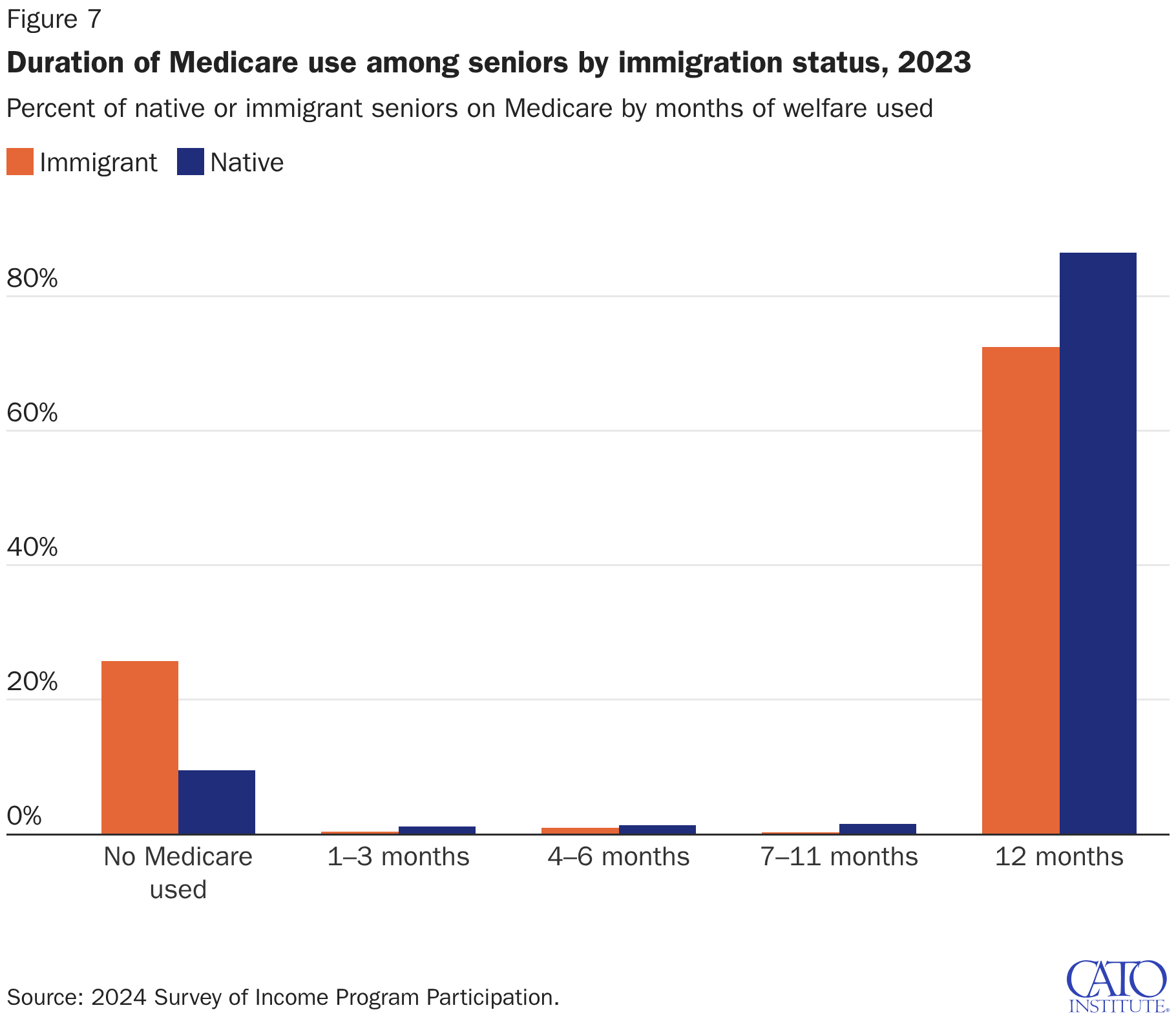
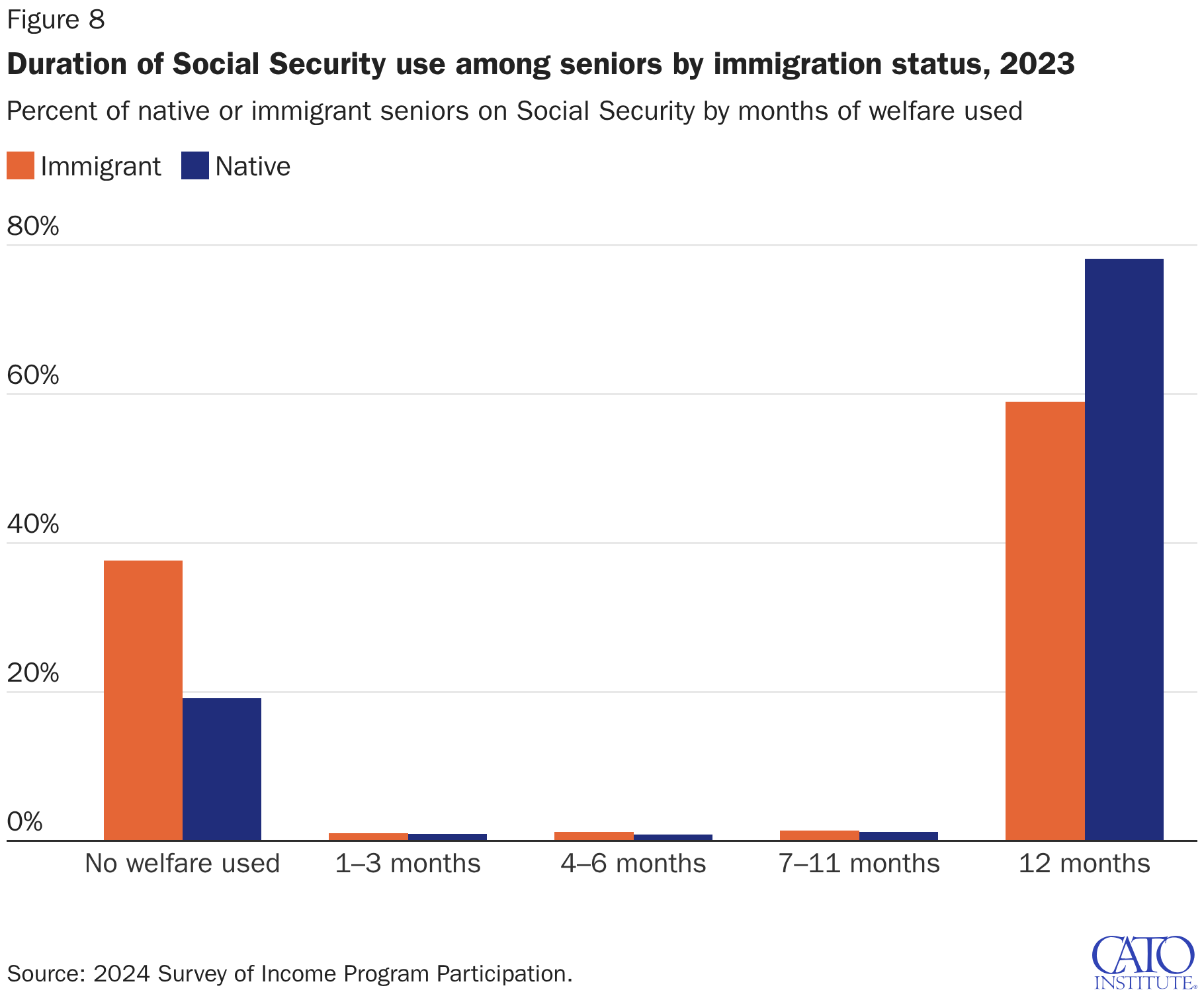
Immigrant seniors were also less likely to report full-time Medicare and Social Security use, although majorities of both immigrants and native-born Americans are full-time users of these expensive programs. Figures 7 and 8 show that immigrants were much more likely to report no use of these programs, and that few seniors were temporary users of these programs.
Discussion
Differences in welfare consumption by immigration status largely reflect life-cycle effects, as immigrants arrive younger, age into entitlement programs later, and often naturalize only after many years in the United States. Overall, immigrants consumed about 24 percent less welfare and entitlement benefits than native-born Americans. All immigrants were 14.8 percent of the US population and consumed just 10.4 percent of all estimated benefits in 2023; noncitizens were 7.5 percent of the population and consumed 3.2 percent of all benefits; and naturalized immigrants were 7.2 percent of the population and consumed 8 percent of all benefits. Native-born Americans consumed more than $3 trillion in means-tested welfare and entitlement benefits in 2023, compared with $401.6 billion consumed by all immigrants, $125.2 billion consumed by noncitizens, and $310.1 billion consumed by naturalized immigrants. If native-born Americans had consumed the same per capita dollar amount of means-tested welfare and entitlement programs as all immigrants, the total expenditures on these programs would have been about $715 billion less in 2023.
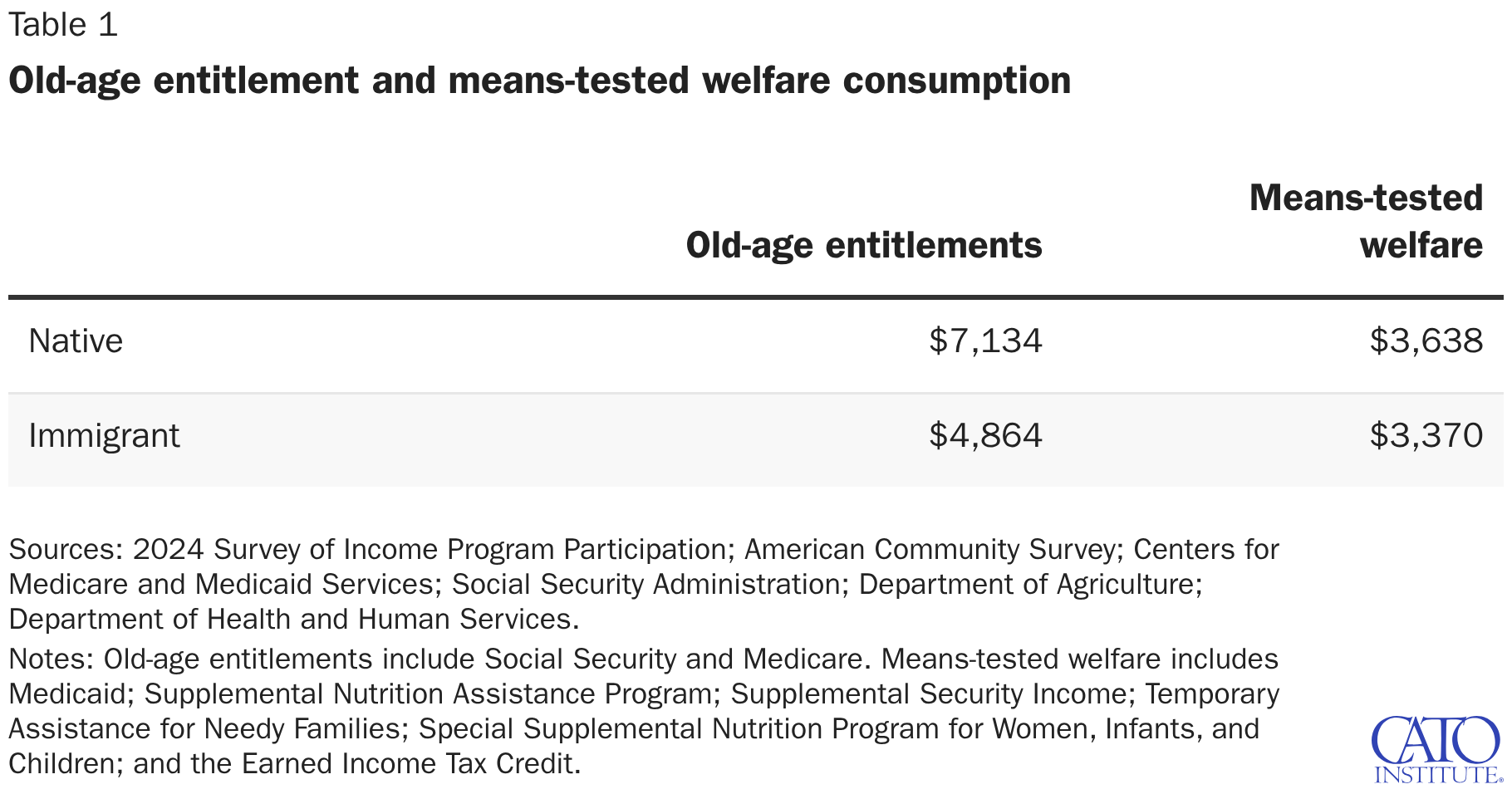
Outlays for the old-age entitlement programs of Social Security and Medicare accounted for 67 percent of all welfare state expenditures in the United States in 2023 and 73 percent of all federal welfare state expenditures. When Social Security and Medicare are combined into a separate old-age entitlement category and the other welfare programs (Medicaid, SNAP, SSI, TANF, WIC, and the EITC) are combined into a means-tested welfare category, the results change somewhat. Table 1 shows that immigrants consume less of both means-tested welfare and old-age entitlement programs. Compared with native-born Americans, immigrants consumed 32 percent less old-age entitlement benefits and 7 percent less means-tested welfare benefits on a per capita basis. Noncitizens used even less: they consumed 77 percent less old-age entitlement benefits and 6 percent less means-tested welfare benefits on a per capita basis.
Immigrants are less likely to enter the welfare system, less likely to remain on welfare for long periods, and less likely to age into the most expensive entitlement programs (Figures 5–8). Their lower welfare costs stem from both lower participation rates and lower benefit levels, driven primarily by age, eligibility rules, labor force participation, and other margins of immigrant selection. Immigrant welfare use is also more temporary than that of native-born Americans. Partial-year welfare use is more consistent with short-term income smoothing than with long-term dependence on taxpayers. This pattern is unsurprising given immigrants’ more limited eligibility for benefits and the greater labor-market volatility faced by new arrivals.
Elderly immigrants consumed more Medicaid benefits than elderly native-born Americans. Regarding elderly immigrants using Medicaid, the same explanation we gave in our previous brief applies: Fewer immigrants qualify for the more expensive Medicare, and more have legal access to Medicaid, thus many of them increase their consumption of Medicaid to compensate. For instance, states have the option of providing Medicaid to pregnant lawful permanent residents, immigrant children, and illegal immigrants in emergency situations and other cases—and many do.13 Refugees and asylum seekers also have access to means-tested welfare benefits for their first seven years in the United States.14 Minor legal changes can significantly reduce immigrants’ access to all these programs and policymakers should pursue them aggressively, specifically ending noncitizen access to all programs.15 We estimate that barring noncitizens from access to welfare programs would have saved approximately $125.2 billion in 2023. Some noncitizens would likely respond to such a legal reform by changing their behavior, including naturalizing if eligible, but there is no plausible mechanism by which this reform would increase total welfare spending. At most, behavioral responses would reduce the estimated savings but they would not reverse them.
Our findings here are similar to earlier briefs on this subject, although in this version we adjust our methods from earlier Cato briefs. Evaluating individual welfare usage—the correct methodology, according to most other researchers and implicitly endorsed by the Department of Homeland Security—is superior to the household approach and yields directionally similar results, regardless of whether the CPS or SIPP is used, once differences in survey design and units of analysis are accounted for.16 In other words, other evaluations of immigrant welfare usage based on the household methodology found that immigrants use more welfare because these studies included the welfare usage of nonimmigrants in the household.
Conclusion
Native-born Americans consume, on an average per capita basis, more welfare and entitlement benefits than all immigrants, and this pattern has held for several years across data from multiple datasets analyzed with different methods. The dollar differences are most pronounced for the two largest entitlement programs, Medicare and Social Security. Noncitizens consume the least, and naturalized immigrants consume more than natives because they are older and thus consume greater per capita quantities of Medicare and Social Security. Immigrants are less likely to enter the welfare system, less likely to remain on welfare for long periods, and less likely to age into the most expensive entitlement programs. These results of per capita welfare use describe observed consumption patterns and do not depend on assumptions about program eligibility, compliance, rates of fraud, or the intensity or effectiveness of enforcement of welfare eligibility rules. Immigrants use less welfare than native-born Americans, but policymakers should still seek to build a higher wall around the welfare state to prevent noncitizens from receiving benefits.

About the Authors


This work is licensed under a Creative Commons Attribution-NonCommercial-ShareAlike 4.0 International License.