Waste, fraud, and abuse in federal welfare programs cost taxpayers billions of dollars each year. Medicaid, the Supplemental Nutrition Assistance Program (SNAP), child nutrition programs, Temporary Assistance for Needy Families (TANF), and Supplemental Security Income (SSI) are among the largest of the more than 90 means-tested federally funded welfare programs, which collectively cost taxpayers nearly $1.2 trillion in fiscal year (FY) 2025.1 Whether administered by state or federal agencies, these programs share structural flaws that make financial mismanagement pervasive.
The most tracked form of misspending is improper payments, which include underpayments and overpayments from administrative errors and outright fraud. Medicaid and SNAP alone accounted for more than $47 billion in improper payments in FY 2025, according to the Government Accountability Office (GAO).2 Another type of mismanagement is the manipulation of program rules. This includes state exploitation of financing mechanisms, waiver authorities, and eligibility loopholes to maximize federal funding, avoid accountability, or redirect federal dollars beyond programs’ intended purposes.
These problems are driven largely by two reinforcing weaknesses. The first is a financing mismatch whereby states process applications and distribute benefits while federal taxpayers finance most, or all, of the expenditures. This leaves states with weak incentives to enforce eligibility standards, invest in fraud prevention, or control waste, since the consequences of financial mismanagement fall overwhelmingly on federal taxpayers. The second is administrative complexity, which is exacerbated by outdated verification systems, reliance on self-reported eligibility data, and underutilized fraud-prevention tools, such as the Treasury’s Do Not Pay system.3
These deficiencies produce error-prone processes that make programs vulnerable to misspending that is difficult to prevent and easy to overlook. Addressing them requires structural reforms that align incentives, modernize verification systems, and hold program administrators accountable for poor outcomes. Congress began that work through the One Big Beautiful Bill Act (OBBBA), which strengthened program integrity in Medicaid and SNAP. This brief recommends ways for Congress to build on those reforms and bring similar accountability measures to child nutrition programs, TANF, and SSI. Savings estimates drawn from Congressional Budget Office scores, other publicly available analyses, and the authors’ calculations are included where available.
Improve Program Integrity in SNAP
SNAP is a $106 billion program that provides monthly food benefits through electronic benefit transfer (EBT) cards to roughly 40 million low-income individuals.4 More than 90 percent of the program’s costs are borne by federal taxpayers (Figure 1).
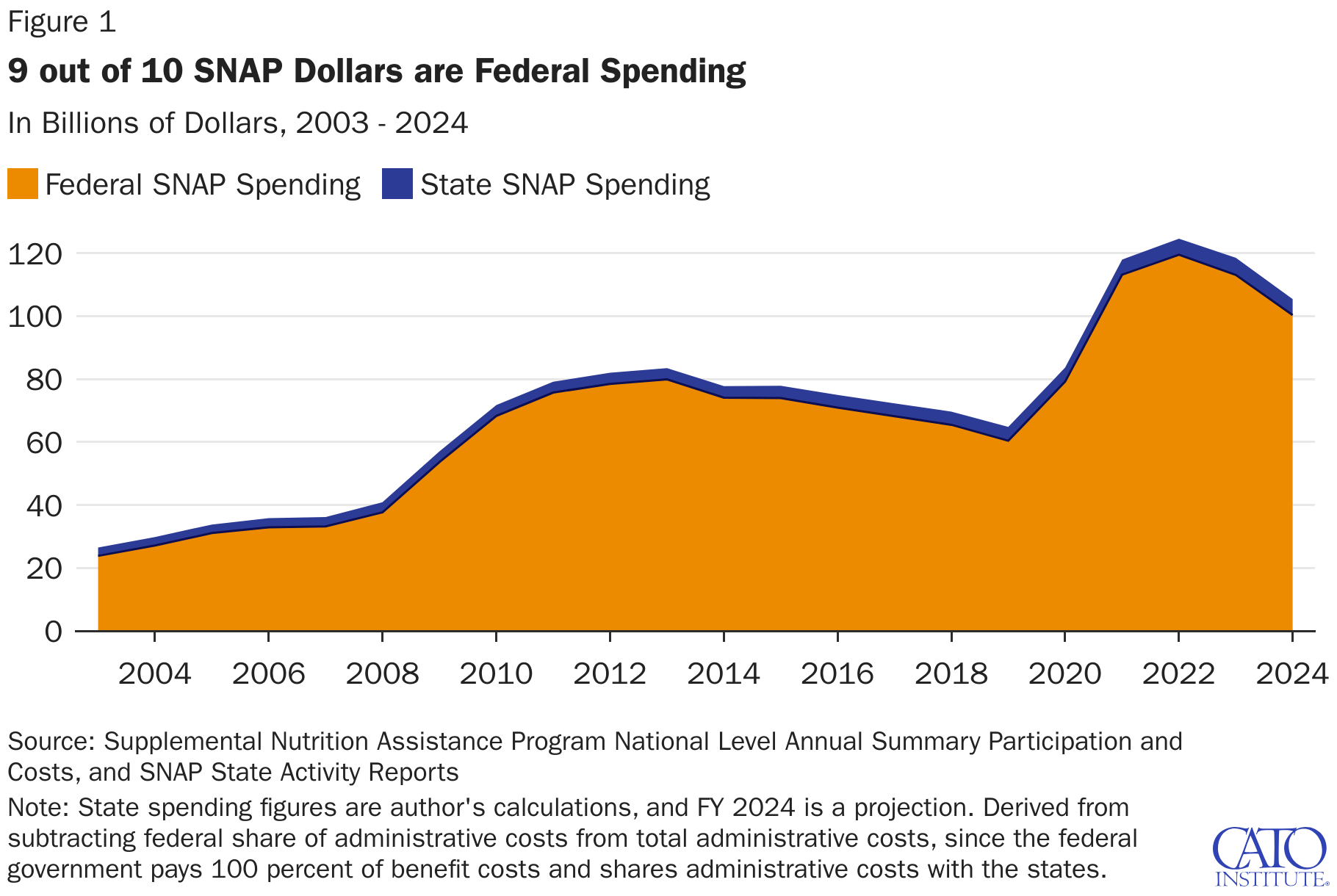
The GAO estimates that SNAP made $10.2 billion in improper payments in FY 2025.5 However, the true amount is likely higher because the program’s quality control (QC) system excludes errors below its tolerance threshold ($58 for FY 2026) from the official count.6 Many of these errors are due to state agencies’ inadequate documentation procedures, outdated eligibility systems, and insufficient oversight.7 The program is also susceptible to at least 10 distinct types of fraud, including EBT theft, with states replacing more than $320 million in stolen benefits from 2022 to 2024.8 Additionally, states use eligibility loopholes to extend benefits to households that fail to meet the program’s federal eligibility requirements, thus expanding the program well beyond congressional intent. Congress should close existing loopholes and fix the structural weaknesses that enable improper payments.
Reforming SNAP
- Gradually eliminate federal SNAP funding. ($550 billion in savings).9 SNAP devolution through a 10-year phaseout of federal funding would give states the flexibility to experiment with program design to lower administrative complexity and reduce improper payments, as the costs of financial mismanagement and inefficiency would fall directly on state budgets.
Short of that, Congress should:
- Convert SNAP into a fixed block grant with a state cost share. ($324 billion in savings).10 A block grant set to inflation-adjusted 2019 spending levels would reset the program to its pre-pandemic level, cap future spending growth, and eliminate states’ ability to draw additional federal funds through eligibility loopholes. Pairing this with a requirement that states cover 15 percent of total SNAP expenditures would also give states a financial stake in improving program integrity, rather than relying on a punitive threshold that they can game or avoid.
- Eliminate broad-based categorical eligibility (BBCE). ($100 billion in savings).11 BBCE allows states to extend SNAP eligibility to households that fail to meet federal gross income and countable asset limits if they receive any TANF-funded benefits, including brochures and pamphlets. Forty-three states and the District of Columbia have implemented this policy, allowing 5.9 million otherwise ineligible people, including households with substantial assets, to enroll in SNAP.12 The GAO also found that the policy is susceptible to improper payments, with households enrolled through BBCE at incomes above federal limits having error rates nearly three times higher than other households, largely because states used the policy to weaken their verification protocols to streamline administration.13
- Eliminate SNAP’s QC threshold. ($80 million in savings).14 The GAO found that 38 percent of misspent SNAP dollars in FY 2013 were not counted in official error calculations because they fell below the program’s QC threshold.15 Since states will now face penalties for high payment error rates, eliminating this threshold would provide greater transparency on the full scope of improper payments in SNAP and strengthen states’ incentives to identify and prevent payment errors.
- Eliminate the “Alaska carveout.” The OBBBA delays the onset of cost-sharing for states with error rates exceeding 13.34 percent until as late as FY 2030, allowing qualifying states to avoid up to $8.44 billion in penalties over two years.16 The provision creates a perverse incentive for states to tolerate—or even inflate—their reported payment error rates to qualify for the delay. Officials in at least two states, Maryland and New Mexico, have already reportedly done so.17 Congress should close this loophole to ensure that the OBBBA’s matching fund requirements apply uniformly across all states with high payment error rates.
Close Financing Gimmicks in Medicaid
Medicaid is the largest means-tested federally funded welfare program. It is intended to provide health care to low-income children, pregnant women, seniors, the disabled, and able-bodied adults. Total state and federal Medicaid spending exceeded $900 billion in FY 2024.18 Although Congress intended it to be a joint federal-state program, federal policy decisions, such as the Affordable Care Act expanding eligibility to able-bodied adults, and states’ use of financing gimmicks have steadily shifted an increasing share of Medicaid’s spending to Washington (Figure 2).
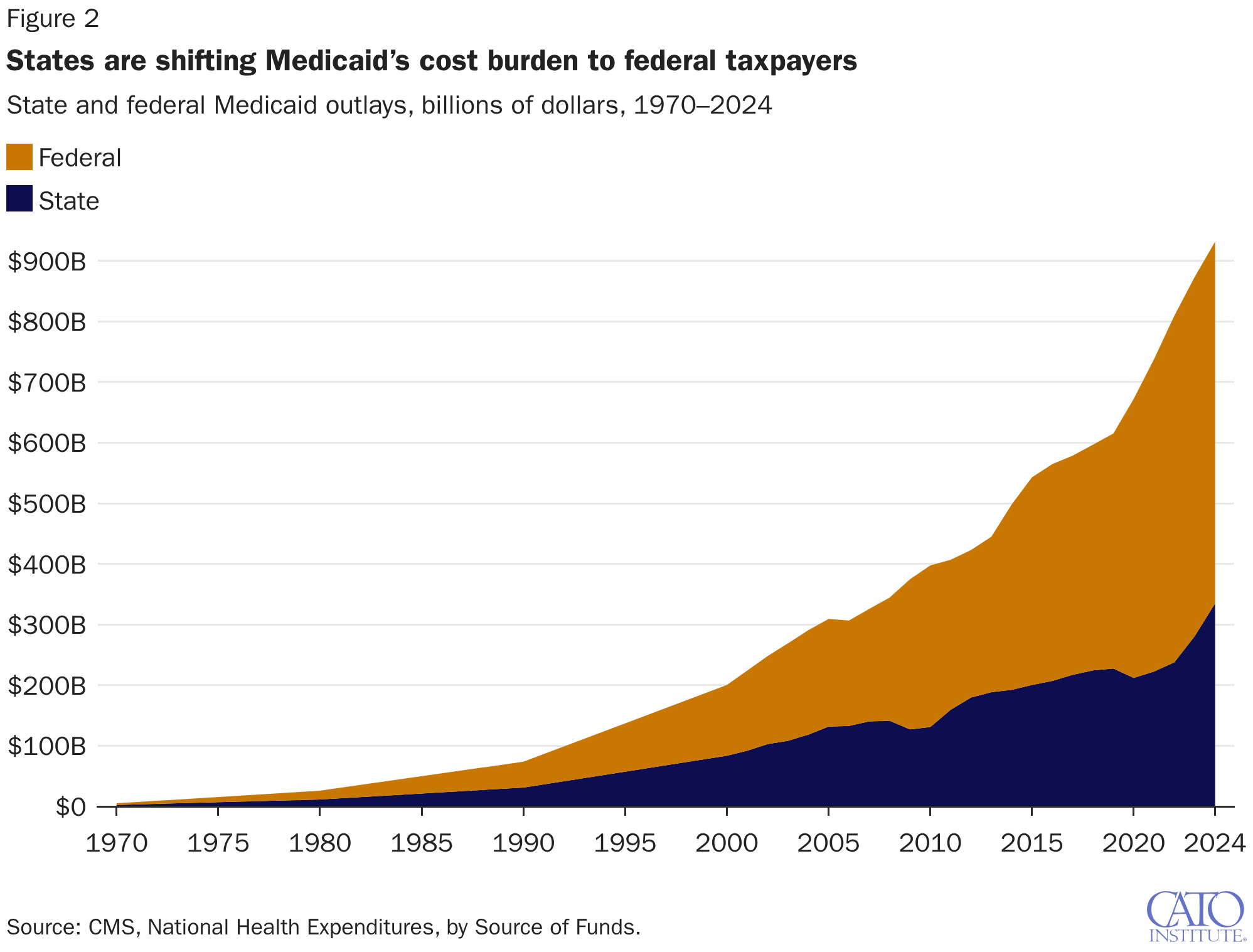
This trend is largely driven by Medicaid’s open-ended matching-grant structure, in which the federal government matches between $1 and $9 for every dollar that states spend on the program, with no limit on total federal contributions.
States exploit this structure with financing gimmicks to artificially inflate their reported expenditures and maximize federal reimbursements. In 2022, nearly 29 percent of federal Medicaid spending came from states’ use of such arrangements.19 The official federal share of Medicaid spending was roughly 64 percent in FY 2024.20 However, the GAO has estimated that states’ reliance on financing gimmicks increases the effective federal share by 5 percentage points above what the matching formula set by Congress would otherwise allow.21 This suggests that the true federal share could approach 70 percent.
Additionally, states have used Section 1115 waivers, which were originally intended to allow states to test innovative approaches to delivering health coverage, as a vehicle to direct Medicaid spending toward nonmedical services, such as housing, groceries, air conditioning, and rideshare services, under the guise of addressing “social determinants of health,” a term encompassing nonmedical factors believed to influence health outcomes.22
Medicaid’s financing structure weakens state incentives to prioritize program integrity, making the program highly prone to financial mismanagement. The GAO has listed Medicaid as being especially vulnerable to waste, fraud, and abuse every year since 2003.23 The Paragon Health Institute estimates that Medicaid issued approximately $1.1 trillion in federal improper payments from FY 2015 to 2024, or almost one of every four federal dollars spent on the program over that period.24
Medicaid fraud is predominantly provider-driven, particularly in high-growth or weakly supervised service categories such as personal care, which accounted for more fraud convictions than all other provider types in FY 2025.25 Other examples include home and community-based services, autism therapy, nonemergency medical transportation, and substance use disorder treatment.26 For example, one scheme fraudulently billed Arizona’s Medicaid agency $650 million for substance abuse services that were never or insufficiently provided.27
The Children’s Health Insurance Program (CHIP) is a $23 billion federal-state program that covers roughly seven million children in families with incomes above their state’s Medicaid eligibility threshold but below the state-set upper income limits for CHIP, which range from 170 to 400 percent of the federal poverty level.28 CHIP operates under the same matching-grant structure as Medicaid, but with a federal reimbursement rate roughly 15 percentage points higher.29 This has incentivized states to significantly expand CHIP eligibility, with the median eligibility threshold exceeding an income of $82,500 for a family of four, and eleven states offering eligibility at an income of $99,000 or more.30 Federal CHIP funding is ostensibly capped through annual allotments, but the cap is not as binding as it appears: To avoid potential coverage losses, Congress has frequently provided supplemental funding when states exhaust their allotments mid-year, which encourages states to overspend.31 The Centers for Medicare & Medicaid Services has also reported that CHIP is classified as a program “at risk for significant improper payments.”32
Congress should end states’ use of financing gimmicks and eliminate Medicaid’s open-ended financing structure, giving states a greater financial stake in program integrity.
Reforming Medicaid and CHIP
- Consolidate Medicaid and CHIP into a zero-growth block grant. ($5 trillion in savings).33 This would eliminate the existing matching-grant system that encourages states to overspend, ignore fraud, and shift costs to federal taxpayers through Medicaid financing gimmicks. Under a fixed allocation, dollars lost to waste or fraud would no longer be replaced with additional federal funds, thus giving states a stronger financial stake in strengthening oversight and preventing waste.
Short of that, Congress should:
- Eliminate provider taxes. ($386 billion in savings).34 This gimmick taxes health care providers and uses the revenue to boost Medicaid payments to those providers, triggering federal matching funds without the state genuinely paying for Medicaid expenditures. The share of states’ Medicaid payments financed through provider taxes grew from 7 percent ($10 billion) in 2008 to 17 percent ($37 billion) in 2018.35 Congress should ban provider tax schemes outright.36
- Eliminate state-directed payments (SDPs). States use SDPs to require Medicaid-participating health insurance companies to pay providers higher prices for Medicaid services, thereby increasing reported state expenditures and drawing additional federal dollars. Although the OBBBA limited SDPs by preventing states from paying providers above what Medicare pays for the same services, Congress should eliminate SDPs altogether.
- Eliminate intergovernmental transfers. Intergovernmental transfers are yet another financing gimmick that states use. Local government-owned health care providers transfer funds to the state, which then claims those funds as state spending in order to receive a federal match and use it to pay back those providers, often at rates far exceeding what providers receive for identical services.37 Congress should eliminate intergovernmental transfers or, at a minimum, enforce payment parity between private and government payers for providing identical services.
- Eliminate states’ use of Section 1115 waivers for social determinants of health. States have used this authority to redirect federal Medicaid dollars toward nonmedical care services.38 Congress should bar states from using Section 1115 waivers for these purposes and limit Medicaid expenditures to medical care.
Restructure Federal Child Nutrition Programs
The federal government spent more than $30 billion in FY 2025 on the National School Lunch Program, School Breakfast, Child and Adult Care Food, and Summer Food Service programs.39
The school lunch and breakfast programs subsidize meals for nearly 30 million children in more than 90,000 schools each year.40 School food service programs rely heavily on federal funding, which makes up 63 percent of the money they receive, compared to just 6 percent from state and local governments. The rest comes from students who fully or partially pay for their meals.41 Consequently, states have little financial incentive to target subsidies more narrowly, reduce waste, or combat fraud.
School meal programs were originally designed to serve low-income students, but eligibility expansions have broadened access to students who aren’t even in poverty. Plate waste is also a significant problem, with students throwing away an estimated 530,000 tons of food and 45 million gallons of milk, at a cost of around $1.7 billion, every year.42 This is partly due to top-down federal nutrition mandates, which leave states and local school districts with little flexibility to adapt menus to their students’ preferences: Billions of dollars in federal reimbursements are converted into cafeteria trash.43
Other federally funded meal programs, such as the Child and Adult Care Food Program and the Summer Food Service Program, rely on third-party sponsors to distribute subsidized meals. Unlike school food programs, where the education system independently verifies enrollment, sponsors submit their own meal counts and attendance records in order to claim federal reimbursement. This makes the programs vulnerable to fraud. The most notorious scandal involved Minnesota’s Feeding Our Future nonprofit, which billed the state for 125 million meals that were never served, defrauding the federal government of nearly $250 million.44 Minnesota officials failed to act despite receiving concerns about the nonprofit as early as 2018, and at one point even asked the organization to investigate complaints about itself.45
Congress should restructure these programs to give states both the incentive and the flexibility to reduce waste, prevent fraud, and better target meal subsidies to low-income students.
Reforming Child Nutrition Programs
- Gradually eliminate federal child nutrition programs. ($262 billion in savings).46 If states were to fund and design meal programs tailored to their students’ needs, they would have a direct incentive to target assistance to those who need it, reduce waste, and prevent fraud. Alternatively, states could step back and allow families, communities, and civil society organizations to meet those needs.
Short of that, Congress should:
- Consolidate all child nutrition programs into a single fixed block grant with a state cost share. ($152 billion in savings).47 This would simplify funding and administration for nutrition programs, give states additional flexibility in designing assistance, and strengthen state incentives to be judicious with spending to avoid misuse.
- Eliminate the Community Eligibility Provision. Under the Community Eligibility Provision, once the share of students in a school or district who individually qualify for subsidized meals through programs such as Medicaid or SNAP reaches a certain threshold, every student in that school or district becomes eligible for federally subsidized meals, regardless of household income. A Biden-era rule lowered that threshold from 40 to 25 percent. In 2024, the Foundation for Government Accountability estimated that nearly three-quarters of public school students were eligible for subsidized meals after the rule change.48 Congress should eliminate the Community Eligibility Provision or, at a minimum, raise the eligibility threshold to 60 percent. The Ways and Means Committee estimated that the higher threshold would save $3 billion over 10 years.49
Close Accountability Gaps in TANF
The federal government provides $16.5 billion annually to the states through the TANF block grant. States direct these funds toward cash assistance, job training programs, childcare, and other supportive services for low-income families.50
TANF requires only that states’ use of federal funds be “reasonably calculated” to accomplish one of the program’s statutory purposes of assisting needy families, reducing government dependence, preventing out-of-wedlock pregnancies, and promoting two-parent families.51 However, neither Congress nor the Department of Health and Human Services (HHS) has offered comprehensive guidance on what this standard means, leaving states with few meaningful constraints on how they spend federal TANF dollars. The GAO has also identified numerous integrity issues with the program, including HHS’s failure to conduct effective oversight of state TANF expenditures, establish clear procedures for assessing fraud, or even comprehensively estimate improper payments.52
This combination of state latitude and poor federal oversight has made TANF highly prone to misuse. For example, state auditors in Mississippi flagged up to $94 million in misspent or insufficiently documented federal TANF funds from 2017 to 2020.53 Similar breakdowns in financial oversight are seen across the program. A 2025 GAO report found 162 deficiencies in TANF internal controls over financial reporting and compliance requirements across 37 states. Examples include states failing to document eligibility checks before issuing payments, failing to review financial records of how contractors spend federal money, and failing to report work participation data. Fifty-six deficiencies were severe, and 37 persisted for two or more years (Figure 3).54
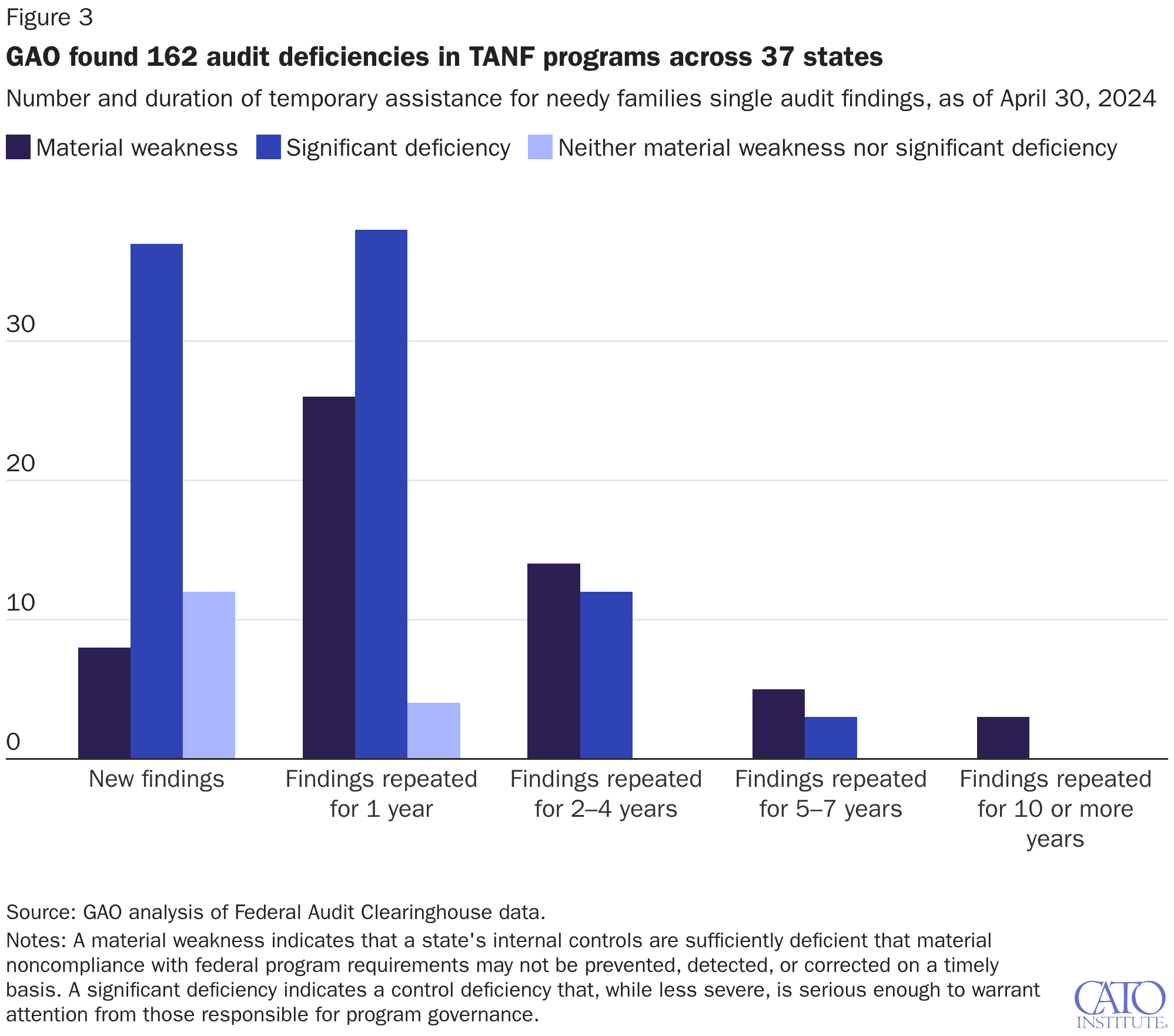
Congress should tighten TANF’s spending standards, close the accountability gaps that allow misuse to persist, and update the outdated provisions that have kept obsolete funding streams in place.
Reforming TANF
- Gradually eliminate federal TANF funding. ($91 billion in savings).55 The federal government should phase out its role in TANF over 10 years. This would end the arrangement under which states exercise near-total discretion over federal funds while facing no financial consequence when those funds are diverted. States that choose to continue providing cash assistance or other services would be held directly accountable to their constituents who fund them.
Short of that, Congress should:
- Eliminate TANF’s contingency fund. ($6 billion in savings).56 The fund was created to provide states with extra funding during recessions, but its eligibility triggers are outdated, making it largely disconnected from real-time economic distress. A state can qualify if its SNAP caseloads exceed FY 1994 levels, which nearly every state has permanently exceeded since 2008, with 45 jurisdictions qualifying as “needy” in every month of FY 2024. The minimum amount states must spend on TANF-related activities as part of their maintenance of effort requirements to receive federal TANF funds has also never been adjusted for inflation, eroding its real value by more than half and substantially lowering the threshold states must meet to qualify.57 Moreover, accumulated unspent TANF funds, which totaled $9.7 billion by FY 2024, have rendered the contingency fund largely duplicative.58
- Strengthen HHS oversight and establish stricter standards for state TANF expenditures. States have used TANF’s loose spending rules to fund initiatives with tenuous or no connection to the program’s goals.59 This includes college scholarships for upper-income families, volleyball stadiums, job-training funds used for employees’ vacations, and brochures to enroll otherwise ineligible households in SNAP. A 2023 HHS proposed rulemaking found that in FY 2021, between $598 million and $1.13 billion in federal TANF funds across 37 states were spent on activities that would not have met the stricter expenditure standards the rule proposed to establish.60 Congress should set stricter rules for permissible TANF expenditures, give HHS the authority to calculate and report improper payments for the program, and require states to regularly report their TANF expenditures for compliance assessments and to repay misspent funds.
Address Administrative Failures in Supplemental Security Income
Supplemental Security Income is a $66.5 billion program that provides monthly cash payments to approximately 7.2 million elderly adults and individuals with qualifying disabilities who have limited incomes and resources.61
Unlike many other federally funded welfare programs, SSI is administered directly by the Social Security Administration (SSA). More than 1 of every 9 dollars spent on the program are improper payments, increasing from 1 of every 13 dollars in FY 2015 (Figure 4).62
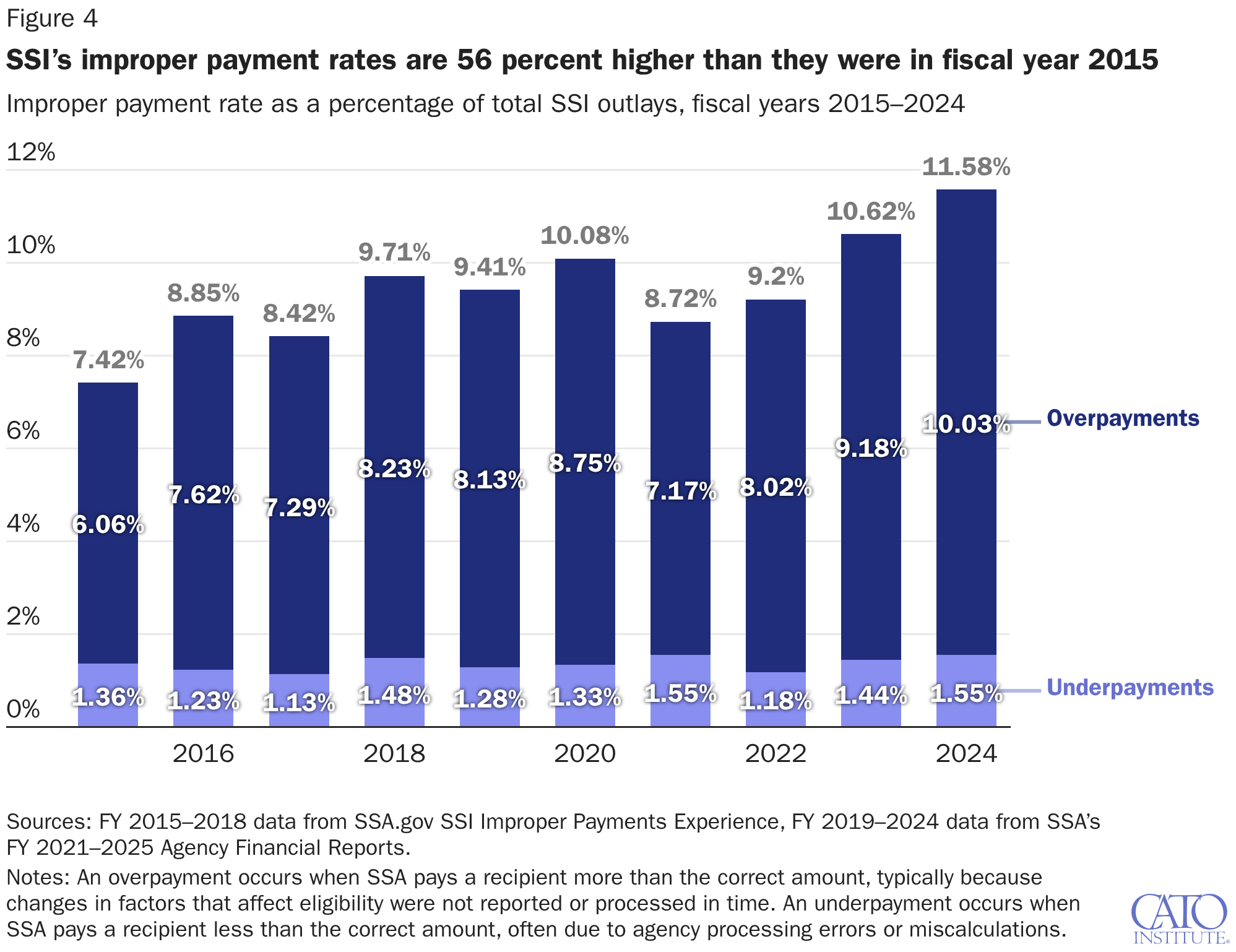
A February 2025 Office of Inspector General (OIG) report attributed 85 percent of SSI overpayments from 2020 to 2023 to recipients who did not report changes affecting their eligibility in time.63 This is partly a consequence of program design. The SSA has not fully deployed available tools to automate eligibility verification, leaving the program heavily reliant on beneficiaries to self-report changes in their income, resources, and living arrangements under complex rules that many recipients may struggle to understand.64
Even when recipients report their earnings on time, overpayments can still occur because of SSA’s persistent lags in processing beneficiaries’ earnings information, according to the GAO.65 When overpayments are discovered, beneficiaries must repay, contest, or request a waiver. The GAO has also found that the risk of repayment and benefit loss deters working-age recipients from seeking employment.66
Congress should modernize SSI by simplifying the program’s eligibility rules and mandating the use of automated verification tools that SSA has failed to fully deploy.
Reforming SSI
- Eliminate In-Kind Support and Maintenance (ISM). The SSI’s in-kind support and maintenance rules reduce benefits when a recipient receives noncash assistance, such as help with rent or utilities. Its rules are so complex that the Social Security Advisory Board has said it is “virtually impossible to attain consistency” in applying them, creating significant burdens on both administrators and recipients.67 ISM is a leading cause of improper payments in SSI, accounting for more than $2.7 billion in payment errors from FY 2019 to 2023.68 Although SSA simplified ISM rules in 2024, Congress should go further and replace ISM with a flat-rate 10 percent benefit reduction for adults living with others (except eligible couples).69 This would be simpler to administer, easier for recipients to understand, and free up SSA staff to focus on addressing other causes of improper payments in the program.
- Expand use of the Access to Financial Institutions (AFI) program. To qualify for SSI, individuals must hold no more than $2,000 in countable assets ($3,000 for couples). These include cash, liquid assets, and financial accounts such as bank accounts and stocks. Recipients’ failure to accurately self-report financial account information is a leading cause of overpayments, averaging $1.4 billion per year from FY 2018 to 2022. The AFI program allows SSA to automatically check applicants’ financial account balances, but it only uses the tool at applications and redeterminations. The OIG estimated that SSA could have prevented approximately $2 billion in overpayments with interim AFI checks, which is almost 200 times as much as the agency spent on checks in FY 2022.70 The SSA also does not require staff to use the AFI program to verify financial account balances reported to be below $400. An OIG audit found that roughly 800,000 applicants and recipients underreported their accounts by $100 or more, resulting in an estimated $718 million in overpayments in FY 2022.71 Requiring AFI checks at more frequent intervals and reducing the $400 tolerance threshold to $0 would improve payment accuracy.
- Require enrollee participation in the Payroll Information Exchange. Wage discrepancies are another major source of SSI overpayments. When recipients authorize SSA to use the Payroll Information Exchange for eligibility determinations, SSA receives recipients’ wage and employment data from their employers directly through participating payroll providers.72 This eliminates the need for self-reporting and allows SSA to adjust payments before overpayments accumulate. However, participation is voluntary and may be revoked at any time.73 Making the Payroll Information Exchange participation mandatory for all working SSI recipients would help ensure that SSA receives automated wage data for every recipient with earnings.
The Path Forward
Waste, fraud, and abuse are not confined to any one agency or federally funded welfare program. They persist because of misaligned incentives, fragmented administration, and outdated verification systems. Effective reforms should better align program authority with financing responsibility. In most state-administered welfare programs, states exercise broad discretion over program administration while bearing little of the cost. This dilutes accountability and creates incentives that reward more spending over better stewardship. Yet, as SSI demonstrates, even without this state–federal incentive misalignment, administrative complexity and outdated verification systems contribute to billions of dollars in improper payments each year. Structural reform must therefore address both the incentives that allow financial mismanagement to persist with little accountability and the administrative failures that make fraud and payment errors difficult to prevent.
Congress can save federal taxpayers nearly $6 trillion over the next decade by adopting the structural reforms proposed in this brief, namely eliminating federal SNAP, TANF, and child nutrition funding, and converting Medicaid and CHIP into a zero-growth block grant.74 These reforms would help address the structural incentive problems that are driving widespread financial mismanagement in these programs, giving states a more direct financial stake in improving program performance by preventing fraud and reducing administrative failures that they have been slow to address. Short of that, Congress can still save federal taxpayers nearly $500 billion over the next decade by tightening eligibility standards, ending financing gimmicks, and eliminating outdated funding streams.75
If the federal government continues to operate and fund these programs, it has an obligation to ensure that taxpayer dollars are not lost to preventable waste, fraud, and administrative failures. Congress should, at a minimum, pursue reforms that strengthen verification systems, enhance oversight, and reduce abuse.

About the Authors


This work is licensed under a Creative Commons Attribution-NonCommercial-ShareAlike 4.0 International License.