Electricity demand in the United States was essentially flat for two decades, but now the country is in a period of rapid load growth driven by artificial intelligence (AI), data centers, advanced manufacturing, and electrification. This surge is colliding with an electricity system built for slow, incremental change. Consumers face rising costs, power producers struggle with multiyear interconnection delays, and grid operators confront growing reliability risks. State and federal policymakers are under pressure to address these issues quickly—without burdening taxpayers or existing ratepayers.
Consumer-Regulated Electricity (CRE) is a reform that would allow privately financed, off-grid electric utilities to serve new customers under voluntary contracts. These utilities would be physically “islanded” from the regulated grid and would not be subject to economic regulation at the state or federal level. Because they would not interconnect with incumbent systems, CRE utilities would impose no costs, reliability risks, or stranded-asset exposure on existing customers. CRE is thus a policy proposal that offers a practical and simple tool for policymakers.
CRE would resolve a central tension in today’s electricity policy: how to welcome new industrial investment without socializing its costs. By creating a parallel track for new load growth, CRE would allow states to attract new electricity-intensive industries at zero cost to taxpayers and ratepayers. At the same time, CRE would create space for rapid innovation in generation, transmission, and system design—experimentation that is nearly impossible within the highly risk-averse regulated grid.
Finally, CRE would supplement rather than harm the existing electricity system. By allowing voluntary, off-grid arrangements for sophisticated customers, CRE would protect households from rising costs, relieve reliability constraints on the grid, and help states meet the defining electricity challenge of the coming decade: speed to power.
The Electricity Crunch: A New Era of Demand Growth
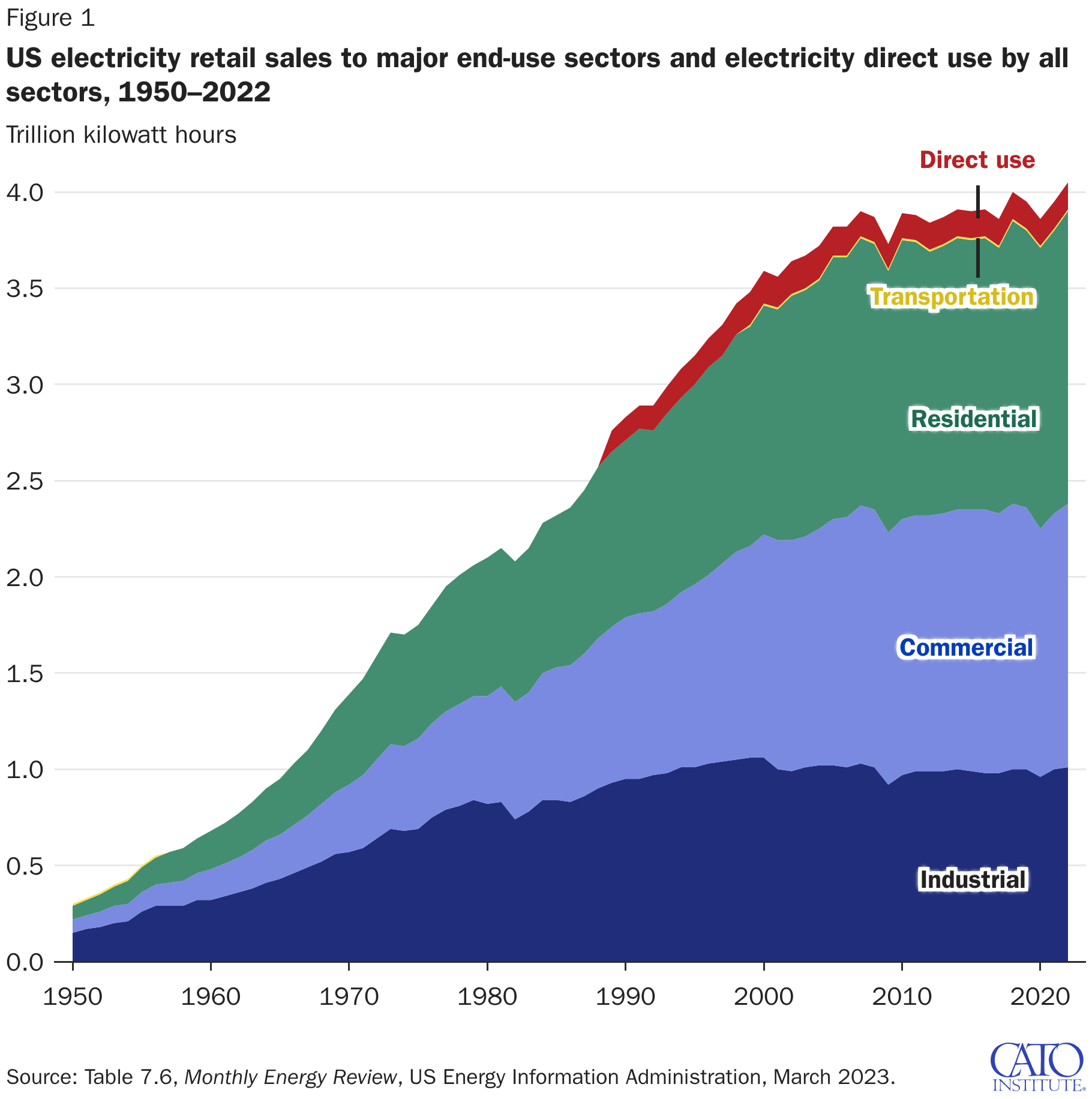
For nearly 20 years, US electricity demand was essentially flat.1 That era is over. A convergence of economic forces, including the development of AI, the boom in data center construction, growth in advanced manufacturing, and more electrification, is driving electricity demand growth at a pace not seen since the mid-20th century (Figure 1).2
Data centers illustrate the scale of the challenge. They were once a negligible share of electricity consumption but are rapidly becoming some of the largest and most power-intensive facilities in the economy.3 In the aggregate, US data centers consumed about 183 terawatt-hours (TWh) of electricity in 2024, which represented about 4 percent of total consumption. By 2030, the International Energy Agency expects total US data center electricity consumption to more than double, to 426 TWh.4
Training large AI models can require enormous amounts of energy. As the MIT Technology Review explains, “training OpenAI’s GPT‑4 took over $100 million and consumed 50 gigawatt-hours of energy, enough to power San Francisco for three days.”5 A simple rule of thumb is that 1 megawatt is enough power for about one thousand homes, on average, and a large nuclear reactor supplies about 1,000 megawatts (or 1 gigawatt), enough for one million homes.6 Hence, training a large AI model could draw as much power as approximately one million households.
Once the up-front training is complete, AI models are ready to perform inference, meaning answering the questions they have been trained to answer.7 Inference systems require continuously available computing power to serve billions of daily queries. Combining training, inference, and non-AI uses, analysts estimate that US data centers could consume roughly 8–10 percent of national electricity demand by 2030, with much higher concentrations in certain regions.8 Northern Virginia’s “Data Center Alley” already consumes more electricity than many US states, and similar hubs are emerging in Texas, Ohio, Georgia, Arizona, and elsewhere.9
Utilities accustomed to annual electricity demand growth of 1–2 percent now face requests equivalent to suddenly adding a brand-new entry to the list of the US’s 25 most populous cities (imagine plugging in a new Philadelphia).10 Unlike the more gradual growth of the mid-20th century, this growth is coming in large chunks and presenting new problems for regulators.11 Yet the electricity sector remains constrained by problems that have been brewing for years—multiyear interconnection queues, decade-long timelines for building large transmission lines, and regulatory processes ill-equipped to handle rapid change.12 The result is the threat of rising retail rates, mounting reliability concerns, and growing frustration among large customers unable to secure power on commercially viable timelines.13
New customers who value speed to power, exemplified by large data centers, are less concerned about the cost of electricity and more focused on the far greater business opportunity ahead of them.14 Put differently, the opportunity cost of not being able to run their facilities dwarfs the cost of electricity. Today’s power sector is holding those customers back, and it’s not merely a problem of insufficient generation or transmission. It is a problem of poor institutional design.
Why the Status Quo Cannot Adapt
Electricity was once a frontier industry.15 In the late 19th and early 20th centuries, figures such as Thomas Edison and George Westinghouse (along with Nikola Tesla) built competing private systems in a race to electrify America.16 That environment of experimentation and rivalry was gradually replaced by a model of regulated monopolies, justified by questionable concerns over duplication, reliability, and consumer protection.17 The typical refrain is that electricity is a natural monopoly, and the best policymakers can do is regulate it wisely or quarantine the monopoly to certain segments of the industry.18 Regulations intentionally consolidated the industry.
Over time, that regulatory model evolved into something more complex and less coherent. Today’s electricity sector is neither a traditional regulated monopoly nor a genuinely competitive market. It is a patchwork of overlapping state and federal rules, institutional practices enforced by regional transmission organizations, and administrative processes that strongly favor incumbents. Despite frequent references to “electricity markets,” entry by new utilities is effectively prohibited. Forming a new utility or offering a competing service typically requires approval from state public utility commissions (PUCs), a process that is slow, uncertain, and prone to regulatory capture.19
The PUCs were designed to protect residential consumers from monopoly abuse. But they now govern an industry serving sophisticated global firms with billion-dollar balance sheets and strong incentives to manage risk. The result is a system that prioritizes caution over speed and political process over innovation, which is precisely the opposite of what today’s demand shock requires.
Regulated electric utilities are in an untenable position. In the quest to protect consumers, regulators have handicapped utilities relative to businesses in more open markets by placing a ceiling on their profits.20 In times of slow growth, a low but stable rate of return can be attractive to investors.21 During periods of rapid and risky growth, however, a modest rate of return keeps investment inefficiently constrained. In other words, today’s electricity industry is built for a low-growth and low-risk environment, whereas meeting the electricity demands of tomorrow requires entrepreneurs to make bold and risky investments that might yield returns that regulators would not support.
Consumer-Regulated Electricity to the Rescue
Consumer-Regulated Electricity (CRE) is a policy framework that creates space for new, privately financed electric utilities to operate outside the traditional regulatory system. If enabled, CRE utilities would generate, transmit, and sell electricity directly to customers under voluntary contracts, without interconnecting to the existing regulated grid or seeking permission from economic regulators at the state or federal level.
The CRE model rests on two essential conditions:
- Physical separation: CRE utilities must remain islanded, meaning they may not electrically connect to the regulated grid.
- Sophisticated customers: CRE utilities must serve only customers who voluntarily contract for service and can manage their own risks.
When these conditions are met, the traditional justifications for utility regulation disappear. Islanded systems impose no costs on the regulated grid. The usual arguments for economic regulations—natural monopoly, public goods, information asymmetry, network effects, and so on—do not apply once systems are physically islanded and sophisticated customers opt in by contract. There would be no economic rationale for dictating entry, exit, pricing, technology choices, or business models. Major multinational corporations negotiate global supply chains, finance billion-dollar facilities, and manage complex operational risks. There is no reason for a regulator to scrutinize their electricity contracts.
How CRE Differs from Existing Alternatives
CRE is fundamentally different from earlier electricity reforms. It is certainly not a continuation of the restructuring efforts of the late 1990s and early 2000s, which yielded mixed results.22 Today’s options, including self-supply by single customers and variations on the “mandatory open access” approach to the electric grid, are insufficient to meet the AI moment.23
Pure self-supply is legal and allows firms or individuals to build and operate their own generation facilities. Although this approach provides autonomy, it sacrifices economies of scale and forces firms to divert capital and attention away from their core business. For example, AI companies may not want to become power plant owners and operators. CRE would enable third-party utilities to serve many customers, resulting in lower costs, higher reliability, and a smaller environmental footprint compared to self-supply options.
Co-location refers to end-use customers physically connecting to the grid at or near the same site as generation facilities.24 Critically, co-location arrangements are dependent on the regulated grid. This exposes customers to interconnection delays and political meddling, including regulatory priorities that shift from one presidential administration to the next. Co-location also raises questions about cost socialization and new reliability risks for other ratepayers. CRE avoids these risks entirely by operating independently.25
The Public Utility Regulatory Policies Act of 1978 opened a channel for non-utility generation, but it requires sales through incumbent utilities at rates determined by state regulators.26 CRE bypasses these constraints. Similarly, retail choice programs offer limited competition among suppliers on a shared distribution system but retain full dependence on the monopoly grid and its rules and regulators, whereas CRE removes that dependence altogether.27
Some restructured markets, such as the Electric Reliability Council of Texas, allow limited private-use networks, typically confined to single properties and subject to oversight by the Public Utility Commission of Texas (PUC). CRE expands this concept to allow multicustomer, multifacility utilities operating fully outside PUC control.
The Benefits of Consumer-Regulated Electricity
For new customers, CRE moves at the speed of entrepreneurs rather than the speed of regulators. Without interconnection queues, transmission approvals, or legacy grid standards, CRE utilities could move quickly from contract to construction. For industries operating on rapid innovation cycles, speed to power is decisive.
For states, CRE offers an alternative to subsidizing economic development with tax credits and infrastructure spending. When constituents clamor for policymakers to address the cost or reliability of electricity, enacting CRE is a tangible policy action that would promote industry without burdening residential ratepayers.
For existing ratepayers, CRE avoids the socialized costs of serving large new customers. Because CRE utilities are islanded, existing customers would not pay for new substations, transmission lines, or speculative demand that might never materialize. Further, customer-friendly innovation would improve because CRE utilities would have far more incentive and leeway to experiment.
CRE would bring dynamic competition. The legal protection of monopoly utilities essentially eliminated the likelihood that a utility could go out of business. Reducing the threat of destruction reduced the vital economic force of creative destruction, meaning CRE utilities would embrace the competitive process of continual improvement and innovation or be replaced by those that do.28
Scientific advancement would also benefit. Freed from regulatory micromanagement, CRE utilities would experiment with technologies, system designs, and business models ranging from advanced natural gas turbines and geothermal systems to small modular nuclear reactors and combinations of wind, solar, and battery systems, as well as novel transmission architectures. Experimentation is key to survival in a competitive market. Moreover, consumers, not regulators, would decide what mix of cost, reliability, and other attributes they prefer.
Perhaps counterintuitively, CRE could create opportunities for incumbent utilities. Existing utilities or independent power producers could serve large customers outside their present footprints. These unshackled independent producers and competitive affiliates, infused with utility knowledge and experience, could move much faster and be far more innovative than their regulated counterparts.
Proofs of Concept in the States
CRE is neither purely theoretical nor a speculative policy dream: It is a practical response to real-world pressures. The question now is whether US states (and perhaps the federal government) will provide the legal certainty needed for these models to take root and expand. A few examples highlight the promise of CRE.
New Hampshire: The First State to Enact CRE in a Stand-Alone Bill
In August of 2025, New Hampshire became the first state to pass legislation explicitly authorizing what it called “off-grid electricity providers.”29 House Bill 672 allowed independent entities that aren’t connected to the grid to generate, transmit, and sell electricity without coming under the jurisdiction of the state’s PUC, provided they remain physically separate from the existing grid.30
The passage of HB 672 was significant because it showed that a state legislature could, with simple statutory language, carve out an exemption for new utilities serving sophisticated customers. It also demonstrated bipartisan appeal. When filed, the bill featured 11 cosponsors: eight Republicans and three Democrats.
Ohio: The New Albany Off-Grid Data Center Cluster
In a practical demonstration of CRE-like thinking, developers in New Albany, Ohio, have pursued data centers and industrial facilities on timelines that local utilities could not meet. The solution was to establish an off-grid power cluster, an islanded set of generation and load facilities designed to operate independently from the existing grid.31 The New Albany case, enabled by CRE-friendly provisions in the 2025 state law HB 15, illustrates that companies are willing to pay significantly more for electricity if it means they don’t have to wait years for a utility to build substations and lines.32
West Virginia: Ravenswood Industrial Site
Another example comes from Ravenswood, West Virginia, where developers are building an industrial site scheduled for completion in 2027 that will be powered by dedicated off-grid electricity resources. Like New Albany, the Ravenswood project illustrates that large customers—a titanium-smelting facility in this case—often need independent solutions when monopoly utilities cannot meet their needs.33 Ravenswood also underscores the economic development potential of CRE. In regions that have struggled with deindustrialization, the ability to promise reliable, fast-deployed electricity can be decisive in attracting new investment. By allowing off-grid utilities, states like West Virginia could leverage CRE not only to support data centers but also to revive manufacturing and heavy industry.
Oklahoma: Behind-the-Meter Legislation
Oklahoma’s SB 480 updates state utility law to allow large industrial and commercial customers to build and operate behind-the-meter power systems, such as on-site natural gas generators, without involving public utilities. These systems provide electricity directly to the customer’s facilities and are not subject to traditional utility regulations. The law aims to alleviate grid bottlenecks, accelerate project timelines, and attract data center and manufacturing investments. As state Rep. Brad Boles noted, SB 480 enables the private sector to finance and develop its own energy infrastructure, reducing reliance on long transmission lines and relieving grid congestion.34
Utah: Electric Utility Amendments
Utah’s SB 132 sets rules for serving customers with loads of 100 MW or more and offers three service paths: traditional utility service, utility-transmission service from a large-scale generation provider, or a fully off-grid closed private generation system. Closed systems must be physically independent of utility transmission.
Large-load customers must pay all costs, and service under the bill is exempt from rate regulation but must meet safety and reliability standards. The law requires state review of large-load contracts, formal request procedures, and registration and qualification of generation providers. It applies only to contracts starting before December 31, 2034, and mandates periodic oversight by state regulators, creating a clear pathway for data centers and industrial users to build off-grid or behind-the-meter power when utilities cannot.35
Addressing Common Objections
Concerns about cost and reliability overlook the voluntary nature of CRE. If CRE utilities cannot compete, customers will not choose them. Clean-slate systems may deliver higher reliability by tailoring redundancy to specific loads. Critics who fear a “utility death spiral” misunderstand CRE’s scope. CRE serves new load growth, not existing customers. By absorbing uncertain demand, CRE reduces risk for incumbent utilities and their residential customers.
Likewise, safety concerns are mitigated by physical separation. Failures in islanded systems are contained and do not cascade across the grid. Governance is handled through contracts, as it is for other critical industrial inputs.
Many grids desperately need upgrades and modernization and are counting on data center growth to pay for them. However, this view doesn’t consider the risk inherent in these new large loads. Not only can they introduce new reliability risks, but there is also uncertainty in their future load. If their load falls short of forecast, then not only won’t they underwrite any work, but utility buildouts could include stranded capital, which typically is backstopped by the remaining ratepayers.
People on both sides of the political aisle talk about the US being in an AI arms race with China, and so the argument goes that we need to emulate China’s centrally planned approach to electricity.36 CRE takes advantage of the causes of US economic success: capitalism and free enterprise.37 Entrepreneurs and the profit motive have spurred the incredible wealth of the US. Opening the door to more capitalism and free enterprise has always provided the best results.38
How States Can Implement CRE
Implementing CRE requires modest statutory changes. States can exempt islanded utilities serving new nonresidential customers from the definition of a public utility. The American Legislative Exchange Council (ALEC) recently approved model policy that provides a template for states.39 The ALEC model defines CRE utilities as physically islanded from regulated utilities and allows them to serve new nonresidential loads without triggering state PUC oversight. Importantly, CRE utilities will remain subject to all other state laws and regulations, including environmental, building, and workplace safety.
Federal Reforms That Support CRE
The primary focus of CRE is on state policy change because states regulate retail electricity, but there is also a need for federal policy changes if CRE utilities are to operate free of permission from economic regulators. The cleanest way to address the federal overlay is via legislation that would exempt CRE utilities from various federal electricity statutes.
For example, Senator Tom Cotton (R‑AR) recently introduced the Decentralized Access to Technology Alternatives Act of 2026, or the DATA Act.40 The DATA Act would provide the needed exemptions from federal statutes such as the Federal Power Act. Crucially, the bill would allow entrepreneurs to accelerate the growth of AI and electricity infrastructure and insulate captive residential ratepayers from cost and reliability risk.
The administration can also allow CRE through regulatory reforms. The Department of Energy (DOE) is seeking ways to accelerate new electricity grid connections for data centers. As part of its inquiry, the DOE issued a public request for information on ways to accelerate speed to power. The DOE could advance CRE by encouraging states to adopt it and by advocating for clarifying guidance that CRE utilities are not public utilities subject to the Federal Power Act.41
The Federal Energy Regulatory Commission (FERC) is confronting the tension between the rapid development of AI and concerns about cost and reliability. FERC, at the behest of the DOE, initiated a rulemaking to accelerate the interconnection of large loads.42 CRE would provide FERC with a complementary pathway. FERC may not need to undertake a new rulemaking to enable CRE (a policy statement likely would suffice), but it should provide certainty to developers by confirming that CRE utilities are not public utilities and are exempt from FERC-enforced reliability standards.
Conclusion
Electricity demand is growing faster than our regulatory institutions can accommodate. CRE offers a parallel path that would protect households, empower consumers, and unleash private investment without public fiscal risk. It is a reform that would complement the existing system rather than attempt to replace it. CRE would allow entrepreneurs to make better and faster decisions than regulators. Electricity is too complex and too important to centrally control. Consumer-Regulated Electricity would help policymakers meet today’s electricity challenges with a solution that is pragmatic, market-driven, and quintessentially American.

About the Authors


This work is licensed under a Creative Commons Attribution-NonCommercial-ShareAlike 4.0 International License.