Many American cities suffer from political corruption. We assembled 15 case studies to illustrate the many ways that local government officials illegally abuse their positions. The corruption examined here involves elected or career officials receiving bribes from businesses or individuals in return for special government treatment.
Local governments have large spending and regulating powers, which gives corrupt officials many ways to provide illegal aid. Local officials have power over licensing, permitting, zoning, contracting, granting, tax breaks, and other sorts of approvals and payments. The larger the government, the larger the corruption opportunities.
The figure illustrates the cycle of corruption. The write-ups and table below summarize, in no particular order, 15 corruption scandals from recent years in cities across the nation.
It is appalling that well-paid people who are entrusted with power abuse their privileged positions in such selfish ways. And it is surprising that the states haven’t imposed tighter protocols to prevent such abuses, which have plagued some cities for decades.

1. New York City. In 2024, 70 New York City Housing Authority (NYCHA) employees were charged with bribery and extortion. The employees allegedly demanded bribes ranging from $500 to $2,000 from vendors in exchange for no-bid building maintenance contracts. Some of the NYCHA employees have been taking bribes for more than a decade, and bribes have totaled at least $2 million.
2. Scranton. In this Pennsylvania city, Mayor Bill Courtright was sentenced in 2020 to seven years in jail for corruption. The mayor frequently directed city officials “to hold up licenses, permits, or contracts to extort cash and campaign contributions from entities doing business in or with the city.” He “threatened economic harm” to businesses dealing with the city “and made good on his threats with adverse official actions [in order] to obtain payments, campaign contributions, and other property.” Over five years, “tens of thousands of dollars of ill-gotten cash ended up in a safe in Courtright’s West Mountain home, delivered by intermediaries.”
3. North Charleston. Three city council members in this South Carolina city were charged in 2025 for demanding bribes from local businesses. In one scheme, council members Jerome Heyward, Mike Brown, and Sandino Moses allegedly took thousands of dollars from a businessman in return for supporting the rezoning of a former hospital site. In another scheme, Heyward allegedly took “a $40,000 kickback from two nonprofit organizations in return for steering to them part of a $1.3 million grant to fight gun violence in North Charleston.” In yet another scheme, Heyward allegedly extorted a business to pay him tens of thousands of dollars for help with licensing and zoning approvals. Heyward and Moses have pleaded guilty to various charges, while Brown has pleaded not guilty.
4. Dallas. City council members Dwaine Caraway and Carolyn Davis pled guilty in 2019 to crimes related to supporting government loans and housing tax credits for real estate developers in return for thousands of dollars in bribes. A decade earlier, housing tax credits were at the center of the “largest political corruption case in Dallas history.” At that time, 14 people were convicted of bribery and related crimes, including a state representative, a city council member, and the city planning commissioner.
5. Boston. City council member Taina Fernandes Anderson pled guilty to corruption in 2025 after collecting $7,000 from a staff member’s bonus. Anderson hired a relative and gave her a bonus of $13,000 on the condition that $7,000 be kicked back to herself. Also, between 2021 and 2023, Anderson was found to have misused campaign funds for personal gain, filed false tax returns, stolen funds from a program, and illegally hired relatives.
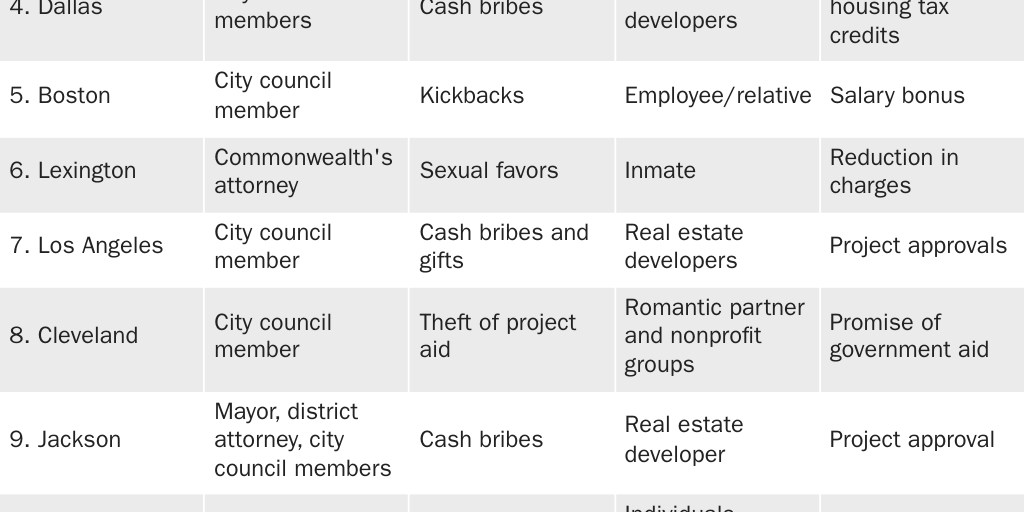
6. Lexington. Ronnie Goldy, a government attorney in Kentucky, was sentenced in 2024 to prison for performing official acts in exchange for sexual favors from a criminal defendant. Goldy solicited and accepted sexual favors from Misty Helton in return for seeking Helton’s release from incarceration and asking for the withdrawal of arrest warrants.
7. Los Angeles. City council member José Huizar was sentenced to prison after pleading guilty to racketeering and tax evasion in 2024. Huizar performed official acts for real estate developers, such as pushing for project approvals, in return for $1.5 million in bribes and gifts. Not only did Huizar take bribes, but “if anyone dared rebuff his call to pay bribes, he punished them and their city projects, threatening developers with indefinitely delayed projects and financial peril.” US Attorney Nick Hanna said, “The scope of corruption outlined in this indictment is staggering,” noting that Huizar turned his “city council seat into a money-making criminal enterprise.” Hanna called corruption at Los Angeles city hall a “disease of elected officials and staff members breaking a series of laws in order to line their own pockets, maintain power and keep open a spigot of illicit bribes.”
8. Cleveland. City council member Basheer Jones was charged in 2024 with stealing more than $200,000 meant for charitable projects. Jones’s schemes were “devised to deceive nonprofit entities into making payments toward projects they thought were for the community’s benefit. Instead, the money ultimately went into bank accounts controlled by Jones’s romantic partner.” In one scheme, Jones allegedly told a group to hire a consultant for $5,000 a month to move a project forward. The consultant was Jones’s partner, who did no work for the project. In another scheme, Jones allegedly received $50,000 from a group to fund a children’s event that never took place. In other schemes, Jones allegedly pocketed money for taking actions to move real estate deals forward.
9. Jackson. In this Mississippi town, Mayor Chokwe Antar Lumumba, District Attorney Jody Owens, city council member Aaron Banks, and former city council member Angelique Lee were charged in 2024 with taking bribes in exchange for aiding developers in a proposed hotel project. Allegedly, Lumumba took a $50,000 bribe, Banks took $10,000, and Lee took $19,000. Owens allegedly facilitated the bribes in return for $115,000. Lee has pleaded guilty to bribery charges.
10. New York City. Half a dozen New York Police Department officers were found guilty of taking bribes for expediting gun licenses from 2013 to 2016. The officers received “everything from cash, prostitutes, and expensive watches to baseball memorabilia and exotic vacations.” Paul Dean, who as “second-in-command of the License Division had accepted gifts and favors in connection with his approval of gun licenses, conspired upon his retirement from the NYPD to open his own ‘expediting’ business in which he would pay bribes to his fellow NYPD officers, once his subordinates in the License Division, to issue gun licenses to Dean’s clients. ” Officer Alex Lichtenstein was caught “on tape bragging that he had obtained at least 150 licenses for people to carry guns by paying up to $6,000 in bribes for each weapon.” With bribes in hand, officers issued gun licenses with little due diligence for people with violent criminal histories.
11. Toledo. Three Toledo city council members pleaded guilty to taking bribes in 2022. Tyrone Riley, Yvonne Harper, and Larry Sykes “each accepted cash payments in return for their support and votes on zoning changes and special use permits (SUPs) for local businesses. Riley accepted more than $10,000 in payments and meals in return for his support on five separate city council matters. Harper accepted more than $5,000 in return for her support on two matters, and Sykes accepted $1,500 for his support on three matters.” A fourth city council member, Gary Johnson, was also convicted of bribery.
12. New Orleans. In 2019, New Orleans building inspector Kevin Richardson “admitted taking more than $65,000 in bribes from contractors and property owners to look the other way on permit violations or falsify inspections, marking the first domino to fall in what’s expected to be a wide-ranging dragnet in the city’s Safety and Permits office.” Richardson also bribed an analyst within the Safety and Permits office to get her approval of fraudulent permits. Investigations in 2025 by local news media found that the city’s permitting system is a dysfunctional mess.
13. Los Angeles. In 2018, “Two former officials in California’s liquor agency pleaded guilty … to running a bribery scheme that for years targeted karaoke bar owners in Los Angeles’ Koreatown.” Wilbur Salao worked for the Department of Alcoholic Beverage Control (ABC), and Scott Seo was a former ABC employee and consultant for bar owners. The pair gained tens of thousands of dollars in bribes by fast-tracking liquor license approvals, slowing license approvals for competitor bars, and threatening bar owners with enforcement actions.
14. Fall River. The young mayor of Fall River, Massachusetts, Jasiel Correia, was convicted in 2021 of accepting $600,000 in bribes from companies seeking marijuana licenses. Massachusetts gave cities the discretion to hand out a limited number of pot licenses, a legalization approach that Politico noted has created “a market for local corruption” in many states. Correia was also convicted of defrauding investors out of $230,000 they put into his software company—cash that he used for funding a lavish lifestyle of expensive cars, designer clothing, airfare, hotels, restaurants, casinos, and adult entertainment.
15. Philadelphia. Philadelphia’s Department of Licensing and Inspections has been plagued by corruption for decades. The City Controller’s Office is supposed to prevent such abuse, but employee Jeffrey Blackwell pleaded guilty in 2020 to taking bribes from numerous individuals himself: “One of the individuals owned a furniture store and paid Blackwell for permits to park a storage container on the street. The second person was renovating a house and paid Blackwell for permits to allow that renovation. The third person owned a construction business and paid Blackwell to obtain a plumbing permit. The fourth person owned an auto body shop and paid Blackwell in the hope of getting a license to buy and sell cars, as well as a city contract to install decals on police vehicles.” Blackwell is the grandson of a congressman and step-grandson of a city councilwoman.