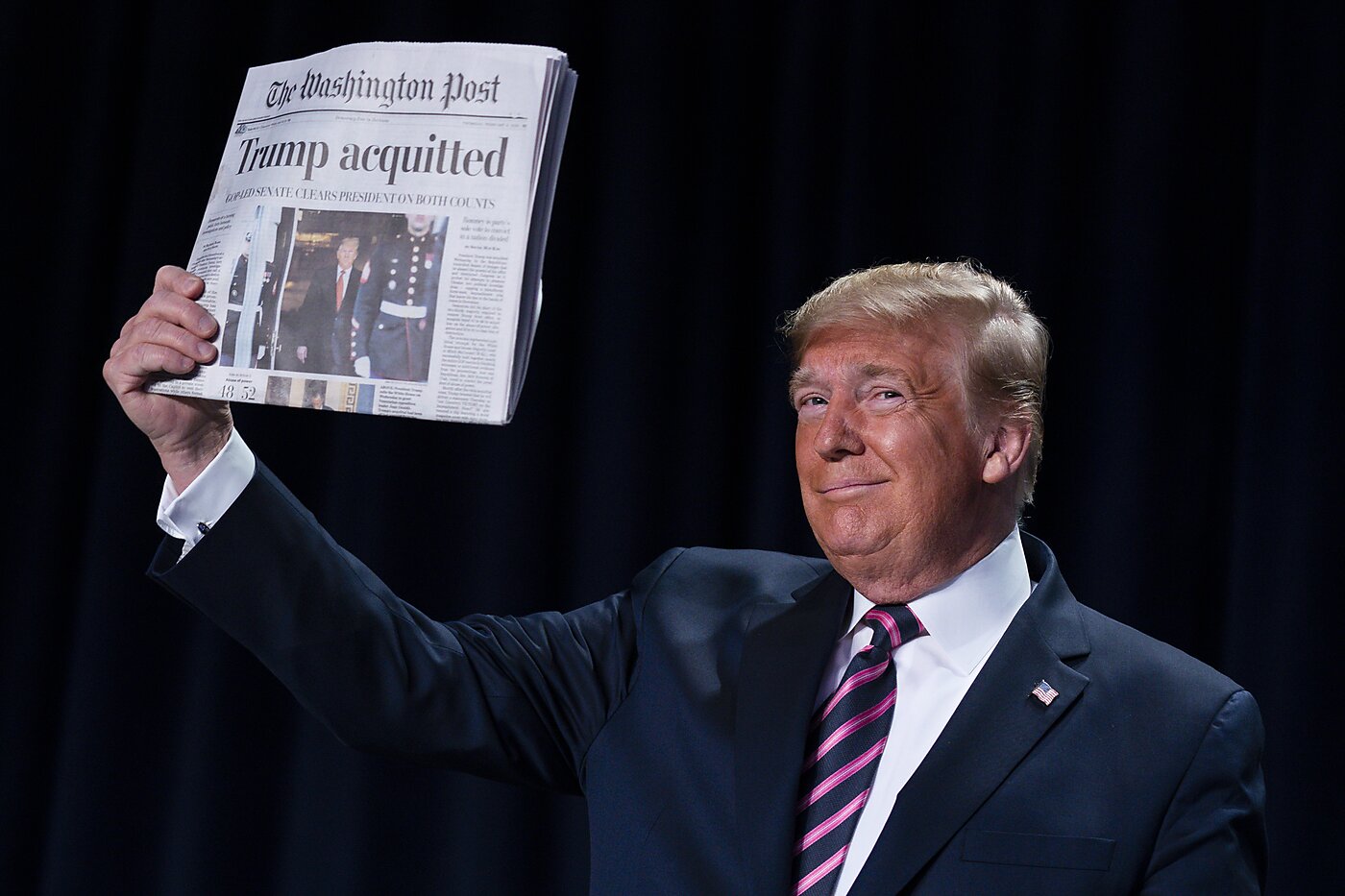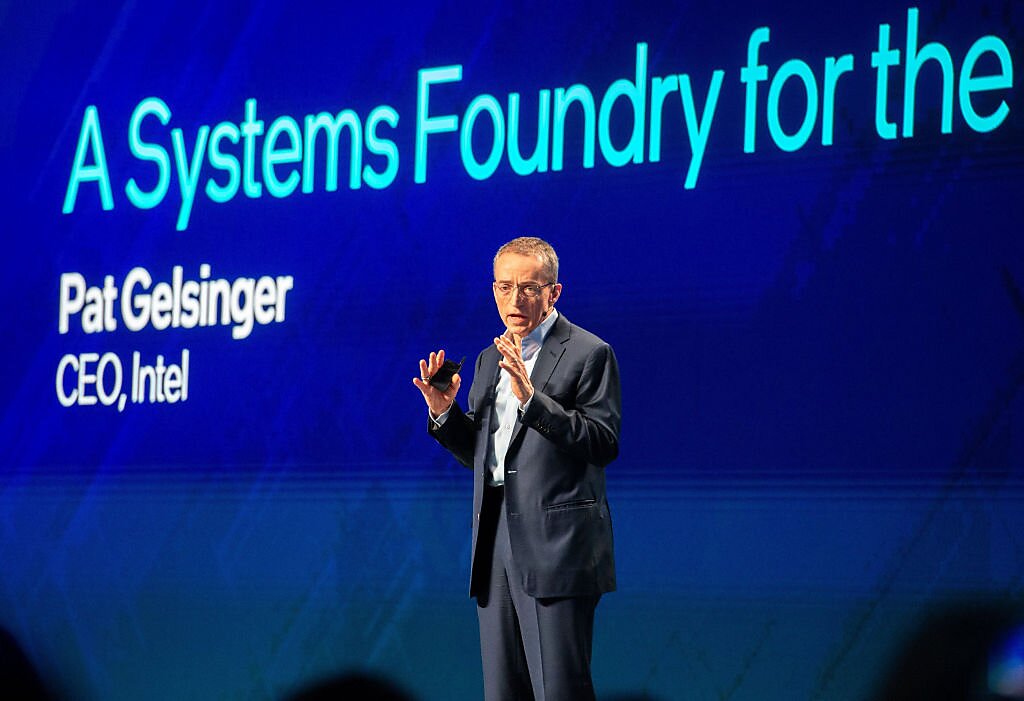
President Trump issued an executive order in February to plan a US sovereign wealth fund (SWF). An SWF is a government investment fund that manages public assets, typically financed from surplus or natural resource revenues, to generate long-term returns for government use. It’s a bad idea. But now ex-Intel CEO and CHIPS Act cheerleader Pat Gelsinger has reemerged to advocate for one.
Gelsinger, a partner at venture capital firm Playground Global, recently penned a Wall Street Journal op-ed in which he claims, “If the U.S. wants to win the global race for technological supremacy, the country’s best tool is a sovereign-wealth fund.” That’s a bold claim, but it comes from a flawed messenger who relies on blanket assertions and seems oddly oblivious to how things work in Washington.
Gelsinger says a “well-structured” sovereign wealth fund should be an “independent and nonpolitical agency.” He also says, “intelligently deploying President Trump’s proposed sovereign wealth fund could secure American leadership in such critical technologies as quantum computing, artificial intelligence, and advanced microchips.”
An SWF administered by altruistic technocrats, completely walled off from politics, is a fantasy. It would have to be created by Congress, so forget about being “well-structured” or “intelligently” deployed. Should it exist, presidents and members of Congress can and will exert influence on it just as they do on any other nominally independent federal agency.
That influence can be subtle or, in Trump’s case, brazen.
For example, whatever one thinks of the Federal Reserve and Jerome Powell’s job performance as Fed Chair, the Trump administration has embarked on a lame fishing expedition to jettison Powell because the Fed has ignored the president’s call for a rate cut. Should Powell step down or be removed, the president would appoint his successor (subject to confirmation by the Republican-controlled Senate). It’s a pretty safe bet Trump will want a pliant replacement.
It is absurd, therefore, to think Trump will stand idly by while a massive government investment fund has all the fun planning the country’s economic future. Trump just effectively nationalized US Steel. His confused tariff policy is built on arrogance and a bellicose approach to trade relations. He’s been bullying private companies from the beginning and now uses the White House to bully everything from individual citizens to broadcasters to allied countries.
Sure, Trump won’t be president forever. But imagine it’s 2029, and President AOC has a Democratic-controlled Congress. What are the odds they’ll refrain from “encouraging” fund administrators to target investments toward green energy companies or make it mandatory to consider a company’s Environmental, Social, and Governance practices?
But let’s indulge the fantasies for a moment. Where’s the money for an SWF coming from?
Gelsinger casually dismisses “concerns about forming a fund when the US is running budget deficits” by breezily claiming, “The benefits far outweigh the risks.” Fiscal policy experts would probably beg to differ. The federal government will run a nearly $2 trillion deficit this year, and the national debt is almost $37 trillion and growing. Washington’s abysmal financial management doesn’t instill confidence that adding an investment fund would be prudent.
It would be interesting to see if and how those bleak fiscal numbers factored into Gelsinger’s risk assessment matrix, but we’re left to take his word for it. In August 2024, when asked about his turnaround plan for Intel, the then-CEO told Reuters, “I’m very confident that we’re going to pull it off … Three years in, yeah. This one’s going to happen, baby.” Several months later, Gelsinger resigned after being forced out by the company’s board of directors.
He apparently underestimated the risks of his turnaround plan.
Gelsinger says “other countries have used sovereign-wealth funds to great national advantage,” citing Norway’s Government Pension Fund Global (GPFG) as “the premier example.” However, Norway relies on oil and gas revenues to finance its funds, with the returns used to smooth budget fluctuations. By design, the GPFG invests only abroad to avoid distorting the domestic economy, which is the opposite of what Gelsinger wants a US SWF to do.
Of course, China is a different story. The Chinese government has and continues to spend enormous amounts of money to reduce the country’s reliance on Western technology and establish itself as a cutting-edge global economic power. That’s Gelsinger’s underlying concern, and it’s understandable.
However, large-scale state-directed spending on particular industries does not automatically guarantee long-term success. For example, China’s semiconductor initiative has resulted in numerous failed or “zombie” projects and has been plagued by fraud and corruption. Whether done by Washington or Beijing, government spending is not a free lunch. There are costs, both seen and unseen. Regardless, the federal government is already heavily engaged in industrial policy (unfortunately).
Gelsinger just thinks American central planning isn’t centralized enough.
According to Gelsinger, a specialized team of government planners must direct investment in private companies because “our current model has fed notable innovations, but its focus is on short-term returns, not long-term competition.” He points to quantum computing and says, “American firms like PsiQuantum and Google have achieved significant breakthroughs, yet scaling these technologies requires patient, long-term capital typically unavailable from Wall Street or traditional funds.”
That’s another questionable assertion, and one that’s undermined by the Beltway political market’s inability to see past the next midterm election.
Curiously, he leaves out that PsiQuantum’s largest shareholder is reportedly Playground Global—the venture capital firm where Gelsinger is currently a general partner.
In addition to private equity financing, the company has been awarded federal defense contracts and received subsidies from the state of Illinois to anchor a quantum park in Chicago. It also received government support from the United Kingdom for an R&D facility and a $620 million package from Australia in 2024 to build the “world’s first utility-scale, fault-tolerant quantum computer.”
It sounds like the company is doing fine, attracting private and public funds without help from a US SWF. But then, Intel CEO Gelsinger was one of the loudest advocates for the 2022 CHIPS Act and its $52 billion subsidy package to incentivize domestic semiconductor production. That wasn’t enough, so now he wants an SWF to “invest strategically in semiconductor startups.”
Intel’s experience shows why it’s premature (to say the least) to pile on top of CHIPS.

In 2022, President Biden joined Gelsinger in Ohio for a ceremonial groundbreaking on a new $20 billion Intel semiconductor manufacturing project to be subsidized by the CHIPS Act. Initially promising tens of thousands of jobs and the production of cutting-edge chips starting in 2025, Intel now says operations won’t begin until 2030 at the earliest.
Alas, Gelsinger was out of a job barely a week after Intel’s $7.9 billion CHIPS award was finalized, of which $1.5 billion was for the Ohio project.
Between the time when Gelsinger was pining for federal subsidies and his forced departure, Intel’s stock price dropped by half. Last week, Intel announced it “will cut 15% of its workforce and scrap plans to spend tens of billions of dollars on new chip facilities in Europe, as it takes steps to revive its sagging fortunes.”
Being the CEO of a legendary tech company is certainly not easy. As with Intel, Gelsinger presumably has good intentions, even with the self-serving odor attached to his latest call for more industrial policy. Nonetheless, the record speaks for itself.
Gelsinger says, “Critics will call such a fund industrial policy in disguise or a chance to ‘pick winners,’ but this isn’t an attempt to surmount market forces…. A U.S. sovereign-wealth fund would complement—not replace—private markets.” But there’s no disguise—it’s industrial policy. And having the government pick the technological winners of the future is precisely what he wants a federal investment fund to do. While he’s correct that an SWF wouldn’t replace private markets, it would distort and undermine—not complement—them.