Each year, the Treasury Department quietly publishes the Financial Report of the United States Government, a comprehensive assessment of America’s long-term financial trajectory. Unlike the Congressional Budget Office, which focuses on 10-year and 30-year economic and budget projections, the Financial Report evaluates the government’s long-term unfunded obligations.
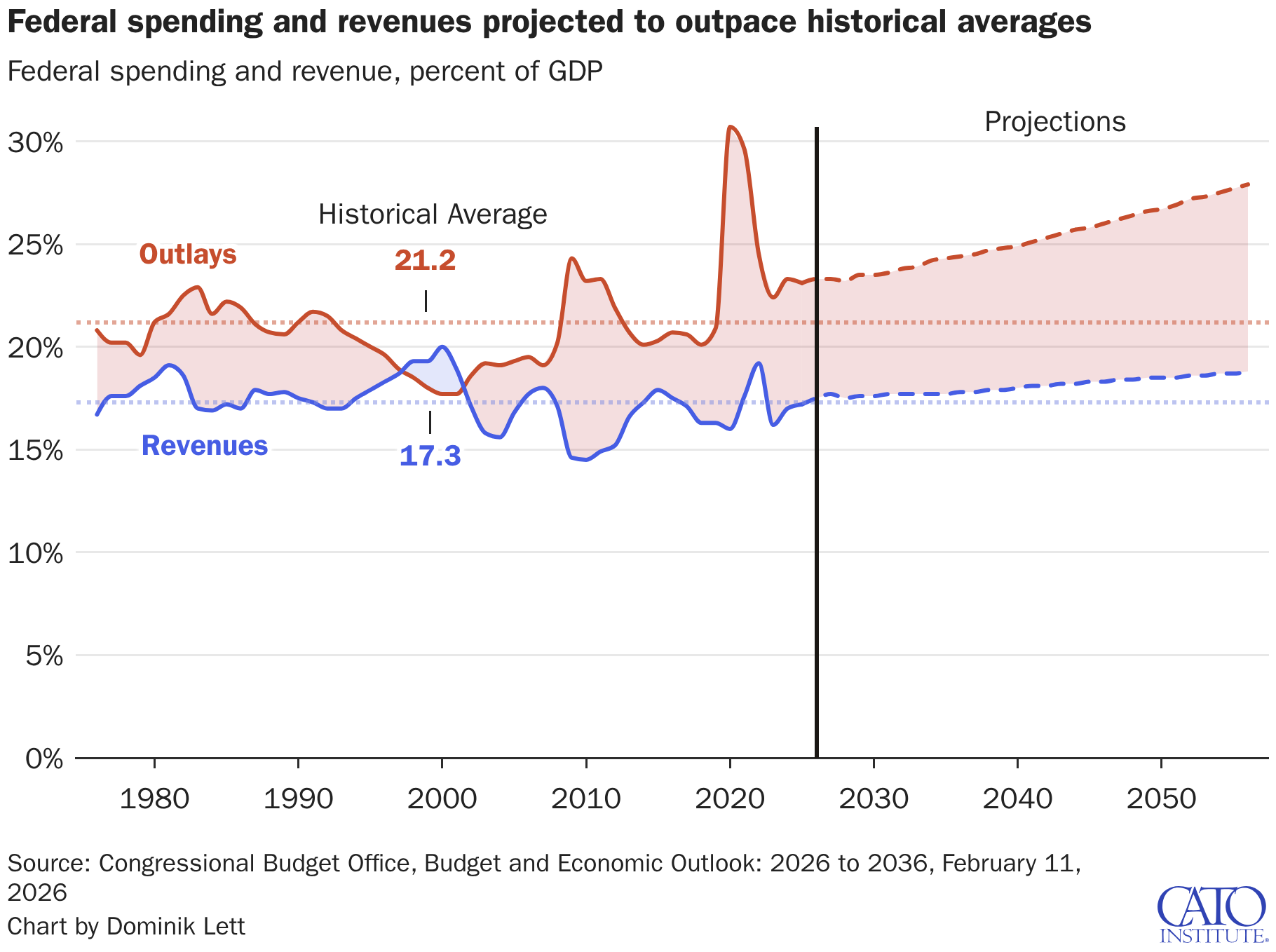
The latest report shows that over the next 75 years, the federal government faces a $79.6 trillion gap between projected noninterest spending and revenues. In other words, projected spending commitments (excluding interest payments) exceed expected revenues by roughly 2.6 times the size of the entire US economy today.
Three Key Takeaways from the Financial Report:
- Social Security and Medicare account for more than the government’s entire $79.6 trillion long-term funding gap. Treasury estimates that total social insurance obligations exceed dedicated funding by about $88.4 trillion, almost all of which is attributable to Social Security and Medicare. A small share—about $0.1 trillion—comes from the Railroad Retirement and Black Lung programs. This means the rest of the budget is running an $8.8 trillion surplus.
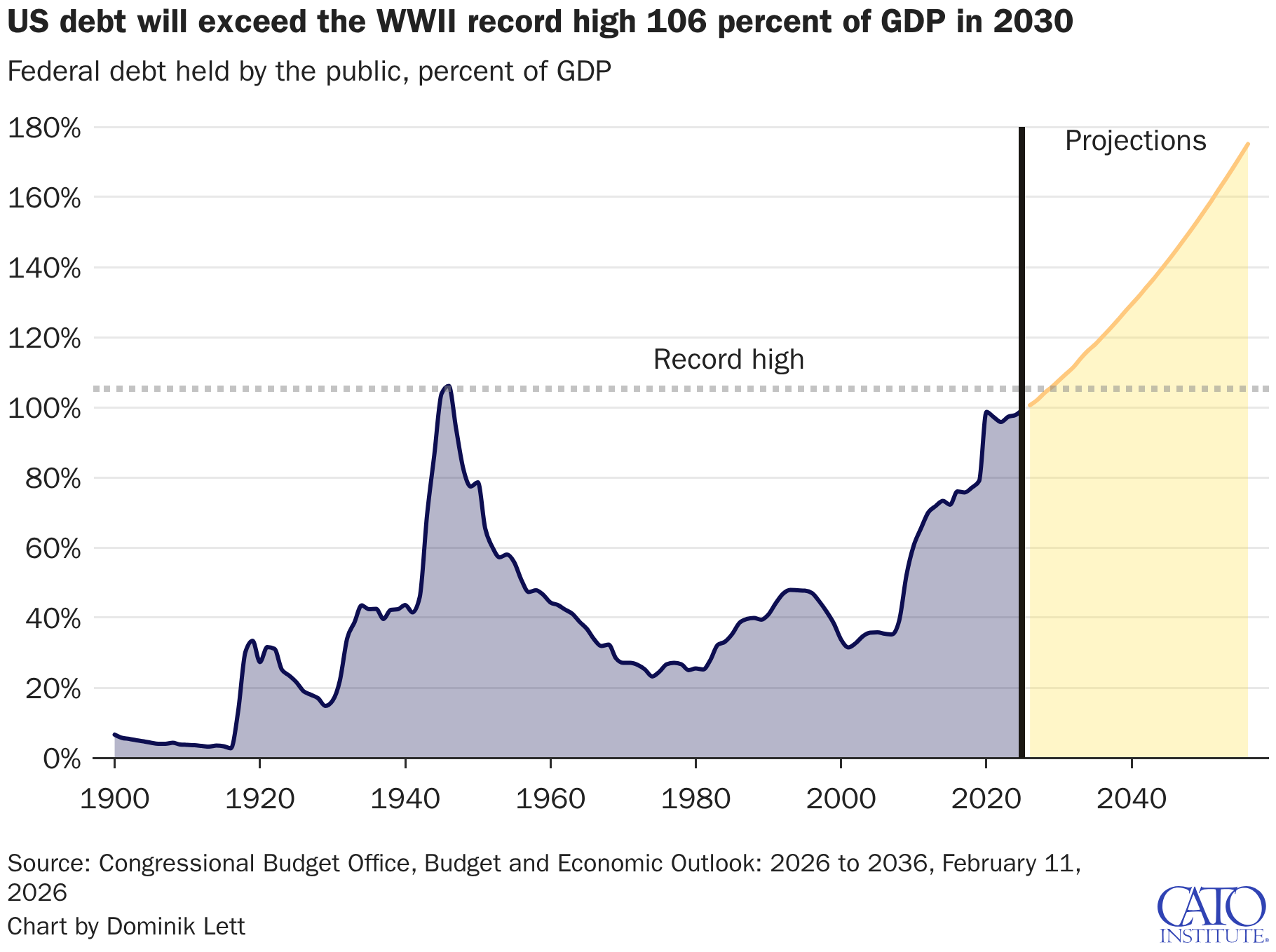
- The US fiscal trajectory is rapidly worsening. Federal debt is already roughly equal to the size of the economy and continues to grow indefinitely under current law. The debt-to-GDP ratio is projected to rise from 102 percent in 2026 to 200 percent by 2048 and to 576 percent by 2100.
- Delaying necessary policy options comes at a high price. Closing the fiscal gap—defined as stabilizing the debt-to-GDP ratio over 75 years—would require an average annual primary (noninterest) deficit reduction of 4.7 percent of GDP, assuming Congress acts immediately. Delaying action until 2036 or 2046 raises the required reduction to 5.6 percent and 6.9 percent of GDP, respectively.
Social Security and Medicare Must Be Reformed
The most important finding in the Financial Report is that the long-term fiscal imbalance is driven primarily by Social Security and Medicare.
Over the next 75 years, projected spending on these programs exceeds their dedicated revenues by a wide margin. Social Security is primarily financed through payroll taxes on current workers, with benefits paid out to current retirees, while Medicare relies on a mix of payroll taxes (for hospital insurance), general revenues, and beneficiary premiums. These financing structures were not designed to support the scale of benefits promised under current law, especially as the population ages and fewer workers support more retirees.
Treasury estimates that total social insurance obligations exceed dedicated funding by about $88.4 trillion, including $27.9 trillion for Social Security, $60.4 trillion for Medicare, and $0.1 trillion for the Black Lung and Railroad Retirement programs (see chart below).
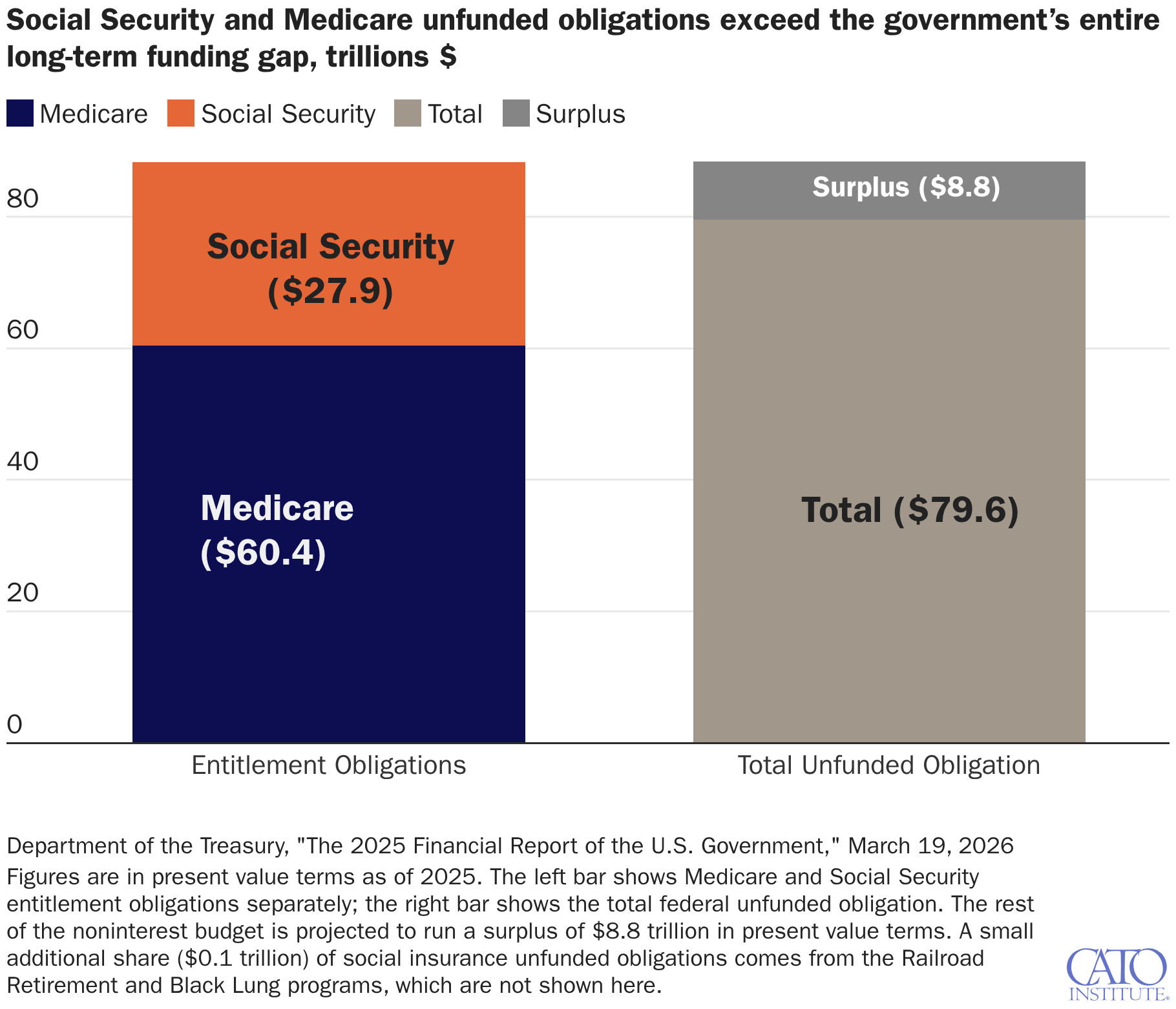
The overwhelming takeaway: there is no realistic path to fiscal solvency that avoids reducing spending on the major entitlement programs. Suggesting otherwise is delusional.
Congress should reform Social Security and Medicare to better align benefits with available resources, focusing on slowing spending growth rather than burdening younger Americans with ever-higher taxes. This includes gradually increasing the retirement age to reflect longer life expectancies, targeting benefits more effectively to seniors in need, reducing excessive Medicare subsidies that drive up costs, and empowering patients to purchase insurance and health care services directly to improve incentives.
Delaying these changes will only force more abrupt and disruptive adjustments later.
Debt Is on a Disastrous Path
The Financial Report depicts a clear picture that current fiscal policy is unsustainable.
Federal debt is already near 100 percent of GDP. Under current policy, it continues to rise faster than economic growth. While there is no precise threshold at which debt triggers a crisis, continued increases in the debt-to-GDP ratio reduce economic growth by crowding out private investment, impose higher borrowing costs by driving up interest rates, and compromise the government’s ability to respond effectively to an unexpected crisis.
Closing the fiscal gap requires significant policy changes: most importantly, slower spending growth. The longer policymakers wait, the larger the required adjustments become. Delaying reforms requires sharper changes later, concentrating the burden on fewer cohorts and limiting legislative policy options.
Higher inflation becomes the path of least resistance the longer legislators procrastinate on making the economically necessary changes that are politically difficult.
The fiscal gap is useful in this respect, summarizing both the size of the imbalance and the cost of postponing action. Congress can solve the problem by immediately reducing annual deficits by 4.7 percentage points of GDP. Delaying action until 2036 or 2046 raises the required reduction to 5.6 percent and 6.9 percent of GDP, respectively.
Why the Report Receives Little Attention
The Financial Report receives limited attention in Washington and in major media coverage. Its central implication—that Social Security and Medicare drive the long-term imbalance—is politically inconvenient. Instead of addressing the problem, Washington’s fiscal debate has become a performance: acknowledge the debt and avoid the solution.
The report makes clear that rising debt is not a temporary problem. It is the result of unsustainable policy choices. Chief among them: bestowing lavish benefits on older, more politically active Americans financed by borrowing that shifts the cost to younger, less politically active generations.
Stabilizing the debt will require changing the trajectory of Social Security and Medicare by slowing their unsustainable spending growth. Delay only increases the size of the adjustment and raises the risk that Congress will rely more heavily on tax increases to avoid sudden and disruptive benefit changes.
A 3 Percent of GDP Deficit Target to Restore Sustainability
Congress is considering a 3 percent of GDP deficit target—a useful benchmark for signaling fiscal discipline and restoring credibility. But a target alone is not enough.
To be effective, it should be paired with a mechanism capable of producing politically difficult reforms, such as a BRAC-like fiscal commission. Without such a process, targets risk becoming aspirational rather than binding. Done right, a 3 percent deficit limit, backed by an actionable reform mechanism, could help put the federal budget on a more sustainable path.
Reforming Social Security and Medicare is key to stabilizing the growth in the debt.
Join us on May 6, 2026, at 10 a.m. for the event: Social Security in the Red: Implications for Federal Debt. Register here.