The ongoing government shutdown is threatening to stall funding for the Supplemental Nutrition Assistance Program (SNAP), which provides food aid to more than 40 million Americans. According to Politico, at least 25 states have issued notices to beneficiaries that their benefits will cease on November 1.
The fact that a program providing food assistance to millions of Americans can be brought to the edge of a cliff because of partisan gridlock illustrates the perils of allowing the welfare apparatus to become increasingly centralized in Washington. Devolving welfare programs such as SNAP to the states would align spending authority with accountability and insulate food aid from federal dysfunction.
SNAP’s Federal Funding Bottleneck
At its core, SNAP’s problems stem from its flawed financing structure. While technically administered by the states, the federal government has always borne the lion’s share of the program’s costs.
The federal government and the states currently have a 50–50 split in paying for SNAP’s administrative costs. Federal taxpayers, however, still pay 100 percent of the program’s benefits costs, meaning that whether food stamp enrollees across the country receive their benefits depends entirely on congressional appropriations. This particular spending formula has not been amended a single time since the Food Stamp Act of 1964.
The breakdown of this cost-sharing arrangement reveals just how lopsided Washington’s fiscal burden really is. According to the Department of Agriculture’s National Level Annual Summary, SNAP’s total federal costs were roughly $100.27 billion in fiscal year 2024, of which $93.67 billion—or 93.4 percent of total costs—was for benefits. The federal government’s share of SNAP’s administrative costs will drop to 25 percent in FY 2027; however, as long as Congress continues to pay for the program’s benefit costs, Washington will continue to dictate the program’s fate.[i]
This imbalance has only deepened over time. In FY 2003, the federal government paid roughly 90 percent of SNAP’s total costs. In FY 2023, its share climbed to over 95 percent (Figure 1).
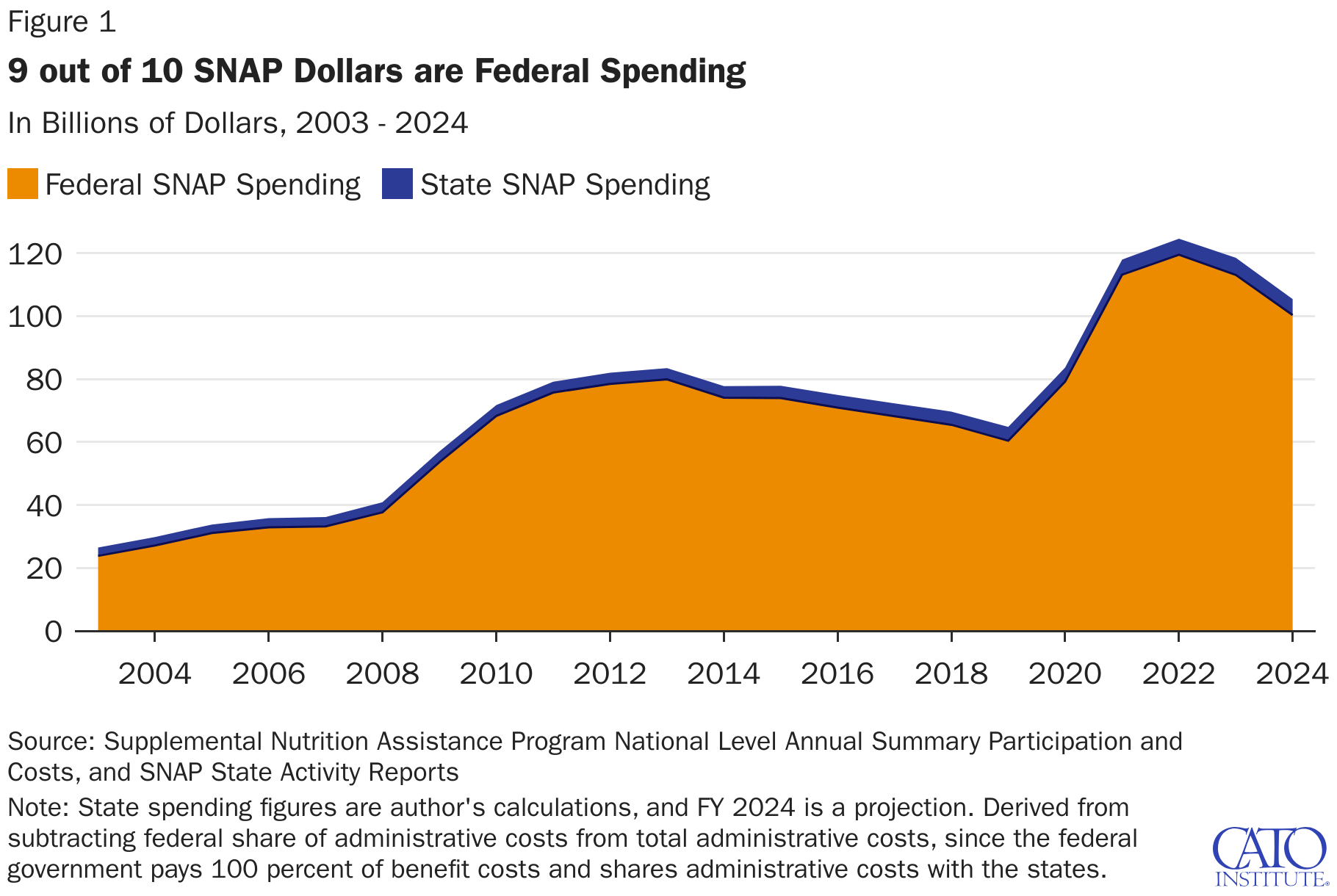
By design, SNAP’s funding model creates a single point of failure. When Washington stalls because Congress can’t get its act together, the nation’s primary food aid program stalls along with it—not because states lack the capacity to manage their programs but because Uncle Sam controls the purse.
This is not a one-off issue. SNAP’s reliance on annual appropriations bills makes it susceptible to budget lapses during government shutdowns as states cannot issue benefits without federal funds, even though the program remains authorized by law. This structural weakness risks triggering funding crises that reverberate through grocery stores nationwide.
Bringing Accountability Home
SNAP’s funding arrangement, which centralizes funding and rulemaking in Washington, leaves states managing programs they don’t fully control. As Angela Rachidi and Leslie Ford of the American Enterprise Institute note, states have little flexibility in tailoring SNAP’s structure, including benefits levels, eligibility, and purchase rules. This has significantly constrained states’ ability to “adapt SNAP rules to meet their individual needs, including efforts to increase efficiencies, constrain costs, address fraud, and improve participant outcomes.” Consequently, states are relegated to being little more than benefits processors.
Empowering states by giving them both the administrative autonomy and the financial responsibility to run their programs as they see fit would link costs and decisionmaking, ensuring state governments manage their programs effectively. As Cato scholar Chris Edwards highlights, allowing states to fund and administer their own food aid programs enables them to experiment and innovate with state-specific policies to improve outcomes for low-income families. This may include trying different rules for purchases, work requirements, benefits levels, and other program features. States funding their own SNAP programs would have the flexibility to find “better solutions for taxpayers, recipients, and the economy” and allow them to design anti-poverty programs that best meet the needs of their constituents, rather than being tied to the one-size-fits-all federal solutions.
States should be the primary decisionmakers for their welfare programs, and a key part of this is having them play a greater role in funding the programs they operate.
The Path Forward
The long-term solution is not another emergency appropriation or a stopgap “Keep SNAP Funded” bill similar to the one proposed by Sen. Josh Hawley (R‑MO). Real SNAP reform requires empowering states to take matters into their own hands and assume the financial responsibility of administering their own programs.
As Chris Edwards notes in his options for SNAP reform, Congress can do this by converting SNAP from an entitlement to a fixed block grant for each state. The change would be similar to the approach taken with the 1996 welfare reforms to Temporary Assistance for Needy Families, which has kept federal spending at $16.5 billion for nearly three decades. This framework is already well established in US food aid policy through the Nutrition Assistance Program, which provides capped grants to Puerto Rico, the Northern Mariana Islands, and American Samoa. The block grant model would be paired with a gradual phasedown of the federal SNAP contribution, allowing the states to fund and manage their own food aid programs.
Under this proposal, the federal government would provide an initial block grant capped at current spending levels (roughly $100 billion). Its share of SNAP benefits funding would decline incrementally—perhaps as much as 7.5 percent annually over 10 years—until both the benefit and administrative cost-sharing rates are equivalent. This would halt SNAP’s spending growth—thus reducing federal costs while giving states the incentive to manage their programs responsibly and tailor them to constituents’ needs. These qualities are sorely lacking in the program’s current structure.
Some critics, such as the Center on Budget and Policy Priorities, argue that converting SNAP into a block grant would eliminate the program’s automatic expansion during economic downturns, rendering it less responsive to changes in need. This view, however, is misplaced for two primary reasons. First, the shutdown grinding the entire system to a halt shows that the current federal structure is anything but reliable. By contrast, a state with its own funding authority can maintain benefits even when Washington is paralyzed. Second, devolving SNAP funding to the states would make the program more responsive to local challenges, not less. State governments are closer to the populations they serve and understand their economic conditions and community needs far better than any DC bureaucrat. States can adjust their program and benefit rules to allocate resources where they are needed most without waiting for federal action. By pairing a fixed federal block grant with a gradual phasedown of federal contributions, states would have the prerogative to adjust their programs to meet changing demand rather than relying on distant federal officials to dictate their rules and priorities.
Federal dominance over SNAP funding has made the program hostage to Washington’s shutdown fight. Now, the fate of millions of families’ SNAP benefits depends on the whims of an overly partisan budgeting process. However, by phasing out federal SNAP funding and transferring program authority and financing to the states, Congress would empower state governments to scale and redesign their programs to provide more stable and accountable support closer to home or cut them entirely—all while insulating them from political dysfunction in Washington.
[i] The One Big Beautiful Bill Act imposed matching fund requirements that do not take effect until FY 2028, mandating states to pay for a share of SNAP’s benefits costs. The share depends on a state’s payment error rate. States will generally pay 0 percent when the payment error is less than 6 percent, 5 percent when payment error is 6–8 percent, 10 percent when payment error is 8–10 percent, and 15 percent when payment error is greater than 10 percent. As this hinges on payment error rates, not all states will be obligated to pay for a share of SNAP’s benefits costs.



![Figure 3 [print]: Federal public debt, share of GDP, post-OBBBA](https://infogram-thumbs-1024.s3-eu-west-1.amazonaws.com/4f952a2c-cc34-4069-8818-037359bab036.jpg)
![Copy: Table 1 [print]: Emergency spending reform bills introduced in Congress](https://infogram-thumbs-1024.s3-eu-west-1.amazonaws.com/4741b31d-7684-4284-b5d4-aafbb55897a9.jpg)