There has been a revolution in school choice over the past few years. After decades of slowly creating programs focused on students from low-income families, with disabilities, or assigned to public schools with poor academic outcomes, we have seen an explosion of “universal” programs that place no limits on who is eligible to receive funding for private educational options. This has changed the school choice debate, moving once largely theoretical questions into reality.
Perhaps the biggest concern is who will tend to benefit from universal choice. In particular, will it mainly be used by people already educating their kids privately, and if so, does that mean it will mainly help the “rich”?
Theory goes two ways.
The pro-choice view is that absent choice programs, access to education is dominated by family income. Richer families can get better education by acquiring expensive homes in high-achieving school districts or by paying for private schools. Choice reduces the income gap by providing lower-income families money to help pay for private education.
The anti-choice worry is that universal programs will mainly be a boon for the rich. Higher-income people are more likely to be in private schools already and better able to access such schools going forward. Choice will mainly be a discount for them rather than an equalizer for lower-income families.
As long as program eligibility was constrained by income or some proxy, such as the performance of an assigned public school, it was impossible to test how choice would play out if everyone were eligible. With the arrival of universal programs, we can begin to see what will happen.
Eleven states have enacted such programs since 2021, but many are brand new or phasing universality in over a few years. None but Arizona’s has been in effect for at least a year. So our ability to look at real-world outcomes is still very narrow. It is also likely why Arizona has become the focus of many projections about what universal school choice portends.
Arizona enacted legislation making its Empowerment Scholarship Account (ESA) program universal in July 2022. After a failed referendum effort to stop it, universal eligibility went into effect at the end of September 2022. The program puts money into online accounts for individual children through the Arizona Department of Education. Families can use them to pay for private school tuition, tutoring, therapies, curricular material, and more. Those who enroll get 90 percent of the state’s per-student base funding plus some additional money for which charter schools qualify. Amounts increase for students with diagnosed disabilities based on federal disability categories, which put the average ESA at $9,819 as of the first half of fiscal year (FY) 2024.
Prior to going universal, the program had numerous avenues to qualify, including disability, assignment to a public school receiving a D or F on state assessments, and adoption into a foster family. Students also had to have attended public school for at least 45 days unless they were eligible to enter preschool, were in families earning no more than 185 percent of the poverty line and zoned for a D or F school, or had parents who were active-duty military or killed in the line of duty.
The easiest question to answer concerning universality is whether students new to the program have been transferring from public schools. Note that the data capture students who came directly from public schools, not kids who might have gone to public schools sometime, but not immediately, before receiving an ESA.
What should we expect? Initially, a skew toward kids already in private education. As I have laid out before, families already using private education are best positioned to immediately use a new, universal program. They are, after all, already enrolled. They are also likely to hear about choice expansion before families in public schools because private institutions have much more incentive to inform families of ESA funding than public. Families that are already privately educating are also more likely to be looking out for new funding than public schoolers. Finally, Arizona’s ESA was slated to start at the end of September 2022, and the referendum effort did not officially fail until September 30—well after the start of the 2022–23 school year, making ESAs mainly useable only by people already in private schools.
Over time, we would expect the skew toward higher incomes to moderate. Word about the program should spread, and those enrolled privately at launch will already be in the program.
Enrollment patterns suggest this is correct:
- When the ESA first went universal in FY 2023, of 29,176 new entrants enrolling in grades 1 through 12 via universal admission, 6,157, or 21 percent, had attended public school immediately prior.
- In the first quarter of FY 2024, of the 16,963 who entered, 7,970, or 47 percent, had been in public schools immediately prior.
- Adding second-quarter FY 2024 to first, of 19,252 that had entered in the first half of FY 2024, 11,845, or nearly 62 percent, had been in public schools immediately prior.
What about the income levels of ESA families? We would expect them to skew high because higher-income people are more able to pay twice for education—once in taxes for public schools, again for private education—than lower-income people. So people already using private education will likely skew toward higher incomes.
The state does not report ESA user income directly, but scholars at the Brookings Institution recently examined the distribution of ESAs using zip code tabulation areas (ZCTAs) to translate zip codes into income data. Importantly, the Brookings scholars conducted their analysis before the enrollment data for the full first half of FY 2024 was available, understating switchers.
Figure 1 reproduces the Brookings breakdown of ESA use by ZCTA median household income deciles, weighted by under-18 population. We have added an estimation for the upper and lower bounds for each income decile and a vertical line for the 2022 median household income for an Arizona family of four.
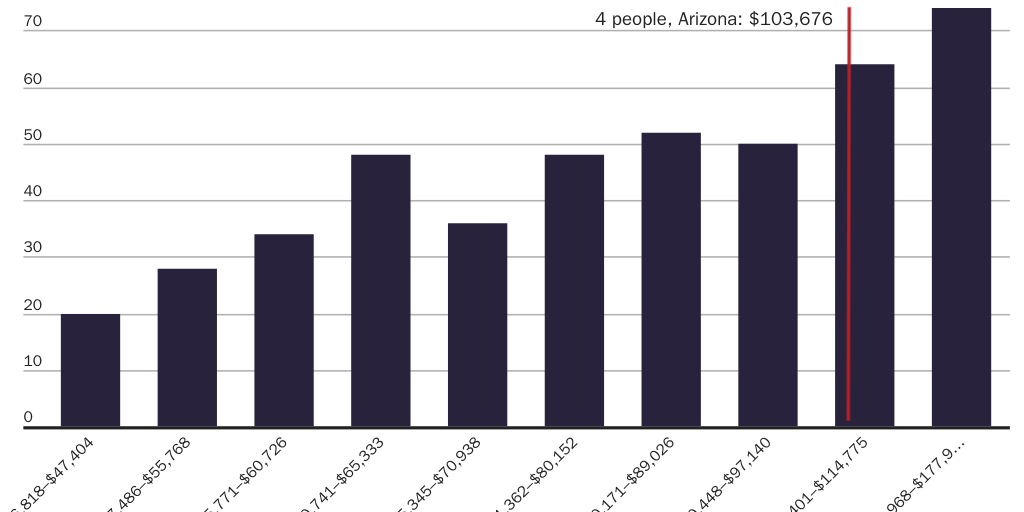
ESA use has a clear skew toward upper-income ZCTAs. Is this evidence that universal choice is, as some opponents have declared, really about helping the rich?
It does not appear so.
We first must define “rich.” There is no readily agreed upon income level that constitutes being rich. A reasonable definition might be the top 5 percent of earners. In Arizona that would be households making $250,000 or more. A broader definition would be the top 20 percent of earners. In Arizona, that starts at $142,368.
The ZCTA data make it hard to pinpoint how many rich households, by our definitions, are using ESAs, in part because the starting income of the top under-18 weighted ZCTA decile—$114,968—is well below the top 5 percent of earners and the threshold for the top 20 percent. Why are top ZCTA medians much lower than top overall incomes? Within ZCTAs, many households are, obviously, earning above the ZCTA median, perhaps by quite a bit.
To assess how “rich” ESA users are, we also need some idea about the incomes of Arizona households with children. Such households tend to have higher incomes than those without, but they also need higher incomes relative to families without dependent children given their additional expenses.
As shown on the chart, the federal government reports that in 2022, the inflation-adjusted median income for an Arizona family of four was $103,676. This suggests, at least based on ZCTA median household incomes, that most ESA users are at the family median or below. Eight of the ZCTA income deciles fall below $103,676, which is about 28 percent of the way into the ninth decile. Of course, we do not know how many ESA users might be at income levels at the top end of their deciles, so this might understate the higher-income skew of users, but we also do not know how many might be at the lower ends.
While there is a clear skew toward higher incomes for ESA users, most users are in ZCTAs with median household incomes below the median for an Arizona family of four. Breaking the deciles roughly into thirds, about 18 percent of users are from the first three ($16,818 to $60,741), 40 percent from the middle four ($60,742 to $89,026), and 41 percent from the top three ($89,027 to $177,965).
What this suggests is that Arizona ESA users are not primarily rich but middle income for families. About 16 percent of users are in the top decile, and the top 5 percent of earners—our narrow definition of “rich”—likely includes a much smaller share. The top two income deciles—our broad definition—includes about 30 percent of all ESA enrollees, but that includes the median income for families, which need more money than childless households.
It is also important to note that the ESA program is hardly the only type of choice available in Arizona. As Matt Ladner writes, the state also has four tax credit programs, two of which are income-capped and one is for students with disabilities, as well as charter schools and robust public school open enrollment. And programs like ESAs help to free up open-enrollment seats in high-achieving school districts when kids living in those districts go elsewhere.
Keeping in mind the fundamental principle of choice—public funding follows all children to the education their families select—and the expectation that early users will be especially skewed toward current private schoolers, the ESA distribution is neither shocking nor outrageous. Sizeable numbers from all income strata are in the program, and the skew is likely moving less wealthy.
Research associates Kayla Susalla and Krit Chanwong contributed to this post.