Today the House of Representatives is debating H. Res. 672, which would call on the government of Vietnam to release imprisoned bloggers and respect Internet freedom.
Here is an article or two about what is happening with Vietnamese bloggers.
Today the House of Representatives is debating H. Res. 672, which would call on the government of Vietnam to release imprisoned bloggers and respect Internet freedom.
Here is an article or two about what is happening with Vietnamese bloggers.
I was unimpressed with the security arguments made by the chairman and ranking member of the House Homeland Security Committee in a letter to appropriators the other week. Citing the “commando-style” terrorist raid on a train station in Mumbai last year, the letter objected to language in the Transportation, Housing and Urban Development, and Related Agencies Appropriations Act that would require Amtrak to allow firearms in checked luggage.
But the risk of a commando-style raid does not support—in fact it undermines—the authors’ argument that weapons should be banned on passenger trains. With law-abiding citizens fully disarmed, any terrorist raiders would know that they are more free to cut a deadly swath through an innocent population.
It was counterattack by civilians that prevented a fourth plane from being used as a guided bomb on September 11, 2001. Disarming the law-abiding citizen is contrary to the lesson of that day.
Right on the heels of my post the other day discussing the error in inviting terrorism reporting, here’s another video (and suspicious-activity-reporting Web site) produced by the Los Angeles Police Department.
The production values in this video are hipper, and L.A. appears to have its share of actors willing to look concerned about terrorism. But really, the attacks of September 11, 2001 were all the Public Service Announcement we needed to encourage reporting of genuine suspicions.
Asking amateurs for tips about terrorism will have many wasteful and harmful results, like racial and ethnic discrimination, angry neighbors turning each other in, and—given the rarity of terrorism—lots and lots of folks just plain getting it wrong. People with expertise—even in very limited domains—can discover suspicious circumstances in their worlds almost automatically when they find things “hinky.”
My impressions of the LAPD were formed up in the late 80’s and early 90’s when I lived in southern California. To encourage reporting, what that department needs most is to make the community confident of its own fairness and competence. Reporting of meritorious suspicions will naturally follow that. There’s no need for it to artificially gin up crime or terrorism reporting.
A. It’s encouraging to see Rahm Emanuel and John Kerry saying that we shouldn’t up force levels in Afghanistan without a reliable partner. But if we shouldn’t send 40,000 more troops to prop up a crooked government, why keep the 68,000 we have there? A focused counter-terrorism mission would require far less than that.
B. According to Dexter Filkins’ article in the New York Times Magazine, the war in Iraq taught General Stanley McChrystal the following:
No situation, no matter how dire, is ever irredeemable — if you have the time, resources and the correct strategy. In the spring of 2006, Iraq seemed lost. The dead were piling up. The society was disintegrating. One possible conclusion was that it was time for the United States to cut its losses in a country that it never truly understood. But the American military believed it had found a strategy that worked, and it hung in there, and it finally turned the tide.
What’s interesting about this claim is its utter confidence in the potential efficacy of US military power — it is not just necessary to solving Iraq’s problems, but sufficient. If this view is right, Iraqis themselves, and their civil war, were unnecessary to the limited political reconciliation that occurred there.
Filkins, surprisingly, seems to agree, depicting the evolution of the war this way:
For four years, the American military had tried to crush the Iraqi insurgency and got the opposite: the insurgency bloomed, and the country imploded. By refocusing their efforts on protecting Iraqi civilians, American troops were able to cut off the insurgents from their base of support. Then the Americans struck peace deals with tens of thousands of former fighters — the phenomenon known as the Sunni Awakening — while at the same time fashioning a formidable Iraqi army. After a bloody first push, violence in Iraq dropped to its lowest levels since the war began.
Note the use of the word “then” preceding the sentence about peace deals. It carries a heavy load. Filkins wants to say that the hearts and mind theory of counterinsurgency caused the Anbar Awakening. But he offers no real causal story about how they are connected; he just says that one happened and then the other.
Another view, one that leaves Iraqis some agency, is that the growth of the al Qaeda Iraq and the progress of the civil war changed the Sunni insurgents’ strategic calculus, such that they decided to cooperate with Americans to gain locally. And that in turn, limited violence. U.S. forces had a role in this — the covert killing campaign that McChrystal led and Filkins chronicles probably pressured insurgents and weakened AQI, for one. But the deals — the awakening — began well before the troop surge and before David Petraeus took command and tried to implement a new counterinsurgency doctrine. The key American decision was willingness to play ball with insurgent groups. This decision had little to do with winning hearts and minds via population security and increased troop levels. And by empowering forces at odds with the central government, it contradicted the goal of state-building in Iraq, at least in the short-term.
I obviously agree with the latter view. Our dependence on local politics limits what we can accomplish in counterinsurgency. We can certainly affect what happens in Afghanistan, but it is hubris to think we control it.
Filkins also quotes McChrystal on Afghanistan’s effect on Pakistan:
“If we are good here, it will have a good effect on Pakistan,” he told me. “But if we fail here, Pakistan will not be able to solve their problems — it would be like burning leaves on a windy day next door.
It’s sensible to conclude chaos nearby is unhelpful to stability in Pakistan, but it goes way too far to say that Afghanistan’s stability is necessary to Pakistan’s, which has been fairly stable for long periods while Afghanistan was not. What’s more, as Robert Pape argues, it is likely that U.S. forces are a cause of insurgency in both countries.
The Berlin Wall fell 20 years ago. A hideous symbol of the suppression of liberty, it should remind us of the ever-present threat to our freedoms. Even two decades later the legacy of repression continues to afflict many people in Eastern Europe. For instance, those in countries formerly behind the Iron Curtain still struggle with the knowledge that their friends and neighbors routinely spied on them.
Stelian Tanase found out when he asked to see the thick file that Romania’s communist-era secret police had kept on him. The revelation nearly knocked the wind out of him: His closest pal was an informer who regularly told agents what Tanase was up to.
“In a way, I haven’t even recovered today,” said Tanase, a novelist who was placed under surveillance and had his home bugged during the late dictator Nicolae Ceausescu’s regime.
“He was the one person on Earth I had the most faith in,” he said. “And I never, ever suspected him.”
Twenty years ago this autumn, communism collapsed across Eastern Europe. But its dark legacy endures in the unanswered question of the files — whether letting the victims read them cleanses old wounds or rips open new ones.
Things have never been so bad here, obviously, but that gives us even more reason to jealously guard our liberties. Defend America we must, but we must never forget that it is a republic which we are defending.
Well before Barack Obama was awarded the Nobel Peace Prize, Americans were speculating on whether his ascendancy to the highest office in the land would help to improve the United States’ tarnished reputation in the world.
The early indications were encouraging, but largely anecdotal. The Pew Research Center provided data from surveys taken in May and June, and found a mixed picture: attitudes toward the United States were most improved in Western Europe, East Asia, and Africa (Nigeria and Kenya), but barely changed in the several predominantly Muslim countries polled, including U.S. allies Turkey and Pakistan.
The more relevant question is whether we should care. International relations is not a popularity contest. In the classical formulation, nation-states pursue policies that they believe will advance their interests. Sometimes these policies backfire. Sometimes they fail. But, all other factors being equal, we should assume that policies are directed from within, and not much influenced by without.
A recent study published by the American Political Science Association makes a reasonably convincing case that Americans should care about U.S. “standing” not purely for the sake of feeling good about ourselves, but also because improved standing is likely to contribute to more effective foreign policy. “Diminished standing may make it harder for the United States to get things done in world politics,” the report explains. In this context, the report continues, we should “think of standing … as the foreign-policy equivalent of ‘political capital.’ ” If we have a stored reserve of such capital, we can deploy this to mobilize international support. At a minimum, this will convince other countries to go along with us; in ideal cases, we might obtain their active support.
The report was commissioned by the outgoing APSA president, Peter J. Katzenstein of Cornell University, and the task force was chaired by Jeffrey Legro of the University of Virginia, and included a number of eminent scholars. [The full report is available here, a shorter public version was made available here, and Katzenstein and Legro summarized the findings in a recent article at Foreign Policy.com.]
For the sake of argument, I will concede that America’s reputation is a factor in the extent to which other countries support or oppose our policies, and therefore that it is worthwhile to attempt to bolster our reputation. But the report inadvertently shows that, in practice, even concerted effort by policymakers and opinion leaders to improve U.S. standing is likely to fail, largely because of deep contradictions between what others expect of Uncle Sam, and what Americans expect from our government and from others.
Generally speaking, non-Americans like the United States playing the role of world policeman — provided we do the job well. If the U.S. military deters aggression against small or weak countries, those countries won’t have to devote resources to defending themselves. Oppressed people often welcome U.S. pressure on the autocratic regimes that are oppressing them; some disenfranchised people welcome U.S. government efforts to give them some say in how they are governed, and by whom.
If the opinions of non-Americans were decisive in the formulation of U.S. policies, then we might be able to do all of these things. But they are not. In a list of 14 foreign policy goals polled by the Chicago Council on Global Affairs, Americans rank “Promoting and defending human rights in other countries” and “Protecting weaker nations against foreign aggression” 12th and 13th, respectively. As far as democracy promotion goes, that falls dead last on the list; a mere 17 percent of respondents thought this a “very important” goal for the U.S. government.
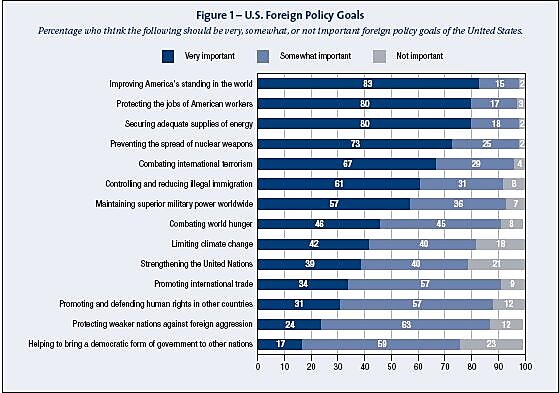
Despite public skepticism toward these goals here in the United States, non-Americans can be forgiven for believing that the U.S. government exists to do such things for them. After all, the notion that the United States should be the primary provider of global public goods has guided U.S. foreign policy for decades, and almost always in the face of strong opposition to such philanthropic impulses.
As I explain at length in my book The Power Problem, the disconnect between what the public wants, and what the policymakers give them, is deliberate and by design. Most of the people in Washington dismiss public attitudes as misinformed at best and isolationist at worst. But while I agree that we should not conduct our foreign policy on the basis of polls and focus groups, in the grand scheme, the hand-waving and misdirection that our leaders have employed since the end of the Cold War to conceal and distort the true costs of our current grand strategy is, well, unseemly.
Michael Lind has a better word for it: “Nothing could be more repugnant to America’s traditions as a democratic republic,” he writes in The American Way of Strategy, “than a grand strategy that can be sustained only if the very existence of the strategy is kept secret from the American people by their elected and appointed leaders” (my emphasis).
I wholeheartedly agree. In a country that presumes some measure of popular consent, the current pattern is repugnant.
So what does this mean for improving American standing? If the rest of the world wants the United States to be the world’s cop, social worker, and election monitor, but Americans expect our government of limited, enumerated powers to do these things only when U.S. national interests are at stake (and they rarely are), is this the counsel of despair?
Not necessarily. There is another way in which the United States could improve its international standing without having to go out of its way to convince others of our good intentions, and without systematically concealing from the American people the true object of our foreign policies.
As formulated by the APSA task force, “standing” consists of two elements, “credibility” — “the U.S. government’s ability to do what it says it is going to do” — and “esteem” — which “referes to America’s stature, or what America is perceived to ‘stand for.’ ” The right-leaning members of the academy, including George Washington University professor Henry Nau and Stanford’s Stephen Krasner, who submitted a spirited dissent from the report, question the importance of esteem. Tod Lindberg echoed these sentiments in comments at the National Press Club several weeks ago, at the time of the report’s public release.
I think it goes too far to say that esteem is essentially irrelevant, but I agree that credibility is the more important of the two. As such, it is crucial to fashion policies that are consistent with the wishes of the American people, and that can be sustained in the face of difficult circumstances and potentially high costs.
This means we need a new grand strategy. We could drop the revolutionary impulse behind our foreign policies, declaring ourselves content with the international status quo, and therefore not an imminent threat to any other country or people that respects our rights and liberties. We could likewise disavow any attempt to overthrow the established social order in foreign lands, and reaffirm our respect for sovereignty under international law. Finally, and most importantly, we could reestablish our international reputation by keeping our promises, and that would begin by not making promises that we can’t — and have no intention to — keep.
I will have more to say about that last point at a discussion next month hosted by the Institute on Global Conflict and Cooperation at the University of California’s Washington Center. To learn more, visit their website.
(C/P from the Partnership for Secure America’s Across the Aisle)
Last week, I wrote a piece for Reason in which I took a close look at the USA PATRIOT Act’s “lone wolf” provision—set to expire at the end of the year, though almost certain to be renewed—and argued that it should be allowed to lapse. Originally, I’d planned to survey the whole array of authorities that are either sunsetting or candidates for reform, but ultimately decided it made more sense to give a thorough treatment to one than trying to squeeze an inevitably shallow gloss on four or five complex areas of law into the same space. But the Internets are infinite, so I’ve decided I’d turn the Reason piece into Part I of a continuing series on PATRIOT powers. In this edition: Section 206, roving wiretap authority.
The idea behind a roving wiretap should be familiar if you’ve ever watched The Wire, where dealers used disposable “burner” cell phones to evade police eavesdropping. A roving wiretap is used when a target is thought to be employing such measures to frustrate investigators, and allows the eavesdropper to quickly begin listening on whatever new phone line or Internet account his quarry may be using, without having to go back to a judge for a new warrant every time. Such authority has long existed for criminal investigations—that’s “Title III” wiretaps if you want to sound clever at cocktail parties—and pretty much everyone, including the staunchest civil liberties advocates, seems to agree that it also ought to be available for terror investigations under the Foreign Intelligence Surveillance Act. So what’s the problem here?
To understand the reasons for potential concern, we need to take a little detour into the differences between electronic surveillance warrants under Title III and FISA. The Fourth Amendment imposes two big requirements on criminal warrants: “probable cause” and “particularity”. That is, you need evidence that the surveillance you’re proposing has some connection to criminal activity, and you have to “particularly [describe] the place to be searched and the persons or things to be seized.” For an ordinary non-roving wiretap, that means you show a judge the “nexus” between evidence of a crime and a particular “place” (a phone line, an e‑mail address, or a physical location you want to bug). You will often have a named target, but you don’t need one: If you have good evidence gang members are meeting in some location or routinely using a specific payphone to plan their crimes, you can get a warrant to bug it without necessarily knowing the names of the individuals who are going to show up. On the other hand, though, you do always need that criminal nexus: No bugging Tony Soprano’s AA meeting unless you have some reason to think he’s discussing his mob activity there. Since places and communications facilities may be used for both criminal and innocent persons, the officer monitoring the facility is only supposed to record what’s pertinent to the investigation.
When the tap goes roving, things obviously have to work a bit differently. For roving taps, the warrant shows a nexus between the suspected crime and an identified target. Then, as surveillance gets underway, the eavesdroppers can go up on a line once they’ve got a reasonable belief that the target is “proximate” to a location or communications facility. It stretches that “particularity” requirement a bit, to be sure, but the courts have thus far apparently considered it within bounds. It may help that they’re not used with great frequency: Eleven were issued last year, all to state-level investigators, for narcotics and racketeering investigations.
Surveillance law, however, is not plug-and-play. Importing a power from the Title III context into FISA is a little like dropping an unfamiliar organism into a new environment—the consequences are unpredictable, and may well be dramatic. The biggest relevant difference is that with FISA warrants, there’s always a “target”, and the “probable cause” showing is not of criminal activity, but of a connection between that target and a “foreign power,” which includes terror groups like Al Qaeda. However, for a variety of reasons, both regular and roving FISA warrants are allowed to provide only a description of the target, rather than the target’s identity. Perhaps just as important, FISA has a broader definition of the “person” to be specified as a “target” than Title III. For the purposes of criminal wiretaps, a “person” means any “individual, partnership, association, joint stock company, trust, or corporation.” The FISA definition of “person” includes all of those, but may also be any “group, entity, …or foreign power.” Some, then, worry that roving authority could be used to secure “John Doe” warrants that don’t specify a particular location, phone line, or Internet account—yet don’t sufficiently identify a particular target either. Congress took some steps to attempt to address such concerns when they reauthorized Section 206 back in 2005, and other legislators have proposed further changes—which I’ll get to in a minute. But we actually need to understand a few more things about the peculiarities of FISA wiretaps to see why the risk of overbroad collection is especially high here.
In part because courts have suggested that the constraints of the Fourth Amendment bind more loosely in the foreign intelligence context, FISA surveillance is generally far more sweeping in its acquisition of information. In 2004, the FBI gathered some 87 years worth of foreign language audio recordings alone pursuant to FISA warrants. As David Kris (now assistant attorney general for the Justice Department’s National Security Division) explains in his definitive text on the subject, a FISA warrant typically “permits aquisition of nearly all information from a monitored facility or a searched location.” (This may be somewhat more limited for roving taps; I’ll return to the point shortly.) As a rare public opinion from the FISA Court put it in 2002: “Virtually all information seized, whether by electronic surveillance or physical search, is minimized hours, days, or weeks after collection.” The way this is supposed to be squared with the Fourth Amendment rights of innocent Americans who may be swept up in such broad interception is via those “minimization” procedures, employed after the fact to filter out irrelevant information.
That puts a fairly serious burden on these minimization procedures, however, and it’s not clear that they well bear it. First, consider the standard applied. The FISA Court explains that “communications of or concerning United States persons that could not be foreign intelligence information or are not evidence of a crime… may not be logged or summarized” (emphasis added). This makes a certain amount of sense: FISA intercepts will often be in unfamiliar languages, foreign agents will often speak in coded language, and the significance of a particular statement may not be clear initially. But such a deferential standard does mean they’re retaining an awful lot of data. And indeed, it’s important to recognize that “minimization” does not mean “deletion,” as the Court’s reference to “logs” and “summaries” hints. Typically intercepts that are “minimized” simply aren’t logged for easy retrieval in a database. In the 80s, this may have been nearly as good for practical purposes as deletion; with the advent of powerful audio search algorithms capable of scanning many hours of recording quickly for particular words or voices, it may not make much difference. And we know that much more material than is officially “retained” remains available to agents. In the 2003 case U.S. v. Sattar, pursuant to FISA surveillance, “approximately 5,175 pertinent voice calls .. were not minimized.” But when it came time for the discovery phase of a criminal trial against the FISA targets, the FBI “retrieved and disclosed to the defendants over 85,000 audio files … obtained through FISA surveillance.”
Cognizant of these concerns, Congress tried to add some safeguards in 2005 when they reauthorized the PATRIOT Act. FISA warrants are still permitted to work on descriptions of a target, but the word “specific” was added, presumably to reinforce that the description must be precise enough to uniquely pick out a person or group. They also stipulated that eavesdroppers must inform the FISA Court within ten days of any new facility they eavesdrop on, and explain the “facts justifying a belief that the target is using, or is about to use, that new facility or place.”
Better, to be sure; but without access to the classified opinions of the FISA Court, it’s quite difficult to know just what this means in practice. In criminal investigations, we have a reasonable idea of what the “proximity” standard for roving taps entails. Maybe a target checks into a hotel with a phone in the room, or a dealer is observed to walk up to a pay phone, or to buy a “burner.” It is much harder to guess how the “is using or is about to use” standard will be construed in light of FISA’s vastly broader presumption of sweeping up-front acquisition. Again, we know that the courts have been satisfied to place enormous weight on after-the-fact minimization of communications, and it seems inevitable that they will do so to an even greater extent when they only learn of a new tap ten days (or 60 days with good reason) after eavesdropping has commenced.
We also don’t know how much is built into that requirement that warrants name a “specific” target, and there’s a special problem here when surveillance roves across not only facilities but types of facility. Suppose, for instance, that a FISA warrant is issued for me, but investigators have somehow been unable to learn my identity. Among the data they have obtained for their description, however, are a photograph, a voiceprint from a recording of my phone conversation with a previous target, and the fact that I work at the Cato Institute. Now, this is surely sufficient to pick me out specifically for the purposes of a warrant initially meant for telephone or oral surveillance. The voiceprint can be used to pluck all and only my conversations from the calls on Cato’s lines. But a description sufficient to specify a unique target in that context may not be sufficient in the context of, say, Internet surveillance, as certain elements of the description become irrelevant, and the remaining threaten to cover a much larger pool of people. Alternatively, if someone has a very unusual regional dialect, that may be sufficiently specific to pinpoint their voice in one location or community using a looser matching algorithm (perhaps because there is no actual recording, or it is brief or of low quality), but insufficient if they travel to another location where many more people have similar accents.
Russ Feingold (D‑WI) has proposed amending the roving wiretap language so as to require that a roving tap identify the target. In fact, it’s not clear that this quite does the trick either. First, just conceptually, I don’t know that a sufficiently precise description can be distinguished from an “identity.” There’s an old and convoluted debate in the philosophy of language about whether proper names refer directly to their objects or rather are “disguised definite descriptions,” such that “Julian Sanchez” means “the person who is habitually called that by his friends, works at Cato, annoys others by singing along to Smiths songs incessantly…” and so on. Whatever the right answer to that philosophical puzzle, clearly for the practical purposes at issue here, a name is just one more kind of description. And for roving taps, there’s the same kind of scope issue: Within Washington, DC, the name “Julian Sanchez” probably either picks me out uniquely or at least narrows the target pool down to a handful of people. In Spain or Latin America—or, more relevant for our purposes, in parts of the country with very large Hispanic communities—it’s a little like being “John Smith.”
This may all sound a bit fanciful. Surely sophisticated intelligence officers are not going to confuse Cato Research Fellow Julian Sanchez with, say, Duke University Multicultural Affairs Director Julian Sanchez? And of course, that is quite unlikely—I’ve picked an absurdly simplistic example for purposes of illustration. But there is quite a lot of evidence in the public record to suggest that intelligence investigations have taken advantage of new technologies to employ “targeting procedures” that do not fit our ordinary conception of how search warrants work. I mentioned voiceprint analysis above; keyword searches of both audio and text present another possibility.
We also know that individuals can often be uniquely identified by their pattern of social or communicative connections. For instance, researchers have found that they can take a completely anonymized “graph” of the social connections on a site like Facebook—basically giving everyone a name instead of a number, but preserving the pattern of who is friends with whom—and then use that graph to relink the numbers to names using the data of a differentbut overlapping social network like Flickr or Twitter. We know the same can be (and is) done with calling records—since in a sense your phone bill is a picture of another kind of social network. Using such methods of pattern analysis, investigators might determine when a new “burner” phone is being used by the same person they’d previously been targeting at another number, even if most or all of his contacts have alsoswitched phone numbers. Since, recall, the “person” who is the “target” of FISA surveillance may be a “group” or other “entity,” and since I don’t think Al Qaeda issues membership cards, the “description” of the target might consist of a pattern of connections thought to reliably distinguish those who are part of the group from those who merely have some casual link to another member.
This brings us to the final concern about roving surveillance under FISA. Criminal wiretaps are always eventually disclosed to their targets after the fact, and typically undertaken with a criminal trial in mind—a trial where defense lawyers will pore over the actions of investigators in search of any impropriety. FISA wiretaps are covert; the targets typically will never learn that they occurred. FISA judges and legislators may be informed, at least in a summary way, about what surveillance was undertaken and what targeting methods were used, but especially if those methods are of the technologically sophisticated type I alluded to above, they are likely to have little choice but to defer to investigators on questions of their accuracy and specificity. Even assuming total honesty by the investigators, judges may not think to question whether a method of pattern analysis that is precise and accurate when applied (say) within a single city or metro area will be as precise at the national level, or whether, given changing social behavior, a method that was precise last year will also be precise next year. Does it matter if an Internet service initially used by a few thousands—including, perhaps, surveillance targets—comes to be embraced by millions? Precisely because the surveillance is so secretive, it is incredibly hard to know which concerns are urgent and which are not really a problem, let alone how to think about addressing the ones that merit some legislative response.
I nevertheless intend to give it a shot in a broader paper on modern surveillance I’m working on, but for the moment I’ll just say: “It’s tricky.” What is absolutely essential to take away from this, though, is that these loose and lazy analogies to roving wiretaps in criminal investigations are utterly unhelpful in thinking about the specific problems of roving FISA surveillance. That investigators have long been using “these” powers under Title III is no answer at all to the questions that arise here. Legislators who invoke that fact as though it should soothe every civil libertarian brow are simply evading their responsibilities.