Topic: Education and Child Policy

86ing the Arguments for California Props 30, 38

Californians are being asked to raise their taxes by between $7 billion (Prop 30) and $10 billion (Prop 38) to prop-up public school budgets. If they don’t, backers warn, public schools will face “devastating cuts.” That’s the fear mongering. This is the reality:

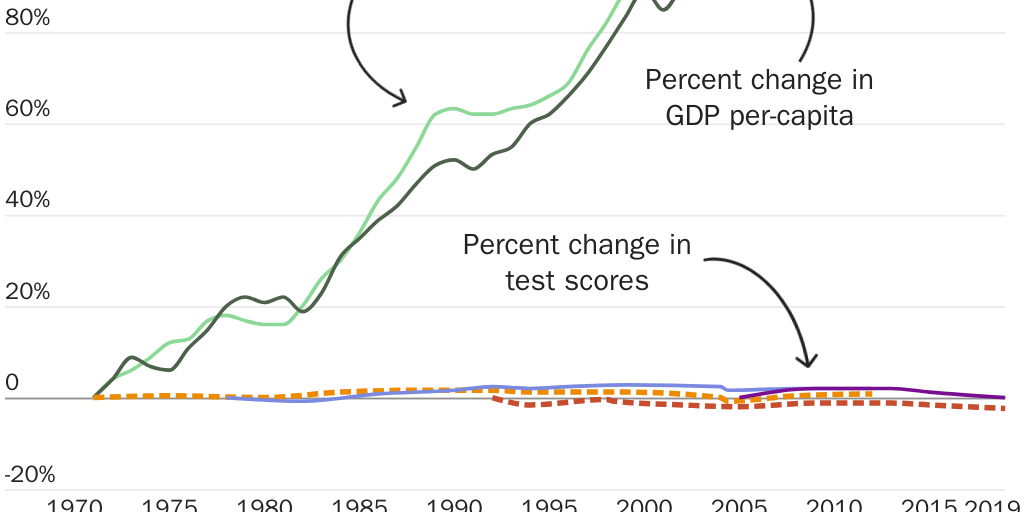
Over the past four decades, real per pupil spending in California has roughly doubled. In dollar terms, Californians are spending $27 billion more today on K-12 education than they did in 1974, when Gov. Jerry Brown was first elected to office—and that is after controlling for both enrollment growth and inflation.

The last dashed spike on the spending line is the increase if Prop 30 passes, as Governor Jerry Brown has been assuming. If it doesn’t pass, per pupil spending will still be up more than 80 percent over this period, after controlling for inflation. What’s more, there is no evidence that the fantastic spending increases of the past have done anything to improve student achievement.

The only state-level achievement data we have that go back this far are the SATs, and, taking into account the renorming that occurred in the mid 1990s, they have actually declined by five percent. None of the customary excuses can explain away this dismal record. A larger share of students participated in 1972 than do so today, so if a shrinking test-taking pool is the sign of a more elite subset of students taking the test, then scores should be higher today, not lower. And while state-level breakdowns by race and ethnicity are not available that far back, the national trend is similar and it shows stagnation in the scores of majority white students—which excludes changing demographics as an explanation.

As I wrote earlier this year:

It is true that a $7 billion tax increase would at least preserve a certain number of public sector jobs, even if those jobs have not, and likely will not, improve educational outcomes. But if that $7 billion is not taxed out of the free-enterprise sector of California’s economy, it will preserve or create private-sector jobs when it is spent or invested. And, contrary to the pattern shown in the accompanying chart, jobs in the free-enterprise sector do produce things that people value: from movies and music to citrus fruits and cellphones—thus generating new revenue. Tax away that money and you take away those private-sector jobs and revenue.

The final question boils down to this: Can Californians afford to tax $7 billion out of the productive sector of the economy and get nothing in return for the damage it would do?

That’s the question California voters must ask themselves on November 6th.

Would Romney Be Good for American Education?

Without picking a winner in last night’s debate, it’s fair to say that Mitt Romney avoided the sort of conspicuous gaffs that can sink a campaign. He may well become the next president of the United States. Would that be a good thing for American schoolchildren?

Yesterday, I faulted an op-ed the Governor wrote for consisting chiefly of vagaries—but perhaps that’s not such a bad thing. Given that the federal government has spent roughly $2 trillion on k-12 education since 1965 and achieved none of its objectives, a president who talks much but does less would be a decided improvement.

But there are a few specifics in Romney’s education white paper… and some of them are deeply disconcerting. Immediately after stressing that “states and localities are best-positioned to reform their education systems” the document reverses course and declares that “the federal government cannot ignore the troubled state of American K-12 education,” and “is uniquely positioned to provide financial support for the education of our neediest students and to require states and districts to tell the truth about how their schools and students are performing.”

Certainly the federal government should not ignore America’s educational woes, having contributed to many of them for over half a century. But the subsequent claims are untrue and do not follow from the first. It is simply false that federal government funding is “uniquely positioned” to improve the education of the neediest students. In fact, one of the flagship federal programs for helping these students, Head Start, has been proven to have no lasting benefits by the federal government’s own research. More broadly, there appears to be no link between federal K-12 spending patterns and the student achievement gaps by socio-economic status or race. Nor is there any evidence that the federal oversight introduced by the No Child Left Behind law (the “telling the truth” referred to above) improved achievement overall or narrowed the gaps.

To be fair, the document acknowledges the ineffectiveness of past and current federal programs, and so the claim that federal funding is “uniquely positioned” to help disadvantaged students could be read to apply only to the Romney campaign proposal of “attaching federal funding to the students it is intended to support rather than dispersing it to districts.” The idea is essentially to voucherize federal funds, allowing them to be used even at private schools, where permitted by state law.

The benefits of increasing parental choice and competition between schools are well supported by the evidence, but here again, the federal “uniqueness” claim is simply false. Federal funding is not unique or necessary to ensuring universal school choice. The states are fully capable of doing this themselves because private schooling is, on average, about two thirds the per-pupil cost of public schooling, and so even without the roughly ten percent of education funding that comes from the federal government, state-level private choice programs could serve everyone.

Even though federal involvement in state school choice programs is not necessary it could still be a good idea. But it isn’t. As I argued when a similar idea was floated by President G. W. Bush, federal regulations would almost certainly follow federal funding of the nation’s private schools, homogenizing them from coast to coast and thereby eliminating the educational diversity upon which any choice program must rely. Since writing that piece, I have conducted a statistical study of the regulations imposed by state-level private school choice programs and found that vouchers already impose a large and highly statistically significant extra burden of regulation on participating schools. This is a grave enough problem when the regulations affect just the private schools in a single state, but that pales in comparison to the damage that would be done by such regulations at the national level.

Universal private school choice can also be achieved via personal and “scholarship donation” tax credits, and these programs do not seem to carry with them the same regulatory pall. But there is no reason to run the risk of enacting such a program at the federal level. On the contrary, the growing diversity of school choice programs at the state level is an asset, allowing us to see which state policies do the most to expand educational freedom and improve quality and efficiency. The best can then be replicated and the worst reformed.

Governor Romney says that he understands the free enterprise system, and knows that trickle-down government doesn’t work. He says that he wants to uphold our nation’s founding principles. Well, the evidence is clear that there is no need for or benefit to federal government intervention in state education policy and that there are in fact very grave risks to such intervention. And though it is unfashionable to draw attention to this fact, neither the word education nor the word school is mentioned in the U.S. Constitution. So if Governor Romney becomes President Romney, American schoolchildren will be very lucky if he remembers these facts, and uses the presidential bully pulpit to promote more and better state-level school choice programs rather than opening the Pandora’s Box of federal funding and regulation of private schools.

Care about the Poor? Consider Consequences

On the day of the second presidential debate, I had the pleasure of participating in a panel discussion at debate-host Hofstra University. The topic was “defusing the student loan debt bomb,” and I was the lone voice calling for an end to inflation-fueling federal student aid. My co-panelists were Tamara Draut of the think tank Demos, Above the Law blog co-editor Elie Mystal, and U.S. PIRG’s Ed Mierzwinski.

I had perhaps the best interaction with Mystal, with whom I had interesting chats throughout the day. Mystal’s response to my proposal was basically that poor and minority students need help, and phasing out federal aid would disproportionately hurt them. It was an argument with which I could sympathize, and it made more sense than just proclaiming “college education is a public good and should basically be free.” Unfortunately, writing on his blog post-debate, Mystal said that my “view makes a certain kind of sense” but nonetheless smacks of “the classic, Republican ‘f**k ‘em’ approach that disproportionately screws the poor and minorities.”

Um, ouch. Ascribing callousness or cruelty to either me or Republicans because we don’t like the negative effects of aid is, frankly, precisely why we can’t have a reasoned debate about these things. Maybe I’m an exceptionally gifted multi-tasker, or maybe I’ve just contemplated some important logic and facts, but I can be against mega-inflation without being indifferent to the poor. Indeed, quite the opposite.

First, much aid goes to people with little regard to their income. Pell Grants might be pretty well targeted – though they’re getting less so by the minute – but “unsubsidized” federal loans, which are backed by taxpayers, are available irrespective of need. Tax-based aid also skews high-income. The American Opportunity Tax Credit, for instance, can be claimed by joint filers making up to $180,000. And the well-to-do are best positioned to maximize their aid because they can afford financial planners to tell them how to hide wealth, or temporarily reduce income to optimize their eligibility. The cumulative effect of all this is to push up college prices.

Then there’s the psychological effect of hugely inflated sticker prices. If the message “college is astonishingly expensive” is repeated often enough, who do you think will more often be deterred from attending college, the rich or the poor? Probably the latter.

Next, the poor and minorities are no doubt disproportionately burdened by debt. Data indicate that’s definitely the case for African-Americans, and is likely the case for the poor considering that even debt loads that are small compared to some totals might be huge relative to a poor student’s wealth.

Finally, while people of all income levels and races spend too much time and treasure on higher education, the poor and minorities are probably the most snookered by “college for all.” The unfortunate reality is that those groups tend to be the least prepared to do college-level work or pay mammoth, inflated bills, and as a result tend to most readily pursue degrees without completing them. Among first-time, full-time students entering college in 2004, a weak 58.3 percent that didn’t transfer schools completed a four-year program within six years. Much worse, only 39.5 percent of African-Americans completed their degrees, and 50.1 percent of Hispanics. In large part this is the fault of factors preceding higher education – including our moribund K-12 system – but the dismal college completion reality remains.

In light of all this, is it really fair to proclaim that those who want to phase out inflationary, consumption-driving aid don’t care about the poor and minorities? Or is it long past time to give them a full and fair hearing?

Cross-posted from SeeThruEdu.com

Where President Obama Went Wrong in Time

The President and Governor Romney have dueling op-eds in Time Magazine that are nominally about higher education. Neither really is. Governor Romney’s piece, in fact, doesn’t seem to be about anything at all, its vagueness evoking Isaac Asimov’s Lord Dorwin. The President’s piece does offer a few concretes, but mostly about K-12 and entirely wrongheaded. On the principle that bad specifics are worse than no specifics at all, let’s start with President Obama. He writes:

We know that a good teacher can increase the lifetime income of a classroom by more than $250,000. A great teacher can change the trajectory of a child’s life. That’s why, even as we faced one of the worst economic crises in history, I fought to keep teachers in the classroom.

The President conflates the quantity of teachers with their quality. At best, these two factors are uncorrelated. At worst—in those few states and districts which pay teachers based on performance—the two factors are negatively correlated: employing more teachers leaves less money to pay suitable salaries to excellent ones.

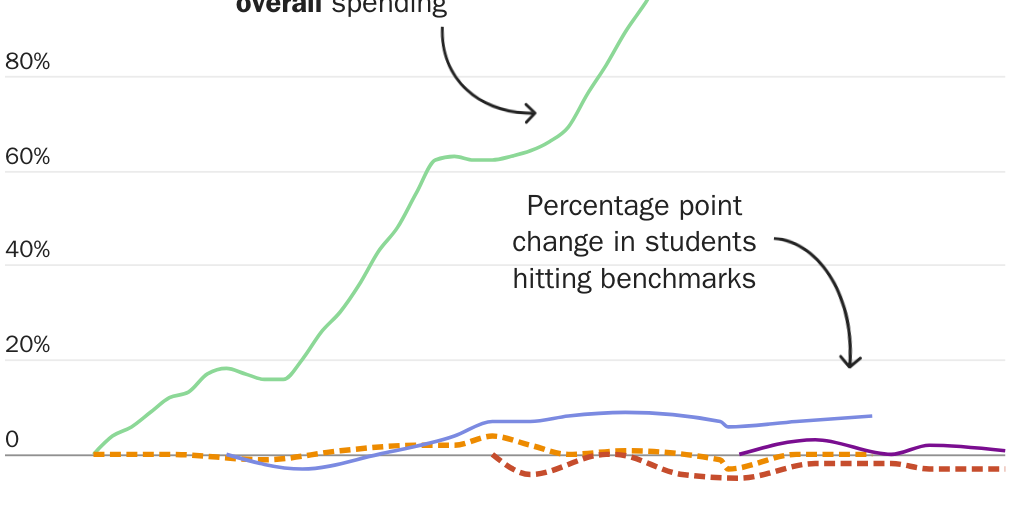
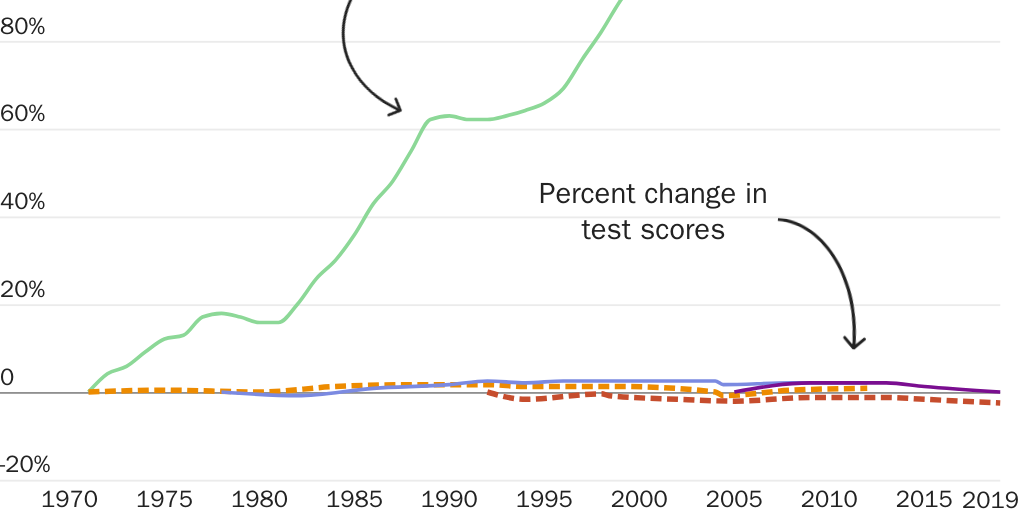
We have already doubled the public school workforce over the past 40 years despite having only 8.5% more students today than we did in 1970. Put another way, employment has grown 11 times faster than enrollment. What good did it do? See the charts here. After hiring 3 million additional public school employees—two million of them teachers or teachers’ aides—student performance at the end of high school is essentially flat. The cost of this public school employment bloat is about $210 billion annually—roughly double the combined state budget shortfalls for 2012.

The President knows all this, but can safely assume that most American voters don’t. Thanks to decades of misreporting by the media, most Americans think public school class sizes have been growing and spending has been declining, when in fact the complete opposite is true.

Next, President Obama claims to have spurred states “to raise standards for teaching and learning.” Even if we grant the President’s unjustified assumption that high government standards improve student performance, he is ignoring the reality that his administration’s policy of conditionally waiving requirements of the federal NCLB law have caused some states to lower their standards. A recent and notorious case is Florida, which, thanks to an Obama administration NCLB waiver, has introduced new standards for educational achievement by race and ethnicity: black students will be held to a lower standard than Hispanics, who will be held to a lower standard than whites, who will be held to a lower standard than Asians. Had this happened under a previous administration, the national media would have assailed it as institutional racism and pilloried the President for pursuing the policy that precipitated it.

In a sensible world, each and every child would be helped and encouraged to fulfill his or her individual potential. Children are not interchangeable widgets to be sorted by color—or, for that matter, by age. Proclivity to learn differs not only between kids, but even within them, from one subject to the next.

We live at a time when it is easy to tailor instruction to each child, individually; grouping them—when group instruction is advantageous—based on where they are in the material in each subject, not purely on their age or some other arbitrary measure. The Jesuits started doing this in 1599, for heaven’s sake, we should certainly be doing it in 2012.

Indeed, the private tutoring sector already functions this way all over the world, because it seeks to provide the most educational value for parents’ dollars. Such individually-tailored instruction is unlikely to ever dominate the government-run approach to schooling championed by President Obama.

Minnesota: Beware of Free Education

Imagine that it’s the 21st century, and that at least a handful of people in the education business have realized this. Putting their insight to good use, a few of them create an online service called “Coursera” that offers free lectures from some of the top universities in the nation (Stanford, Johns Hopkins, etc.). Then imagine that the state of Minnesota has decided that it is illegal for Coursera to offer these free lectures to its citizens.

I know, it’s hard to imagine. Unfortunately, you don’t have to, you can just read about how it’s actually happening.

One of the classes you can take at Coursera is “Principles of Macroeconomics.” Maybe the folks who lobbied for and enacted the state’s education regulations are afraid that free learning and economic literacy would threaten their phony-baloney jobs.

France to Ban School Homework

Let’s say that you are a newly-elected French president and you have a lot on your plate. The unemployment rate is 10.2 percent and youth unemployment hovers around 23 percent. The budget deficit is 4.5 percent of the GDP and the explicit national debt 90 percent of the GDP. Your economy is at a standstill and your currency is on the verge of collapse. Many of your most productive people wonder if they should pack up and leave, because you have just asked them to fork over 75 percent of their earnings to the taxman. Your popularity is shrinking faster than you can say sacre bleu! So, what do you do?

Easy. You switch the subject and start talking about something completely different …  even if it is, well, a little crazy.

Thus, “French President François Hollande has said he will end homework as part of a series of reforms to overhaul the country’s education system. He doesn’t think it is fair that some kids get help from their parents at home while children who come from disadvantaged families don’t.”

Better that all children suffer, so long as they suffer equally. Equality of misery—that pretty much sums up socialist mentality everywhere.

The Latest Nobel Prize in Economics… Why It Should Make Us Sad

The latest Nobel Prize in economics has been awarded to Alvin Roth and Lloyd Shapley. They’ve done brilliant work on algorithms for optimally matching pairs of things (such as job vacancies and job seekers), but at least one prominent application of their work should produce a deafening roar of foreheads hitting desktops: public school choice.

As the Nobel organization’s website explains, the original algorithm was developed by Shapley and David Gale to optimally match pairs of individuals who could only each be matched with one other person. For instance, optimally marrying-off 10 men and 10 women based on their relative levels of interest in one another. Over the past decade, it has come to be used to match students to places in local public schools (by Roth).

The problem is that this approach to “school choice” correctly assumes that the better public schools have a fixed number of places and cannot expand to meet increased demand. So it’s about finding the least-awful allocation of students to a static set of schools—a process that does nothing to improve school quality.

Meanwhile, there is something called a “market” which not only allows consumers and producers to connect, it creates the freedoms and incentives necessary for the best providers to grow in response to rising demand and crowd-out the inferior ones. It also provides incentives for innovation and efficiency. But instead of advocating the use of market freedoms and incentives to improve education, some of our top economists are spending their skill and energy tinkering with the increasingly inefficient, pedagogically stagnant status quo.

Forehead… meet desk.