Cato at Liberty
Cato at Liberty
Yesterday evening I blogged on a pending vote in the House on an amendment introduced by Rep. Mike Pompeo (R‑KS) to eliminate funding for the Economic Development Administration. Unfortunately, the amendment failed today on a vote of 129–279. All 175 Democrats voting joined 104 Republicans in keeping the EDA alive.
A single Democrat voting to axe a government program would have been a shock. But congressional Republicans regularly extol the virtues of limited government and free markets. As Rep. Pompeo said in a statement, “If those who talk constantly about rolling back the unsustainable size and scope of the federal government are serious, then they will support my efforts to eliminate the EDA.” Well, 104 Republicans voted to continue spending taxpayer dollars on warmed-over subsidy program that’s been hanging around since the 1960s.
Rep. Kristi Noem (R‑SD), for example, voted against the Pompeo amendment. But in a column she penned in April, Noem said “Our debt crisis is a result of Washington spending money it doesn’t have and letting our children and grandchildren pick up the tab.” Noem favors a Balance Budget Amendment and says that “Our government must come together and make the tough decisions to secure our nation’s prosperous future.” Really? Noem says tough decisions need to be made but she can’t even get behind the elimination of the EDA. Talk about chutzpah.
Noem and 85 other Republicans also voted against Rep. Ben Quayle’s (R‑AZ) amendment that would have defunded a new corporate welfare program asked for by President Obama in his fiscal 2013 budget proposal. Thanks to the 86 Republicans in the House, instead of terminating programs, taxpayers will get a new one called the Advanced Manufacturing Technology Consortia program.
Negativity aside, Representatives Pompeo and Quayle deserve kudos for actually trying to kill a federal program. Even though their efforts failed this time, they could bear fruit in the future if more members decide that they’d rather not take another vote exposing them to be complete hypocrites.
Related Tags
There is a case study being written right now about the absurdity of government. Basically, both parties are trying to outdo each other politically in order to pass a bit of pandering that they actually agree on: freezing at rock-bottom levels interest rates on subsidized federal student loans.
Republicans, at least, are taking some political risk by trying to pay for the lost revenue a freeze would create by digging into a fund that sure seems pretty slushy, but which nonetheless opens them to the accusation that they don’t care about Americans’ health. It’s a small risk — at the very least, what they’re doing likely plays well to their base — but a risk nonetheless.
The Democrats, for their part, are driving home their theme that the rich don’t pay “their fair share” by proposing that taxes be raised on “S corporations,” a legal designation few Americans likely know anything about. Of course, that makes it easier to say such corporations are really just rich people (apparently, these corporations really are people) who, well, don’t pay their fair share.
The really crazy part, though, is that all this political bickering is occurring ultimately to do something that will do no short-term good but real long-term harm.
In the short term, a rate freeze will help no student. The rate will only apply to people taking out subsidized loans next year, and probably only save the average recipient about $7 per month over the life of the loan. And those savings won’t start for at least a year-and-a-half for most students (next year’s college seniors, who also get a six-month repayment grace period after graduation, will be the first). So let’s not hear about this being necessary given the current economy.
The far bigger problem, however, is the long term effect of cheap federal aid. Both overwhelming evidence and logic make it clear that the main effects of federal aid are rampant tuition inflation and millions of people taking on debt for schooling they either cannot handle or aren’t all that motivated to complete. In other words, huge, self-defeating waste.
If members of either party were to take the time to look at the evidence and make policy based on it, we wouldn’t be debating how to pay for a rate freeze at all. We’d be seeing both sides rush legislation to the floor to phase out federal student aid and help return college prices — and consumption — to much more rational levels. But that’s just not how pandering works.
Related Tags
I’m going to jump into the debate about austerity in Europe because it is being closely followed in Latin America, and many people are drawing the wrong conclusions about how austerity is strangling the European economies. But first, we have to be clear about what we mean by “austerity.”
As the debate between Veronique de Rugy of the Mercatus Center and Ryan Avent at The Economist shows, there are different definitions of austerity. The term could mean fiscal consolidation only by spending cuts. It could mean a mixture of spending cuts and tax increases (the so called “balanced approach”), and it could even be just tax increases. So when people blame “austerity” for Europe’s economic malaise, we could be talking about a very different set of policies in each country.
Let’s look at Britain, which just entered into a double dip recession because of, according to Paul Krugman, “the evident failure” of austerity policies. If we look at spending levels in the UK both in nominal and real terms, we can clearly see that despite the announcement of deep cuts, government spending continues to rise:
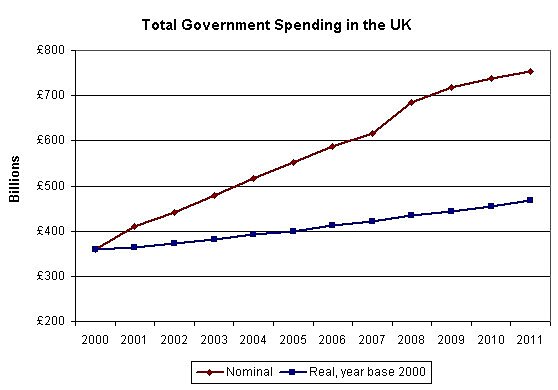
Source: European Commission, Economic and Financial Affairs.
It’s clear that, at least in nominal terms, the rate of growth of spending has declined, but that hardly constitutes brutal cuts as Krugman and others want us to believe. If we look at total government spending as a percentage of the economy, Britain reached a peak in 2009 at 51.5%, and that came down to 49.9% in 2011. Can anyone seriously argue that Britain is in a recession because of that tiny drop in spending as a share of the economy?
Now, let’s remember that the Conservative-Liberal Democrat coalition government that came to power in May 2010 adopted what The Economist hailed as a balanced approach of fiscal consolidation based on £1 of tax increases for £3 of spending cuts. To be fair, the British magazine also said that if economic recovery proved hard to achieve, the government should consider a reprieve in tax increases, but not on spending cuts. We all know that the tax increases already took place (the VAT rate went up from 17.5% to 20%, for example). But as we can see, spending cuts haven’t taken place at all. Thus, austerity in Britain consists only of tax increases.
It’s hard to estimate the impact of tax increases on the British economy. Certainly the economic turmoil in Continental Europe has played a role in taking the U.K. into a second recession. But those who claim that “austerity” is responsible for Britain’s economic malaise should be honest and acknowledge that by austerity they mean only tax increases, not spending cuts.
Related Tags
My new piece at Daily Caller looks at how the Democratic Party’s approach to tax policy has changed over the decades.
The piece was prompted by a recent article from Norm Ornstein and Tom Mann claiming that needed bipartisan reforms are being blocked by the new “ideologically extreme” Republican Party.
Baloney. It’s the Democrats who have changed. The party’s leaders have moved far to the left on economic issues.
As evidence, I point to this Cato Journal article from 1985 by Democrat Richard Gephardt, who was a leader on tax reform. As a free-market guy, I agree with the great majority of what Gephardt said, yet I agree with virtually nothing that modern Democratic leaders say about tax policy.
Regarding ridding the tax code of special breaks, Gephardt says, “I confess that I am not qualified to act as a central planner and I do not know anybody on either committee who is.” Amen!
And Gephardt says, “We in Congress take pride in the free market system.” When was the last time you heard a Democratic leader say something like that?
Related Tags
My colleague Sallie James reported this morning on the looming vote in the House to reauthorize the Export-Import Bank. There are two other votes, which could come as soon as this evening, that would provide a similar indication of how serious the Republican-controlled House is about limiting government and supporting free markets.
An amendment to the House’s fiscal 2013 Commerce, Justice, and Science appropriations bill (H.R. 5326) introduced by Rep. Mike Pompeo (R‑KS) would eliminate funding for the Economic Development Administration. An amendment introduced by Rep. Mike Michaud (D‑ME) would give the EDA an additional $38 million. The House bill appropriates $219 million for the EDA, which is the same amount that President Obama requested.
It’s bad enough that the House Appropriations Committee wants to continue funding this relic of the “Great Society” at any level. However, the appropriations committees are a lost cause regardless of which party is in control. Thus, how the entire Republican House caucus votes on these two amendments will be the more important—and telling—story.
See this Cato essay for background on the Economic Development Administration.
Related Tags
Earlier this year, the Georgetown Journal of Law & Public Policy hosted a symposium on “Hyper-Partisanship and the Law.” The journal editors graciously invited me to join an august panel on partisanship in the judiciary that included George Mason University Law School’s Todd Zywicki and the U.S. Chamber of Commerce’s Rachel Brand. (Brand ran the DOJ’s Office of Legal Policy, which is responsible for vetting and advising the president on judicial nominees, from 2005 to 2007.)
The symposium video isn’t available online, but the participants were invited to publish their presentations in this summer’s issue of the GJLPP. Zywicki has already blogged about his paper, “The Senate and Hyper-Partisanship: Would the Constitution Look Different if the Framers Had Known that Senators Would Be Elected in Partisan Elections?”
My (short) article is entitled “Big Government Causes Partisanship in Judicial Nominations.” Here’s an excerpt:
In 1962, Byron White’s hearing lasted 15 minutes and consisted of three questions. Can you imagine that happening now? Most district court nominees would take that deal. Is it because of TV and the media and the instant sound bite and the new media with the Internet and social networking and all the rest of it? Is it because the issues have gotten more ideologically divisive? I think the answer isn’t really any of these. It isn’t that there’s been a corruption of the confirmation process, the nomination process, presidential or senatorial rhetoric, or the use of filibusters. It’s a relatively new development but one that’s part and parcel of a much larger problem: constitutional corruption.
As government has grown, so have the laws and regulations over which the Court has power. The Court’s power has grown commensurate with the power of Congress, because all of a sudden it’s declaring what Congress can do with its great powers and what kind of new rights will be recognized. As we have gone down the wrong jurisprudential track since the New Deal, judges all of a sudden have more power behind them and the opportunity to really change the direction of public policy more than they ever did.
Read the whole thing (not yet in the final format). My presentation largely tracked some of the points Roger Pilon made in his seminal (and now decade-old) paper, “How Constitutional Corruption Has Led to Ideological Litmus Tests for Judicial Nominees.” You should read that too.