…since 1970, after adjusting for inflation. What have we got to show for it? Bob Ewing of the Institute for Justice tackles that question with a little help from a gory chart I put together a couple of months back, but he’s got another nugget of information that a lot of folks may find more compelling.
Cato at Liberty
Cato at Liberty
Education
So the much ballyhooed Race to the Top program — $4.35 billion out of nearly $110 billion in federal education stimulus and bailouts — is over, with today’s announcement of ten round-two winners. Who knows for sure how the winners were ultimately determined – point allocation was highly subjective — but it’s hard to be impressed by the list: the District of Columbia, Florida, Georgia, Hawaii, Maryland, Massachusetts, New York, North Carolina, Ohio and Rhode Island.
New York? Recent revelations about dumbed-down Regents exams hardly make it seem like a paragon of honest reform. Hawaii? How did last years’ school-free Fridays help them stack up so high? Maryland? Fostering charter schools was supposed to be important, but it has one of the most constricting charter laws in the nation. And Massachusetts? Well, it’s easy to see how it won – it just dropped its own, often-considered nation-leading curriculum standards to adopt national standards demanded by Race to the Top.
In the end, though, how states were chosen really doesn’t matter that much. Why? Because the race was based mainly on who could make the biggest, fastest promises of reform, not who was actually, meaningfully reforming things. So, at the very least, we should all hold our applause for both the winners and the race for several years, because promises are easy — real change is tough.
Related Tags
Many thanks to John Seiler at the Orange County Register and CalWatchdog.com for trying to get the LA Unified School District to clearly explain their finances to the taxpayers who pay for their dysfunctional system.
Related Tags
The hard-nosed, content-at-all-cost folks at the Thomas B. Fordham Foundation have been warned, and warned, and warned some more: Get the national curriculum standards you think are so incredibly important, and they will almost certainly be captured by the pedagogical progressives who have dominated education for decades — and whose notions you disdain. Well, if what’s being reported by Common Core’s Lynne Munson – and reiterated in this lamentation for Massachusetts by the Pioneer Institute’s Jim Stergios — is accurate, that is already happening. (Actually, some prominent analysts have long said that the national standards — created by the Council of Chief State School Officers and National Governors Association — are already nothing the Fordhamites should embrace.) Writes Munson:
This is strange. P21 is being subsumed into CCSSO. There’s nothing to be read about this on either CCSSO’s or P21′s websites. But according to Fritzwire the two organizations have formed a “strategic management relationship” that will commence December 1.
So what is P21 — the group cozying up with the standards-writing CCSSO — you ask? Let the Fordham Institute tell you:
The Partnership for 21st Century Skills (P21) has some powerful supporters, including the NEA, Cisco, Intel, and Microsoft. Fourteen states have also climbed aboard its effort to refocus American K‑12 education on global awareness, media literacy and the like–and to defocus it on grammar, multiplication tables and the causes of the Civil War. Its swell-sounding yet damaging notions have been plenty influential–but the unmasking and truth-telling have begun, thanks in large part to a valiant little organization named Common Core. And new research validates this and other skeptics’ criticisms. Today the contest resembles David vs. Goliath–but remember who ultimately prevailed in that one.
Uh-oh. It might be time to end the biblical references — it looks more and more like Goliath is going to win.
Related Tags
It’s the hot new public-sector trend; massively expensive K‑12 school buildings.
Christina Hoag of the AP writes that LA takes the prize for conspicuous public consumption with the Robert F. Kennedy Community Schools:
With an eye-popping price tag of $578 million, it will mark the inauguration of the nation’s most expensive public school ever. The K‑12 complex to house 4,200 students has raised eyebrows across the country as the creme de la creme of “Taj Mahal” schools, $100 million-plus campuses boasting both architectural panache and deluxe amenities.
Gone are the days when great emperors gave expression to love and grief in spires and domes of white marble. No longer do poor parishioners and wealthy kings construct cathedrals of awe and glory.
Today, we build monuments to government schooling; vast money-pit monstrosities made of matte aluminum flashing and a bureaucrat-chic modern aesthetic.
“Districts want a showpiece for the community, a really impressive environment for learning,” says Joe Agron, editor-in-chief of American School & University, a school construction journal.
Indeed, an impressively expensive environment that is completely unrelated to student achievement. Students only need good lighting, ventilation and protection from the elements to learn. Now we have massive buildings and mini Olympic villages with aquatic centers and professional-grade sports fields. It’s no wonder LA budgeted close to $30,000 per student in 2008.
All of this overbuilding has upfront and long-term costs. Big, expensive and complicated facilities cost more to run and maintain, and the bonds that fund much of this spending leave taxpayers strapped with an increasingly heavy debt burden.
These modern Taj Mahal Schools seem to be a nation-wide phenomenon. National Center for Education Statistics data show that spending on facilities and construction has been increasing at a much faster pace than it has for classroom instruction.

From 1989 to 2008 spending on facilities acquisition and construction has increased a stunning 445% while instructional spending increased 198 percent. The number of students, meanwhile, increased just 7 percent.
Not only is government education spending out of control, much of the increase is being sunk into hugely expensive and unnecessary building projects.
We need to put more money in the hands of parents and taxpayers. We need to invest more effectively and efficiently with education tax credits.
Related Tags
During a recent media conference call, the education secretary made this outlandish claim:
The vast majority of districts around the country have literally been cutting for five, six, seven years in a row. And, many of them, you know, are through, you know, fat, through flesh, and into bone.… [M]any folks in the American public don’t understand how tough these cuts have been for a number of years in a row.
Somebody definitely doesn’t understand public school spending trends, and that somebody is Arne Duncan. How many of America’s 14,000 odd public school districts have cut spending for seven years in a row? Seven. How many have cut spending for even five years in a row? 87… out of 14,000. You do not need to be wearing a pocket-protector while calculating satellite orbital velocities on your shiny new Droid X to see that neither of these numbers represents even one percent of the nation’s school districts. And yet, somehow, the United States Secretary of Education is under the impression that they represent “the vast majority of districts.” Um… NO. [These figures were computed by my intrepid research assistant Ian Hinsdale. Merci Ian].

What would possess Arne Duncan to depart so extravagantly from reality? Perhaps he has been duped by the chicanery that passes itself off as public school district budgeting. Clearly, only a tiny percentage of districts have actually cut spending for even five years in a row. But when public school districts make claims about “budget cuts” they are not using that term in the way that you, or I, or perhaps even the Secretary of Education expect. They are not comparing current year spending to the previous year’s spending. What they’re doing is comparing the approved current year budget to the budget that they initially dreamed about having in an idealized, make-believe world. Unicorn-per-pupil ratios in these initial budgets have been known to exceed one. It is considered impolite when drafting them to draw attention to such niceties as the actual amount of taxpayer dollars available.
Back in the real world, a k‑12 public education costs 4 times as much as it did in 1970, adjusting for inflation: $150,000 versus the $38,000 it cost four decades ago (in constant 2009 dollars). The extra $10 billion that secretary Duncan, the Obama administration, and the congressional majority just threw at the public school monopoly did not serve children or the U.S. economy. They must dearly be hoping that the American public never hears the real story.
Related Tags
Yesterday, FoxNews.com posted a story on what appears to be a growing problem for public school systems across the country: accommodating Muslim holidays. Unfortunately, the report didn’t contain the solution to the problem. It did, though, contain a very succinct discussion of the root of the problem; an example of the good intent that causes people to ignore the problem; and the kind of “solution” that is ultimately at odds with the most basic of American values.
A quote from New York City mayor Michael Bloomberg captured the essence of the problem:
One of the problems you have with a diverse city is that if you close the schools for every single holiday, there won’t be any school.
There you have the basic conundrum in a nutshell: Whenever you have a diverse population — whether in a hamlet, city, state, or nation — and everyone has to support a single system of government schools, you cannot possibly treat all people — or even most of them — equally. Either there are winners and losers, or nobody gets anything.
Understanding why public schooling can’t handle diversity — why, simply, one size can’t fit all — is really basic common sense. So why isn’t there more outrage over, or even just recognition of, the utter illogic of our education system? Mohamed Elibiary, President and CEO of the Freedom and Justice Foundation, illustrated the attitude that likely causes lots of Americans to wear blinders:
I’m a little torn. I want Muslims to be getting the same recognition as other Americans, but at the same time I don’t want to see public education systems be a battleground between religious identities, because then we’re missing the point of why we have a public education system to begin with.
No doubt many people truly believe as Elibiary does: that a major purpose of public schooling is to bring diverse people together and, by doing so, unify them. It’s a fine intention, but also a classic case of intent not matching reality. Indeed, the reality is often very much the opposite. Rather than unifying people, public schooling has repeatedly forced religious conflict (as well as conflict over race, ethnicity, political philosophy, curriculum, and on and on).
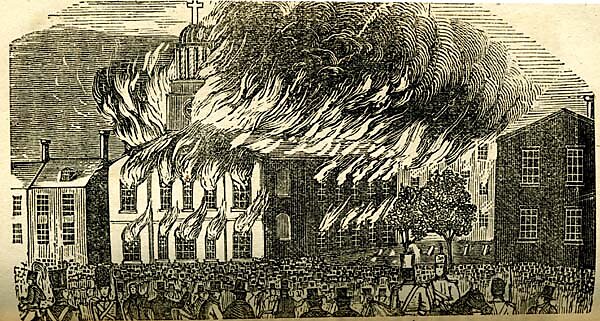
It started almost on Day One, when Horace Mann, a Unitarian, was locked in conflict with Calvinists over what kind of Protestantism the state’s nascent “common schools” would teach. When Roman Catholics began arriving in America in large numbers, battles — sometimes deadly – erupted over who would get what kind of Christianity in the public schools. When Tennessee outlawed the teaching of evolution, the Scopes “Monkey Trial” fired the first big blast in the war over the teaching of human origins, a fight we are still very much in. In the latter part of the twentieth century, the fighting moved to what, if any, religious expression is permissible in public schools. And now, we’re getting fired up over whose holidays will get the most deference from government schools. It almost seems like war without end.
Finally, the article gropes at — but doesn’t grab — the solution to our education and diversity problem. Says Georgetown University professor Bradley Blakeman:
That’s the beauty of having a school district responsive to the localities as opposed to blanket rules that affect multiple jurisdictions, states or even countries. One size doesn’t fit all when it comes to these kinds of rules and regulations. We’re not a homogeneous nation, which makes us so great.
Blakeman is heading in the right direction (even as federal policy pushes us the opposite way): The closer that control of education gets to individual people, the more easily it can be tailored to unique needs, values, and desires. Unfortunately, Blakeman fails to identify the obvious last step: completely decoupling government funding from provision of education. In other words, instituting universal educational choice. Making matters worse, Blakeman for all intents and purposes concludes that as long as decisions are made at the local level, and the majority gets its way, everything is fine:
A school should reflect the beliefs and practices of the community that they serve. And if school boards are sensitive to their populations, that’s fine, provided the decisions of the board reflect the majority opinion of its community.
It may sound harsh, but one way to describe this is simply “tyranny of the majority” — whatever the majority wants, it gets, as long as it is the local majority. It’s a solution that completely ignores that ours is not supposed to be a nation of majority rule, but rule of law that protects individual freedom. And, of course, one of the most basic protections is the prohibition on government tipping the scales in favor of one religion, two religions, or no religion at all.
This solution also fails, by the way, to address the problem at hand: School districts — not states or Washington — having to accommodate diverse populations. In other words, “local control” is ultimately no solution at all.
Universal choice is, quite simply, the only system of education compatible with the most basic of American values — individual liberty — and the only way to avoid constant, divisive battles over who will get what out of the schools. Hopefully, people will come to realize that before our conflicts get even worse.