# A Hearing with Sanctuary City Mayors
Unfortunately, the US immigration system was not designed to be followed.
March 5, 2025 • Testimony
By [David J. Bier](https://www.cato.org/people/david-bier)
Chairman Comer, ranking member Connolly, and distinguished members of the committee, thank you for the opportunity to testify.
My name is David Bier. I am the Director of Immigration Studies at the Cato Institute, a nonpartisan public policy research organization in Washington, D.C. The Cato Institute’s half-century of independent research demonstrates that people of all races, religions, and birthplaces can thrive when the Constitution’s principles of individual liberty and limited government are followed.
## Cities Have to Deal with the Fallout of Congress’s Failing Immigration System
Unfortunately, the US immigration system was not designed to be followed. It was designed in a way that effectively excludes the vast majority of peaceful people who want to immigrate legally to the United States. Congress’s failure to meaningfully update the legal immigration system in the last 35 years has meant that only about 3 percent of those seeking legal permanent resident status in the United States received green cards in 2024.[1](#_ednref1) For people who are not close relatives of US citizens, the percentage is less than one percent.
The result of this effective prohibition is illegal immigration. Congress should restore the immigration system envisioned by America’s founders and legalize immigration through visa reform. Congress should allow people living in the United States without status or with temporary status to obtain a permanent legal status after being vetted for security concerns and paying a fee or fine. This would revitalize America’s economy and would be the best approach to restoring order and legality to the immigration system.
Congress’s continuous refusal to correct its past mistakes and legalize immigration has forced states and local governments to deal with the fallout of illegal immigration. America’s cities benefit from the economic contributions of these immigrants, who have become integrated into their communities as family members, friends, parishioners, workers, and employers. As a result, Congress and the president have forced these communities to choose between aiding federal law enforcement or risk tearing apart their cities.
State and local governments should cooperate with the federal government when it comes to identifying individuals who threaten the lives and liberty of Americans. However, the federal government’s focus on indiscriminate enforcement undermines trust and cooperation with municipalities. A better approach would require Immigration and Customs Enforcement (ICE) to concentrate its efforts on serious offenders so localities could be confident about ICE’s intentions when working with local officers.
## Cities Have Good Reasons to Limit Cooperation with Immigration Enforcement
However, states should not simply agree to help the federal government with mass deportation. Even when immigrants are unable to obtain legal status, they benefit their communities, and cities have good reasons not to indiscriminately aid the federal government in removing them.
- *Illegal immigrants provide goods and services that improve the lives of Americans*. Mass deportation would cut US production by about 7 percent of Gross Domestic Product.[2](#_ednref2) Illegal immigrants look after Americans’ children, provide their health care, and care for them when they become elderly and disabled. Immigrants build and clean Americans’ homes, harvest their fruits and vegetables, and process their meat and seafood. Mass deportation would crash local economies, creating a death spiral of lost consumers, closed businesses, and declining tax revenue.
- *Many Americans’ jobs directly depend on illegal immigrant workers*. For instance, there are 33 million US-born Americans who are managers or supervisors for over 8 million unauthorized immigrant workers.[3](#_ednref3)
- *Illegal immigrants are providers for US citizen family members*. There are over one million undocumented spouses of US citizens, and nearly 17 million US citizens share a household with an unauthorized immigrant.[4](#_ednref4) Mass deportation would impoverish many of these families, cutting household income at least in half.[5](#_ednref5)
- *Illegal immigrants support state and local governments* with more than $37 billion in state and local tax revenue in 2022.[6](#_ednref6)
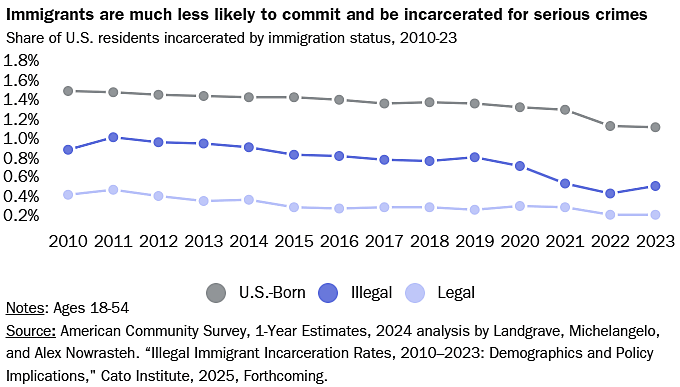
- *Illegal immigrants reduce crime rates by committing fewer crimes*. More than a dozen studies have found that immigration, including illegal immigration, is associated with less crime.[7](#_ednref7) Illegal immigrants were half as likely to have committed an offense serious enough for them to be incarcerated in the United States in 2023.[8](#_ednref8) In recent years, there has been a negative correlation between murders and immigration court filings in major US cities.[9](#_ednref9)
Fewer than half a million immigrants with criminal convictions of any kind were on ICE’s docket in 2024—which is less than 3 percent of the roughly 14 million illegal immigrants.[10](#_ednref10) Although ICE’s docket does not include every illegal immigrant convicted of anything, it consists of the vast majority. The docket also includes legal immigrants in the process of having their status removed for crimes, and some illegal immigrants who have died or left, as well as those convicted of nothing but entering illegally. Regardless, 3 percent is a low share compared to the broader population. Roughly 30 percent of Americans have been arrested,[11](#_ednref11) and about 8 percent have felony convictions.[12](#_ednref12)
- *Illegal immigrants can directly stop crimes*. An unauthorized immigrant working as a convenience store nightwatchman stopped a burglary in Texas.[13](#_ednref13) Another in New Mexico chased down a child abductor, safely returning a 6‑year-old girl to her parents.[14](#_ednref14) Two Venezuelan asylum seekers in New York City (Oswaldo Robles Lino and Josnan Alberto Palacios) stopped a stabbing in 2024.[15](#_ednref15)
- *Illegal immigrants help solve crimes*. From 2017 to 2019, noncitizens worked with police and reported crimes at higher rates than US-born Americans.[16](#_ednref16) Over the last decade, about 100,000 unauthorized immigrants have obtained legal status through their cooperation with law enforcement,[17](#_ednref17) and local agencies have about 355,000 requests pending for unauthorized immigrants to receive legal status based on their cooperation with them right now.[18](#_ednref18) Hispanics were somewhat more likely to report crimes in sanctuary cities from 1980 to 2004.[19](#_ednref19)
- *Cities have more important law enforcement priorities*. In the United States, more than 40 percent of murders, about 60 percent of violent crimes, and 85 percent of property crimes go unsolved.[20](#_ednref20) Mandating that police divert resources away from these offenses to enforce immigration status violations would make cities less safe. It prioritizes jail space for non-threatening individuals over addressing actual threats to the community. It costs New York City over $1,500 per day to detain someone.[21](#_ednref21)
- *Reasonable restrictions on aiding immigration enforcement do not increase crime*. A dozen studies have found that limits on ICE cooperation do not lead to higher crime rates.[22](#_ednref22) Sanctuary policies were associated with fewer assaults and burglaries after adoption in 2014.[23](#_ednref23) There was no change in Florida counties that adopted sanctuary policies.[24](#_ednref24) From 1999 to 2010, sanctuary policies had no effect on crime in those cities.[25](#_ednref25) “Sanctuary cities,” broadly defined, saw more significant decreases in both violent and property crimes from 2014 to 2016,[26](#_ednref26) and they did not experience higher violent or property crime rates than other cities.[27](#_ednref27) Additionally, California’s SB 54 did not increase crime rates.[28](#_ednref28)
A limitation of this research is that it mostly predates many of the most extreme restrictions on ICE cooperation and includes a mix of extreme and moderate restrictions. From 2010 to 2015, these policies did reduce deportations, but not of people with violent convictions. This is an indication that those policies did not severely hamper ICE’s efforts to target violent criminals during that period.[29](#_ednref29) Whether these conclusions hold true for much more extreme policies adopted in the wake of President Trump’s 2015–2016 presidential campaign is unclear.
Illegal immigrants could contribute more to their cities and the country if they had a permanent legal status and employment authorization. States and cities should not cooperate with immigration enforcement efforts targeting peaceful individuals.
## States Have the Power to Limit Cooperation with the Federal Government
States have the independent authority to decide how their law enforcement agencies interact with federal immigration enforcement. Although regulating immigration falls solely under federal jurisdiction, and federal law is supreme, states may still determine how to allocate their resources and whether to assist in enforcing federal law. Congress may not mandate states to comply with the federal government’s bidding.
Under the Constitution’s federalist system, state governments are not creations of the federal government. Under the 10th Amendment, states retain all powers not explicitly delegated to the federal government. This system of “dual sovereignty” keeps the states directly accountable to their citizens for any actions that the states take. They cannot claim that the federal government “forced” them to take any particular action.
As the Supreme Court stated in *Printz v. United States* (1997), “The power of the Federal Government would be augmented immeasurably if it were able to impress into its service-and at no cost to itself-the police officers of the 50 States.”[30](#_ednref30) The Supreme Court has extended this principle to include the use of federal monetary grants to coerce cooperation. *NFIB v. Sebelius* (2012) stated: “Congress may use its spending power to create incentives for States to act in accordance with federal policies. But when ‘pressure turns into compulsion,’ ibid., the legislation runs contrary to our system of federalism.”[31](#_ednref31)
Moreover, several courts have found that it is unconstitutional for states to detain individuals solely based on a federal request.[32](#_ednref32) More than a dozen settlements have involved subjects of immigration detainers who were wrongly detained by localities.[33](#_ednref33) This means that states and localities *cannot* lawfully arrest and detain someone merely based on an immigration detainer request from the federal government without a court order supported by probable cause. Many states and cities are labeled “sanctuaries” simply for following these court decisions.
During its first term, the Trump administration attempted to impose new requirements for certain law enforcement grants. However, four of the five appeals courts that considered the issue found that those requirements were adopted unlawfully and unconstitutionally.[34](#_ednref34) As the Seventh Circuit Court of Appeals wrote in 2020, “states do not forfeit all autonomy over their own police power merely by accepting federal grants.”[35](#_ednref35)
## The Administration Sows Mistrust Between Federal and Local Law Enforcement
Notwithstanding these facts, the Trump administration is attempting to bully state and local governments into compliance with his agenda.
- *The administration is attempting to coerce state governments unconstitutionally*. He has issued an executive order that attempts to block all federal grants to municipalities that do not allocate their resources to help ICE.[36](#_ednref36) His administration has sued Illinois and Chicago for refusing to help ICE, asserting that the president can mandate that they do what he wants.[37](#_ednref37) His Department of Justice (DOJ) has issued a memorandum requiring *criminal* investigations into state and local officials who fail to cooperate with the federal government.[38](#_ednref38)
- *The administration is attempting mass deportation of noncriminals.* President Trump signed an executive order removing requirements that ICE target public safety threats, and instead mandating ICE and DOJ to focus on immigration status violations.[39](#_ednref39) A majority of the people that ICE has arrested since President Trump’s inauguration have no criminal convictions.[40](#_ednref40) In fact, two-thirds of the increase in ICE book-ins from ICE arrests have come from individuals with no criminal convictions—including a sevenfold increase in detentions of individuals who had criminal convictions or criminal charges.[41](#_ednref41)
- *The administration is targeting lawful immigrants for deportation*. President Trump is revoking the legal status of more than a million people who are living in the United States legally.[42](#_ednref42) He is ending parole and Temporary Protected Status even for immigrants who entered the country through legal channels.[43](#_ednref43) ICE is already arresting people with valid parole status and subjecting them to detention and expedited removal.[44](#_ednref44) Additionally, they are arresting fathers and breadwinners in an attempt to force families to leave.[45](#_ednref45)
- *The administration is attempting to arrest and deport US citizens*. The president signed an executive order that purports to strip US citizenship from, and render deportable, all children born to temporary visa holders and people without lawful status, despite the constitutional guarantee of birthright citizenship.[46](#_ednref46) This flagrantly unconstitutional act effectively calls for a series of serious crimes, including wrongful arrests, imprisonment, civil rights violations, and unlawful deprivation of voting rights. Although he claims it will only be applied to people born after February 2025, it is unprecedented in American history for a president to seek the power to strip potentially tens of millions of US citizens of their constitutional rights.
- *The administration is ordering violations of the law*. President Trump signed an executive order that explicitly states that he can ignore any law passed by Congress that limits the removal of noncitizens.[47](#_ednref47) He has told Border Patrol and ICE to ignore “provisions of the INA \[Immigration and Nationality Act\] that would permit their \[certain noncitizens’\] continued presence in the United States.”
- *The administration is misrepresenting his immigration agenda*. In his inaugural address, President Trump stated that he would be removing “millions and millions of criminal aliens”—even though there are not millions and millions of immigrants with criminal records.[48](#_ednref48) His administration has erroneously claimed that all the immigrants that they have arrested have “criminal records,”[49](#_ednref49) and we now know that most do not. They have also said that only the “worst of the worst” would be detained at Guantanamo Bay prison, but we now know that 39 percent were deemed low-level offenders even by the current administration,[50](#_ednref50) and some entered legally and never violated any US law.[51](#_ednref51)
The Trump administration’s lawless assault on the rule of law in pursuit of indiscriminate mass deportation creates mistrust between immigrants and law enforcement and between state and local governments and the federal government. Congress should restore cooperation and trust by requiring that ICE target only serious criminal threats and work with state and local governments to stop serious criminals in their communities.
## Congress Should Not Attempt to Coerce States and Cities into Mass Deportation
Unfortunately, rather than attempting to reestablish trust, Congress is considering legislation that explicitly seeks to coerce states and localities into cooperation with mass deportation. H.R. 32, the No Bailouts for Sanctuary Cities Act, forces states and cities to choose between federal grants and literally any other governmental priority.
- *H.R. 32 does not focus on public safety*. Instead, it would mandate cooperation with ICE when necessary to protect the public from a safety threat. This bill imposes a blanket mandate that supports the Trump administration’s indiscriminate, random, and chaotic deportation agenda.
- *H.R. 32 mandates cities violate the Constitution and court orders*. H.R. 32 would mandate that cities comply with all ICE requests to detain immigrants. This would force cities to violate court orders and settlements stating that local police cannot detain people solely based on immigration detainers, as this is an arrest without probable cause. Many US citizens have been targeted by ICE detainers.[52](#_ednref52)
- *H*.*R. 32 imposes unfunded mandates and liabilities on states and localities*. In addition to the risk of lawsuits, H.R. 32 requires state and federal governments to allocate their criminal law enforcement resources to engage in deportation efforts, without providing any additional funds to states and localities to carry out the mandate. Local police already struggle to keep pace with America’s high crime rates. They do not need additional burdens imposed—especially when Congress refuses to pay for those burdens.
- *H*.*R. 32 unconstitutionally coerces US cities and states*. The legislation explicitly attempts to coerce states and localities into following federal dictates by withholding all federal grants to those cities—for everything from education to transportation to housing to policing—that the city or state “intends to use for the benefit” of illegal immigrants. As the Supreme Court said, “Permitting the Federal Government to force the States to implement a federal program would threaten the political accountability key to our federal system.”[53](#_ednref53) Moreover, the bar is raised to impose conditions after the grant program starts because taking away existing funds is more coercive than limiting new grants, and it is also unconstitutional because H.R. 32 jeopardizes grants that have nothing to do with immigration policy.[54](#_ednref54) Finally, threatening to pull the plug on funding to law enforcement is fundamentally more threatening than anything attempted in the past.[55](#_ednref55)
- *H*.*R. 32 is a classic case of “pass-the-bill-to-see-what’s‑in-it.”* No one—not even the bill’s authors—can say exactly which federal grants could be deemed “intended for the benefit” of undocumented immigrants, violating the Supreme Court’s requirement that any limitations on federal grants must be clearly stated in law.[56](#_ednref56) However, since all grants, in theory, directly or indirectly, can benefit everyone in the area, H.R. 32 could plausibly be used to deny all grants to certain states or cities.
- *States cannot constitutionally avoid H.R. 32’s coercion*. It is impossible for states and localities to avoid spending some resources on illegal immigrants. For instance, states and localities cannot lawfully interrogate individuals about their immigration status without reasonable suspicion before they use public areas or roads, as established in *Arizona v. United States*.[57](#_ednref57) Moreover, the Supreme Court ruled in *Plyler v. Doe* that all states must provide public education equally to all persons within their borders, so no state can lawfully deny education—partially funded by federal dollars—to someone without legal status.
- *H.R. 32 is an attack on federalism*. Regardless of its constitutionality, H.R. 32 is a direct threat to federalism. Intergovernmental grants always undermine federalism and imperil local accountability, but H.R. 32’s attack on federalism is of a different character. If enacted, it would establish a precedent allowing the federal government to fully dictate all state and local policing priorities—a direct repudiation of America’s founders’ intent.
- *H*.*R. 32 targets cities who follow state policies over which they have no control*. Every jurisdiction in at least 14 states will lose federal funding under H.R. 32 even if they had no choice whether to adopt the policies that the bill targets.[58](#_ednref58)
- *H.R. 32 turns state and local governments against their own residents and citizens*. States and localities must either comply with H.R. 32’s mandates, which would tear apart their communities, rip up families, and destroy local economies, or risk being effectively expelled from the fiscal union of the United States. While H.R. 32 would still tax these cities, the collected funds would be redistributed to states and localities that adopt the authors’ preferred immigration policies. No matter what they choose, the targeted states and localities lose.
Congress should follow the advice of the Major City Chiefs Association: “The decision to have local police officers perform the function and duties of immigration agents should be left to the local government. This shall not be mandated or forced upon them by the federal government through the threat of sanctions or the withholding of existing police assistance funding.” While state and local governments will not always make the correct decisions about how to allocate their resources, they are usually better equipped to do so than the federal government.
Immigrants who have violated the rights of Americans should be deported, but to achieve that outcome, we need to reform our immigration laws. Congress should let peaceful immigrants pay to get vetted, work, and contribute legally to society, while enabling law enforcement at all levels to focus on keeping Americans safe.
##### About the Author
[](/people/david-bier)
##### [David J. Bier](/people/david-bier)
Director, Immigration Studies, and The Selz Foundation Chair in Immigration Policy, Cato Institute
[
](https://x.com/David_J_Bier) [
](mailto:dbier@cato.org)
Show Endnotes
Hide Endnotes
##### Notes
[1](#_edn1). Much of this testimony was previously presented in other congressional hearings
David J. Bier, “[Green Card Approval Rate Reaches Record Lows](https://www.cato.org/briefing-paper/green-card-approval-rate-reaches-record-lows),” Cato Institute Briefing Paper no. 173, February 15, 2024.
[2](#_edn2). Anjali V. Bhatt, et al., “[Mass deportations would harm the US economy](https://www.piie.com/blogs/realtime-economics/2024/mass-deportations-would-harm-us-economy),” *Peterson Institute for International Economics*, September 26, 2024.
[3](#_edn3). American Community Survey, 1‑year, 2023; and Jennifer Van Hook, Ariel G. Ruiz Soto, and Julia Gelatt, “[The Unauthorized Population Expands amid Record US-Mexico Border Arrivals](https://www.migrationpolicy.org/news/unauthorized-immigrant-population-mid-2023),” *Migration Policy Institute*, February 2025.
[4](#_edn4). “[US Citizen Children Impacted by Immigration Enforcement](https://www.americanimmigrationcouncil.org/research/us-citizen-children-impacted-immigration-enforcement),” *American Immigration Council*, June 24, 2021; Ajay Chaudry, et al., “[Facing Our Future: Children in the Aftermath of Immigration Enforcement](https://www.urban.org/sites/default/files/publication/28331/412020-Facing-Our-Future.PDF),” *The Urban Institute*, February 2010.
[5](#_edn5). Matthew Lisiecki and Gerard Apruzzese, “[Proposed 2024 Mass Deportation Program Would Socially and Economically Devastate American Families](https://cmsny.org/publications/2024-mass-deportation-program-devastate-american-families-101024/),” *Center for Migration Studies*, October 10, 2024.
[6](#_edn6). “[State and Local Tax Contributions by Undocumented Immigrants](https://itep.org/undocumented-immigrants-taxes-by-state/),” *Institute on Taxation and Economic Policy*, August 1, 2024.
[7](#_edn7). Tim Wadsworth, “[Is Immigration Responsible for the Crime Drop? An Assessment of the Influence of Immigration on Changes in Violent Crime Between 1990 and 2000](https://www.jstor.org/stable/42956415).” *Social Science Quarterly* 91, no. 2 (2010): 531–53.
Jacob I. Stowell, et al., [Immigration and The Recent Violent Crime Drop in The United States: A Pooled, Cross-Sectional Time-Series Analysis of Metropolitan Areas.](https://doi.org/10.1111/j.1745-9125.2009.00162.x) *Criminology*, 47 (2009): 889–928.
R.J. Sampson, “[Rethinking Crime and Immigration.](https://journals.sagepub.com/doi/10.1525/ctx.2008.7.1.28)” *Contexts*, 7, no. 1 (2008): 28–33.
Garth Davies and Jeffrey Fagan, “[Crime and Enforcement in Immigrant Neighborhoods: Evidence from New York City](https://doi.org/10.1177/0002716212438938),” *The ANNALS of the American Academy of Political and Social Science*, 641, no. 1 (2012): 99–124.
Lee, Matthew T., Ramiro Martinez, and Richard Rosenfeld. “[Does Immigration Increase Homicide? Negative Evidence from Three Border Cities](http://www.jstor.org/stable/4121133).” *The Sociological Quarterly* 42, no. 4 (2001): 559–80.
Lesley Williams Reed, et al., “[The immigration–crime relationship: Evidence across US metropolitan areas](https://doi.org/10.1016/j.ssresearch.2005.01.001),” *Social Science Research* 34 no. 4 (2005): 757–780.
Ben Feldmeyer, et al., “[More immigrants, less death: An analysis of immigration effects on county-level drug overdose deaths, 2000–2015](https://doi.org/10.1111/1745-9125.12318),” *Criminology*, 60 (2022): 667–699.
Ben Feldmeyer, “[Immigration and violence: the offsetting effects of immigrant concentration on Latino violence](https://doi.org/10.1016/j.ssresearch.2009.03.003),” *Social Science Research* 33 no. 3 (2009): 717–31.
Michael T. Light and Ty Miller, “[Does Undocumented Immigration Increase Violent Crime?](https://doi.org/10.1111/1745-9125.12175)” *Criminology*, 56 (2018): 370–401.
Graham C. Ousey and Charis E. Kubrin, (2009). “[Exploring the connection between immigration and violent crime rates in U.S. cities, 1980–2000](https://doi.org/10.1525/sp.2009.56.3.447),” *Social Problems* 56, no. 3 (2009): 447–473.
Christopher J. Lyons, María B. Vélez, and Wayne A. Santoro. “[Neighborhood Immigration, Violence, and City-Level Immigrant Political Opportunities](https://doi.org/10.1177/0003122413491964),” *American Sociological Review* 78, no. 4 (June 17, 2013): 604–32.
Min Xie and Eric P. Baumer, “[Reassessing the Breadth of the Protective Benefit of Immigrant Neighborhoods: A Multilevel Analysis of Violence Risk by Race, Ethnicity, and Labor Market Stratification](https://nij.ojp.gov/library/publications/reassessing-breadth-protective-benefit-immigrant-neighborhoods-multilevel),” 2018.
Ramiro Martinez, Jr., et al. “[Immigration and Crime in an Era of Transformation: A Longitudinal Analysis of Homicides in San Diego Neighborhoods, 1980–2000](https://www.ojp.gov/ncjrs/virtual-library/abstracts/immigration-and-crime-era-transformation-longitudinal-analysis)” *Criminology* 48, no. 3 (2010): 797–830.
[8](#_edn8). *Hearing on Given the Green Light: Open Border Policies and Threats to Law Enforcement, Before the Committee on Homeland Security, Subcommittee on Emergency Management and Technology*, 118th Cong. 2nd Sess.(December 10, 2024) ([statement](https://www.cato.org/testimony/given-green-light-open-border-policies-threats-law-enforcement) of David J. Bier, Director of Immigration Studies, Cato Institute).
[9](#_edn9). *Hearing on Given the Green Light: Open Border Policies and Threats to Law Enforcement, Before the Committee on Homeland Security, Subcommittee on Emergency Management and Technology*, 118th Cong. 2nd Sess.(December 10, 2024) ([statement](https://www.cato.org/testimony/given-green-light-open-border-policies-threats-law-enforcement) of David J. Bier, Director of Immigration Studies, Cato Institute).
[10](#_edn10). Patrick J. Lechleitner, “[Letter to the Honorable Tony Gonzales](https://homeland.house.gov/wp-content/uploads/2024/09/24-01143-ICEs-Signed-Response-to-Representative-Tony-Gonzales.pdf),” *US Immigrations and Customs Enforcement*, September 25, 2024.
[11](#_edn11). Robert Brame, et al., “[Cumulative Prevalence of Arrest From Ages 8 to 23 in a National Sample](https://publications.aap.org/pediatrics/article-abstract/129/1/21/31558/Cumulative-Prevalence-of-Arrest-From-Ages-8-to-23?redirectedFrom=fulltext),” *Pediatrics* 129, no. 1 (2012): 21–27.
Joe Craven McGinty, “[How Many Americans Have a Police Record? Probably More Than You Think](https://www.wsj.com/articles/how-many-americans-have-a-police-record-probably-more-than-you-think-1438939802),” *Wall Street Journal*, August 7, 2015.
[12](#_edn12). Sarah K. S. Shannon, et al., “[The Growth, Scope, and Spatial Distribution of People With Felony Records in the United States, 1948–2010](https://link.springer.com/article/10.1007/s13524-017-0611-1),” *Demography* 54 (2017): 1795–1818.
[13](#_edn13). David Bier, “[Donald Trump Is Wrong—Immigrants Don’t Commit More Crimes,](https://time.com/4509413/presidential-debate-donald-trump-immigration/)” *Time*, September 2016.
[14](#_edn14). Jeri Clausing, “[Man who saved girl says he’s illegal immigrant](https://www.nbcnews.com/id/wbna44206940),” *NBC News*, August 2011.
[15](#_edn15). Louis Finley, “NYPD honors migrants with award for stopping stabbing suspect,” *Spectrum News NY1*, August 20, 2024.
[16](#_edn16). Jessica M. Vaughan, Steven A. Camarota, and Karen Zeigler, “[Are Immigrants Less Willing to Report Crime?](https://cis.org/Report/Are-Immigrants-Less-Willing-Report-Crime)” *Center for Immigration Studies*, October 14, 2021.
[17](#_edn17). There is an annual cap of 10,000 U visas.
[18](#_edn18). “[Number of Service-wide Forms Fiscal Year To Date](https://www.uscis.gov/sites/default/files/document/data/quarterly_all_forms_fy2024_q1.xlsx),” USCIS, 2023.
[19](#_edn19). Ricardo D. Martínez–Schuldt and Daniel E. Martínez, “[Immigrant Sanctuary Policies and Crime-Reporting Behavior: A Multilevel Analysis of Reports of Crime Victimization to Law Enforcement, 1980 to 2004](https://journals.sagepub.com/doi/10.1177/0003122420978406),” *American Sociological Review* 86, no. 1 (2021): 154–185.
[20](#_edn20). [Preliminary Data Points to Small Improvements in Clearance Rates Nationally in 2024](https://jasher.substack.com/p/preliminary-data-points-to-small?utm_source=post-email-title&publication_id=1234332&post_id=153424663&utm_campaign=email-post-title&isFreemail=true&r=j385f&triedRedirect=true&utm_medium=email).
[21](#_edn21). “[Comptroller Stringer: Cost of Incarceration per Person in New York City Skyrockets to All-Time High](https://comptroller.nyc.gov/newsroom/comptroller-stringer-cost-of-incarceration-per-person-in-new-york-city-skyrockets-to-all-time-high-2/),” *New York City Comptroller Scott M. Stringer*, December 6, 2021.
[22](#_edn22). Daniel E. Martínez, Ricardo D. Martínez-Schuldt, and Guillermo Cantor, “[Providing Sanctuary or Fostering Crime? A Review of the Research on ‘Sanctuary Cities’ and Crime](https://compass.onlinelibrary.wiley.com/doi/abs/10.1111/soc4.12547),” *Sociology Compass* 12, no. 1 (January 2018).
[23](#_edn23). Dale T. Manning and Jesse Burkhardt, “[The local effects of federal law enforcement policies: Evidence from sanctuary jurisdictions and crime](https://onlinelibrary.wiley.com/doi/10.1111/coep.12564?af=R),” *Contemporary Economic Policy* 40, no. 3 (July 2022): 423–438.
[24](#_edn24). Alex Nowrasteh and Andrew C. Forrester, “[Sanctuary Jurisdictions in Florida Do Not Have Higher Crime Rates](https://www.cato.org/blog/sanctuary-jurisdictions-florida-do-not-have-higher-crime-rates),” *Cato at Liberty* (blog), March 29, 2019.
[25](#_edn25). Yuki Otsu, “[Sanctuary Cities and Crime](https://ssrn.com/abstract=3453413),” October 4, 2021.
[26](#_edn26). Marta Ascherio, “[Do sanctuary cities increase crime? Contrary evidence from a county-level investigation in the United States](https://www.sciencedirect.com/science/article/abs/pii/S0049089X22000497),” *Social Science Research* 106 (August 2022).
[27](#_edn27). Adam R. Schutt, “[Sanctuary Cities and Their Respective Effect on Crime Rates](https://digitalcommons.iwu.edu/uer/vol16/iss1/20),” *Undergraduate Economic Review* 16 no. 1, Article 20 (2019).
[28](#_edn28). Charles E. Kubrin and Bradley J. Bartos, “[Sanctuary Cities and Crime in California: What’s the Connection?](https://doi.org/10.1080/24751979.2020.1745662)” *Justice Evaluation Journal* 3, no. 2 (April 2020) 115–133.
[29](#_edn29). David K. Hausman, “[Sanctuary policies reduce deportations without increasing crime](https://doi.org/10.1073/pnas.2014673117),” *Proc. Natl. Acad. Sci. U.S.A* 117, no. 44 (October 19, 2020): 27262–27267.
[30](#_edn30). [*Printz v. United States*](https://supreme.justia.com/cases/federal/us/521/898/#tab-opinion-1960203), 521 U.S. 898 (1997).
[31](#_edn31). [*National Federation of Independent Business v. Sebelius*](https://supreme.justia.com/cases/federal/us/567/519/#tab-opinion-1970522), 567 U.S. 519 (2012).
[32](#_edn32). [*Cisneros v. Elder*](https://www.aclu-co.org/en/cases/cisneros-v-elder-compensation-false-imprisonment#:~:text=Elder%20(compensation%20for%20false%20imprisonment),-Facebook&text=This%20case%20seeks%20monetary%20compensation,his%20daughter%20posted%20his%20bond), 522 P.3d 255 (Colo. Ct. App. 2022);
[*Galarza v. Lehigh County*](https://www.aclupa.org/sites/default/files/field_documents/galarza_third_circuit_opinion_3-4-14.pdf), No. 12–3991 (2014);
[*Miranda-Olivares v. Clackamas County*](https://casetext.com/case/miranda-olivares-v-clackamas-cnty), Case No. 3:12-cv-02317-ST (D. Or. Apr. 11, 2014);
[*Morales v. Chadbourne*](https://casetext.com/case/morales-v-chadbourne-1), 793 F.3d 208 (1st Cir. 2015);
[*Jimenez Moreno et al v. Napolitano et al*](https://cases.justia.com/federal/district-courts/illinois/ilndce/1:2011cv05452/258719/230/0.pdf?ts=1475324257), Case No. 11 C 5452 (September 30, 2016).
[33](#_edn33). “[Local jurisdictions remain legally vulnerable for honoring ICE detainers](https://www.aclu.org/sites/default/files/field_document/recent_ice_detainer_damages_cases_2018.pdf),” *ACLU*, April 3, 2018.
[34](#_edn34). 1st: [*City of Providence v. United States Department of Justice*](https://law.justia.com/cases/federal/appellate-courts/ca1/19-1802/19-1802-2020-03-24.html), No. 19–1802 (1st Cir. 2020).
3rd: [*City of Philadelphia v. Attorney General of the U.S.A*](https://www2.ca3.uscourts.gov/opinarch/182648p.pdf)*.*, No. 18–2648 (3rd Cir. 2018).
7th: [*City of Chicago v. Barr*](https://law.justia.com/cases/federal/appellate-courts/ca7/19-3290/19-3290-2020-04-30.html), No. 19–3290 (7th Cir. 2020).
9th: [*City of Los Angeles v. Barr*](https://cdn.ca9.uscourts.gov/datastore/opinions/2019/10/31/18-56292.pdf), No. 18–56292 (9th Cir. 2019).
2nd: [*New York v. United States Department of Justice*](https://law.justia.com/cases/federal/appellate-courts/ca2/19-267/19-267-2020-02-26.html), No. 19–267 (2d Cir. 2020).
[35](#_edn35). [*City of Chicago v. Barr*](https://law.justia.com/cases/federal/appellate-courts/ca7/19-3290/19-3290-2020-04-30.html), No. 19–3290 (7th Cir. 2020).
[36](#_edn36). See Sec. 17: “Executive Order of January 20, 2025, [Protecting the American People Against Invasion](https://www.whitehouse.gov/presidential-actions/2025/01/protecting-the-american-people-against-invasion/).”.
[37](#_edn37). Joel Rose, “[Justice Department sues Chicago and Illinois over ‘sanctuary’ laws](https://www.npr.org/2025/02/06/nx-s1-5288871/justice-department-sues-chicago-and-illinois-over-sanctuary-laws#:~:text=DOJ%20sues%20Chicago%20and%20Illinois%20over%20'sanctuary'%20laws%20The%20federal,to%20carry%20out%20their%20responsibilities.%22),” *NPR.org*, February 6, 2025.
[38](#_edn38). “[Sanctuary Jurisdiction Directives](https://www.justice.gov/ag/media/1388531/dl?inline),” *Office of the Attorney General*, February 5, 2025;
*Cities of Chelsea and Somerville v. Donald J. Trump et al*, Case No. 25–10442 (Mass. Dist. Ct 2025).
[39](#_edn39). “Executive Order of January 20, 2025, [Protecting the American People Against Invasion](https://www.whitehouse.gov/presidential-actions/2025/01/protecting-the-american-people-against-invasion/).”.
[40](#_edn40). Mica Rosenberg and Perla Trevizo, “[Four Years in a Day](https://www.propublica.org/article/donald-trump-immigration-executive-orders),” *ProPublica*, February 7, 2025.
[41](#_edn41). CBP share of criminal book-ins estimated using CBP criminal detained share: Immigrations and Customs Enforcement, “[Detention Management](https://www.ice.gov/detain/detention-management),” 2025.
[42](#_edn42). Suzanne Gamboa and Gabe Gutierrez, “[Trump shuts down immigration app, dashing migrants’ hopes of entering U.S.,](https://www.nbcnews.com/news/latino/trump-shuts-cbp-one-immigration-app-dashing-migrants-hopes-entering-us-rcna188448)” *NBCnews.com*, January 20, 2025.
[43](#_edn43). Daniel Seiden, “[Trump Sued Over Ending Protections for Haitians, Venezuelans (2)](https://news.bloomberglaw.com/litigation/trump-sued-over-ending-protections-for-haitians-venezuelans),” *Bloomberg Law*, March 3, 2025.
[44](#_edn44). Ben Brown, “[ICE arrests Arizona man with legal work permit and active parole status](https://www.abc15.com/news/state/ice-arrests-arizona-man-with-legal-work-permit-and-active-parole-status),” *ABC15*, February 28, 2025; Benjamine C. Huffman, “[Guidance Regarding How to Exercise Enforcement Discretion](https://www.dhs.gov/sites/default/files/2025-01/25_0123_er-and-parole-guidance.pdf),” *US Department of Homeland Security*, January 23, 2025.
[45](#_edn45). CNN, “[Georgia woman speaks out after ICE arrests husband outside church](https://www.wjcl.com/article/tucker-georgia-church-immigration-arrest/63601465),” *WJCL22*, January 29, 2025.
[46](#_edn46). “Executive Order of January 20, 2025, [Protecting the Meaning and Value of American Citizenship](https://www.whitehouse.gov/presidential-actions/2025/01/protecting-the-meaning-and-value-of-american-citizenship/).”.
[47](#_edn47). “Executive Order of January 20, 2025, [Guaranteeing the States Protection Against Invasion](https://www.whitehouse.gov/presidential-actions/2025/01/guaranteeing-the-states-protection-against-invasion/).”.
[48](#_edn48). David J. Bier, “[Is Trump Arresting Criminal Aliens?](https://www.cato.org/blog/trump-arresting-criminal-aliens)” *Cato at Liberty* (blog), February 7, 2025.
[49](#_edn49). Russell Contreras and Avery Lotz, “[All undocumented immigrants are ‘criminals,’ Trump administration says](https://www.axios.com/2025/01/28/trump-immigrants-criminals-white-house-briefing),” *Axios*, January 28, 2025.
[50](#_edn50). [*Las Americas Immigrant Advocacy Center et al v. Kristi Noem et al*](https://storage.courtlistener.com/recap/gov.uscourts.dcd.277395/gov.uscourts.dcd.277395.14.3.pdf), Civil Action No. 25–0418 (D.C. Dist. Ct. 2025).
[51](#_edn51). CiberCuba Editorial Team, “[The reason why the relatives of three Venezuelans sent to Guantánamo have sued the U.S. government](https://en.cibercuba.com/noticias/2025-02-13-u1-e129488-s27061-nid297120-familiares-venezolanos-enviados-guantanamo-demandan),” *CiberCuba*, February 13, 2025.
[52](#_edn52). [https://www.cato.org/sites/cato.org/files/pubs/pdf/irpb‑8.pdf](https://www.cato.org/sites/cato.org/files/pubs/pdf/irpb-8.pdf)
[https://www.cato.org/blog/details-155-immigration-detainers-us-citizens](https://www.cato.org/blog/details-155-immigration-detainers-us-citizens).
[53](#_edn53). [*National Federation of Independent Business v. Sebelius*](https://supreme.justia.com/cases/federal/us/567/519/#tab-opinion-1970522), 567 U.S. 519 (2012).
[54](#_edn54). Devin Watkins, “[5 Ways Trump’s Anti-Sanctuary City Orders Are Unconstitutional](https://www.cato.org/commentary/5-ways-trumps-anti-sanctuary-city-orders-are-unconstitutional),” Cato Institute, March 31, 2017.
[55](#_edn55). Trevor Burrus, “[When the Levee Breaks: How the SAFE Act Could Unconstitutionally Strip States of FEMA Funding](https://www.cato.org/blog/when-levee-breaks-how-safe-act-unconstitutionally-strips-states-fema-funding),” *Cato at Liberty* (blog), February 6, 2014.
[56](#_edn56). [*Pennhurst State Sch. & Hosp. v. Halderman*](https://supreme.justia.com/cases/federal/us/451/1/), 451 U.S. 1 (1981).
[57](#_edn57). [*Arizona v. United States*](https://supreme.justia.com/cases/federal/us/567/387/#tab-opinion-1970515), 567 U.S. 387 (2012).
[58](#_edn58). [https://cis.org/Map-Sanctuary-Cities-Counties-and-States](https://cis.org/Map-Sanctuary-Cities-Counties-and-States)
[](http://creativecommons.org/licenses/by-nc-sa/4.0/)
This work is licensed under a [Creative Commons Attribution-NonCommercial-ShareAlike 4.0 International License](https://creativecommons.org/licenses/by-nc-sa/4.0/).