# Reforming State and Local Economic Development Subsidies
State and local business subsidies are costly and increasing. Eliminating them would be ideal, but incremental reforms could also reduce their political attractiveness and deployment.
September 19, 2024 • Policy Analysis No. 980
By [Scott Lincicome](https://www.cato.org/people/scott-lincicome), [Marc Joffe](https://www.cato.org/people/marc-joffe), and [Krit Chanwong](https://www.cato.org/people/krit-chanwong)

# Reforming State and Local Economic Development Subsidies
State and local business subsidies are costly and increasing. Eliminating them would be ideal, but incremental reforms could also reduce their political attractiveness and deployment.
September 19, 2024 • Policy Analysis No. 980
By [Scott Lincicome](https://www.cato.org/people/scott-lincicome), [Marc Joffe](https://www.cato.org/people/marc-joffe), and [Krit Chanwong](https://www.cato.org/people/krit-chanwong)
[
Download PDF
](https://www.cato.org/sites/cato.org/files/2024-08/Policy-Analysis-980.pdf)
State and municipal business subsidies can induce companies to invest locally but are often ineffective and costly, especially when compared to alternative policies proven to encourage investment in a more efficient and equitable way. Recently, states have offered companies such as semiconductor and electric vehicle producers especially large incentives, usually linked to Biden-era industrial policy.
Though these subsidy packages are, like many of their predecessors, already raising economic and practical concerns, incentives remain attractive (if not irresistible) to elected officials because they are highly visible to voters, used by competitor states and localities, and frequently subject to few disclosure requirements.
Thus, while eliminating all state and local incentives would be ideal, this study explores two incremental alternatives that would rein in these measures: greater transparency and interstate compacts. Implementing these fiscal discipline measures would limit the use of incentives and allow the public to analyze and understand their costs.
## What Are Business Incentives?
Business incentives are subsidies offered by state and municipal governments, ostensibly to induce companies to move to, expand in, or remain in a certain jurisdiction. Labor economist Timothy Bartik defines them as “business assistance programs that provide companies with benefits such as tax breaks, cash grants, free land, and free job training.”[1](#_ednref1) Other types of business incentives include low-interest loans, loan guarantees, ability to issue bonds paying tax-exempt interest, “free” (taxpayer-funded) infrastructure, utility rate reductions, and expedited permitting or reduced permitting requirements. As explained by the Council for Community and Economic Research, business incentives are “designed to influence business investment behaviors for an economic development purpose” in the locality at issue.[2](#_ednref2)
Business incentives do not include government measures targeting individuals or horizontal policies that might encourage investment but do not benefit specific companies, such as corporate income tax rate reductions. Rather, the government-provided benefits are narrowly focused on one or a few companies considering whether to engage in some type of business activity in the jurisdiction offering the incentive. Often, business incentives are tied to specific benchmarks, such as investing a certain dollar amount or employing a certain number of local residents, and can be rescinded (“clawed back”) if a beneficiary company fails to hit promised thresholds.
## Business Incentives’ Budgetary Costs
Due to the lack of transparency and definitional issues, estimating the total budgetary cost of state and local incentives is difficult. Bartik estimated the annual cost at $60 billion (converted to 2023 dollars) based on a review of 2015 data.[3](#_ednref3) Matthew Mitchell of the Mercatus Center at George Mason University and colleagues reviewed a variety of estimates that ranged up to $113 billion per year (in 2023 dollars).[4](#_ednref4)
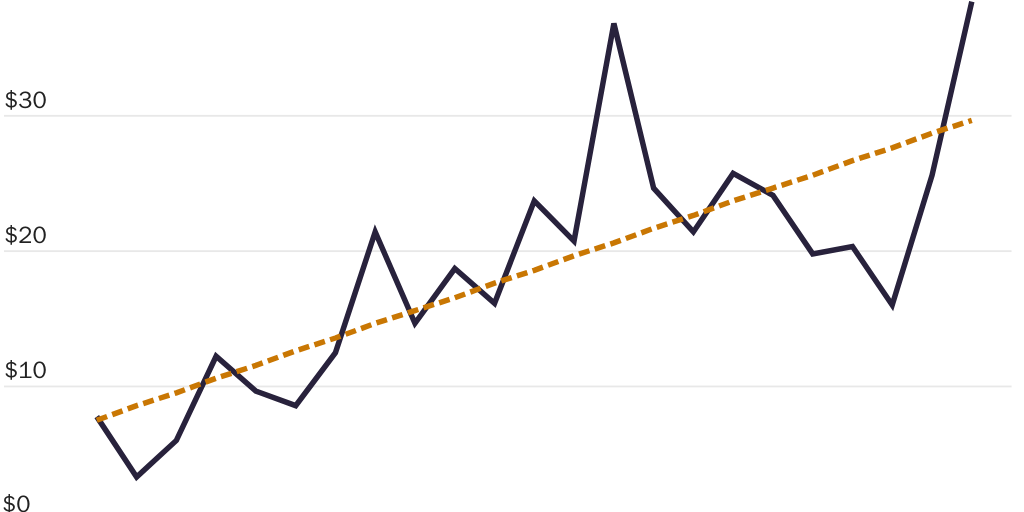
The best source of more recent incentive data is the database maintained by Good Jobs First, a policy resource center that promotes accountability in economic development. While governments’ lack of transparency limits the comprehensiveness of the database, the Good Jobs First analysts supplement their review of government financial filings with searches for media coverage of incentive deals. In addition, a “Subsidy Tracker” includes details of each business incentive deal the organization finds, including the value of the benefit provided. Since subsidies can take the form of loans, which may or may not be paid back, Good Jobs First’s subsidy value does not equate to a state or local government’s budgetary cost. Figure 1 shows the total subsidy value of Subsidy Tracker entries by calendar year, excluding federal subsidies.
There was a sharp increase in incentives during 2021–2022, when state and local governments appeared to have been inspired by industrial policy at the federal level.
After peaking in the aftermath of the Great Recession, when state and local government competition for scarce jobs was heaviest, the aggregate value of incentives fell during the latter years of the 2010s. But there was a sharp increase in incentives during 2021 and 2022, a time when state and local governments were awash in American Rescue Plan funds and appear to have been inspired by industrial policy at the federal level to become more aggressive in courting corporate employers. The next section examines two industries favored by the Biden administration that have seen substantial state and local incentive activity: electric vehicles (EVs) and semiconductors.
## The Recent Increase in State Subsidies for Electric Vehicles and Semiconductors
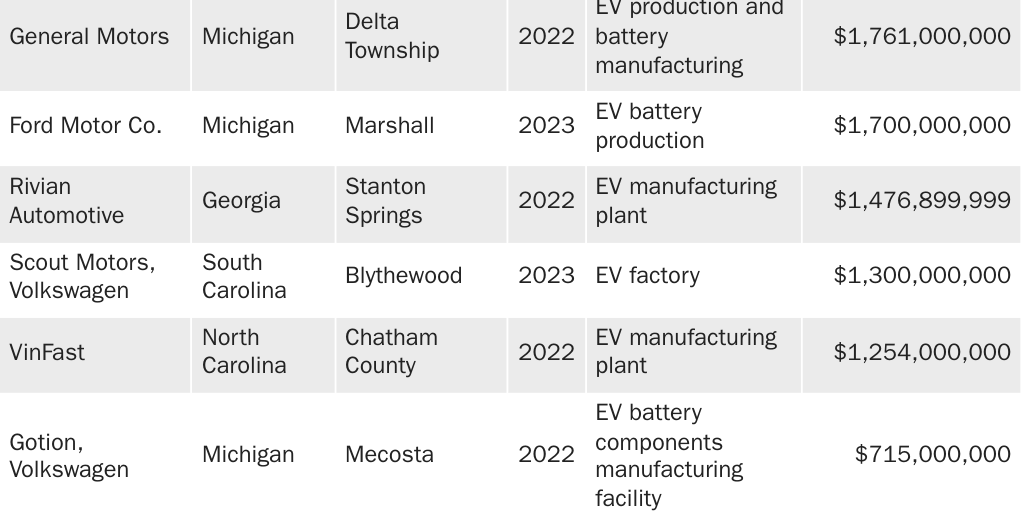
In recent years, states have competed to site plants that produce EVs, EV batteries, or both. Table 1 shows large electric-vehicle-related subsidy deals recorded by Good Jobs First in 2022 and 2023. The aggregate value of these state subsidies exceeded $15 billion.
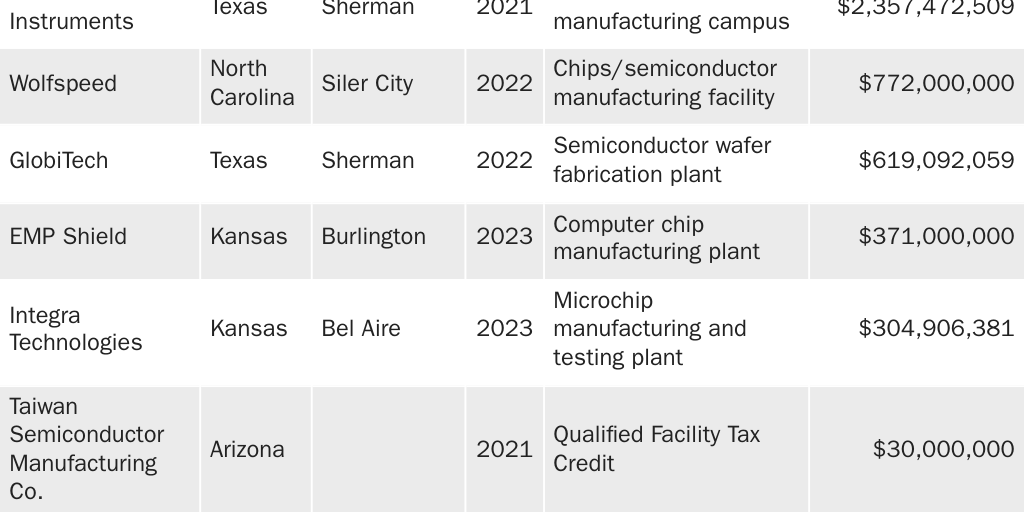
Microprocessor chip manufacturing firms have also benefited from large place-based incentive packages. Table 2 details nearly $11 billion of semiconductor manufacturing incentives offered by states in 2022 and 2023.
The number and size of these deals suggest an alignment of state policy with federal-level industrial policy that emerged during the first half of President Biden’s administration. Both the Infrastructure Investment and Jobs Act of 2021 and the Inflation Reduction Act of 2022 included provisions intended to encourage domestic manufacturing and consumption of electric vehicles.[5](#_ednref5) Since then, government officials at various levels (President Biden, members of Congress, governors, mayors, secretaries of commerce, etc.) have repeatedly held joint public events or issued press releases touting each other’s support for the subsidized projects at issue.[6](#_ednref6) In the case of Vietnamese EV manufacturer VinFast, for instance, the office of North Carolina governor Roy Cooper—at the company’s request—contacted the Biden administration directly about possible federal support.[7](#_ednref7)
##### Related Media
While it is too early to declare the latest EV projects to be either successes or failures, warning signs have already emerged. By 2023, for example, an oversupply of electric vehicles has become apparent, with many consumers concerned about battery range.[8](#_ednref8) These concerns were exacerbated first by a January 2024 cold snap that revealed the limitations of EVs and charging infrastructure during winter weather, and then by Tesla’s April 2024 decision to lay off much of the team working on its charger network and thereby slow its expansion.[9](#_ednref9) Combined with EVs’ continued price premium, repair issues, and possible partisan opposition to a Biden administration priority, US EV sales had cooled substantially by mid-2024.
As a result, widely celebrated domestic EV supply chain investments have been delayed or downsized, even after initial site-clearing and construction work had begun. For example, Ford Motor Company scaled back a Marshall, Michigan, plant that had been granted $1.7 billion in incentives in 2023.[10](#_ednref10) In March 2024, Rivian Automotive, citing a need to conserve capital, indefinitely paused construction on an EV plant in Stanton Springs, Georgia, after being promised $1.467 billion in state and local incentives.[11](#_ednref11) Finally, VinFast first scaled back and then paused construction on a Chatham County, North Carolina, EV plant for which it garnered $1.254 billion in tax breaks in March 2022.[12](#_ednref12) Most recently, VinFast announced that the plant would begin production in 2028—four years later than originally planned.[13](#_ednref13) The risk that EV-related government subsidies will generate malinvestment is now apparent.
Similarly, the federal CHIPS and Science Act of 2022 provided incentives to produce semiconductors domestically, including tens of billions of dollars in direct grants and subsidized loans to large chipmakers, as well as a 25 percent tax credit for capital investments in semiconductor manufacturing.[14](#_ednref14) States and localities have piled on their own incentives totaling billions more, as shown in Table 2. Between 2021 and 2023, state and local semiconductor incentives totaled $13.2 billion.
##### Related Event
It remains to be seen whether these semiconductor incentives—at the federal, state, and local level—will achieve advocates’ stated objectives (i.e., producing large, cutting-edge domestic chip facilities that can prosper in a cutthroat global industry without additional government support and significantly increasing the United States’ share of advanced semiconductor production). But some warning signs have already emerged, with facilities facing significant cost overruns and delays. For example, an Intel chip plant under construction in New Albany, Ohio, is now slated to start production in 2027, two years later than originally expected.[15](#_ednref15) The Taiwan Semiconductor Manufacturing Company’s (TSMC) first Arizona factory, meanwhile, will achieve commercial production in 2025, not 2024 as initially promised.[16](#_ednref16) Samsung’s Taylor, Texas, facility also appears to be facing delays.[17](#_ednref17)
There are also concerns that these US semiconductor facilities will not be at the industry’s bleeding edge, as Scott Lincicome explained in June 2024 testimony before Congress’s Joint Economic Committee:
> TSMC’s first Arizona facility will produce 4‑nanometer chips in relatively small volumes (20,000 wafers per month) when it begins commercial production in mid‐2025, but the company is already producing 3‑nanometer chips in Taiwan in much larger volumes (100,000 wafers/month this year) and intends to begin mass producing 2‑nanometer chips there next year. Samsung will also reportedly begin 4‑nanometer production in Texas in 2025, at which time the company will be moving to 2‑nanometer production in Korea. Both companies have also reported substantial cost overruns at their US facilities— costs that they may pass on to US customers.… The companies’ executives also have repeatedly maintained that they will keep “the most cutting‐ edge chip fabrication technologies in their home countries.” National champion Intel, meanwhile, has suffered setbacks in advanced chip production since at least 2018, and many analysts today question the company’s ability to catch industry leaders like TSMC and Samsung.[18](#_ednref18)
Of course, state and local subsidies have not been limited to environmental goods and semiconductors. Other industries that have benefited from large incentives include steel, oil and gas, real estate, online retailing, consumer electronics, and internet services such as data centers. Amazon, which is involved with both online retail and internet services, benefited from four incentive packages of more than $100 million each in 2022 and 2023.19 Meta and Google also have received multiple state and local incentives, albeit with lower price tags.[19](https://www.cato.org/policy-analysis/reforming-state-local-economic-development-subsidies#_ednref19)
Research shows that very few business incentives are directly responsible for causing the investment at issue.
The largest of the recent Amazon deals, estimated at $1 billion over 15 years, was provided by governments in Morrow County, Oregon, a sparsely populated area well to the east of Portland. The package of tax breaks was intended to induce Amazon to build five additional data centers in the county. Three commissioners who approved the incentives own a fiber-optics company that provides services to Amazon and stood to increase its revenue if Amazon expanded its footprint within the county.[20](https://www.cato.org/policy-analysis/reforming-state-local-economic-development-subsidies#_ednref20)
## The Purported Benefits of Business Incentives
Advocates of corporate incentives routinely allege that the measures generate significant benefits for state and local governments and their communities, but these claims are questionable.
In fact, state and local subsidies often pay companies for investments they would have made regardless of whether a business incentive was offered. Notably, research shows that very few business incentives are directly responsible for causing the investment at issue. In fact, a literature review from 2018 by the W. E. Upjohn Institute for Employment Research found that subsidies and incentives decisively affected only 2 to 25 percent of all investment decisions, implying that at least three of four incentives did not play a crucial role in attracting an investment.[21](#_ednref21) Similarly, a 2015 survey of North Carolina executives found that the availability of state and local business incentives ranked below more than a dozen other factors in their assessment of the state’s business environment.[22](#_ednref22)
Governments providing these subsidies are quick to credit them with inducing the corporate investments at issue, but, as the aforementioned research shows, such causation is rare. In fact, company statements or actions often show that the incentives did not affect their siting decisions. For example, Cargill applied for a tax incentive from the State of Texas four months after it announced plans to build an animal feed plant within the state. The CEO of another Texas incentive recipient, Freeport ISG’s Michael Smith, said that the $375 million in tax credits his company received “were not a factor in the site decision.”[23](#_ednref23) Other news reports cite additional cases.[24](#_ednref24) However, given their vested interests and confidentiality concerns, companies are unlikely to disclose that an incentive did not drive their decision, so there are likely many more unreported cases like these.
Governments providing these subsidies are quick to credit them with inducing corporate investments. However, company actions regularly show that the incentives did not affect their siting decisions.
Advocates of business incentives also claim that the measures—rather than merely reallocating investments and resources from one location to another or funds from taxpayers to businesses—generate “spillover” or “multiplier” effects for local communities, generating economic benefits that far exceed budgetary outlays. However, skepticism here is also warranted, as oft-asserted multipliers and spillovers are rarely confirmed by rigorous economic analysis.
For example, David Neumark and colleagues recently reviewed the effects of the California Competes Tax Credit (CCTC) for businesses seeking to locate or expand in California. The authors estimated that for each CCTC-incentivized job created, almost two additional jobs were added in the employer’s census tract and that overall benefits totaled $5.66 per dollar credited. They also found “little evidence that the program creates significant reallocation of employment or payroll across establishments within firms nationwide.”[25](#_ednref25) However, the largest and fourth-largest beneficiaries of the CCTC were Lockheed Martin and Northrop Grumman, respectively[26](#_ednref26)—two US defense contractors that, regardless of the availability of tax credits, would have expanded US employment and capital expenditures in response to federal requisitions.
In 2020, Cailin Slattery and Owen Zidar reviewed a $558 million tax incentive package that the State of Tennessee offered to Volkswagen to site a new plant in Chattanooga. They compared subsequent auto industry employment changes in Chattanooga with those in Huntsville, Alabama, a city that was also competing for the VW plant. The employment gap between the two markets narrowed in the first four years after the VW incentive deal was approved in 2008, but then began moving roughly in tandem. During those four years, Chattanooga gained an additional 2,750 auto jobs, well below the 14,000 jobs promised by Tennessee’s commissioner for economic and community development. Based on this case and other data Slattery and Zidar reviewed, the researchers concluded that the evidence for spillover benefits of place-based economic incentives was limited.[27](#_ednref27)
## Quantitative Analysis of Development Incentives’ Purported Benefits
Our analysis of state subsidy data and state gross domestic product (GDP) does not support the often-made assertion that spending more money on incentives leads to better economic performance. For this analysis, we look at aggregate subsidy spending from the end of the Great Recession, 2010, through 2022. Figure 2 shows the relationship between subsidies offered during that period as a percentage of 2022 GDP and GDP per capita. All values are shown in 2023 dollars.
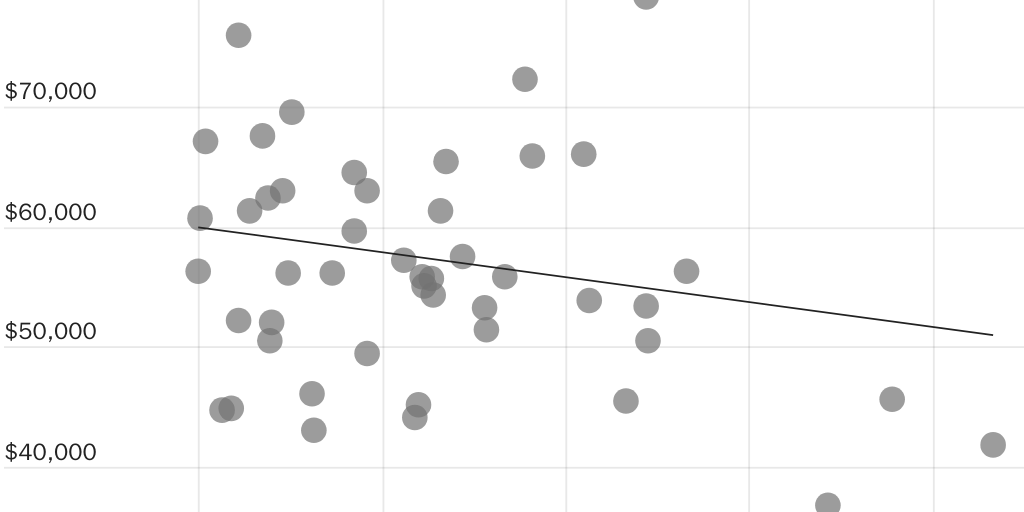
As shown in Figure 2, there is a slight negative correlation of ‑0.2 between GDP per capita and the amount of subsidies offered. In other words, states offering a higher level of subsidies tend to be somewhat less affluent than those offering less generous subsidies. Oklahoma, for example, has offered subsidies worth 3.8 percent of its 2022 GDP while having a GDP per capita of $45,616. In comparison, New Hampshire has a GDP per capita of $60,745 while offering subsidies worth less than 0.1 percent of GDP.[28](#_ednref28)
The data also do not support the notion that a greater level of subsidies helps states catch up to their wealthier peers. Figure 3 shows total subsidies offered from 2010 to 2022 as a percentage of 2022 GDP plotted against the compound annual growth rate of each state’s GDP from 2010 to 2022. The correlation coefficient for each variable is ‑0.15, meaning that more subsidies coincide with slightly slower growth. West Virginia, for example, has offered subsidies worth 4.32 percent of its GDP, yet had a compound GDP growth rate of just 0.46 percent.
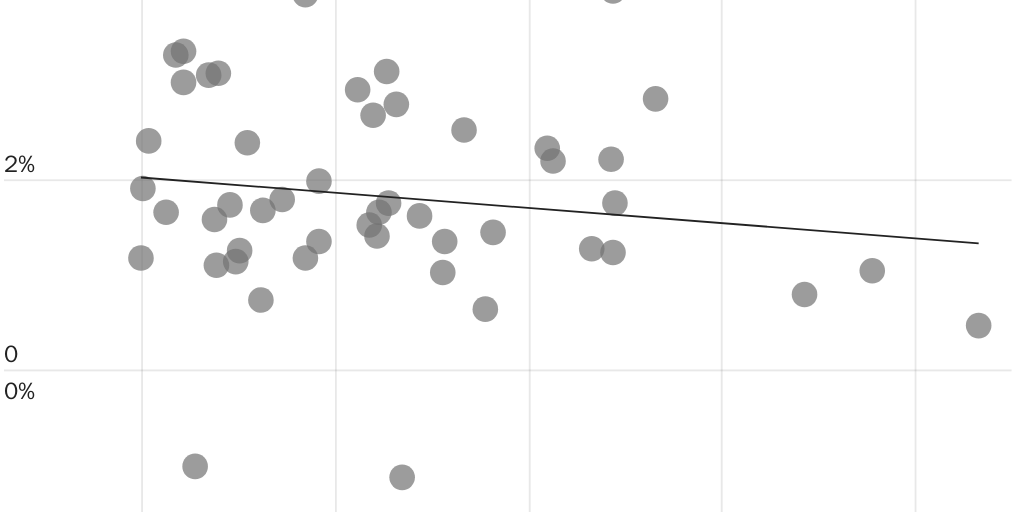
Although these correlations do not and cannot prove causation, they should nonetheless give subsidy advocates pause. If corporate incentives were as economically effective as politicians claim them to be—generating substantial positive economic and social spillovers for a state economy—we should expect a positive correlation between subsidies offered, wealth, and economic growth. Instead, we see the opposite.
## The Economic Costs of State and Local Business Incentives
While the apparent benefits of corporate subsidies are seen and tangible, often taking the form of a new office building or manufacturing plant, the economic costs are less obvious. Nevertheless, these costs are significant and widespread:
- **Fiscal costs.** Business incentives usually require taxpayer dollars, and thus entail both direct budgetary costs and indirect opportunity costs. Given that budgets are finite and especially limited at the state and local level, spending on corporate incentives will necessarily mean either less revenue available for policies benefiting the general public, such as tax cuts or infrastructure spending, or higher taxes to pay for the subsidies. Beyond simple concerns of fairness and good government, this can mean lower economic growth and with it lower tax revenue in the future.
- **Competitor costs.** Subsidies disadvantage local businesses that compete with subsidized firms for customers and resources. The firms might also face higher costs as the beneficiary firm acquires scarce local labor, materials, and other resources at taxpayers’ expense.[29](#_ednref29) And because tax incentives are disproportionately awarded to larger, more profitable firms, these unseen effects on unsubsidized firms may be especially damaging for newer or smaller competitors.[30](#_ednref30)
- **Deadweight costs.** Subsidies cause companies to redirect resources from efficient and socially productive activities toward promoting less productive ventures or seeking economic rents arising from place-based subsidies. For example, New Jersey state and local governments have provided over $1 billion in incentives since 2017 to support the development of American Dream, a megamall in Secaucus.[31](#_ednref31) Since its opening, the mall has been losing money and has not generated sufficient cash flow to fully cover interest on municipal bonds issued to finance construction.[32](#_ednref32) At a time when shopping malls’ popularity is declining, the state took a major gamble on a business that is not panning out.
Incentives also draw more money into the political system—and thus away from productive private enterprises. A 2022 study by economists Russell Sobel, Gary Wagner, and Peter Calcagno found that once a state has begun offering corporate incentive megadeals, annual contributions to candidates for state offices increase by $1 million.[33](#_ednref33)
Finally, companies divert resources from their core business operations and toward site selection consultants. Although location consulting would likely exist in the absence of corporate incentives, today’s environment of cross-jurisdictional competition gives consulting firms the opportunity to provide additional services and greatly increase billing. One such firm, Global Location Strategies, tells company executives that it can “identify qualified incentive programs for your project … effectively negotiate financial and non-financial incentives that maximize your return on investment … \[and\] partner with you to set up procedures to ensure that you receive all the benefits you were promised.”[34](#_ednref34) Money devoted to these rent-seeking activities is money that cannot be devoted to capital expenditures, workers, or R&D, or returned to shareholders.
- **Costly failures.** Incentives often do not achieve their desired outcomes or even go to companies that later fail entirely. In 2010, the State of Delaware provided Fisker Automotive with $21.5 million in incentives to take over a shuttered General Motors plant on Boxwood Road in Wilmington, creating at least 2,495 jobs in the process.[35](#_ednref35) But Fisker Automotive went bankrupt before taking over the plant, which never reopened (Fisker’s founder started a second EV maker, which also filed for bankruptcy in June 2024).[36](#_ednref36) Eventually, the plant was demolished and replaced with an Amazon fulfillment center with the help of an additional $4.5 million in state incentives.[37](#_ednref37) In 2017, the State of Wisconsin offered Foxconn Technology Group $3 billion in incentives to build an LCD-screen manufacturing facility employing 13,000 residents, but, after a high-profile groundbreaking with then president Donald Trump and then governor Scott Walker, the plant was never built.[38](#_ednref38) Since 2015, New York State spent almost $1 billion on a Tesla solar panel facility in Buffalo that was expected to produce enough solar panels to cover the roofs of 1,000 homes, but by 2023, the facility was making only about 2 percent of that projected volume.[39](#_ednref39) Numerous other subsidy failures dot the American landscape.
- **Eminent domain abuse.** Business incentives are also often linked to the misuse of eminent domain authority. An especially notorious case occurred in New London, Connecticut, in 2001, when the state lured Pfizer to the struggling city with property tax abatements and other inducements. New London tried to remove homes near the new Pfizer facility through eminent domain. Homeowners sued to protect their homes, taking their case all the way to the Supreme Court, which ruled against the homeowners in 2005 in *Kelo v. City of New London*. Ultimately, Pfizer decided to leave New London altogether, and the neighborhood that had been cleared of residences was never redeveloped. A national backlash against the use of eminent domain for private purposes in the wake of the *Kelo* decision caused 43 states to adopt legislation curbing the practice.[40](#_ednref40)
One state that did not reform eminent domain, North Carolina, invoked it in 2022 to clear land for the VinFast EV plant. The state’s plan was to provide free infrastructure to the factory by removing 27 homes, five small businesses, and a church built in 1888—despite several current landowners’ opposition. As discussed in the “Recent Increase in State Subsidies for EVs and Semiconductors” section, plans to build the facility and complete the eminent domain process have recently stalled, perhaps due to weak EV demand.[41](#_ednref41)
Beyond these notable examples, incentive programs routinely suffer from other unseen costs associated with national industrial policy, such as moral hazard, adverse selection, and policy uncertainty—phenomena that can not only strain budgets but also breed failures and discourage private investment, even in industries that subsidizing governments are trying to support.[42](#_ednref42)
## Incentives’ Lack of Transparency
As discussed in the section on incentives’ costs, measuring the budgetary impact of corporate subsidies is complicated by a lack of transparency. There is no single comprehensive source that covers all spending and forgone tax revenue related to corporate incentives.
Efforts to improve transparency in this area have traditionally focused on tax expenditures and tax abatements; loans and outright subsidies have received less attention. Therefore, it is useful to define these terms before exploring the available resources.
A tax expenditure is any reduction in government revenue attributable to a special provision of the tax code.[43](#_ednref43) This broad category includes such “as-of-right” exclusions as the mortgage interest deduction. This type of provision can be used by a wide array of taxpayers and normally lies outside the definition of a corporate tax incentive.[44](#_ednref44)
##### Related Media
The Governmental Accounting Standards Board’s (GASB) Statement 77 requires transparency for a narrower category, tax abatements, which are revenue losses “resulting from an agreement between a government and an individual or entity in which the government promises to forgo tax revenues and the individual or entity promises to subsequently take a specific action that contributes to economic development or otherwise benefits the government or its citizens.”[45](#_ednref45)
GASB 77, which took effect in 2017, has increased tax incentive transparency, but the statement and its implementation have several limitations. First, it does not require governments to report a lifetime revenue loss from any given abatement, but only the amount lost in the fiscal year covered by the relevant financial statement. Second, local governments in several states are not required to implement GASB reporting standards and generally do not do so.
While the apparent benefits of corporate subsidies are seen and tangible, their costs are less obvious. Nevertheless, they are significant and widespread.
Finally, even among GASB-compliant entities, tax abatement reporting has not been consistent since Statement 77 went into effect. Analysis by Good Jobs First finds uneven local government tax abatement reporting across states, with many failing to report “passive” revenue losses, which occur when a tax abatement implemented by one jurisdiction affects overlapping entities (e.g., counties, municipalities, school districts, and special districts that all tax a given area).[46](#_ednref46)
Another promising data source is tax incentive reports published by most states and some local governments. A Volcker Alliance analysis found that 42 states issued such reports for the 2019 fiscal year.[47](#_ednref47) The Institute on Taxation and Economic Policy provides a set of links to more recent tax expenditure reports produced by most states.[48](#_ednref48)
However, tax expenditure reports vary widely across states and suffer from important limitations. Consider Ohio, which was cited by the Volcker Alliance for having an especially high level of detail in its reporting. Despite this level of transparency and detail, gathering data on tax incentives for Ohio presents challenges.
Ohio’s latest tax expenditure report shows revenue losses for fiscal years 2022–2025 across 154 state tax measures. In FY 2023, aggregate revenue losses totaled $10.5 billion, with most of the tax expenditures stemming from as-of-right provisions such as a blanket sales tax exemption for tangible property intended for use in manufacturing.[49](#_ednref49)
The Ohio report includes several true corporate tax incentives, such as job creation and job retention tax credits. The report does not show which companies benefited from these credits, but lists of beneficiaries can be found in the Appendix to the Ohio Department of Development’s annual report.[50](#_ednref50) Unfortunately, these lists do not show the amount credited to each participating employer. Finally, the revenue losses shown in the state’s tax expenditure report do not reconcile with totals shown in the tax abatements note to the state’s 2023 Annual Comprehensive Financial Report (ACFR).[51](#_ednref51)
Delaware’s tax incentive reporting is less developed than Ohio’s and thus presents further challenges. The state’s most recent “Tax Preference” report covers 54 tax expenditures over two fiscal years, but for *about half* of these, the total revenue loss is shown as $0, Negligible, Unknown, N/A, or not disclosable due to taxpayer privacy laws.[52](#_ednref52) Delaware’s latest ACFR shows only two tax abatements totaling $8 million, and reported amounts do not correspond to those shown in the Tax Preference report.[53](#_ednref53) Other state reports present similar transparency problems.
Finally, GASB 77 and tax expenditure reports exclude important categories of incentives, such as grants, loans, and subsidized infrastructure.
## So Why Do Incentives Persist?
Despite the well-documented, widely shared concerns associated with corporate incentives, their use has persisted and even increased in the early 2020s. One reason is political: Voters tend to support incentives, and elected officials in different jurisdictions compete to win votes by attracting businesses. A second factor is that courts have been deferential to what elected officials define as “public purpose.” This allows legislators to circumvent anti-aid or gift clauses in state constitutions.
### Political Attractiveness and the Incentives Arms Race
Most politicians and voters support incentives—especially when an opportunity becomes available to bring a large company into a community. For example, when Amazon staged a competition among state and local governments for the location of its second headquarters, an MSN poll found that 68 percent of Republicans and 55 percent of Democrats would “back government incentives to lure a big company.”[54](#_ednref54) In a 2014 paper, political scientist Nathan Jensen and colleagues polled 1,974 respondents on what would happen if their governor supported corporate incentives. They found that voters would be 2.4 percent more likely to vote for a governor who supported incentives.[55](#_ednref55) Interestingly, they note, the “vote bonus for offering greater incentives than competitors do is actually higher for a governor whose state loses the project (about 5.2 percent from all respondents and 10.7 percent from political independents).”[56](#_ednref56) However, “politicians are rewarded more strongly if they offer incentives in a losing effort, leading to a dominant strategy \[of offering incentives\] under certain economic conditions.”[57](#_ednref57) So, it seems that when corporate incentives are offered and investments are won, voters reward the incumbent governor more modestly.
The corporate incentives game creates a subsidies arms race among states and localities—one that is difficult to stop without an agreement among policymakers.
Voters’ preference for seen over unseen economic activity—and for politicians trying to subsidize the seen—is hardly surprising. As French economist Frédéric Bastiat explained almost two centuries ago in his essay “That Which Is Seen and That Which Is Not Seen,” we commonly recognize the visible benefits of government actions while ignoring their invisible costs. Thus, for incentives, it is natural for voters to reward elected officials for providing or attempting to provide incentives that generate clear and tangible outputs—factories, jobs, investments—while ignoring those same projects’ many hidden costs, especially opportunity costs.[58](#_ednref58)
The behavior of elected officials with respect to corporate incentives is also a classic “collective action” problem when states and localities compete for scarce corporate resources—the factories, jobs, and investments involved. Economists frequently explain the issue in terms of the prisoner’s dilemma, a concept from game theory in which two guilty prisoners being interrogated by the police would go free if they stay silent, but, because neither can be sure that the other will do so, both end up confessing to minimize their jail time.[59](#_ednref59)
Many economists and political scientists have applied this framework to corporate relocation incentives and two hypothetical legislators, A and B, from different states. The optimal outcome for both would be to withhold these subsidies. But because each legislator has no way of ensuring that the other will abstain, and because one’s support of subsidies will make the abstaining politician lose votes or political support, they *both* offer subsidies.[60](#_ednref60) This “game” is described in Figure 4.
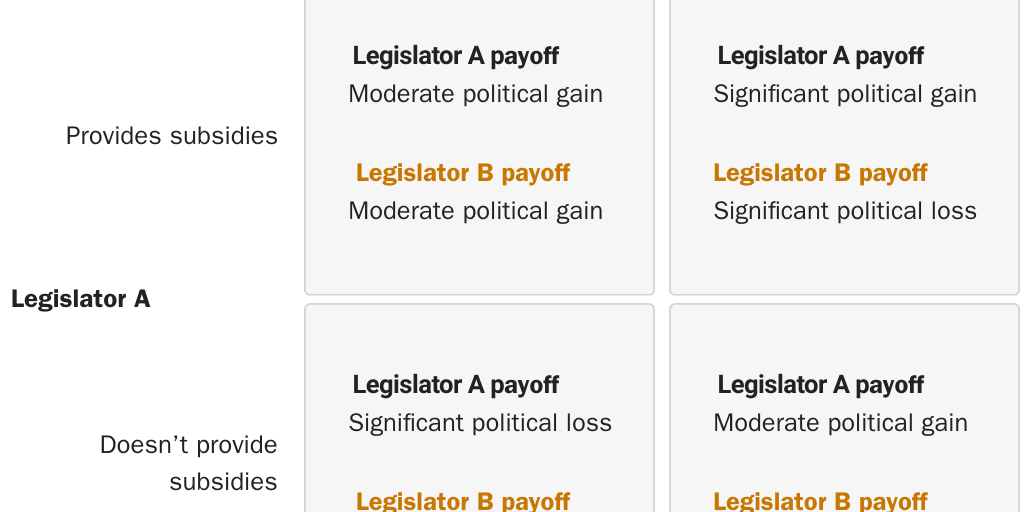
The corporate incentives game creates a subsidies arms race among states and localities—one that is difficult, if not impossible, to stop without an agreement among policymakers to abstain from subsidies altogether.
### The Public Purpose Doctrine and Corporate Incentives
Courts also regularly uphold the constitutionality of state corporate incentives through their interpretation of what’s known as the public purpose doctrine. And they do so despite the prevalence of constitutional anti-aid provisions in many states that are intended to prevent state funds from being used for private gain.
The public purpose doctrine states that public funds can be used only for public purposes. However, the term “public purpose” has been vaguely defined as anything that benefits the general public. Courts regularly defer to state legislatures in determining what public purpose means.
For example, Pennsylvania’s legislature in 1967 passed P.L. 251–102, now known as the Economic Development Financing Law, which provides subsidies to manufacturing plants in the state. The law declares that “the present and prospective … general welfare of the people of this Commonwealth require as a public purpose the promotion and development of new … economic activities.”[61](#_ednref61) The legislation contains six other references to the term “public purpose.”[62](#_ednref62) In 1968, the Pennsylvania Supreme Court dismissed a lawsuit that claimed P.L. 251–102 violated the state’s anti-aid provisions. In reaching this decision, the court opined that the legislature “is more responsive to the people and has more adequate facilities for gathering and assembling the requisite data,” and therefore “is in a better position to evaluate and determine public purpose.”[63](#_ednref63) And since the legislature had determined that P.L. 251–102 served public purposes, then “the Agreements entered into by the Authorities pursuant to the Act are for a public purpose.”[64](#_ednref64)
Judicial deference to legislative conceptions of public purpose is not unique to Pennsylvania. In fact, by 1996, 46 states had upheld the constitutionality of economic development incentives.[65](#_ednref65) It is this judicial deference that allows elected officials to offer corporate incentives, enabling them to compete with other states in the subsidies arms race. (The Appendix details the history of how the public purpose doctrine evolved and led to the erosion of state anti-aid provisions.)
## Policy Recommendations
Ideally, state and local governments should eliminate all corporate tax incentives and subsidies, given their economic, political, and ethical drawbacks. Government is least disruptive to economic activity when it limits spending to essential state activities, avoids intervening in private, commercial markets, and finances its operations through low, broad-based, easily understood taxes. Corporate incentives violate these principles while enriching a select few—typically large and wealthy corporations—at taxpayers’ and other businesses’ expense. They should be avoided entirely, or at least dramatically scaled back.
However, since the political temptation to continue these economic interventions is so strong, their immediate abolition seems unlikely. For the time being, therefore, policymakers could make incremental progress in reforming state incentives by entering into compacts with other jurisdictions and seeking transparency reforms.
### State Compacts
Compacts among states and localities to abstain from offering incentives would address arguably the largest political motivation and most common political justification for costly subsidy packages, the prisoner’s dilemma. By assuring local lawmakers that their cross-border rivals will not offer subsidies to entice companies to move to or remain in their own jurisdictions, interstate compacts can short-circuit the bidding-war problem that pervades incentives policy across the United States as well as politicians’ justifications for providing such subsidies.
As will be discussed next, subsidies compacts are rare in the US interstate context but common in international trade law. Most notably, World Trade Organization (WTO) agreements contain multiple subsidy discipline measures agreed on by all 164 member governments, including the United States and all other large, industrialized economies, and incorporated into their domestic laws. These disciplines (1) define subsidies and limit (or even prohibit) those that are most economically harmful and trade-distorting; (2) require member governments to annually report on their use of subsidies; (3) provide a venue for governments to discuss subsidies and negotiate new rules for their use; and (4) allow governments to challenge others’ use of subsidies through national anti-subsidy actions (called countervailing duty measures in the United States) or government-to-government litigation (dispute settlement) at the WTO. These rules are not perfect, but WTO member governments—including the United States, the European Union, and China—use them frequently, with some significant and notable successes in increasing disclosure of nations’ agricultural and industrial subsidies and reducing their use.[66](#_ednref66) As such, the WTO’s *international* agreements limiting government subsidies could serve as a guide for *interstate* agreements (compacts) seeking to achieve the same general objectives in the United States.
According to the National Center for Interstate Compacts (NCIC) at the think tank Council of State Governments, an interstate compact has been defined as a “contract between two or more states” that “carries the force of statutory law and allows states to perform a certain action, observe a certain standard, or cooperate in a critical policy area.”[67](#_ednref67) The Compact clause of the US Constitution (Article I, Section 10, clause 3) prohibits states from entering into compacts without congressional approval. However, the Supreme Court has adopted a functional interpretation, ruling in *Virginia v. Tennessee* (1893) that congressional consent is required only when the compact enhances the power of states at the expense of the federal government.[68](#_ednref68)
The NCIC lists 192 compacts covering a wide range of issues.[69](#_ednref69) Widely adopted compacts include the Interstate Commission for Adult Offender Supervision, the Interstate Compact on the Placement of Children, and the Driver License Compact.[70](#_ednref70)
An interstate compact (or series of regional compacts) prohibiting or strictly limiting corporate incentives is a reasonable way to stem interstate competition for corporate facilities.
Given the long experience with compacts and their acceptability at the federal level, an interstate compact (or series of regional compacts) prohibiting or strictly limiting corporate incentives is a reasonable way to stem interstate competition for corporate facilities.
There is some precedent for such a compact. Because the Kansas City metropolitan area is split between the states of Missouri and Kansas, companies sought to obtain job creation incentives by making a small move across the state line and retaining largely the same workforce. An incentive “border war” ensued, and in 2019 the two states took action to ease the conflict. First, the Missouri legislature passed SB 182, which prohibited the issuance of new tax credits or subsidies to companies relocating from Kansas border counties to Missouri border counties.[71](#_ednref71) The legislation was to become effective once Kansas took reciprocal action. Kansas governor Laura Kelly then issued Executive Order 19–09, which contained provisions similar to the Missouri legislation.[72](#_ednref72)
As of early 2024, the interstate truce was still holding but with some setbacks. Tax incentive deals that were pending at the time of the truce were allowed to move forward.[73](#_ednref73) The Kansas legislature failed to pass legislation to incorporate Governor Kelly’s executive order into the state’s statutes.[74](#_ednref74) Finally, the truce does not prevent interstate competition over Kansas City’s professional baseball and football teams (the Royals and Chiefs, respectively). In 2022, Kansas City, Missouri, mayor Quinton Lucas tweeted that the city’s loss of the Chiefs to Kansas would “scuttle the entire truce.”[75](#_ednref75) But in June 2024, the Kansas legislature passed a plan to attract the teams by potentially issuing billions of dollars of stadium bonds.[76](#_ednref76)
The Coalition to Phase Out Corporate Tax Giveaways, a bipartisan group of state legislators, made a more ambitious effort to stop corporate incentives through an interstate compact. Between 2019 and 2021, members in 15 states introduced legislation to prevent their respective states from offering “taxpayer dollars to induce a facility in another state that has joined the agreement to move to the offering state.”[77](#_ednref77) As of this writing, however, it does not appear that any state has enacted this compact, and the coalition is no longer active.
Over time, state and local governments should adopt consistent standards for incentive reporting. Such standards could be created and maintained by a recognized standards body.
Nevertheless, policymakers looking to stem incentives should review the compact proposed by the Coalition to Phase Out Corporate Tax Giveaways. Arizona’s 2021 version of the proposed compact included provisions to create a National Board for Best Practices in Economic Development. The proposal would also have banned attempts to entice relocations from one member state to another, as well as improved data reporting and transparency for offered corporate subsidies.[78](#_ednref78) Since proposed compacts of this type appear to have lost momentum, it may be politically necessary to scale them back to a more modest objective, such as limits on the size and type of incentives that participating states may offer.
Finally, it is worth emphasizing that any such compact should be limited to company-specific incentives. States should not cede their ability to enact horizontal economic reforms that affect all companies equally—for example, reducing or eliminating corporate taxes—or to take other measures that broadly improve their jurisdiction’s overall business climate.
### Improved Transparency
A better understanding of the budgetary and other costs associated with corporate incentives might help shift the debate on corporate incentive issues. GASB 77 and state tax expenditure reports provide a starting point for incentive transparency, but substantial improvements are needed.
Good Jobs First has developed model legislation that state policymakers could use as a starting point for enacting their own transparency reforms. One of their model bills calls for a unified economic development budget that would require state agencies to provide lists (in electronic spreadsheet form) of all tax expenditures, with dollar amounts by company, program, and agency. This model could be usefully extended by requiring the inclusion of incentives other than tax expenditures such as subsidies, loans, and contributed infrastructure.[79](#_ednref79) The WTO’s Agreement on Subsidies and Countervailing Measures contains a broad definition of a subsidy, which could be incorporated into legislative text.[80](#_ednref80) Another extension to the legislative model would be to include not only the annual cost of the incentive but also the accumulated cost to date, as well as projected future costs of the corporate benefit.
Another useful model from Good Jobs First is its Taxpayer Right to Know on Jobs Act. This legislative proposal requires subsidized companies to report the number of jobs they agreed to create as a result of the incentive versus the number they actually created, as well as any related reductions in employment elsewhere.[81](#_ednref81)
Over time, state and local governments should adopt consistent standards for incentive reporting. Such standards could be created and maintained by a recognized standards body or an ad hoc group of academics, policy analysts, and practitioners.
### Other Reforms
Short of a compact to fully end the subsidy race, states should consider unilateral actions to rein in some of the worst practices. One option currently being considered in Michigan is to require legislative approval of incentive deals negotiated by the executive branch.[82](#_ednref82) While far from perfect, such a reform would at least encourage transparency, discourage abuse, and possibly check the costliest corporate incentives.
The best approach to local economic policy is to eschew special deals and provide a better environment for all companies by lowering taxes, reducing regulations, and accelerating permitting processes.
Of course, the best approach to state and local economic policy is to eschew special deals to individual companies and instead provide a better environment for all companies in the jurisdiction by lowering and simplifying business taxes, reducing regulations, and accelerating permitting processes. State-level rankings provide reference points and models for pursuing such reforms. For example, the Tax Foundation publishes an annual study that ranks the states’ business tax policies.[83](#_ednref83) Although states that do not have income or sales taxes dominate the top positions, the study also gives high scores to Indiana and Utah—two states that levy all major categories of tax but do so at relatively low rates and with relatively broad bases.
QuantGov, a project of the Mercatus Center at George Mason University, counts the number of regulatory restrictions imposed by most of the 50 states. In its latest ranking, QuantGov found that Idaho, South Dakota, and Alaska had the fewest regulations.
## Conclusion
Politicians have powerful motivations to offer corporate incentives, and in many states, they face few impediments to doing so. This is unfortunate, as these incentives often fail to deliver promised jobs and economic growth while imposing heavy budgetary and nonbudgetary costs. During the Biden administration, the state- and local-level incentives race has coincided with large federal subsidies to usher in a new era of US industrial policy. One government-favored industry, electric vehicles, is already experiencing lower-than-expected demand, leaving some of the federal, state, and local investments in EV and battery production at risk.
To break the prisoner’s dilemma driving the proliferation of incentives, lawmakers should enter into compacts with other governments, starting a process of multilateral incentive disarmament. The Coalition to Phase Out Corporate Tax Giveaways has offered a model for such a compact.
In the meantime, governments should provide taxpayers and other stakeholders with more information than elected officials have provided to date about the costs of corporate incentives. That could be accomplished through greater transparency, possibly in line with model legislation offered by Good Jobs First.
The best approach to state and local business subsidies is simply not to offer them. Until this worthy outcome is achieved, however, incremental reforms could at least limit incentives’ worst abuses and reduce their economic harms.
## Appendix
State legislatures enacted anti-aid provisions to attempt to restrain state borrowing after the economic turmoil of the early 19th century. In 1825, the Erie Canal was completed in upstate New York with funds raised through bonds issued by the state government.[84](#_ednref84) Other states, inspired by the canal’s success, issued bonds of their own. However, as Mercatus Center scholar Matthew Mitchell and colleagues note in a 2020 paper, “The unsustainable nature of these public investments in private ventures was laid bare by the panic of 1837 and the significant recession that lasted from 1839 to 1843.”[85](#_ednref85) This panic resulted in eight states and one territory defaulting on their bond payments.[86](#_ednref86)
Anti-aid provisions were also enacted as an attempt to restore the creditworthiness of state bonds. New York’s finances, for example, had been badly hit by the Panic of 1837. By 1842, New York’s credit was close to defaulting on its debt.[87](#_ednref87) To avoid default, New York’s legislature approved new taxes to maintain the state’s creditworthiness. Unsurprisingly, these new taxes were unpopular, so New York legislators proposed amending the state constitution to limit the amount of debt the state could incur. These amendments failed to pass in 1845, and thus a constitutional convention was called in the same year, leading to the addition of articles that limited the amount of debt the state could incur and banned the issuance of new debt for single projects.[88](#_ednref88)
##### Related Podcast
[
Download Episode
](https://assets.pippa.io/shows/5e28e0d8963f166217546493/d7511af8-289f-46c1-b570-b504a42baf4d.mp3)Subscribe:
[
Apple Podcasts
](http://itunes.apple.com/podcast/cato-daily-podcast/id158961219) [
Spotify
](https://open.spotify.com/show/4dHRhKEljj8zcLdl3Gvsv7)
These provisions were not specific to New York. In fact, by 1857, all states had constitutional debt restrictions.[89](#_ednref89) A second wave of anti-aid provisions followed during the 1870s, as state legislatures attempted to rein in municipal and local borrowing.[90](#_ednref90)
Initial state-level enforcement of these anti-aid provisions was generally strict. For example, in 1879, the Colorado Supreme Court ruled that the City of Boulder’s ownership of railway shares was impermissible under the state’s new anti-aid provisions. The opinion stated that Colorado’s constitution prohibited “all public aid to railroad companies, whether by donation, grant or subscription, no matter what might be the public benefit and advantages flowing from the construction of such road.”[91](#_ednref91)
However, the authority and extent of anti-aid provisions was significantly undermined by the rise of public purpose jurisprudence in the late 19th and early 20th centuries.[92](#_ednref92) This doctrine was first clearly enunciated in the 1853 Pennsylvania Supreme Court case *Sharpless v. Mayor*, which held that “railroads are not private affairs. They are public improvements, and it is the right and duty of the state to advance the commerce and promote the welfare of the people.”[93](#_ednref93) As such, the Pennsylvania Supreme Court allowed the City of Philadelphia to circumvent the state’s anti-aid provisions and own shares in a railroad company.
The public purpose doctrine was applied at the national level in the US Supreme Court’s 1874 decision *Loan Association v. Topeka*, which struck down legislation that allowed Kansas’s county and city governments to issue bonds to fund private construction of infrastructure. In reaching this conclusion, the Court clearly endorsed the public purpose doctrine, stating, “We have established, we think, beyond cavil that there can be no lawful tax which is not laid for a public purpose.”[94](#_ednref94)
Matthew Mitchell notes that “from the beginning, courts have shown an extraordinary tendency to construe ‘public purpose’ in as broad a light as possible.”[95](#_ednref95) In *Sharpless*, for example, the term “public purpose” was interpreted liberally to include any welfare gains from any publicly funded private project. By the early 20th century, the US Supreme Court also adopted a similarly liberal interpretation of the term. In the 1918 case *State of Georgia v. Trustees of Cincinnati Southern*, the Court held that Georgia’s 1879 perpetual grant of land to the railway company Cincinnati Southern was “\[a\] conveyance in aid of a public purpose from which great benefits are expected.” Because of this, Georgia’s grant of land was “not within the class of evils that \[Georgia’s\] Constitution intended to prevent.” Georgia’s perpetual land grant thus could not be revoked by invoking the state’s anti-aid provisions.[96](#_ednref96)
The Mississippi Supreme Court, in upholding that state’s 1936 Balance Agriculture with Industrial (BAWI) program, marked a major development in public purpose jurisprudence. The BAWI program, often considered the start of the modern targeted-subsidies era, “attempted to minimize the effects of the Great Depression by coupling low taxes, cheap land, and low wages with tax abatements and other subsidies and incentives to entice northern industries to expand or relocate in the South.”[97](#_ednref97) BAWI seemed to violate the due process and anti-aid provisions of Mississippi’s Constitution.[98](#_ednref98) Nevertheless, in its 1938 decision *Albritton v. City of Winona*, the Mississippi Supreme Court upheld the constitutionality of the BAWI program, concluding that “the courts are without the right to substitute their judgment for that of the Legislature.”[99](#_ednref99) After the *Albritton* decision, state courts were more likely to defer to legislative bodies in defining the limits of public purpose.
## Citation
Lincicome, Scott, Marc Joffe, and Krit Chanwong. “[Reforming State and Local Economic Development Subsidies](https://www.cato.org/policy-analysis/reforming-state-local-economic-development-subsidies),” Policy Analysis no. 980, Cato Institute, Washington, DC, September 19, 2024.
[](https://www.cato.org/sites/cato.org/files/2024-08/Policy-Analysis-980.pdf)
### Download This Policy Analysis
##### Reforming State and Local Economic Development Subsidies
[
Download PDF
](https://www.cato.org/sites/cato.org/files/2024-08/Policy-Analysis-980.pdf)
##### About the Authors
[](/people/scott-lincicome)
##### [Scott Lincicome](/people/scott-lincicome)
Vice President, General Economics and Stiefel Trade Policy Center, Cato Institute
[
](https://x.com/scottlincicome) [
](mailto:slincicome@cato.org)
[](/people/marc-joffe)
##### [Marc Joffe](/people/marc-joffe)
Former Federalism and State Policy Analyst, Cato Institute
[
](https://x.com/joffemd) [
](mailto:mjoffe@cato.org)
[](/people/krit-chanwong)
##### [Krit Chanwong](/people/krit-chanwong)
Research Associate, Cato Institute
Show Endnotes
Hide Endnotes
##### Notes
[1](#_edn1). “[Better Business Incentives for Better Prosperity](https://www.bls.gov/opub/mlr/2021/book-review/better-business-incentives-for-better-prosperity.htm),” Review of *Making Sense of Incentives: Taming Business Incentives to Promote Prosperity* by Timothy J. Bartik, Bureau of Labor Statistics, March 2021.
[2](#_edn2). “[Glossary](https://www.stateincentives.org/about/glossary/),” State Business Incentives Database, Council for Community and Economic Research.
[3](#_edn3). Timothy J. Bartik, “[Using Place-Based Jobs Policies to Help Distressed Communities](https://pubs.aeaweb.org/doi/pdfplus/10.1257/jep.34.3.99),” *Journal of Economic Perspectives* 34, no. 3 (Summer 2020): 99–127.
[4](#_edn4). Matthew D. Mitchell et al., “[The Economics of a Targeted Economic Development Subsidy](https://www.mercatus.org/research/research-papers/economics-targeted-economic-development-subsidy),” Mercatus Center at George Mason University, November 21, 2019.
[5](#_edn5). “[Fact Sheet: Biden-Harris Administration Announces New Private and Public Sector Investments for Affordable Electric Vehicles](https://www.whitehouse.gov/briefing-room/statements-releases/2023/04/17/fact-sheet-biden-harris-administration-announces-new-private-and-public-sector-investments-for-affordable-electric-vehicles/),” Briefing Room, White House, April 17, 2023.
[6](#_edn6). For example, President Biden appeared in March 2024 at an Intel facility in Chandler, Arizona, a suburb of Phoenix, to announce $8.5 billion in CHIPS Act subsidies for the semiconductor behemoth. He was joined by Arizona governor Katie Hobbs and Phoenix mayor Kate Gallego. “[Biden Announces $8.5 Billion for Intel Semiconductor Projects at Chandler Factory](https://kjzz.org/content/1874754/biden-announces-85-billion-intel-semiconductor-projects-chandler-factory),” KJZZ Radio, March 20, 2024. And, in April 2024, New York governor Kathy Hochul issued a press release celebrating the Biden administration’s plan to give $6.1 billion to Micron Technologies to support the company’s investment upstate. The state government had already provided Micron with $5.5 billion in “performance-based Green CHIPS incentives.” “[Governor Hochul Celebrates Biden Administration’s $6.1 Billion Investment in Micron to Grow the Semiconductor Industry in the United States](https://www.governor.ny.gov/news/governor-hochul-celebrates-biden-administrations-61-billion-investment-micron-grow),” Governor’s Press Office, New York State, April 25, 2024.
[7](#_edn7). Brian Gordon and Tyler Dukes, “[VinFast Lobbied Gov. Cooper to Advance Federal Loan Bid to Avoid ‘Further’ NC Delays](https://www.newsobserver.com/news/politics-government/article277702563.html),” *News and Observer*, April 19, 2024.
[8](#_edn8). William Samir Simpson, “[US EV Sales Are Slowing: Implications for the Auto Industry](https://www.bradley.com/insights/publications/2023/11/us-ev-sales-are-slowing-implications-for-the-auto-industry),” Insights and Events, Bradley law firm, November 21, 2023.
[9](#_edn9). Emily Schmall and Jenny Gross, “[Electric Car Owners Confront a Harsh Foe: Cold Weather](https://www.nytimes.com/2024/01/17/business/tesla-charging-chicago-cold-weather.html),” *New York Times*, January 17, 2024; and Jennifer Hiller, Sean McLain, and Ryan Felton, “[Tesla Is Pulling Back from EV Charging, and People Are Freaking Out](https://www.wsj.com/business/autos/tesla-is-pulling-back-from-ev-charging-and-people-are-freaking-out-ee8e490c),” *Wall Street Journal*, May 1, 2024.
[10](#_edn10). Paula Gardner, “[Ford Changes EV Strategy but Proceeds with Smaller Michigan Battery Factory](https://www.bridgemi.com/business-watch/ford-changes-ev-strategy-proceeds-smaller-michigan-battery-factory),” *Bridge Michigan*, April 9, 2024.
[11](#_edn11). Jeff Amy and Russ Bynum, “[Automaker Rivian Pauses Construction of Its $5 Billion Electric Truck Plant in Georgia](https://apnews.com/article/rivian-ev-georgia-plant-paused-97d89bd751961aad4a75b42ce7c051d7),” Associated Press, March 7, 2024.
[12](#_edn12). Brian Gordon, “[Construction Paused at VinFast’s NC Site as Carmaker Seeks a Smaller Footprint](https://www.newsobserver.com/news/business/article287732910.html),” *News and Observer*, April 18, 2024.
[13](#_edn13). Patrick George, “[VinFast Delays North Carolina EV Plant to 2028 over ‘Economic Headwinds’ and Not Any Other Reasons](https://insideevs.com/news/726556/vinfast-north-carolina-delay-2028/),” InsideEVs, July 14, 2024.
[14](#_edn14). “[Fact Sheet: One Year after the CHIPS and Science Act, Biden-Harris Administration Marks Historic Progress in Bringing Semiconductor Supply Chains Home, Supporting Innovation, and Protecting National Security](https://www.whitehouse.gov/briefing-room/statements-releases/2023/08/09/fact-sheet-one-year-after-the-chips-and-science-act-biden-harris-administration-marks-historic-progress-in-bringing-semiconductor-supply-chains-home-supporting-innovation-and-protecting-national-s/),” Briefing Room, White House, August 9, 2023.
[15](#_edn15). Sean McDonnell, “Intel’s Ohio Plants Delayed 2 Years; Will Start Production in 2027 or Later,” Cleveland.com, March 20, 2024.
[16](#_edn16). “[TSMC Arizona](https://www.tsmc.com/static/abouttsmcaz/index.htm),” Taiwan Semiconductor Manufacturing Company.
[17](#_edn17). Kara Carlson, “[Samsung to Delay Mass Chip Production at Massive Taylor Facility until 2025, Report Says](https://www.statesman.com/story/business/technology/2023/12/27/samsungs-taylor-facility-to-delay-chimanufacturing-at-massive-taylor-facility-until-2025-report-says/72033688007/),” *Austin American‐Statesman*, December 27, 2023.
[18](#_edn18). Scott Lincicome, “[Made in America: The Boom in US Manufacturing Investment](https://www.cato.org/testimony/made-america-boom-us-manufacturing-investment),” Testimony before the Joint Economic Committee, 118th Cong., 2nd sess., June 12, 2024.
[19](#_edn19). Amazon is also notable for its 2017–2018 competition in which cities offered incentive packages in the hopes of attracting a second headquarters for the company. After 238 governments submitted proposals, the project went to sites in Long Island City, New York, and the District of Columbia’s Northern Virginia suburbs. The New York component was later canceled following a public backlash against the lavish incentive package there. Nathan M. Jensen, “[Five Economic Development Takeaways from the Amazon HQ2 Bids](https://www.brookings.edu/articles/five-economic-development-takeaways-from-the-amazon-hq2-bids/),” Brookings Institution, March 4, 2019.
[20](#_edn20). Mike Rogoway, “[Amazon Secures $1 Billion in Tax Breaks for Five New Data Centers in Eastern Oregon](https://www.oregonlive.com/silicon-forest/2023/05/amazon-secures-1-billion-in-tax-breaks-for-five-new-data-centers-in-eastern-oregon.html),” *The Oregonian*, May 10, 2023. The three officials were later charged by the Oregon Government Ethics Commission with conflict-of-interest violations.
[21](#_edn21). Timothy J. Bartik, “[‘But For’ Percentages for Economic Development Incentives: What Percentage Estimates Are Plausible Based on the Research Literature?](https://research.upjohn.org/cgi/viewcontent.cgi?article=1307&context=up_workingpapers),” W. E. Upjohn Institute for Employment Research Working Paper 18–289, July 1, 2018.
[22](#_edn22). G. Jason Jolley, Mandee Foushee Lancaster, and Jiang Gao, “[Tax Incentives and Business Climate: Executive Perceptions from Incented and Nonincented Firms](https://journals.sagepub.com/doi/abs/10.1177/0891242415571127),” *Economic Development Quarterly* 29, no. 2 (2015): 180–86.
[23](#_edn23). Patrick Michels, “[Free Lunch](https://www.texasobserver.org/chapter-313-texas-tax-incentive/),” *Texas Observer*, March 2016.
[24](#_edn24). For example, see Mike Morris, John Tedesco, and Stephanie Lamm, “[Huge Corporations Are Saving $10 Billion on Texas Taxes, and You’re Paying for It](https://www.houstonchronicle.com/news/investigations/unfair-burden/article/unfair-burden-part-1-texas-tax-corporations-covid-16164744.php),” *Houston Chronicle*, May 12, 2021. The authors state that Texas companies announced 15 fractionation facilities, which separate crude natural gas into its components, before seeking tax incentives via local school districts. See also Nathan M. Jensen, “[Bargaining and the Effectiveness of Economic Development Incentives: An Evaluation of the Texas Chapter 313 Program](https://www.jstor.org/stable/48719941),” *Public Choice* 177, no. 1/2 (October 2018): 29–51. Jensen finds a similar dynamic with wind-farm operators.
[25](#_edn25). David Neumark et al., “A Hiring Incentive That Works: The California Competes Tax Credit,” Public Policy Institute of California, December 2023.
[26](#_edn26). Authors’ analysis of CCTC awardee data at “[Tax Credit Awardee List: A Comprehensive List of Every Business That Has Received a California Competes Tax Credit](https://business.ca.gov/california-competes-tax-credit/awardee-list/),” California Governor’s Office of Business and Economic Development.
[27](#_edn27). Cailin Slattery and Owen Zidar, “[Evaluating State and Local Business Incentives](https://pubs.aeaweb.org/doi/pdf/10.1257/jep.34.2.90),” *Journal of Economic Perspectives* 34, no. 2 (Spring 2020): 90–118.
[28](#_edn28). We drop Louisiana from Figure 2 and Figure 3 because Louisiana is an outlier, offering reported subsidies worth about 18 percent of its 2022 GDP over the 13-year period—quadruple the proportion offered by the next highest state. The empirical relationship between all variables is clearer without Louisiana, although the inclusion of Louisiana increases the magnitude of the negative correlations for both GDP per capita and GDP growth. Louisiana’s outlying position appears to be the result of some combination of better statewide reporting of local property tax abatements and more aggressive abatements for large projects, such as those in the oil and gas industry.
[29](#_edn29). Russell S. Sobel, “[Who Really Gains from Billions in Economic Development Incentives?](https://www.econlib.org/library/columns/y2024/sobeldevelopmentincentives.html),” Econlib, January 1, 2024.
[30](#_edn30). Cailin Slattery and Owen Zidar, “[Evaluating State and Local Business Incentives](https://pubs.aeaweb.org/doi/pdf/10.1257/jep.34.2.90),” *Journal of Economic Perspectives* 34, no. 2 (Spring 2020): 90–118.
[31](#_edn31). Kelly Heyboer and Brent Johnson. “[More than $1B in NJ Taxpayer Money Has Been Committed to American Dream](https://www.nj.com/news/2019/10/more-than-1b-in-nj-taxpayer-money-has-been-committed-to-american-dream.html),” NJ.com, October 25, 2019.
[32](#_edn32). Martin Z. Braun, “[NJ’s American Dream Megamall Losses Quadrupled in 2022](https://news.bloomberglaw.com/bankruptcy-law/american-dream-mega-mall-lost-245-million-in-2022-filing-shows),” Bloomberg Law, September 19, 2023; and Martin Z. Braun, “[NJ Grant-Backed Bonds for American Dream Mall Poised to Miss Payment](https://www.bloomberg.com/news/articles/2023-07-31/nj-grant-backed-bonds-for-american-dream-poised-to-miss-payment?embedded-checkout=true),” Bloomberg, July 31, 2023.
[33](#_edn33). Russell S. Sobel, Gary A. Wagner, and Peter T. Calcagno, “[The Political Economy of State Economic Development Incentives: A Case of Rent Extraction](https://onlinelibrary.wiley.com/doi/abs/10.1111/ecpo.12233),” *Economics and Politics* 36, no. 1 (March 2024): 104–51.
[34](#_edn34). “[Your Global Partner for Location Strategy](https://globallocationstrategies.com/location-strategy/),” Global Location Strategies.
[35](#_edn35). Bob Yearick, “[The Car That Will Save Our Souls?](https://delawaretoday.com/life-style/the-car-that-will-save-our-souls/),” *Delaware Today*, September 9, 2010.
[36](#_edn36). Karl Baker, “[Deal to Sell Idled Boxwood Plant Could Mean Thousands of Jobs](https://www.delawareonline.com/story/news/2017/10/09/newport-developer-formally-announces-pending-purchase-boxwood-plant/745451001/),” *Delaware Online*, October 9, 2017.
[37](#_edn37). Jacob Owens, “[Delaware OKs $4.5M Amazon Grant for Boxwood](https://delawarebusinesstimes.com/news/breaking-state-approves-4-5-amazon-grant-for-boxwood/),” *Delaware Business Times*, February 24, 2020.
[38](#_edn38). Steven Martinez, “[Here’s a Short Timeline of Foxconn’s Plans and Development in Wisconsin](https://www.jsonline.com/story/money/business/2023/11/10/what-happened-to-foxconn-in-wisconsin-a-timeline/71535498007/),” *Milwaukee Journal Sentinel*, November 10, 2023.
[39](#_edn39). Julie Bykowicz and Ted Mann, “[New York State Built Elon Musk a $1 Billion Factory. ‘It Was a Bad Deal,’](https://www.wsj.com/articles/elon-musk-tesla-buffalo-new-york-solar-plant-1b634b9e)” *Wall Street Journal*, July 6, 2023.
[40](#_edn40). Patrick McGeehan, “[Pfizer to Leave City That Won Land-Use Case](https://www.nytimes.com/2009/11/13/nyregion/13pfizer.html),” *New York Times*, November 12, 2009. The *Kelo* case was later dramatized in the 2017 film [*Little Pink House*](https://www.imdb.com/title/tt3863632/).
[41](#_edn41). Paul Best, “[Between a New Factory and an Old Church: VinFast’s Bumpy Road in North Carolina](https://www.cato.org/free-society/between-new-factory-old-church-vinfasts-bumpy-road-north-carolina),” *Free Society* 1, no. 1 (Spring 2024): 30–37.
[42](#_edn42). Scott Lincicome and Huan Zhu, “[Questioning Industrial Policy](https://www.cato.org/white-paper/questioning-industrial-policy),” Cato Institute White Paper, September 28, 2021.
[43](#_edn43). Nicole Kaeding, “Understanding So-Called ‘Tax Expenditures,’” National Taxpayers Union Foundation, October 14, 2019.
[44](#_edn44). Norton Francis, writing for the Urban Institute, defines “as-of-right” to mean that anyone who satisfies certain conditions has a right to the provision; for example, a credit for the purchase of an efficient appliance is available to anyone in the jurisdiction who purchases the appliance. Norton Francis, “[GASB 77: Reporting Rules on Tax Abatements](https://www.urban.org/sites/default/files/2015/10/09/2000474-gasb-77-reporting-rules-on-tax-abatements.pdf),” Urban Institute, October 2015.
[45](#_edn45). “[Summary of Statement No. 77](https://gasb.org/page/pronouncement?pageId=/standards-and-guidance/pronouncements/summary-statement-no-77.html),” Governmental Accounting Standards Board, August 2015.
[46](#_edn46). “[Special Blog Series on GASB 77 Compliance](https://goodjobsfirst.org/special-blog-series-gasb-77-compliance/),” Good Jobs First, July 6, 2020.
[47](#_edn47). [*Truth and Integrity in State Budgeting: Preparing for the Storm: Five-Year Review: Fiscal 2015–19*](https://www.volckeralliance.org/sites/default/files/attachments/Truth-and-Integrity-in-State-Budgeting-Preparing-for-the-Storm.pdf) (New York: Volcker Alliance, 2021).
[48](#_edn48). “[State-by-State Tax Expenditure Reports](https://itep.org/state-by-state-tax-expenditure-reports/),” Institute on Taxation and Economic Policy, June 15, 2022.
[49](#_edn49). “[Tax Expenditure Report: The State of Ohio Executive Budget for Fiscal Years 2024–2025](https://archives.obm.ohio.gov/Files/Budget_and_Planning/Operating_Budget/Fiscal_Years_2024-2025/ExecutiveBudget/Book_Two_Tax_Expenditure_Report.pdf),” Ohio Department of Taxation, January 25, 2023.
[50](#_edn50). “[Appendix 1: Ohio Historic Preservation Tax Credits](https://dam.assets.ohio.gov/image/upload/development.ohio.gov/annualreports/Development-Annual-Report-2023-Appendix.pdf),” in *Annual Report, Fiscal Year 2023* (Columbus: Ohio Department of Development, 2023).
[51](#_edn51). Kimberly A. Murnieks and Stacie L. Massey, [*State of Ohio Annual Comprehensive Financial Report, Fiscal Year Ended June 30, 2023*](https://archives.obm.ohio.gov/Files/State_Accounting/Financial_Reporting/Comprehensive_Annual_Financial_Report/2023/ACFR_2023.pdf) (Columbus: Ohio Office of Budget and Management, December 2023).
[52](#_edn52). “[State of Delaware Tax Preference Report, 2023 Edition](https://financefiles.delaware.gov/Reports/TaxPref/Tax%20Preference%20Report%202023.pdf),” Delaware Department of Finance, Division of Revenue.
[53](#_edn53). “[Delaware Annual Comprehensive Financial Report for the Fiscal Year Ended June 30, 2022](https://accountingfiles.delaware.gov/docs/2022acfr.pdf),” Delaware Department of Finance, Division of Accounting.
[54](#_edn54). Dennis Green, “[Most Americans Want Amazon’s HQ2 to Come to Their City](https://www.businessinsider.com/most-americans-want-amazon-hq2-poll-2018-2),” *Business Insider*, February 5, 2018.
[55](#_edn55). Nathan M. Jensen et al., “[Pass the Bucks: Credit, Blame, and the Global Competition for Investment](https://www.jstor.org/stable/24014600),” *International Studies Quarterly* 58, no. 3 (September 2014): 433–47.
[56](#_edn56). Nathan M. Jensen et al., “[Pass the Bucks: Credit, Blame, and the Global Competition for Investment](https://www.jstor.org/stable/24014600),” *International Studies Quarterly* 58, no. 3 (September 2014): 433–47.
[57](#_edn57). Nathan M. Jensen et al., “[Pass the Bucks: Credit, Blame, and the Global Competition for Investment](https://www.jstor.org/stable/24014600),” *International Studies Quarterly* 58, no. 3 (September 2014): 433–47.
[58](#_edn58). Frédéric Bastiat, “[That Which Is Seen and That Which Is Not Seen](https://fee.org/resources/that-which-is-seen-and-that-which-is-not-seen/),” uncredited translation underwritten by the Foundation for Economic Education. Bastiat’s essay was originally published in 1850 by the Paris publishing firm Librairie de Guillaumin.
[59](#_edn59). Steven Kuhn, “[Prisoner’s Dilemma](https://plato.stanford.edu/entries/prisoner-dilemma/),” in the *Stanford Encyclopedia of Philosophy* (Winter 2019 edition), Edward N. Zalta, ed. (Stanford, CA: Stanford University Philosophy Department, 2019).
[60](#_edn60). Michael D. Farren and Matthew D. Mitchell, “[An Interstate Compact to End the Economic Development Subsidy Arms Race](https://www.mercatus.org/research/research-papers/interstate-compact-end-economic-development-subsidy-arms-race),” Mercatus Center at George Mason University, July 23, 2020.
[61](#_edn61). [73 P.S. § 372(3)](https://casetext.com/statute/pennsylvania-statutes/statutes-unconsolidated/title-73-ps-trade-and-commerce/chapter-12-economic-development-financing-law/section-372-findings-and-declaration-of-policy).
[62](#_edn62). [73 P.S. §§ 371–386](https://casetext.com/statute/pennsylvania-statutes/statutes-unconsolidated/title-73-ps-trade-and-commerce/chapter-12-economic-development-financing-law/section-371-short-title?).
[63](#_edn63). [*Basehore v. Hampden Ind. Dev. Auth*](https://casetext.com/case/basehore-v-hampden-ind-dev-auth), 433 Pa. 40 (Pa. 1968).
[64](#_edn64). [*Basehore v. Hampden Ind. Dev. Auth*](https://casetext.com/case/basehore-v-hampden-ind-dev-auth), 433 Pa. 40 (Pa. 1968).
[65](#_edn65). [*Maready v. Winston-Salem*](https://casetext.com/case/maready-v-winston-salem), 463 S.E.2d 253 (N.C. 1995).
[66](#_edn66). James Bacchus, “[The Future of the WTO](https://www.cato.org/policy-analysis/future-wto),” Cato Institute Policy Analysis no. 947, May 25, 2023.
[67](#_edn67). “[What Is a Compact?](https://aslpcompact.com/wp-content/uploads/2019/08/80057-What-is-a-Compact_Final.pdf),” Audiology and Speech-Language Pathology Interstate Compact.
[68](#_edn68). “[ArtI.S10.C3.3.1 Overview of Compact Clause](https://constitution.congress.gov/browse/essay/artI-S10-C3-3-1/ALDE_00013531/),” Constitution Annotated: Analysis and Interpretation of the US Constitution, Congress.gov.
[69](#_edn69). “[NCIC Database](https://compacts.csg.org/database/),” National Center for Interstate Compacts, Council of State Governments. Although the center’s database includes 192 compacts, it also states that more than 250 are in place.
[70](#_edn70). “[About](https://interstatecompact.org/about),” Interstate Commission for Adult Offender Supervision; “[ICPC FAQ’s](https://aphsa.org/AAICPC/AAICPC/icpc_faq_2.aspx),” American Public Human Services Association; and “Driver License Compact,” American Association of Motor Vehicle Administrators.
[71](#_edn71). [S.B. 182](https://www.senate.mo.gov/19info/pdf-bill/tat/SB182.pdf), 100th Gen. Assemb., 1st Reg. Sess. (Mo. 2019).
[72](#_edn72). “[Executive Order No. 19–09, Promoting Cooperation in Economic Development](https://governor.kansas.gov/wp-content/uploads/2019/08/EO-19-09_Executed.pdf),” Office of Governor Laura Kelly, State of Kansas, August 2, 2019.
[73](#_edn73). Patrick Tuohey, “[About That Border War Truce …](https://showmeinstitute.org/blog/subsidies/about-that-border-war-truce/),” Show-Me Institute, June 24, 2020.
[74](#_edn74). Michael A. Smith, “[Tax Truce Is Holding, but It’s Time to Finish the Job](https://www.emporiagazette.com/free/article_08e3a3e6-e073-11ed-ada8-53bca7bebc3e.html),” *Emporia Gazette*, April 22, 2023.
[75](#_edn75). “[\#EconDevWeek22 Disaster #10: The Kansas City ‘Border War,’](https://economicaccountability.org/border-war/)” Center for Economic Accountability.
[76](#_edn76). Joseph Hernandez and Jenna Barackman, “[KC Officials Say Kansas Violated Five-Year-Old ‘Truce’ with STAR Bonds. Here’s What It Said](https://www.kansascity.com/news/politics-government/article289411284.html),” *Kansas City Star*, June 21, 2024.
[77](#_edn77). “[A National, Bipartisan Campaign by State Legislators](https://endtaxgiveaways.org/),” Coalition to Phase Out Corporate Tax Giveaways, EndTaxGiveaways.org.
[78](#_edn78). [S.B. 1701](https://www.azleg.gov/legtext/55leg/1R/bills/SB1701P.pdf), 55th Leg., 1st Reg. Sess. (Ariz. 2021).
[79](#_edn79). “[Model Legislation for Accountability in Economic Development: Unified Economic Development Budget](https://www.goodjobsfirst.org/wp-content/uploads/docs/pdf/GJF_model_UEDB.pdf),” Good Jobs First.
[80](#_edn80). “[Agreement on Subsidies and Countervailing Measures](https://www.wto.org/english/docs_e/legal_e/24-scm.pdf),” World Trade Organization, p. 229.
[81](#_edn81). “[Model Legislation for Accountability in Economic Development](https://www.goodjobsfirst.org/wp-content/uploads/docs/pdf/GJF_model_complete.pdf),” Good Jobs First, p. 6.
[82](#_edn82). Paula Gardner, “[New Push to Reform Michigan Corporate Subsidies, This Time from Republicans](https://www.bridgemi.com/business-watch/new-push-reform-michigan-corporate-subsidies-time-republicans),” *Bridge Michigan*, April 19, 2024.
[83](#_edn83). Jared Walczak, Andrey Yushkov, and Katherine Loughead, [*2024 State Business Tax Climate Index*](https://taxfoundation.org/wp-content/uploads/2023/10/2024-State-Business-Tax-Climate-Index-1.pdf) (Washington: Tax Foundation, 2023).
[84](#_edn84). Greg Rosalsky, “[The Erie Canal as a Model of How to Build Big Projects Again](https://www.npr.org/sections/money/2020/01/28/800025377/the-erie-canal-as-a-model-of-how-to-build-big-projects-again),” *Planet Money* newsletter, NPR, January 28, 2020.
[85](#_edn85). Matthew D. Mitchell et al., “[Outlawing Favoritism: The Economics, History, and Law of Anti-Aid Provisions in State Constitutions](https://www.mercatus.org/research/working-papers/outlawing-favoritism-economics-history-and-law-anti-aid-provisions-state),” Mercatus Working Paper, Mercatus Center at George Mason University, 2020.
[86](#_edn86). Matthew D. Mitchell et al., “[Outlawing Favoritism: The Economics, History, and Law of Anti-Aid Provisions in State Constitutions](https://www.mercatus.org/research/working-papers/outlawing-favoritism-economics-history-and-law-anti-aid-provisions-state),” Mercatus Working Paper, Mercatus Center at George Mason University, 2020.
[87](#_edn87). Horace Secrist, “[An Economic Analysis of the Constitutional Restrictions upon Public Indebtedness in the United States](https://babel.hathitrust.org/cgi/pt?id=wu.89013941430&seq=7)” (doctoral thesis, University of Wisconsin, 1914), p. 24.
[88](#_edn88). Horace Secrist, “[An Economic Analysis of the Constitutional Restrictions upon Public Indebtedness in the United States](https://babel.hathitrust.org/cgi/pt?id=wu.89013941430&seq=7)” (doctoral thesis, University of Wisconsin, 1914), p. 26.
[89](#_edn89). Horace Secrist, “[An Economic Analysis of the Constitutional Restrictions upon Public Indebtedness in the United States](https://babel.hathitrust.org/cgi/pt?id=wu.89013941430&seq=7)” (doctoral thesis, University of Wisconsin, 1914), p. 54.
[90](#_edn90). Matthew D. Mitchell et al., “[Outlawing Favoritism: The Economics, History, and Law of Anti-Aid Provisions in State Constitutions](https://www.mercatus.org/research/working-papers/outlawing-favoritism-economics-history-and-law-anti-aid-provisions-state),” Mercatus Working Paper, Mercatus Center at George Mason University, 2020.
[91](#_edn91). Matthew D. Mitchell et al., “[Outlawing Favoritism: The Economics, History, and Law of Anti-Aid Provisions in State Constitutions](https://www.mercatus.org/research/working-papers/outlawing-favoritism-economics-history-and-law-anti-aid-provisions-state),” Mercatus Working Paper, Mercatus Center at George Mason University, 2020.
[92](#_edn92). Dale F. Rubin, “[The Public Pays, the Corporation Profits: The Emasculation of the Public Purpose Doctrine and a Not-for-Profit Solution](https://scholarship.richmond.edu/cgi/viewcontent.cgi?article=2110&context=lawreview),” *University of Richmond Law Review* 28, no. 5 (1994): 1311–46.
[93](#_edn93). [*Sharpless v. Mayor*](https://casetext.com/case/sharpless-v-mayor), 21 Pa. 147 (Pa. 1853).
[94](#_edn94). [*Loan Association v. Topeka*](https://supreme.justia.com/cases/federal/us/87/655/), 87 U.S. 655 (1874).
[95](#_edn95). Matthew D. Mitchell et al., “[Outlawing Favoritism: The Economics, History, and Law of Anti-Aid Provisions in State Constitutions](https://www.mercatus.org/research/working-papers/outlawing-favoritism-economics-history-and-law-anti-aid-provisions-state),” Mercatus Working Paper, Mercatus Center at George Mason University, 2020.
[96](#_edn96). [*Georgia v. Trustees of the Cincinnati Southern Railway*](https://casetext.com/case/georgia-v-cincinnati-so-ry), 248 U.S. 26 (1918).
[97](#_edn97). Landy Carien Johnson, “[Balance Agriculture with Industry Program (BAWI)](https://mississippiencyclopedia.org/entries/balance-agriculture-with-industry-program/),” in *Mississippi Encyclopedia* (Oxford, MS: Center for Study of Southern Culture, 2017).
[98](#_edn98). Miss. Const. art. III, § 14; Miss. Const. art. VII, § 183; and Miss. Const. art. XIV, § 258.
[99](#_edn99). [*Albritton v. City of Winona*](https://casetext.com/case/albritton-v-city-of-winona), 181 Miss. 75 (Miss. 1938), 178 So. 799.
[](http://creativecommons.org/licenses/by-nc-sa/4.0/)
This work is licensed under a [Creative Commons Attribution-NonCommercial-ShareAlike 4.0 International License](https://creativecommons.org/licenses/by-nc-sa/4.0/).
[
Download PDF
](https://www.cato.org/sites/cato.org/files/2024-08/Policy-Analysis-980.pdf)