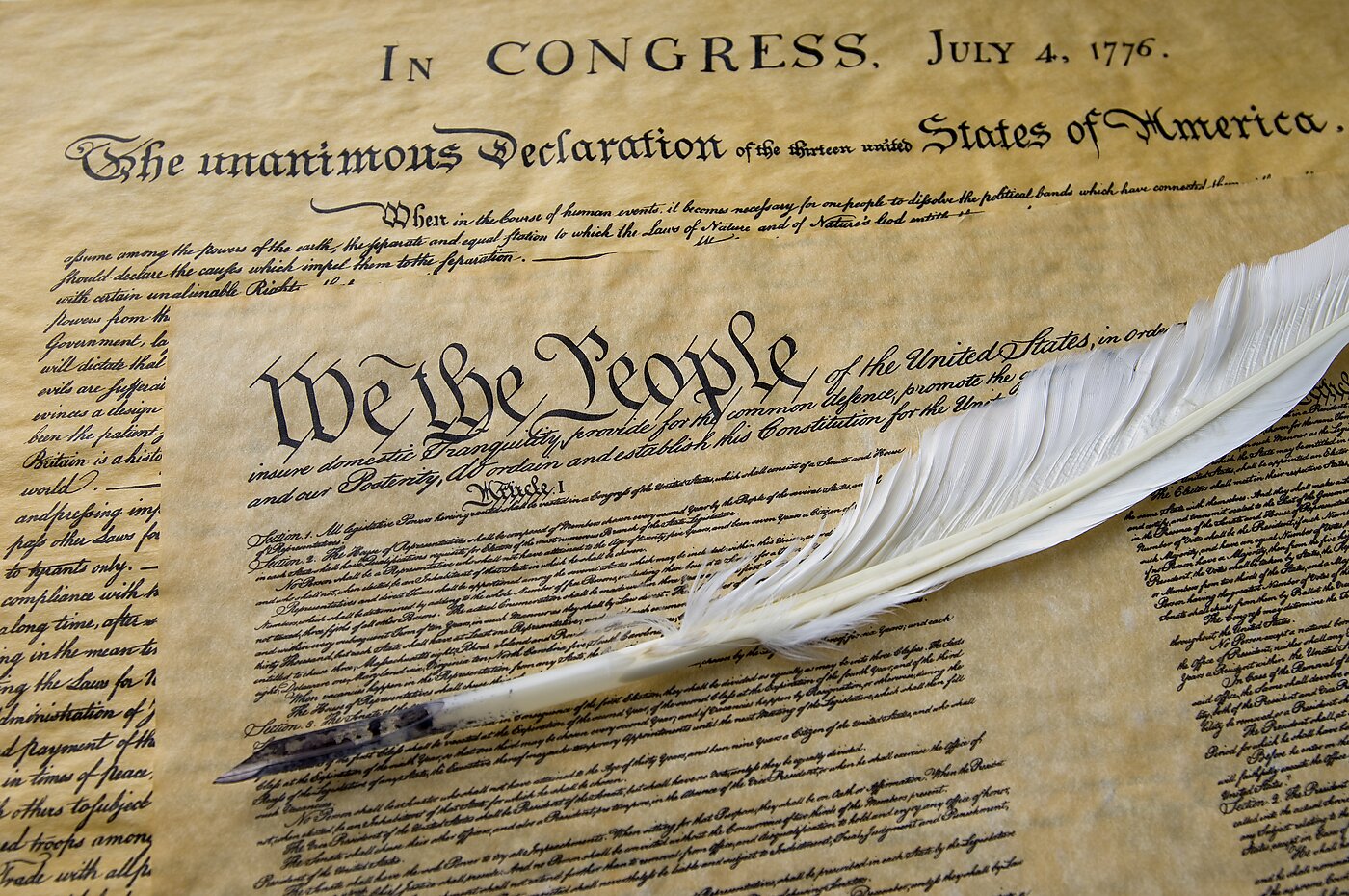
The new Cato Institute Fourth of July Survey, conducted with Morning Consult, asked seven basic civic knowledge questions as the country celebrates the nation’s 250th anniversary. A majority of Gen Z correctly answered only one of them.
While about two-thirds (66%) of Gen Z correctly identified George Washington as the first president, a substantial minority (34%) could not.
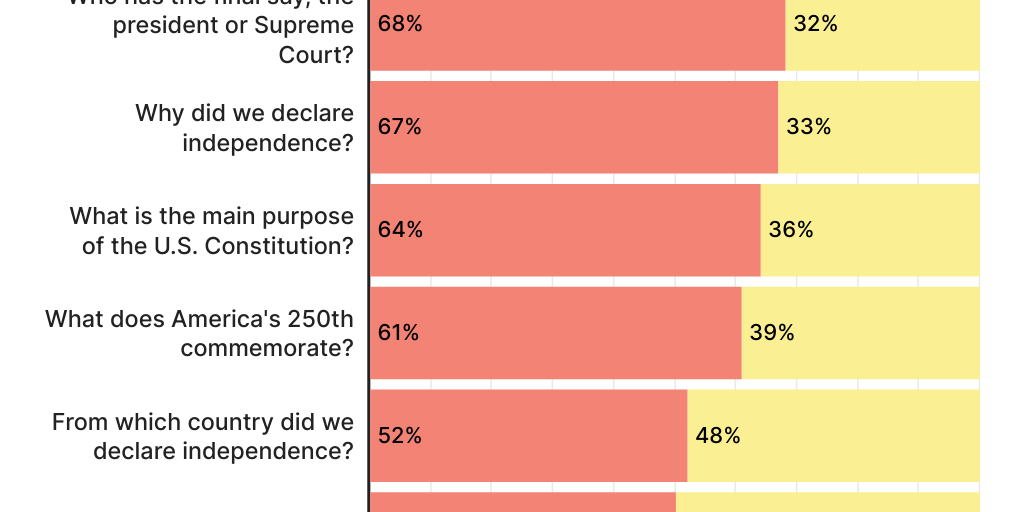
Nearly two-thirds (61%) of Americans under 30 are unaware of what America’s 250th is commemorating this year, while just 39% know we are celebrating the adoption of the Declaration of Independence. Of those who answered incorrectly, 11% thought America’s 250th was celebrating the first presidential election, 8% thought it was the ratification of the Constitution, 7% thought it was the victory of the Revolutionary War, 4% thought it was the pilgrims’ landing at Plymouth Rock, 1% said it was the founding of Jamestown, and 30% admitted they didn’t know what America’s 250th is about.
A majority (52%) of Gen Z Americans also don’t know what country from which the American colonies declared their independence, while 48% correctly answered that it was Great Britain.
More importantly, two-thirds (67%) of Gen Z do not know why the American colonies declared independence from Great Britain, while 33% correctly answered that it was to protest high taxes and a lack of representation in government.
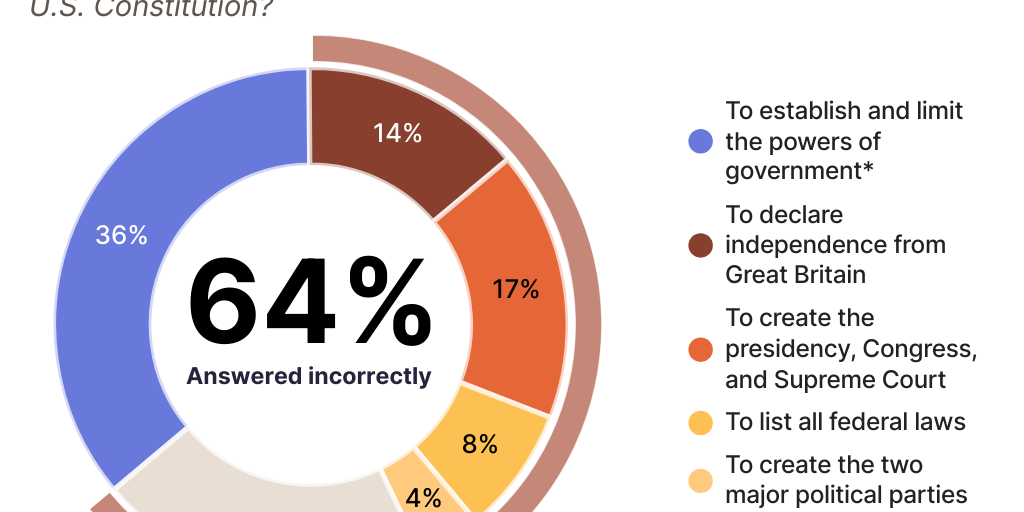
Six in ten Americans (64%) under 30 likewise don’t know what the main purpose of the US Constitution is. Instead, 14% thought the main purpose of the Constitution was to declare independence from Great Britain (which is what the Declaration of Independence did), 17% thought the main purpose was to create a presidency, Congress, and Supreme Court, 8% thought it was to list all federal laws, and 4% thought it was to create two major political parties. Another 21% admitted they didn’t know. Only 36% knew that the main purpose of the Constitution is to establish and limit the powers of government.
More than two-thirds (68%) did not know who has final say if the president and the Supreme Court disagree about whether a president’s actions are constitutional; 32% knew that the Supreme Court has the final say.
Gen Z came close to knowing that the federal government has three separate branches, with 50% who answered correctly and 50% who did not.
Young Americans performed the worst of any generation on all seven questions. Despite correctly identifying the first president as George Washington (66%), that is 11 points lower than Americans overall (77%) and 28 points lower than the nation’s seniors (94%). Gen Z was the only generation to fail to identify Great Britain as the country we declared independence from (52% incorrect).
Implications
As Gen Z comes of age and takes a more predominant role in shaping this nation’s future, their lack of knowledge of the country’s history may exacerbate an already concerning trend. The problem is not merely that many young Americans cannot recall historical facts. It is that without understanding that history, they are less likely to understand why the Constitution was written as it was: to restrain government power, protect individual liberty, and preserve self-government.
This same poll found that 57% of Americans and 60% of Gen Z believe that America has strayed from its founding principles. That drift will likely accelerate if rising generations do not understand the historical experiences that helped Americans recognize the value of those principles. It becomes increasingly difficult to stay true to the country’s founding principles when we do not know the reasons that explain why those principles matter.
Methodology
The Cato Institute 2026 4th of July Survey was designed and conducted by the Cato Institute in collaboration with Morning Consult. MorningConsult collected responses online June 25–26, 2026, from a national sample of 2,253 Americans 18 years of age and older. The margin of error for the survey is ± 2 percentage points at the 95 percent level of confidence.
Full TOPLINES and METHODOLOGY for the survey can be found HERE, and CROSSTABS can be found HERE. Detailed tables can be found HERE.