President Obama has seemingly made an entire mountain range out of his Race-to-the-Top reform molehill, while he’s gotten more or less a free pass on all he’s done to enrich the status quo. And now, with big midterm losses looming for his party, he appears to be resorting to one of the easiest political ploys in the book: Claim the GOP will cut funding to education and, in so doing, hurt innocent children and cripple the nation’s economic future. As the President opined in his weekly address:
[I]f Republicans in Congress had their way.…We’d have a harder time offering our kids the best education possible. Because they’d have us cut education by 20 percent — cuts that would reduce financial aid for eight million students; cuts that would leave our great and undervalued community colleges without the resources they need to prepare our graduates for the jobs of the future.
Now, it is true that when it comes to our budget, we have real challenges to meet. And if we’re serious about getting our fiscal house in order, we’ll need to make some tough choices. I’m prepared to make those choices. But what I’m not prepared to do is shortchange our children’s education. What I’m not prepared to do is undercut their economic future, your economic future, or the economic future of the United States of America.
Where did the President get the 20 percent number? It most likely stems from the promise in the House Republican’s “Pledge to America” to return federal spending unrelated to defense or senior citizens to pre-stimulus levels. Presumably, that means education spending would be reduced to the level it was at before passage of the stimulus. Considering that the stimulus was supposed to be a one-shot thing, that hardly seems like a draconian move.
That said, the much more important consideration is that based on decades of evidence — not to mention the strictures of the Constitution — federal education spending should not only be reduced, it should be phased out completely. Looking at the evidence since the feds started delving deeply into education in the mid-1960s, it’s clear that we’ve gotten very little for our money.
Start with K‑12 education, where we have results from the National Assessment of Educational Progress, a consistent measure of performance since the early 1970s :
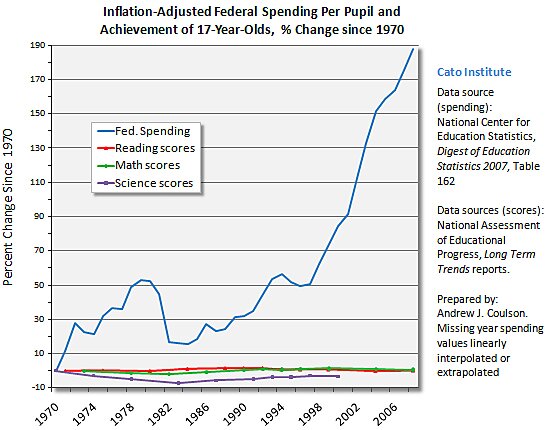
As you can see, Washington has spent steeply increasing amounts of money and not moved the needle at all for the 17-year-olds that constitute the “final products” of our elementary and secondary schools.
How about higher education?
Here the main focus has been providing stduent financial aid to increase college access, and in defense of the feds we have seen big increases in college enrollment since the mid-1960s. Enrollment, however, had been increasing substantially for many decades prior to 1965 or the post-World War II G.I. Bill, suggesting that Washington might have just caught an enrollment wave that was coming in anyway. There is also strong evidence that federal student aid has helped fuel rampant tuition inflation, largely negating the aid’s value. And while we have no consistent, long-term measure of learning outputs, we can at a minimum see that literacy among holders of at least a bachelor’s degree dropped between 1992 and 2003. According to the National Assessment of Adult Literacy, forty percent of people whose highest educational attainment was a bachelor’s degree were proficient prose readers in 1992 . By 2003, only 31 percent were. For Americans with graduate degrees, 51 percent were proficient in 1992. Eleven years later, only 41 percent were.
Unfortunately, for decades federal politicians have expended taxpayer money either in goodhearted — but misguided — efforts to improve education, or more selfishly, to appear to “care about the children” and make political hay. Regardless of the motivation, at this point it must no longer be ignored: Washington ‘s spending on education has gotten us little of demonstrable value. For President Obama to not even acknowledge the powerful evidence of this, but instead trot out the old canard that less spending is synonymous with worse education, signals that he’s more than willing to play bankrupting education politics as usual.