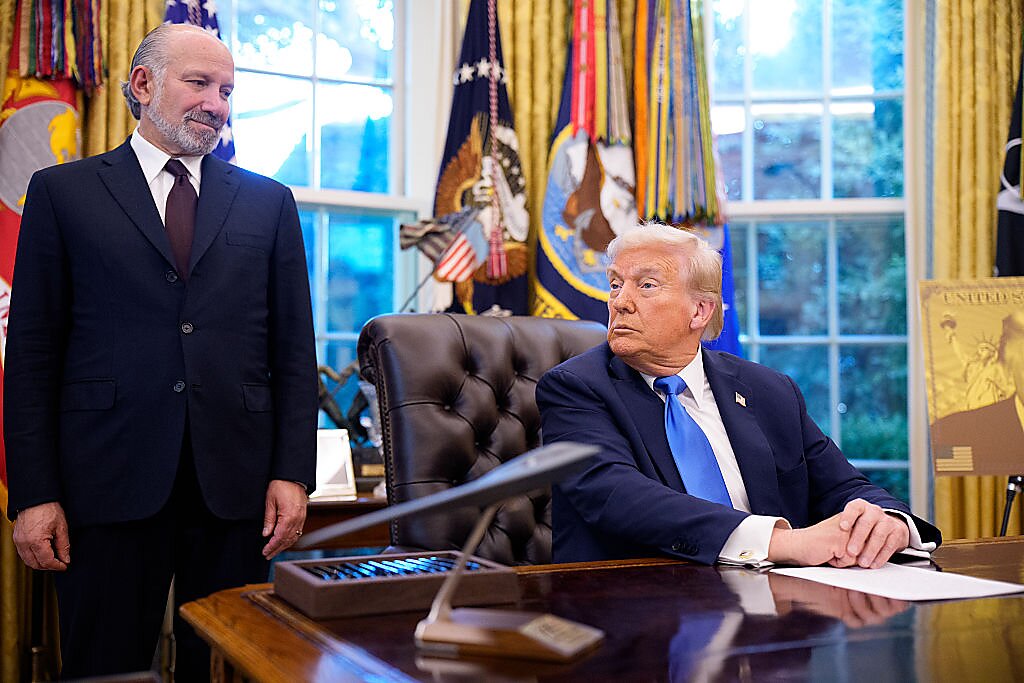
President Trump’s 2025 financial disclosure landed last week showing more than $2 billion in income, roughly triple 2024’s figure. Cryptocurrency alone accounted for $1.4 billion, most from meme-coin royalties and token sales tied to the Trump family’s World Liberty Financial. Read against the deals cataloged below, the filing paints a sordid picture of self-dealing within the upper echelons of the White House—or at the very least, the appearance of such.
Tungsten and Kazakhstan
Let’s start with tungsten. Today, China controls roughly 80 percent of the world’s supply and has spent the past year and a half tightening export controls. This has caused the metal’s cost to grow from around $340 per ton to well past $3,000. The US hasn’t run a commercial tungsten mine since 2015. Given tungsten’s importance to a number of security-related products, including weapons systems, American policymakers are actively looking to break China’s chokehold.
Over the summer of 2025, the US Export–Import Bank and US International Development Finance Corporation issued letters of interest—non-binding but meaningful signals—for up to $1.6 billion in potential financing for a Kazakh tungsten venture led by Cove Kaz Capital: $900 million from EXIM and $700 million from DFC, against total development costs pegged at roughly $1.1 billion. The joint venture itself, pairing Cove Kaz with Kazakhstan’s national mining company Tau-Ken Samruk, was unveiled in November 2025 at the C5+1 summit by President Trump and Kazakh President Kassym-Jomart Tokayev. President Trump personally worked out the deal with Kazakhstan President Kassym-Jomart Tokayev; Commerce Secretary Lutnick was also heavily involved. The developer has since gone back to the well, asking the Pentagon for another $400 million.
The president’s two eldest sons found their way into the deal through a side door. According to Financial Times reporting, Donald Trump Jr. and Eric Trump entered the picture in August 2025 through American Ventures, an investment vehicle holding a stake in Skyline Builders, a Nasdaq-listed firm, and they added to those positions on October 28, 2025. On October 31—weeks after Lutnick met Tokayev in New York with President Trump joining by phone—investors participating through a financing structure involving Dominari Securities, a Trump Tower-based firm partly owned by the brothers, acquired a 20 percent stake in the entity tied to the tungsten project. The US-Kazakhstan agreement was signed six days later. Skyline and Cove Kaz have since agreed to combine into Kaz Resources Inc., expected to trade on Nasdaq as KAZR. The Trump brothers’ precise financial interests have not been fully disclosed.
Cantor Fitzgerald, run by Secretary Lutnick’s two sons, helped raise $210 million for one of the lead investors working with Dominari on the deal—the kind of assignment that typically produces millions in fees.
The New York Times reported that it counted $18.6 billion in federal backing for 60 critical minerals projects since President Trump took office, with the Trump and Lutnick families having some ties to at least 14 of them.
The new disclosure shows this wasn’t a one-off. Trump reported capital gains of $100,000 to $1 million on shares of MP Materials, the rare-earth miner whose stock jumped roughly 50 percent the day the Pentagon announced it was taking a 15 percent equity stake. And Donald Trump Jr.‘s venture fund, 1789 Capital, bought into Vulcan Elements in August 2025—three months before the Pentagon handed Vulcan a $620 million loan that helped push its valuation from around $200 million to nearly $2 billion. Different metal, different shell company, same shape.
Semiconductors and the United Arab Emirates
The UAE side of the ledger runs on a similar mechanism, just with chips instead of ore. As the Wall Street Journal detailed earlier this year, four days before Trump’s second inauguration, an Abu Dhabi vehicle backed by Sheikh Tahnoon bin Zayed Al Nahyan—the UAE’s national security adviser, director of the country’s largest sovereign wealth fund, and brother of the UAE’s president—bought 49 percent of World Liberty Financial for $500 million. Eric Trump signed the deal, and roughly $187 million landed in Trump-controlled accounts before anyone outside the deal knew it had happened. The CEO of World Liberty Financial is Zach Witkoff, son of Steve Witkoff, President Trump’s special envoy to the Middle East and key member of the administration’s foreign policy team.
Meanwhile, White House AI czar David Sacks pushed hard to loosen Biden-era chip restrictions on the UAE despite his fund’s ties to Tahnoon’s own sovereign wealth vehicle. The one senior official resisting that push, National Security Council Senior Director David Feith, was fired within weeks. Days before it would have taken effect, the administration killed the Biden export rule; by May, Washington had agreed to sell the UAE 500,000 advanced Nvidia chips a year, with one-fifth earmarked for Tahnoon’s own AI company. That same month, another Tahnoon vehicle ran $2 billion through World Liberty’s stablecoin into Binance—the exchange whose founder Trump pardoned five months later.
These private profits for Trump administration officials and their family members sit downstream of specific US international trade and investment practices, including efforts to mitigate China’s chokehold on tungsten, other rare earths, and semiconductor export controls. None of these policy goals is necessarily illegitimate on its own terms, but the means of pursuing those goals are transforming ordinary policy into family enrichment schemes.
Update: This post has been revised to clarify the timing of the EXIM and DFC Letters of Interest, the structure of the Trump family’s financial exposure to the Kazakhstan tungsten deal and Cantor Fitzgerald’s role in the transaction.